


 |
市场调查报告书
商品编码
1928890
美白产品市场机会、成长要素、产业趋势分析及2026年至2035年预测Skin Lightening Products Market Opportunity, Growth Drivers, Industry Trend Analysis, and Forecast 2026 - 2035 |
||||||

全球美白产品市场预计到 2025 年将达到 179 亿美元,到 2035 年将达到 499 亿美元,年复合成长率为 11%。
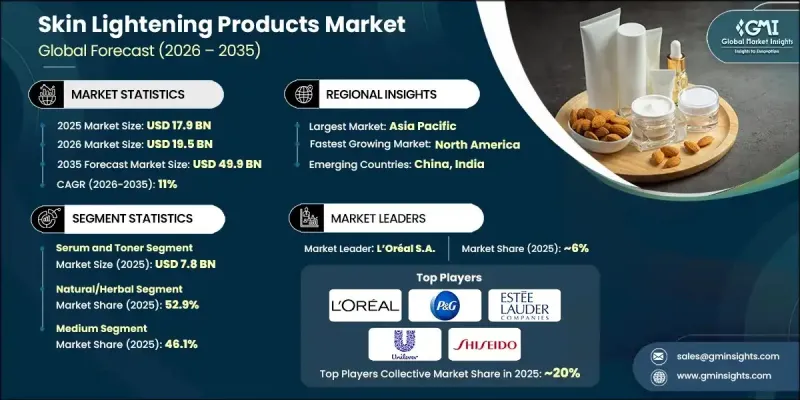
市场成长主要得益于电子商务和直销管道的快速扩张,彻底改变了消费者发现和购买美容护肤产品的方式。线上平台提供了更广泛的产品选择和更便捷的购物体验,尤其惠及实体店覆盖范围有限的地区的消费者。数位化互动也正在重塑消费者的购买行为,品牌主导的线上社群和网红推广活动有助于建立消费者信任和品牌认知。这些趋势不仅增加了产品供应,也加深了品牌与消费者之间的连结。同时,配方创新和功效导向的宣传不断推动市场需求。消费者越来越倾向于选择能够提供多种功效的单一产品,兼顾功效和便利性。这种对多功能产品的偏好反映了不断变化的生活方式需求,并推动全球各地市场的持续扩张。
| 市场覆盖范围 | |
|---|---|
| 开始年份 | 2025 |
| 预测年份 | 2026-2035 |
| 起始值 | 179亿美元 |
| 预测金额 | 499亿美元 |
| 复合年增长率 | 11% |
预计到2025年,精华液和化妆水市场收入将达到78亿美元,2026年至2035年的复合年增长率将达到10.9%。该品类凭藉其针对性强的功效和高浓度配方,正获得强劲的成长动能。消费者日益青睐其轻盈的质地和与日常护肤流程的兼容性,这也有助于其在更广泛的产品系列中保持领先地位。
预计到2025年,中价位产品将占据46.1%的市场份额,并在2035年之前以10.9%的复合年增长率成长。这些产品因其性价比高而深受广大消费者的欢迎。中价位产品介于大众市场和高端市场之间,吸引那些追求可靠功效但又不想支付高昂价格的消费者,从而支撑了都市区和半都市区市场的强劲需求。
美国美白产品市场预计2025年将达到21亿美元,2026年至2035年的复合年增长率将达到9.9%。市场需求的驱动力在于消费者更重视肤色平衡和光泽,而非传统的产品定位,反映了消费者对整体美的偏好。消费者优先考虑产品的安全性、透明度和合规性,而数位化零售通路的渗透和线上促销活动的增加也推动了市场成长。
目录
第一章调查方法和范围
第二章执行摘要
第三章业界考察
- 生态系分析
- 供应商情况
- 利润率
- 每个阶段的附加价值
- 影响价值链的因素
- 产业影响因素
- 司机
- 人们越来越重视美容和整装仪容
- 电子商务与D2C通路的扩张
- 配方和声明方面的创新
- 挑战与困难
- 监理和伦理风险
- 对原物料安全性的担忧
- 机会
- 朝向天然纯净的美容方式转变
- 个性化与科技集成
- 司机
- 成长潜力分析
- 未来市场趋势
- 科技与创新趋势
- 当前技术趋势
- 新兴技术
- 价格趋势
- 按地区
- 副产品
- 监管环境
- 北美洲
- 美国:消费品安全委员会(CPSC)联邦法规(CFR)第16篇第1512部分
- 加拿大:国际标准化组织(ISO)4210
- 欧洲
- 德国:德国标准化协会 (DIN) 欧洲标准 (EN) ISO 4210
- 英国:欧洲标准 (EN) ISO 4210/英国合格评定 (UKCA)
- 法国:欧洲标准 (EN) ISO 4210
- 亚太地区
- 中国:国家标誌(GB)3565
- 印度:印度标准 (IS) 10613
- 日本:日本工业标准(JIS)D 9110
- 拉丁美洲
- 巴西:巴西技术标准协会 (ABNT) 巴西标准 (NBR) ISO 4210
- 墨西哥:国际标准化组织(ISO)4210
- 中东和非洲
- 南非:南非国家标准 (SANS) 311
- 沙乌地阿拉伯:沙乌地阿拉伯标准、计量和品质组织 (SASO) 海湾标准组织 (GSO) ISO 4210
- 北美洲
- 贸易统计(HS编码-33049920)
- 主要进口国
- 主要出口国
- 波特分析
- PESTEL 分析
第四章 竞争情势
- 介绍
- 公司市占率分析
- 按地区
- 北美洲
- 欧洲
- 亚太地区
- 拉丁美洲
- 中东和非洲
- 按地区
- 企业矩阵分析
- 主要市场公司的竞争分析
- 竞争定位矩阵
- 重大进展
- 併购
- 伙伴关係与合作
- 新产品发布
- 扩张计划
第五章 依产品类型分類的市场估算与预测,2022-2035年
- 精华液和化妆水
- 乳霜和乳液
- 洗面乳
- 面具
- 其他(磨砂膏、凝胶)
第六章 市场估算与预测:依性质划分,2022-2035年
- 天然/草本
- 合成
- 有机的
第七章 2022-2035年按价格区间分類的市场估计与预测
- 低价位
- 中号
- 高价位范围
第八章 依最终用途分類的市场估算与预测,2022-2035年
- 女士
- 男性
- 男女通用的
9. 2022-2035年按分销管道分類的市场估算与预测
- 在线的
- 电子商务
- 公司网站
- 离线
- 专业美容店
- 药房和药品商店
- 皮肤科诊所
- 其他(美容诊所等)
第十章 2022-2035年各地区市场估计与预测
- 北美洲
- 我们
- 加拿大
- 欧洲
- 德国
- 英国
- 法国
- 义大利
- 西班牙
- 亚太地区
- 中国
- 印度
- 日本
- 韩国
- 澳洲
- 拉丁美洲
- 巴西
- 墨西哥
- 阿根廷
- 中东和非洲
- 沙乌地阿拉伯
- 阿拉伯聯合大公国
- 南非
第十一章 公司简介
- Avon Products, Inc.
- Beiersdorf AG
- Bio Veda Action Research Private Limited
- Civant LLC
- Clarins Group
- 雅诗兰黛公司
- Eveline Cosmetics
- Himalaya Global Holdings Ltd.
- Kaya Limited
- L'Oreal SA
- Lotus Herbals Pvt. Ltd.
- Procter &Gamble
- RichFeel Hair &Beauty Pvt. Ltd.
- Rozge Cosmeceutical
- Sabinsa Corporation
- Sanora Beauty Products
- Shiseido Co., Ltd.
- Unilever PLC
- VLCC Health Care Limited
The Global Skin Lightening Products Market was valued at USD 17.9 billion in 2025 and is estimated to grow at a CAGR of 11% to reach USD 49.9 billion by 2035.
Market growth is supported by the rapid expansion of e-commerce and direct-to-consumer sales channels, which have transformed how consumers discover and purchase beauty and grooming products. Online platforms provide broader product availability and convenience, particularly benefiting consumers in regions with limited access to physical retail outlets. Digital engagement has also reshaped purchasing behavior, as brand-led online communities and influencer-driven promotion strengthen consumer trust and brand visibility. These dynamics have increased product accessibility while fostering deeper relationships between brands and consumers. At the same time, innovation in formulations and performance-driven claims continues to accelerate demand. Consumers increasingly gravitate toward solutions that offer multiple benefits in a single product, valuing both effectiveness and convenience. This shift toward multifunctional offerings reflects evolving lifestyle needs and reinforces sustained market expansion across global regions.
| Market Scope | |
|---|---|
| Start Year | 2025 |
| Forecast Year | 2026-2035 |
| Start Value | $17.9 Billion |
| Forecast Value | $49.9 Billion |
| CAGR | 11% |
The serum and toner segment generated USD 7.8 billion in 2025 and is expected to grow at a CAGR of 10.9% from 2026 to 2035. This category has gained strong traction due to its targeted application and concentrated formulations. Lightweight textures and regimen compatibility have increased consumer preference, supporting continued dominance within the broader product landscape.
The medium-priced segment held a 46.1% share in 2025 and is forecast to grow at a CAGR of 10.9% through 2035. These offerings appeal to a wide consumer base by balancing cost and perceived quality. Positioned between mass-market and premium categories, mid-tier products attract consumers seeking dependable results without premium pricing, supporting strong demand across urban and semi-urban markets.
United States Skin Lightening Products Market reached USD 2.1 billion in 2025 and is projected to grow at a CAGR of 9.9% from 2026 to 2035. Market demand is shaped by a focus on skin tone balance and radiance rather than traditional positioning, reflecting inclusive beauty preferences. Consumers emphasize product safety, transparency, and regulatory compliance, while strong digital retail penetration and online promotion support market growth.
Key companies operating in the Global Skin Lightening Products Market include L'Oreal S.A., Unilever PLC, Estee Lauder Companies Inc., Procter & Gamble, Beiersdorf AG, Shiseido Co., Ltd., Clarins Group, Avon Products, Inc., Himalaya Global Holdings Ltd., VLCC Health Care Limited, Lotus Herbals Pvt. Ltd., Kaya Limited, Eveline Cosmetics, Bio Veda Action Research Private Limited, Sabinsa Corporation, Civant LLC, RichFeel Hair & Beauty Pvt. Ltd., Sanora Beauty Products, and Rozge Cosmeceutical. Companies in the Skin Lightening Products Market strengthen their market position through continuous formulation innovation and portfolio diversification. Many brands focus on developing multifunctional products that address multiple skin concerns while simplifying daily routines. Expansion of direct-to-consumer platforms and digital engagement strategies improves customer reach and brand loyalty.
Table of Contents
Chapter 1 Methodology & Scope
- 1.1 Market scope & definitions
- 1.2 Research design
- 1.2.1 Research approach
- 1.2.2 Data collection methods
- 1.3 Base estimates and calculations
- 1.3.1 Base year calculation
- 1.3.2 Market estimates & forecasts parameters
- 1.4 Forecast Model
- 1.4.1 Key trends for market estimates
- 1.4.2 Quantified market impact analysis
- 1.4.2.1 Mathematical impact of growth parameters on forecast
- 1.4.3 Scenario analysis framework
- 1.5 Primary research and validation
- 1.5.1 Some of the primary sources (but not limited to)
- 1.6 Data mining sources
- 1.6.1 Paid Sources
- 1.7 Primary research and validation
- 1.7.1 Primary sources
- 1.8 Research Trail & confidence scoring
- 1.8.1 Research trail components
- 1.8.2 Scoring components
- 1.9 Research transparency addendum
- 1.9.1 Source attribution framework
- 1.9.2 Quality assurance metrics
- 1.9.3 Our commitment to trust
- 1.10 Market Definitions
Chapter 2 Executive Summary
- 2.1 Industry 3600 synopsis
- 2.2 Key market trends
- 2.2.1 Regional
- 2.2.2 Product
- 2.2.3 Nature
- 2.2.4 Price Range
- 2.2.5 End Use
- 2.2.6 Distribution channels
- 2.3 CXO perspectives: Strategic imperatives
- 2.3.1 Key decision points for industry executives
- 2.3.2 Critical success factors for market players
- 2.4 Future outlook and strategic recommendations
Chapter 3 Industry Insights
- 3.1 Industry ecosystem analysis
- 3.1.1 Supplier landscape
- 3.1.2 Profit margin
- 3.1.3 Value addition at each stage
- 3.1.4 Factor affecting the value chain
- 3.2 Industry impact forces
- 3.2.1 Growth drivers
- 3.2.1.1 Rising beauty & grooming awareness
- 3.2.1.2 Expansion of E-commerce & D2C channels
- 3.2.1.3 Innovation in formulations & claims
- 3.2.2 Pitfalls & Challenges
- 3.2.2.1 Regulatory and ethical risks
- 3.2.2.2 Ingredient safety concerns
- 3.2.3 Opportunities
- 3.2.3.1 Shift toward natural & clean beauty
- 3.2.3.2 Personalization and tech integration
- 3.2.1 Growth drivers
- 3.3 Growth potential analysis
- 3.4 Future market trends
- 3.5 Technology and innovation landscape
- 3.5.1 Current technological trends
- 3.5.2 Emerging technologies
- 3.6 Price trends
- 3.6.1 By region
- 3.6.2 By product
- 3.7 Regulatory landscape
- 3.7.1 North America
- 3.7.1.1 US: Consumer Product Safety Commission (CPSC) 16 Code of Federal Regulations (CFR) part 1512
- 3.7.1.2 Canada: International Organization for Standardization (ISO) 4210
- 3.7.2 Europe
- 3.7.2.1 Germany: Deutsches Institut fur Normung (DIN) European Norm (EN) ISO 4210
- 3.7.2.2 UK: European Norm (EN) ISO 4210 / United Kingdom Conformity Assessed (UKCA)
- 3.7.2.3 France: European Norm (EN) ISO 4210
- 3.7.3 Asia Pacific
- 3.7.3.1 China: Guobiao (GB) 3565
- 3.7.3.2 India: Indian Standard (IS) 10613
- 3.7.3.3 Japan: Japanese Industrial Standard (JIS) D 9110
- 3.7.4 Latin America
- 3.7.4.1 Brazil: Associacao Brasileira de Normas Tecnicas (ABNT) Norma Brasileira (NBR) ISO 4210
- 3.7.4.2 Mexico: International Organization for Standardization (ISO) 4210
- 3.7.5 Middle East & Africa
- 3.7.5.1 South Africa: South African National Standard (SANS) 311
- 3.7.5.2 Saudi Arabia: Saudi Standards, Metrology and Quality Organization (SASO) Gulf Standardization Organization (GSO) ISO 4210
- 3.7.1 North America
- 3.8 Trade statistics (HS Code - 33049920)
- 3.8.1 Major importing countries
- 3.8.2 Major exporting countries
- 3.9 Porter';s analysis
- 3.10 PESTEL analysis
Chapter 4 Competitive Landscape, 2025
- 4.1 Introduction
- 4.2 Company market share analysis
- 4.2.1 By Region
- 4.2.1.1 North America
- 4.2.1.2 Europe
- 4.2.1.3 Asia Pacific
- 4.2.1.4 Latin America
- 4.2.1.5 Middle East & Africa
- 4.2.1 By Region
- 4.3 Company matrix analysis
- 4.4 Competitive analysis of major market players
- 4.5 Competitive positioning matrix
- 4.6 Key developments
- 4.6.1 Mergers & acquisitions
- 4.6.2 Partnerships & collaborations
- 4.6.3 New product launches
- 4.6.4 Expansion plans
Chapter 5 Market Estimates & Forecast, By Product Type, 2022 - 2035, (USD Billion) (Million Units)
- 5.1 Key trends
- 5.2 Serum & toner
- 5.3 Cream & lotion
- 5.4 Cleanser
- 5.5 Mask
- 5.6 Others (scrub, gels)
Chapter 6 Market Estimates & Forecast, By Nature, 2022 - 2035, (USD Billion) (Million Units)
- 6.1 Key trends
- 6.2 Natural/Herbal
- 6.3 Synthetic
- 6.4 Organic
Chapter 7 Market Estimates & Forecast, By Price Range, 2022 - 2035, (USD Billion) (Million Units)
- 7.1 Key trends
- 7.2 Low
- 7.3 Medium
- 7.4 High
Chapter 8 Market Estimates & Forecast, By End Use, 2022 - 2035, (USD Billion) (Million Units)
- 8.1 Key trends
- 8.2 Women
- 8.3 Men
- 8.4 Unisex
Chapter 9 Market Estimates & Forecast, By Distribution Channel, 2022 - 2035, (USD Billion) (Million Units)
- 9.1 Key trends
- 9.2 Online
- 9.2.1 E-commerce
- 9.2.2 Company websites
- 9.3 Offline
- 9.3.1 Specialty beauty stores
- 9.3.2 Pharmacies & drugstores
- 9.3.3 Dermatology clinics
- 9.3.4 Others (aesthetic centers, etc.)
Chapter 10 Market Estimates & Forecast, By Region, 2022 - 2035, (USD Billion) (Million Units)
- 10.1 Key trends
- 10.2 North America
- 10.2.1 U.S.
- 10.2.2 Canada
- 10.3 Europe
- 10.3.1 Germany
- 10.3.2 UK
- 10.3.3 France
- 10.3.4 Italy
- 10.3.5 Spain
- 10.4 Asia Pacific
- 10.4.1 China
- 10.4.2 India
- 10.4.3 Japan
- 10.4.4 South Korea
- 10.4.5 Australia
- 10.5 Latin America
- 10.5.1 Brazil
- 10.5.2 Mexico
- 10.5.3 Argentina
- 10.6 MEA
- 10.6.1 Saudi Arabia
- 10.6.2 UAE
- 10.6.3 South Africa
Chapter 11 Company Profiles
- 11.1 Avon Products, Inc.
- 11.2 Beiersdorf AG
- 11.3 Bio Veda Action Research Private Limited
- 11.4 Civant LLC
- 11.5 Clarins Group
- 11.6 Estee Lauder Companies Inc.
- 11.7 Eveline Cosmetics
- 11.8 Himalaya Global Holdings Ltd.
- 11.9 Kaya Limited
- 11.10 L’Oreal S.A.
- 11.11 Lotus Herbals Pvt. Ltd.
- 11.12 Procter & Gamble
- 11.13 RichFeel Hair & Beauty Pvt. Ltd.
- 11.14 Rozge Cosmeceutical
- 11.15 Sabinsa Corporation
- 11.16 Sanora Beauty Products
- 11.17 Shiseido Co., Ltd.
- 11.18 Unilever PLC
- 11.19 VLCC Health Care Limited

 全球美白产品市场规模、份额、趋势及成长分析报告(2026-2034)
 全球美白产品市场-产业规模、份额、趋势、机会及预测:依产品类型、天然成分、最终用途、通路、地区及竞争格局划分,2021-2031年
 美白产品市场规模、份额及成长分析(依性质、产品类型、销售管道、最终用户及地区划分)-2026-2033年产业预测
 全球美白产品市场:按产品类型、分销管道、成分、用途、最终用户、价格分布和产品形式划分 - 2025-2032 年预测
 全球私人美白产品市场
 私密美白产品市场,按产品类型、成分、价格、消费者群体、配销通路、国家和地区划分 - 2025 年至 2032 年全球产业分析、市场规模、市场份额及预测
 2025 年至 2033 年美白产品市场报告(依产品、性质、性别、配销通路和地区划分)
 亲密美白产品市场、机会、成长动力、产业趋势分析与预测,2024-2032