


 |
市场调查报告书
商品编码
1928891
纺织废弃物回收机械市场机会、成长要素、产业趋势分析及预测(2026年至2035年)Textile Waste Recycling Machine Market Opportunity, Growth Drivers, Industry Trend Analysis, and Forecast 2026 - 2035 |
||||||

全球纺织废弃物回收机械市场预计到 2025 年将达到 42 亿美元,到 2035 年将达到 65 亿美元,年复合成长率为 4.6%。
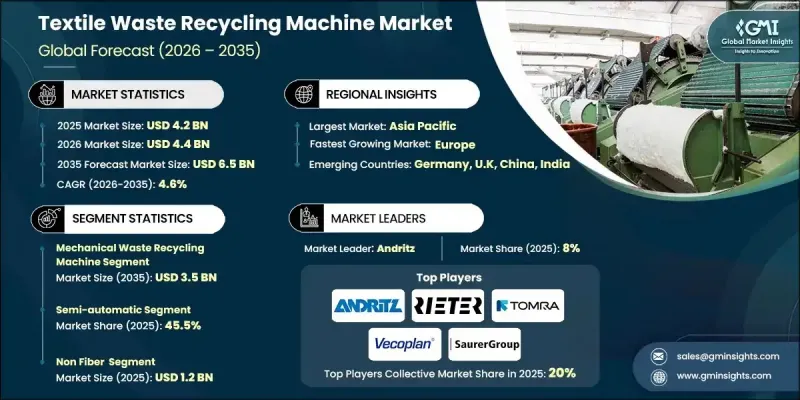
这一增长的驱动力源于人们对纺织品消费和处置的环保意识不断增强,以及监管机构对永续生产实践的支持力度不断加大。业界日益重视减少废弃物和材料回收,推动了对将废弃纺织品转化为可重复使用纤维的机械设备的需求。公共和私营部门为减少对掩埋的依赖和提高资源利用效率而采取的倡议,进一步促进了市场扩张。製造商正积极回应,提高产能,减少环境影响,并推动符合循环经济目标的回收技术。此外,纺织品生产商在负责任地管理消费前和消费后废弃物面临的压力不断增加,也使该行业受益匪浅。随着永续性成为服装和技术纺织品行业的核心营运要求,对先进回收机械的投资持续成长,有助于市场的长期稳定发展,并促进已开发经济体和新兴经济体的稳步普及。
| 市场覆盖范围 | |
|---|---|
| 开始年份 | 2025 |
| 预测年份 | 2026-2035 |
| 起始值 | 42亿美元 |
| 预测金额 | 65亿美元 |
| 复合年增长率 | 4.6% |
预计2025年,机械式回收设备市场规模将达23亿美元,2035年将达35亿美元。由于其成本效益高、能耗低,该细分市场仍是纺织废弃物回收设备市场的支柱。机械系统能够处理各种纺织废弃物,因此成为寻求实用且扩充性回收解决方案的製造商的首选。
预计到2025年,半自动机械设备将占据45.5%的市场。该细分市场之所以领先,是因为其兼具价格优势和操作便利性。半自动系统允许操作人员在保持对核心回收流程控制的同时,实现重复性功能的自动化,从而降低劳动强度,而无需像全自动设备那样投入大量资金。
预计2025年,美国纺织废弃物回收机械市占率将达90.5%。政府重视减少纺织废弃物、制定国家回收战略以及出台促进回收基础设施改善的新立法倡议,都为区域增长提供了支撑。这些措施正在推动对大规模纺织废料回收机械的投资增加。
目录
第一章调查方法和范围
第二章执行摘要
第三章业界考察
- 生态系分析
- 供应商情况
- 利润率
- 每个阶段的附加价值
- 影响价值链的因素
- 产业影响因素
- 司机
- 对永续和环保材料的需求日益增长
- 回收技术的进步
- 政府关于纺织废弃物的法规和政策
- 产业潜在风险与挑战
- 前期投资和机器成本高。
- 高昂的维护和营运成本
- 机会
- 促进永续性政策和循环经济
- 整合物联网和预测性维护解决方案
- 司机
- 成长潜力分析
- 未来市场趋势
- 科技与创新趋势
- 当前技术趋势
- 新兴技术
- 价格趋势
- 按模型
- 按地区
- 监管环境
- 标准和合规要求
- 区域法规结构
- 认证标准
- 贸易统计(HS编码8445)
- 主要进口国
- 主要出口国
- 差距分析
- 风险评估与缓解
- 波特分析
- PESTEL 分析
第四章 竞争情势
- 介绍
- 公司市占率分析
- 按地区
- 企业矩阵分析
- 主要市场公司的竞争分析
- 竞争定位矩阵
- 重大进展
- 併购
- 伙伴关係与合作
- 新产品发布
- 扩张计划
第五章 按车型分類的市场估计与预测,2022-2035年
- 机械回收设备
- 化学回收机
- 热回收机
第六章 按材料类型分類的市场估算与预测,2022-2035年
- 棉布
- 聚酯纤维
- 尼龙
- 羊毛
- 其他的
第七章 2022-2035年各细分市场的估计与预测
- 手动的
- 半自动
- 自动的
第八章 依产能分類的市场估计与预测,2022-2035年
- 最高可达 1,000 公斤/小时
- 最高可达 2,000 公斤/小时
- 最高可达 3000 公斤/小时
- 3000公斤/小时或以上
第九章 按应用领域分類的市场估算与预测,2022-2035年
- 纤维到纤维的回收利用
- 不纺织应用
- 服装製造
- 家用纺织品
- 技术纺织品
第十章 依采购方式分類的市场估计与预测,2022-2035年
- 消费前废弃物
- 消费后废弃物
第十一章 按分销管道分類的市场估算与预测,2022-2035年
- 直销
- 间接
第十二章 2022-2035年各地区市场估算与预测
- 北美洲
- 我们
- 加拿大
- 欧洲
- 德国
- 法国
- 英国
- 义大利
- 西班牙
- 亚太地区
- 中国
- 印度
- 日本
- 韩国
- 澳洲
- 拉丁美洲
- 巴西
- 墨西哥
- 阿根廷
- 中东和非洲
- 南非
- 沙乌地阿拉伯
- 阿拉伯聯合大公国
第十三章:公司简介
- Andritz
- Autefa Solutions
- Balkan Textile Machinery
- Dell'Orco &Villani
- HSN Machinery
- Loptex
- Margasa Projects and Textile Engineering
- Masias Machinery
- Multipro
- Rieter
- SN Surgicare and Healthcare Science
- Starlinger
- Saurer Group
- TOMRA Systems
- Vecoplan
The Global Textile Waste Recycling Machine Market was valued at USD 4.2 billion in 2025 and is estimated to grow at a CAGR of 4.6% to reach USD 6.5 billion by 2035.
Growth is driven by rising environmental awareness surrounding textile consumption and disposal, as well as stronger regulatory support for sustainable manufacturing practices. Industries are increasingly focused on minimizing waste and improving material recovery, which has accelerated demand for machinery capable of converting discarded textiles back into usable fiber forms. Public and private sector initiatives aimed at reducing landfill dependency and improving resource efficiency further support market expansion. Manufacturers are responding by advancing recycling technologies that improve throughput, reduce environmental impact, and align with circular economy goals. The industry also benefits from increasing pressure on textile producers to manage post-consumer and pre-consumer waste responsibly. As sustainability becomes a core operational requirement across apparel and industrial textile sectors, investment in advanced recycling machinery continues to rise, supporting long-term market stability and consistent adoption across developed and emerging economies.
| Market Scope | |
|---|---|
| Start Year | 2025 |
| Forecast Year | 2026-2035 |
| Start Value | $4.2 Billion |
| Forecast Value | $6.5 Billion |
| CAGR | 4.6% |
The mechanical recycling machines segment generated USD 2.3 billion in 2025 and is projected to reach USD 3.5 billion by 2035. This segment remains the backbone of the textile waste recycling machine market due to its cost efficiency and lower energy requirements. Mechanical systems can process a wide range of textile waste streams, making them a preferred choice for manufacturers seeking practical and scalable recycling solutions.
The semi-automatic machines segment accounted for 45.5% share in 2025. This segment leads the market due to its balance of affordability and operational control. Semi-automatic systems allow operators to manage key recycling stages while automating repetitive functions, reducing labor intensity without the high investment associated with fully automated equipment.
United States Textile Waste Recycling Machine Market represented 90.5% share in 2025. Regional growth is supported by increased government focus on textile waste reduction, the development of national recycling strategies, and new legislative measures that encourage improved recycling infrastructure. These efforts are driving higher investment in large-scale textile recycling machinery.
Key companies operating in the Global Textile Waste Recycling Machine Market include Rieter, Andritz, Starlinger, TOMRA Systems, Saurer Group, Vecoplan, Autefa Solutions, Masias Machinery, Loptex, Balkan Textile Machinery, Dell'Orco & Villani, Margasa Projects, Textile Engineering, Multipro, HSN Machinery, and SN Surgicare and Healthcare Science. Companies in the Global Textile Waste Recycling Machine Market focus on strengthening their market position through continuous technology upgrades and sustainability-driven innovation. Manufacturers invest heavily in research and development to enhance machine efficiency, energy performance, and material recovery rates. Strategic collaborations with textile producers and waste management firms help expand customer reach and ensure long-term equipment demand. Firms also prioritize modular machine designs that allow scalability and customization based on processing needs.
Table of Contents
Chapter 1 Methodology & Scope
- 1.1 Market scope and definition
- 1.2 Research design
- 1.2.1 Research approach
- 1.2.2 Data collection methods
- 1.3 Data mining sources
- 1.3.1 Global
- 1.3.2 Regional/Country
- 1.4 Base estimates and calculations
- 1.4.1 Base year calculation
- 1.4.2 Key trends for market estimation
- 1.5 Primary research and validation
- 1.5.1 Primary sources
- 1.6 Forecast model
- 1.7 Research assumptions and limitations
Chapter 2 Executive Summary
- 2.1 Industry 360° synopsis
- 2.2 Key market trends
- 2.2.1 Regional
- 2.2.2 Machine Type
- 2.2.3 Fabric Type
- 2.2.4 Operation
- 2.2.5 Capacity
- 2.2.6 Application
- 2.2.7 Sourcing Type
- 2.2.8 Distribution channel
- 2.3 CXO perspectives: Strategic imperatives
- 2.3.1 Key decision points for industry executives
- 2.3.2 Critical success factors for market players
- 2.4 Future outlook and strategic recommendations
Chapter 3 Industry Insights
- 3.1 Industry ecosystem analysis
- 3.1.1 Supplier landscape
- 3.1.2 Profit margin
- 3.1.3 Value addition at each stage
- 3.1.4 Factor affecting the value chain
- 3.2 Industry impact forces
- 3.2.1 Growth drivers
- 3.2.1.1 Rising demand for sustainable and eco-friendly materials
- 3.2.1.2 Advancements in recycling technologies
- 3.2.1.3 Government regulations and policies on textile waste
- 3.2.2 Industry pitfalls & challenges
- 3.2.2.1 High initial investment and machine cost
- 3.2.2.2 High maintenance and operational costs
- 3.2.3 Opportunities
- 3.2.3.1 Sustainability policies & circular economy push
- 3.2.3.2 Integration of IoT & predictive maintenance solutions
- 3.2.1 Growth drivers
- 3.3 Growth potential analysis
- 3.4 Future market trends
- 3.5 Technology and innovation landscape
- 3.5.1 Current technological trends
- 3.5.2 Emerging technologies
- 3.6 Price trends
- 3.6.1 By machine type
- 3.6.2 By region
- 3.7 Regulatory landscape
- 3.7.1 Standards and compliance requirements
- 3.7.2 Regional regulatory frameworks
- 3.7.3 Certification standards
- 3.8 Trade statistics (HS code 8445)
- 3.8.1 Major importing countries
- 3.8.2 Major exporting countries
- 3.9 Gap analysis
- 3.10 Risk assessment and mitigation
- 3.11 Porter';s analysis
- 3.12 PESTEL analysis
Chapter 4 Competitive Landscape, 2025
- 4.1 Introduction
- 4.2 Company market share analysis
- 4.2.1 By region
- 4.2.1.1 North America
- 4.2.1.2 Europe
- 4.2.1.3 Asia Pacific
- 4.2.1.4 Latin America
- 4.2.1.5 Middle East and Africa
- 4.2.1 By region
- 4.3 Company matrix analysis
- 4.4 Competitive analysis of major market players
- 4.5 Competitive positioning matrix
- 4.6 Key developments
- 4.6.1 Mergers & acquisitions
- 4.6.2 Partnerships & collaborations
- 4.6.3 New product launches
- 4.6.4 Expansion plans
Chapter 5 Market Estimates & Forecast, By Machine Type, 2022-2035 (USD Billion) (Thousand Units)
- 5.1 Key trends
- 5.2 Mechanical Recycling Machines
- 5.3 Chemical Recycling Machines
- 5.4 Thermal Recycling Machines
Chapter 6 Market Estimates & Forecast, By Fabric Type, 2022-2035 (USD Billion) (Thousand Units)
- 6.1 Key trends
- 6.2 Cotton
- 6.3 Polyester
- 6.4 Nylon
- 6.5 Wool
- 6.6 Others
Chapter 7 Market Estimates & Forecast, By Operation, 2022-2035 (USD Billion) (Thousand Units)
- 7.1 Key trends
- 7.2 Manual
- 7.3 Semi-automatic
- 7.4 Automatic
Chapter 8 Market Estimates & Forecast, By Capacity, 2022-2035 (USD Billion) (Thousand Units)
- 8.1 Key trends
- 8.2 Up to 1,000 kg/h
- 8.3 Up to 2,000 kg/h
- 8.4 Up to 3000 kg/h
- 8.5 Above 3000 kg/h
Chapter 9 Market Estimates & Forecast, By Application, 2022-2035 (USD Billion) (Thousand Units)
- 9.1 Key trends
- 9.2 Fiber-to-fibre Recycling
- 9.3 Non-fibre Applications
- 9.4 Apparel Manufacturing
- 9.5 Home Textiles
- 9.6 Technical Textiles
Chapter 10 Market Estimates & Forecast, By Sourcing Type, 2022-2035 (USD Billion) (Thousand Units)
- 10.1 Key trends
- 10.2 Pre-consumer Waste
- 10.3 Post-consumer Waste
Chapter 11 Market Estimates & Forecast, By Distribution Channel, 2022-2035 (USD Billion) (Thousand Units)
- 11.1 Key trends
- 11.2 Direct
- 11.3 Indirect
Chapter 12 Market Estimates & Forecast, By Region, 2022-2035 (USD Billion) (Thousand Units)
- 12.1 Key trends
- 12.2 North America
- 12.2.1 U.S.
- 12.2.2 Canada
- 12.3 Europe
- 12.3.1 Germany
- 12.3.2 France
- 12.3.3 UK
- 12.3.4 Italy
- 12.3.5 Spain
- 12.4 Asia Pacific
- 12.4.1 China
- 12.4.2 India
- 12.4.3 Japan
- 12.4.4 South Korea
- 12.4.5 Australia
- 12.5 Latin America
- 12.5.1 Brazil
- 12.5.2 Mexico
- 12.5.3 Argentina
- 12.6 MEA
- 12.6.1 South Africa
- 12.6.2 Saudi Arabia
- 12.6.3 UAE
Chapter 13 Company Profiles
- 13.1 Andritz
- 13.2 Autefa Solutions
- 13.3 Balkan Textile Machinery
- 13.4 Dell'Orco & Villani
- 13.5 HSN Machinery
- 13.6 Loptex
- 13.7 Margasa Projects and Textile Engineering
- 13.8 Masias Machinery
- 13.9 Multipro
- 13.10 Rieter
- 13.11 SN Surgicare and Healthcare Science
- 13.12 Starlinger
- 13.13 Saurer Group
- 13.14 TOMRA Systems
- 13.15 Vecoplan

 温度控制租赁解决方案市场:按产品类型、温度范围、租赁期限、销售管道、最终用户产业和应用划分-全球预测,2026-2032年废油回收市场按原料类型、技术类型和最终用途划分,全球预测(2026-2032年)
 废弃物回收服务市场分析及预测(至2035年):依类型、产品类型、服务、技术、应用、材料类型、製程、最终用户、设备划分
 全球酒精饮料瓶回收市场规模、份额、趋势和成长分析报告(2026-2034)
 2026年全球化学品市场报告:循环经济视角
 全球废弃物回收服务市场-按产品、应用、地区和竞争格局分類的产业规模、份额、趋势、机会和预测(2021-2031年)
 2032年循环家具市场预测:按产品、材料、应用、最终用户和地区分類的全球分析全球废弃物堆肥技术市场预测(至2032年):按组件、部署模式、技术、应用、最终用户和地区划分超当地语系化废弃物收集和回收服务市场预测至2032年:按废弃物类别、经营模式、技术、最终用户和地区分類的全球分析
 废弃物回收服务市场规模、份额和成长分析(按废弃物类型、应用和地区划分)—产业预测(2026-2033 年)