


 |
市场调查报告书
商品编码
1928906
合约家具市场机会、成长要素、产业趋势分析及2026年至2035年预测Contract Furniture Market Opportunity, Growth Drivers, Industry Trend Analysis, and Forecast 2026 - 2035 |
||||||

全球合约家具市场预计到 2025 年将达到 702 亿美元,到 2035 年将达到 1,232 亿美元,年复合成长率为 5.9%。
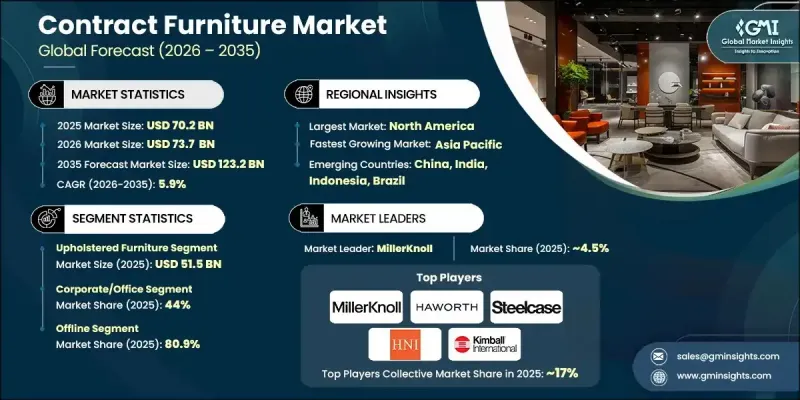
市场成长得益于对商业基础设施的长期投资以及不断变化的职场需求。在商业房地产、酒店业和共用办公空间蓬勃发展的推动下,市场预计将持续成长。企业倾向于选择兼具耐用性、功能性和现代美感的商用级家具。饭店业者则优先考虑能够提升品牌形象并改善使用者体验的家具。灵活职场的兴起加速了对支援协作和空间效率的可适应性家具布局的需求。设计师和开发商更加重视符合当代建筑风格和监管标准的家具产品。商业建筑的持续维修活动也带来了稳定的升级需求。同时,人们对人体工学和员工福祉的日益关注正在影响着采购决策,雇主们正在寻求能够提升舒适度、减轻身体疲劳并提高全天工作效率的解决方案。
| 市场覆盖范围 | |
|---|---|
| 开始年份 | 2025 |
| 预测年份 | 2026-2035 |
| 起始值 | 702亿美元 |
| 预测金额 | 1232亿美元 |
| 复合年增长率 | 5.9% |
预计到2025年,软垫家具市场规模将达到515亿美元,2026年至2035年的复合年增长率(CAGR)为5.9%。该细分市场凭藉其在人流量大的商业空间中兼具的舒适性、耐用性和视觉吸引力而占据主导地位。耐用的材料和可客製化的饰面使企业能够根据其品牌和室内设计目标来配置家具,同时保持其长期性能。
预计到 2025 年,企业和办公室领域将占市场份额的 44%,到 2035 年将以 6.4% 的复合年增长率成长。对符合人体工学和灵活的职场解决方案的强劲需求将继续支撑成长,因为企业正在重新设计办公室,以提高协作性、适应性和员工满意度。
美国合约家具市场预计到 2025 年将达到 215 亿美元,从 2026 年到 2035 年的复合年增长率为 5.8%。企业、饭店和公共部门的持续投资推动了市场需求,而永续性和认证材料正日益影响消费者的购买行为。
目录
第一章调查方法和范围
第二章执行摘要
第三章业界考察
- 生态系分析
- 供应商情况
- 利润率
- 每个阶段的附加价值
- 影响价值链的因素
- 产业影响因素
- 司机
- 商业地产和酒店业的扩张
- 转向灵活协作的工作空间布局
- 越来越重视人体工学和员工福祉
- 挑战与风险
- 高端合约家具的采购和定製成本很高
- 由于设计复杂和製造週期长,前置作业时间较长。
- 机会
- 永续和循环设计合约家具解决方案的成长
- 市场对整合感测器和连接功能的智慧家具的需求日益增长
- 司机
- 成长潜力分析
- 未来市场趋势
- 科技与创新趋势
- 当前技术趋势
- 新兴技术
- 价格趋势
- 按地区
- 副产品
- 监管环境
- 标准和合规要求
- 区域法规结构
- 认证标准
- 波特分析
- PESTEL 分析
第四章 竞争情势
- 介绍
- 公司市占率分析
- 按地区
- 北美洲
- 欧洲
- 亚太地区
- 拉丁美洲
- 中东和非洲
- 按地区
- 企业矩阵分析
- 主要市场公司的竞争分析
- 竞争定位矩阵
- 重大进展
- 併购
- 伙伴关係与合作
- 新产品发布
- 扩张计划
第五章 按类型分類的市场估算与预测,2022-2035年
- 软垫家具
- 无软垫家具
6. 依最终用途分類的市场估计与预测,2022-2035 年
- 政府
- 适用于企业/办公室
- 教育
- 卫生保健
- 饭店业
7. 2022-2035年按分销管道分類的市场估算与预测
- 在线的
- 离线
第八章 2022-2035年各地区市场估算与预测
- 北美洲
- 我们
- 加拿大
- 欧洲
- 德国
- 英国
- 法国
- 义大利
- 西班牙
- 亚太地区
- 中国
- 印度
- 日本
- 韩国
- 澳洲
- 拉丁美洲
- 巴西
- 墨西哥
- 阿根廷
- 中东和非洲
- 沙乌地阿拉伯
- 阿拉伯聯合大公国
- 南非
第九章:公司简介
- Fursys
- Global Furniture Group
- Haworth
- HNI Corporation
- Kimball International
- Kinnarps AB
- Krueger International
- MillerKnoll
- Nowy Styl
- OKAMURA
- Sedus Stol
- Steelcase
- Teknion
- The Senator Group
- VITRA INTERNATIONAL
The Global Contract Furniture Market was valued at USD 70.2 billion in 2025 and is estimated to grow at a CAGR of 5.9% to reach USD 123.2 billion by 2035.
Market growth is supported by long-term investments in commercial infrastructure and evolving workplace requirements. The market is estimated to grow, driven by increased development across commercial real estate, hospitality, and shared work environments. Organizations are favoring contract-grade furniture that delivers durability, functional performance, and contemporary aesthetics. Hospitality operators are prioritizing furnishings that improve user experience while reinforcing brand positioning. The rise of flexible work environments is accelerating demand for adaptable furniture layouts that support collaboration and space efficiency. Designers and developers are placing greater emphasis on products that align with modern architectural themes and regulatory standards. Ongoing renovation activity across commercial buildings is creating consistent replacement demand. At the same time, rising awareness of ergonomics and workforce well-being is influencing purchasing decisions, as employers seek solutions that promote comfort, reduce physical strain, and support productivity throughout the workday.
| Market Scope | |
|---|---|
| Start Year | 2025 |
| Forecast Year | 2026-2035 |
| Start Value | $70.2 Billion |
| Forecast Value | $123.2 Billion |
| CAGR | 5.9% |
The upholstered furniture segment generated USD 51.5 billion in 2025 and is expected to grow at a CAGR of 5.9% between 2026 and 2035. This segment leads the market because it combines comfort, resilience, and visual appeal in high-traffic commercial settings. Durable materials and customizable finishes allow organizations to align furniture with branding and interior design objectives while maintaining long-term performance.
The corporate and office segment accounted for 44% share in 2025 and is forecast to grow at a CAGR of 6.4% through 2035. Strong demand for ergonomic and flexible workplace solutions continues to support growth, as companies redesign offices to improve collaboration, adaptability, and employee satisfaction.
U.S. Contract Furniture Market reached USD 21.5 billion in 2025 and is projected to grow at a CAGR of 5.8% from 2026 to 2035. Demand is supported by steady investment across corporate, hospitality, and institutional sectors, with sustainability and certified materials increasingly influencing buying behavior.
Key companies operating in the Global Contract Furniture Market include Steelcase, MillerKnoll, Haworth, Teknion, HNI Corporation, Global Furniture Group, VITRA INTERNATIONAL, Kinnarps AB, Nowy Styl, Kimball International, OKAMURA, Sedus Stol, Krueger International, The Senator Group, and Fursys. Companies in the Global Contract Furniture Market are strengthening their competitive positions through product innovation, sustainability initiatives, and strategic expansion. Manufacturers are investing in ergonomic research to develop furniture that supports health and productivity. Modular and customizable product lines are being expanded to meet diverse project requirements. Sustainability-focused strategies include the use of certified materials and circular design principles. Strategic partnerships with architects, designers, and developers are improving early-stage project involvement.
Table of Contents
Chapter 1 Methodology & Scope
- 1.1 Market scope and definition
- 1.2 Research design
- 1.2.1 Research approach
- 1.2.2 Data collection methods
- 1.3 Data mining sources
- 1.3.1 Global
- 1.3.2 Regional/Country
- 1.4 Base estimates and calculations
- 1.4.1 Base year calculation
- 1.4.2 Key trends for market estimation
- 1.5 Primary research and validation
- 1.5.1 Primary sources
- 1.6 Forecast model
- 1.7 Research assumptions and limitations
Chapter 2 Executive Summary
- 2.1 Industry 3600 synopsis
- 2.2 Key market trends
- 2.2.1 Regional
- 2.2.2 Type
- 2.2.3 End use
- 2.2.4 Distribution channel
- 2.3 CXO perspectives: Strategic imperatives
- 2.3.1 Key decision points for industry executives
- 2.3.2 Critical success factors for market players
- 2.4 Future Outlook and strategic recommendations
Chapter 3 Industry Insights
- 3.1 Industry ecosystem analysis
- 3.1.1 Supplier landscape
- 3.1.2 Profit margin
- 3.1.3 Value addition at each stage
- 3.1.4 Factor affecting the value chain
- 3.2 Industry impact forces
- 3.2.1 Growth drivers
- 3.2.1.1 Expansion of the commercial real estate and hospitality sectors
- 3.2.1.2 Shift toward flexible and collaborative workspace layouts
- 3.2.1.3 Growing focus on ergonomics and employee well-being
- 3.2.2 Pitfalls & Challenges
- 3.2.2.1 High procurement and customization costs for premium contract furniture
- 3.2.2.2 Longer lead times due to design complexity and manufacturing cycles
- 3.2.3 Opportunities
- 3.2.3.1 Growth of sustainable and circular-design contract furniture solutions
- 3.2.3.2 Rising demand for smart furniture integrated with sensors and connectivity
- 3.2.1 Growth drivers
- 3.3 Growth potential analysis
- 3.4 Future market trends
- 3.5 Technology and innovation landscape
- 3.5.1 Current technological trends
- 3.5.2 Emerging technologies
- 3.6 Price trends
- 3.6.1 By region
- 3.6.2 By product
- 3.7 Regulatory landscape
- 3.7.1 Standards and compliance requirements
- 3.7.2 Regional regulatory frameworks
- 3.7.3 Certification standards
- 3.8 Porter';s analysis
- 3.9 PESTEL analysis
Chapter 4 Competitive Landscape, 2025
- 4.1 Introduction
- 4.2 Company market share analysis
- 4.2.1 By Region
- 4.2.1.1 North America
- 4.2.1.2 Europe
- 4.2.1.3 Asia Pacific
- 4.2.1.4 Latin America
- 4.2.1.5 Middle East & Africa
- 4.2.1 By Region
- 4.3 Company matrix analysis
- 4.4 Competitive analysis of major market players
- 4.5 Competitive positioning matrix
- 4.6 Key developments
- 4.6.1 Mergers & acquisitions
- 4.6.2 Partnerships & collaborations
- 4.6.3 New product launches
- 4.6.4 Expansion plans
Chapter 5 Market Estimates & Forecast, By Type, 2022 - 2035, (USD Billion) (Thousand Units)
- 5.1 Key trends
- 5.2 Upholstered furniture
- 5.3 Non-upholstered furniture
Chapter 6 Market Estimates & Forecast, By End Use, 2022 - 2035, (USD Billion) (Thousand Units)
- 6.1 Key trends
- 6.2 Government
- 6.3 Corporate/Office
- 6.4 Educational
- 6.5 Healthcare
- 6.6 Hospitality
Chapter 7 Market Estimates & Forecast, By Distribution Channel, 2022 - 2035, (USD Billion) (Thousand Units)
- 7.1 Key trends
- 7.2 Online
- 7.3 Offline
Chapter 8 Market Estimates & Forecast, By Region, 2022 - 2035, (USD Billion) (Thousand Units)
- 8.1 Key trends
- 8.2 North America
- 8.2.1 U.S.
- 8.2.2 Canada
- 8.3 Europe
- 8.3.1 Germany
- 8.3.2 UK
- 8.3.3 France
- 8.3.4 Italy
- 8.3.5 Spain
- 8.4 Asia Pacific
- 8.4.1 China
- 8.4.2 India
- 8.4.3 Japan
- 8.4.4 South Korea
- 8.4.5 Australia
- 8.5 Latin America
- 8.5.1 Brazil
- 8.5.2 Mexico
- 8.5.3 Argentina
- 8.6 MEA
- 8.6.1 Saudi Arabia
- 8.6.2 UAE
- 8.6.3 South Africa
Chapter 9 Company Profiles
- 9.1 Fursys
- 9.2 Global Furniture Group
- 9.3 Haworth
- 9.4 HNI Corporation
- 9.5 Kimball International
- 9.6 Kinnarps AB
- 9.7 Krueger International
- 9.8 MillerKnoll
- 9.9 Nowy Styl
- 9.10 OKAMURA
- 9.11 Sedus Stol
- 9.12 Steelcase
- 9.13 Teknion
- 9.14 The Senator Group
- 9.15 VITRA INTERNATIONAL


