


 |
市场调查报告书
商品编码
1928911
海洋雷达市场机会、成长要素、产业趋势分析及预测(2026年至2035年)Marine Radar Market Opportunity, Growth Drivers, Industry Trend Analysis, and Forecast 2026 - 2035 |
||||||

全球海洋雷达市场预计到 2025 年将达到 19.8 亿美元,到 2035 年将达到 34.8 亿美元,年复合成长率为 5.8%。
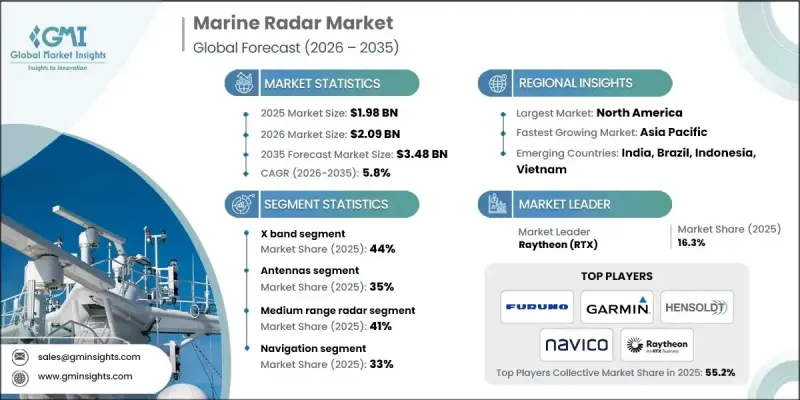
海上贸易量的成长和船舶拥塞加剧,推动了对可靠导航和监视系统的需求。繁忙航道上日益增长的海上事故防范意识,促使人们对先进雷达解决方案的投资不断增加。雷达技术的持续创新加速了升级週期,而老化的商用和军用雷达船队则推动了雷达的更新换代需求。固态雷达解决方案因其耐用性、运作稳定性和较低的维护需求而日益受到青睐。如今,船舶雷达系统与电子海图平台和船舶辨识技术整合得越来越频繁,以提高情境察觉。不断扩展的船舶交通监控服务也支撑了对沿海和陆基雷达安装的需求。对低能见度下导航精度的日益重视,进一步提高了雷达的性能标准。船队现代化倡议也为雷达更换的持续需求做出了贡献。
| 市场覆盖范围 | |
|---|---|
| 开始年份 | 2025 |
| 预测年份 | 2026-2035 |
| 起始值 | 19.8亿美元 |
| 预测金额 | 34.8亿美元 |
| 复合年增长率 | 5.8% |
2025年, X波段市占率达到44%,预计2026年至2035年将以5.3%的复合年增长率成长。这些系统广泛应用于中短程导航、防撞和作业控制。国际海事法规强制要求总吨位超过300吨的船舶安装雷达,这推动了该波段雷达市场的需求。
预计到 2025 年,天线部分将占 35% 的市场份额,到 2035 年将以 5.3% 的复合年增长率成长。天线在雷达维护成本中占很大一部分,因为性能精度、探测范围和分辨率高度依赖商用和渔船队的天线品质。
预计到 2025 年,美国海洋雷达市场将占 88% 的份额,达到 5.745 亿美元。商业船舶、海军行动和休閒划船的高采用率,加上严格的海上安全标准和密集的沿海交通,继续支持对现代雷达系统的持续需求。
目录
第一章调查方法
第二章执行摘要
第三章业界考察
- 生态系分析
- 供应商情况
- 利润率分析
- 成本结构
- 每个阶段的附加价值
- 影响价值链的因素
- 中断
- 产业影响因素
- 司机
- 世界海运贸易的成长
- 更严格的海事安全法规
- 沿海和港口水域交通拥堵日益严重
- 技术升级和数位化融合
- 产业潜在风险与挑战
- 安装和维护成本高昂
- 拥挤海域中的讯号干扰与杂讯
- 市场机会
- 全球老旧机队对维修的需求日益增长
- 离岸风电和海上能源计划的扩张
- 固态和数位雷达的应用趋势
- 成长潜力分析
- 监管环境
- 北美洲
- 美国海岸警卫队(USCG)雷达机载及观测人员要求
- 美国海岸警卫队队(USCG) 根据《联邦法规》第 46 篇对雷达设备核准
- 美国联邦通讯委员会(FCC)雷达认证标准
- 加拿大运输部海事雷达合规指南
- 欧洲
- 欧洲海事安全局 (EMSA) 的监督和执法
- 船舶设备指令 (MED) 型式核准要求
- 欧盟船旗国和港口国监管部门的雷达检查
- 雷达设备的欧洲协调标准 (EN)
- 亚太地区
- 中国船级社(CCS)雷达型式核准标准
- 印度航运总局雷达合规条例
- 国土交通省雷达条例
- 韩国海事局(KR)雷达要求
- 东协区域海上安全和雷达协调指南
- 拉丁美洲
- 巴西海事局(ANTAQ)雷达设备标准
- 阿根廷海岸警卫队雷达合规条例
- 墨西哥海军和运输部雷达法规
- 区域SOLAS实施状况及船旗国管制
- 中东和非洲
- 阿联酋联邦交通管理局海事雷达标准
- 沙乌地阿拉伯港务局雷达要求
- 南非海事安全局 (SAMSA) 条例
- 各区域采用国际海事组织 (IMO) 和国际电工委员会 (IEC) 雷达性能标准的情况
- 北美洲
- 波特分析
- PESTEL 分析
- 科技与创新趋势
- 当前技术趋势
- 新兴技术
- 价格趋势
- 按地区
- 副产品
- 生产统计
- 生产基地
- 消费中心
- 出口和进口
- 成本細項分析
- 雷达系统购置成本
- 安装和整合成本
- 营运和维护成本
- 软体升级和校准成本
- 监理认证和型式核准费用
- 培训和船员熟悉成本
- 专利分析
- 永续性和环境方面
- 永续实践
- 减少废弃物策略
- 生产中的能源效率
- 环保倡议
- 碳足迹考量
- 海洋雷达系统结构与整合框架
- 独立式桥樑系统与整合舰桥系统(IBS)
- 雷达与电子海图显示与资讯系统(ECDIS)、自动识别系统(AIS)、高阶雷达定位系统(ARPA)和惯性导航系统(INS)集成
- 开放式和专有式导航系统结构
- 雷达在感测器融合环境中的作用
- OEM差异化与技术定位因素
- 检测范围、解析度和杂波抑制基准测试
- 区分固态雷达和磁控管雷达
- 软体定义雷达能力
- 可靠性、平均故障间隔时间 (MTBF) 和生命週期性能指标
- 改装和新船的需求趋势
- SOLAS、IMO 和海军采购标准的影响
第四章 竞争情势
- 介绍
- 公司市占率分析
- 北美洲
- 欧洲
- 亚太地区
- 拉丁美洲
- 中东和非洲
- 主要市场公司的竞争分析
- 竞争定位矩阵
- 战略展望矩阵
- 重大进展
- 併购
- 伙伴关係与合作
- 新产品发布
- 企业扩张计画和资金筹措
第五章 雷达市场估算与预测,2022-2035年
- X波段
- S波段
- C波段雷达
- 其他的
第六章 按组件分類的市场估算与预测,2022-2035年
- 发送器
- 天线
- 接收器
- 处理器
- 展示
- 其他的
第七章 2022-2035年各地区市场估算与预测
- 短程雷达(1至20海浬)
- 中程雷达(20-50海浬)
- 远程雷达(50-100海里或更远)
第八章 按应用领域分類的市场估算与预测,2022-2035年
- 导航
- 避免碰撞
- 监控与安防
- 捕鱼活动
- 沿海交通监测
- 天气监测
- 其他的
9. 依最终用途分類的市场估计与预测,2022-2035 年
- 商船
- 海军/国防/军舰
- 休閒船艇/游艇
- 私人船主
- 渔船
- 其他的
第十章 2022-2035年各地区市场估计与预测
- 北美洲
- 我们
- 加拿大
- 欧洲
- 德国
- 英国
- 法国
- 义大利
- 西班牙
- 俄罗斯
- 北欧国家
- 荷兰
- 瑞典
- 亚太地区
- 中国
- 印度
- 日本
- 澳洲
- 韩国
- 新加坡
- 泰国
- 印尼
- 越南
- 拉丁美洲
- 巴西
- 墨西哥
- 阿根廷
- 中东和非洲
- 南非
- 沙乌地阿拉伯
- 阿拉伯聯合大公国
- 土耳其
第十一章:公司简介
- 世界玩家
- BAE Systems
- Furuno Electric
- Garmin
- Hensoldt
- Kongsberg Gruppen
- Leonardo
- Lockheed Martin
- Navico
- Northrop Grumman
- Raymarine
- Raytheon RTX
- Saab
- Sperry Marine
- Teledyne FLIR
- Thales
- 区域玩家
- GEM Elettronica
- JRC Nisshinbo
- Koden Electronics
- Samyung ENC
- TOKIO KEIKI
- 新兴企业/颠覆者
- Alphatron Marine
- Rutter
- Terma
The Global Marine Radar Market was valued at USD 1.98 billion in 2025 and is estimated to grow at a CAGR of 5.8% to reach USD 3.48 billion by 2035.
Rising seaborne trade volumes and growing vessel congestion are increasing the need for reliable navigation and surveillance systems. Heightened awareness around maritime accidents in heavily trafficked waterways is encouraging greater investment in advanced radar solutions. Continuous innovation in radar technology is accelerating upgrade cycles, while aging commercial and defense fleets are driving replacement demand. Solid-state radar solutions are increasingly favored due to their durability, operational stability, and reduced maintenance needs. Marine radar systems are now more frequently integrated with electronic charting platforms and vessel identification technologies to improve situational awareness. Expansion of vessel traffic monitoring services is supporting demand for coastal and shore-based radar installations. Growing focus on navigational accuracy in poor visibility conditions is further improving radar performance standards. Fleet modernization initiatives are also contributing to sustained demand for radar replacements.
| Market Scope | |
|---|---|
| Start Year | 2025 |
| Forecast Year | 2026-2035 |
| Start Value | $1.98 Billion |
| Forecast Value | $3.48 Billion |
| CAGR | 5.8% |
The X-band segment held a 44% share in 2025 and is forecast to grow at a CAGR of 5.3% from 2026 to 2035. These systems are widely used for navigation support, collision avoidance, and operational control over short to medium ranges. International maritime regulations mandate radar installation on vessels exceeding 300 gross tons, reinforcing segment demand.
The antenna segment accounted for 35% share in 2025 and will grow at a CAGR of 5.3% through 2035. Antennas represent a major share of radar maintenance expenditure, as performance accuracy, detection range, and resolution heavily depend on antenna quality across commercial and fishing fleets.
United States Marine Radar Market held an 88% share and reached USD 574.5 million in 2025. High adoption across commercial shipping, naval operations, and recreational boating, combined with strict maritime safety standards and dense coastal traffic, continues to support ongoing demand for modern radar systems.
Key companies operating in the Global Marine Radar Market include Garmin, Furuno Electric, Raytheon RTX, Kongsberg Gruppen, Raymarine, Navico, Hensoldt, Sperry Marine, JRC Nisshinbo, and Terma. Companies in the Marine Radar Market are strengthening their competitive position by investing heavily in solid-state radar innovation and enhanced signal processing capabilities. Strategic product upgrades focused on higher resolution, improved target detection, and seamless system integration are a core priority. Manufacturers are expanding their aftermarket and service offerings to capture recurring revenue from maintenance and replacement cycles. Partnerships with shipbuilders and fleet operators are helping firms secure long-term supply agreements.
Table of Contents
Chapter 1 Methodology
- 1.1 Research approach
- 1.2 Quality Commitments
- 1.2.1 GMI AI policy & data integrity commitment
- 1.2.1.1 Source consistency protocol
- 1.2.1 GMI AI policy & data integrity commitment
- 1.3 Research Trail & Confidence Scoring
- 1.3.1 Research Trail Components
- 1.3.2 Scoring Components
- 1.4 Data Collection
- 1.4.1 Partial list of primary sources
- 1.5 Data mining sources
- 1.5.1 Paid sources
- 1.5.1.1 Sources, by region
- 1.5.1 Paid sources
- 1.6 Base estimates and calculations
- 1.6.1 Base year calculation for any one approach
- 1.7 Forecast model
- 1.7.1 Quantified market impact analysis
- 1.7.1.1 Mathematical impact of growth parameters on forecast
- 1.7.1 Quantified market impact analysis
- 1.8 Research transparency addendum
- 1.8.1 Source attribution framework
- 1.8.2 Quality assurance metrics
- 1.8.3 Our commitment to trust
Chapter 2 Executive Summary
- 2.1 Industry 3600 synopsis, 2022 - 2035
- 2.2 Key market trends
- 2.2.1 Regional
- 2.2.2 Radar
- 2.2.3 Component
- 2.2.4 Range
- 2.2.5 Application
- 2.2.6 End Use
- 2.3 TAM Analysis, 2026-2035
- 2.4 CXO perspectives: Strategic imperatives
- 2.4.1 Executive decision points
- 2.4.2 Critical success factors
- 2.5 Future outlook and strategic recommendations
Chapter 3 Industry Insights
- 3.1 Industry ecosystem analysis
- 3.1.1 Supplier landscape
- 3.1.2 Profit margin analysis
- 3.1.3 Cost structure
- 3.1.4 Value addition at each stage
- 3.1.5 Factor affecting the value chain
- 3.1.6 Disruptions
- 3.2 Industry impact forces
- 3.2.1.1 Growth drivers
- 3.2.1.2 Growth in global seaborne trade
- 3.2.1.3 Stricter maritime safety regulations
- 3.2.1.4 Increasing traffic congestion in coastal and port waters
- 3.2.1.5 Technology upgrades and digital integration
- 3.2.2 Industry pitfalls and challenges
- 3.2.2.1 High installation and maintenance costs
- 3.2.2.2 Signal interference and clutter in congested waters
- 3.2.3 Market opportunities
- 3.2.3.1 Retrofit demand from aging global fleets
- 3.2.3.2 Expansion of offshore wind and offshore energy projects
- 3.2.3.3 Adoption of solid state and digital radar
- 3.3 Growth potential analysis
- 3.4 Regulatory landscape
- 3.4.1 North America
- 3.4.1.1 United States Coast Guard (USCG) Radar Carriage and Observer Requirements
- 3.4.1.2 USCG Approval of Radar Equipment under 46 CFR
- 3.4.1.3 Federal Communications Commission (FCC) Radar Certification Standards
- 3.4.1.4 Canada Transport Canada Marine Radar Compliance Guidelines
- 3.4.2 Europe
- 3.4.2.1 European Maritime Safety Agency (EMSA) Oversight and Implementation
- 3.4.2.2 Marine Equipment Directive (MED) Type Approval Requirements
- 3.4.2.3 EU Flag State and Port State Control Radar Inspections
- 3.4.2.4 Harmonized EN Standards for Radar Equipment
- 3.4.3 Asia Pacific
- 3.4.3.1 China Classification Society (CCS) Radar Type Approval Standards
- 3.4.3.2 India Directorate General of Shipping Radar Compliance Rules
- 3.4.3.3 Japan Ministry of Land Infrastructure Transport Radar Regulations
- 3.4.3.4 South Korea Korean Register of Shipping Radar Requirements
- 3.4.3.5 ASEAN Regional Maritime Safety and Radar Harmonization Guidelines
- 3.4.4 Latin America
- 3.4.4.1 Brazil Maritime Authority (ANtaq) Radar Equipment Standards
- 3.4.4.2 Argentina Prefectura Naval Radar Compliance Regulations
- 3.4.4.3 Mexico Secretariat of Navy and Transport Radar Rules
- 3.4.4.4 Regional SOLAS Implementation and Flag State Controls
- 3.4.5 Middle East & Africa
- 3.4.5.1 UAE Federal Transport Authority Maritime Radar Standards
- 3.4.5.2 Saudi Arabia Ports Authority Radar Requirements
- 3.4.5.3 South Africa Maritime Safety Authority (SAMSA) Regulations
- 3.4.5.4 Regional Adoption of IMO and IEC Radar Performance Standards
- 3.4.1 North America
- 3.5 Porter';s analysis
- 3.6 PESTEL analysis
- 3.7 Technology and innovation landscape
- 3.7.1 Current technological trends
- 3.7.2 Emerging technologies
- 3.8 Price trends
- 3.8.1 By region
- 3.8.2 By product
- 3.9 Production statistics
- 3.9.1 Production hubs
- 3.9.2 Consumption hubs
- 3.9.3 Export and import
- 3.10 Cost breakdown analysis
- 3.10.1 Radar system acquisition costs
- 3.10.2 Installation and integration costs
- 3.10.3 Operational and maintenance costs
- 3.10.4 Software upgrade and calibration costs
- 3.10.5 Regulatory certification and type approval costs
- 3.10.6 Training and crew familiarization costs
- 3.11 Patent analysis
- 3.12 Sustainability and environmental aspects
- 3.12.1 Sustainable practices
- 3.12.2 Waste reduction strategies
- 3.12.3 Energy efficiency in production
- 3.12.4 Eco-friendly Initiatives
- 3.12.5 Carbon footprint considerations
- 3.13 Marine radar system architecture & integration framework
- 3.13.1 Standalone vs integrated bridge systems (IBS)
- 3.13.2 Radar integration with ECDIS, AIS, ARPA, and INS
- 3.13.3 Open vs proprietary navigation system architectures
- 3.13.4 Role of radar in sensor fusion environments
- 3.14 OEM differentiation & technology positioning factors
- 3.14.1 Detection range, resolution, and clutter suppression benchmarks
- 3.14.2 Solid-state vs magnetron radar differentiation
- 3.14.3 Software-defined radar capabilities
- 3.14.4 Reliability, MTBF, and lifecycle performance metrics
- 3.15 Retrofit vs newbuild demand dynamics
- 3.16 Impact of SOLAS, IMO & naval procurement standards
Chapter 4 Competitive Landscape, 2025
- 4.1 Introduction
- 4.2 Company market share analysis
- 4.2.1 North America
- 4.2.2 Europe
- 4.2.3 Asia Pacific
- 4.2.4 LATAM
- 4.2.5 MEA
- 4.3 Competitive analysis of major market players
- 4.4 Competitive positioning matrix
- 4.5 Strategic outlook matrix
- 4.6 Key developments
- 4.6.1 Mergers & acquisitions
- 4.6.2 Partnerships & collaborations
- 4.6.3 New Product Launches
- 4.6.4 Expansion Plans and funding
Chapter 5 Market Estimates & Forecast, By Radar, 2022 - 2035 ($Bn, Units)
- 5.1 Key trends
- 5.2 X-band
- 5.3 S-band
- 5.4 C-Band radar
- 5.5 Others
Chapter 6 Market Estimates & Forecast, By Component, 2022 - 2035 ($Bn, Units)
- 6.1 Key trends
- 6.2 Transmitters
- 6.3 Antennas
- 6.4 Receivers
- 6.5 Processors
- 6.6 Displays
- 6.7 Other
Chapter 7 Market Estimates & Forecast, By Range, 2022 - 2035 ($Bn, Units)
- 7.1 Key trends
- 7.2 Short-range radar (1-20 NM)
- 7.3 Medium-range radar (20-50 NM)
- 7.4 Long-range radar (50-100 NM and above)
Chapter 8 Market Estimates & Forecast, By Application, 2022 - 2035 ($Bn, Units)
- 8.1 Key trends
- 8.2 Navigation
- 8.3 Collision Avoidance
- 8.4 Surveillance & Security
- 8.5 Fishing Operations
- 8.6 Monitoring Coastal Traffic
- 8.7 Weather Monitoring
- 8.8 Others
Chapter 9 Market Estimates & Forecast, By End Use, 2022 - 2035 ($Bn, Units)
- 9.1 Key trends
- 9.2 Commercial vessels
- 9.3 Naval & Defense / Military Naval
- 9.4 Recreational Boats / Yachts
- 9.5 Private boat owners
- 9.6 Fishing vessels
- 9.7 Others
Chapter 10 Market Estimates & Forecast, By Region, 2022 - 2035 ($Bn, Units)
- 10.1 Key trends
- 10.2 North America
- 10.2.1 US
- 10.2.2 Canada
- 10.3 Europe
- 10.3.1 Germany
- 10.3.2 UK
- 10.3.3 France
- 10.3.4 Italy
- 10.3.5 Spain
- 10.3.6 Russia
- 10.3.7 Nordics
- 10.3.8 Netherlands
- 10.3.9 Sweden
- 10.4 Asia Pacific
- 10.4.1 China
- 10.4.2 India
- 10.4.3 Japan
- 10.4.4 Australia
- 10.4.5 South Korea
- 10.4.6 Singapore
- 10.4.7 Thailand
- 10.4.8 Indonesia
- 10.4.9 Vietnam
- 10.5 Latin America
- 10.5.1 Brazil
- 10.5.2 Mexico
- 10.5.3 Argentina
- 10.6 MEA
- 10.6.1 South Africa
- 10.6.2 Saudi Arabia
- 10.6.3 UAE
- 10.6.4 Turkey
Chapter 11 Company Profiles
- 11.1 Global Players
- 11.1.1 BAE Systems
- 11.1.2 Furuno Electric
- 11.1.3 Garmin
- 11.1.4 Hensoldt
- 11.1.5 Kongsberg Gruppen
- 11.1.6 Leonardo
- 11.1.7 Lockheed Martin
- 11.1.8 Navico
- 11.1.9 Northrop Grumman
- 11.1.10 Raymarine
- 11.1.11 Raytheon RTX
- 11.1.12 Saab
- 11.1.13 Sperry Marine
- 11.1.14 Teledyne FLIR
- 11.1.15 Thales
- 11.2 Regional Players
- 11.2.1 GEM Elettronica
- 11.2.2 JRC Nisshinbo
- 11.2.3 Koden Electronics
- 11.2.4 Samyung ENC
- 11.2.5 TOKIO KEIKI
- 11.3 Emerging Players/Disruptors
- 11.3.1 Alphatron Marine
- 11.3.2 Rutter
- 11.3.3 Terma


