


 |
市场调查报告书
商品编码
1928922
先进轮胎市场机会、成长要素、产业趋势分析及2026年至2035年预测Advanced Tires Market Opportunity, Growth Drivers, Industry Trend Analysis, and Forecast 2026 - 2035 |
||||||

预计到 2024 年,全球先进轮胎市场规模将达到 18 亿美元,并预计从 2025 年到 2034 年将以 8.8% 的复合年增长率增长,这主要得益于汽车技术的快速发展和对高性能轮胎需求的不断增长。
随着汽车产业向电动车转型,製造商正致力于研发新一代轮胎,以提升车辆的效率、安全性和耐用性。先进轮胎融合了智慧监控系统、预测性维护技术和低滚动阻力设计,旨在优化车辆性能和能源效率。这些创新对于电动车和自动驾驶汽车至关重要,能够延长电池寿命、确保卓越的道路安全并最大限度地减少维护需求。在对永续且技术先进的交通解决方案日益增长的需求驱动下,汽车製造商和轮胎製造商正携手合作,开发符合未来出行需求的尖端轮胎。
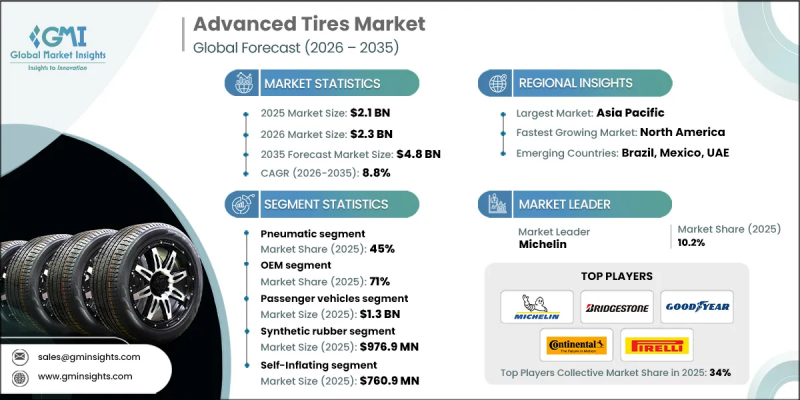
内建感测器的智慧轮胎在商用车和乘用车领域正日益普及。这些感测器能够即时提供轮胎压力、温度和胎面磨损等关键性能指标数据,从而实现预测性维护并降低爆胎风险。更高的安全性和燃油效率使智慧轮胎成为车队营运商和个人消费者的首选。随着远端资讯处理和车辆诊断技术与轮胎技术的日益融合,製造商不断开发能够提升车辆运转率和驾驶性能的解决方案,进一步推动了市场成长。
| 市场覆盖范围 | |
|---|---|
| 开始年份 | 2025 |
| 预测年份 | 2026-2035 |
| 起始值 | 21亿美元 |
| 预测金额 | 48亿美元 |
| 复合年增长率 | 8.8% |
按车辆类型划分,轻型车辆占据了大部分收入份额。截至2024年,该细分市场的规模预计为8亿美元,随着电动车(EV)的日益普及,预计将显着成长。专为电动车设计的先进轮胎专注于降低滚动阻力,这直接影响能源效率和续航里程。整合式智慧监控系统可以即时追踪轮胎状况,帮助驾驶员保持最佳性能和安全性。汽车製造商正优先投资于能够满足不断变化的消费者偏好和监管要求的高效轮胎解决方案。
按销售管道,先进轮胎市场可分为原厂配套(OEM)市场和售后市场,预计到2024年,OEM市场将占据71%的市场份额。汽车製造商正日益将智慧轮胎技术应用于新车,这些技术具备即时胎压监测、自动诊断和预测性维护等功能。这些先进功能不仅提升了车辆的整体性能,也协助了联网汽车和自动驾驶的发展。对车辆自动化的日益重视正在加速智慧轮胎系统的普及,这些系统能够在最大限度地提高安全性和效率的同时,最大限度地减少维护需求。利用这些创新技术,汽车製造商能够提升使用者体验并优化车辆性能策略。
在基础建设和汽车产业大规模发展的推动下,亚太地区预计到2024年将占全球先进轮胎市场40%的份额。中国已成为主要贡献者,创造了2.5亿美元的区域收入。建筑业的快速扩张、交通网络投资的增加以及强大的生产能力,都在推动对耐用、高性能轮胎的需求。随着技术进步不断重塑产业格局,汽车製造商和轮胎製造商之间的合作预计将在未来几年持续推动市场成长。
目录
第一章调查方法和范围
第二章执行摘要
第三章业界考察
- 生态系分析
- 供应商情况
- 利润率
- 成本结构
- 每个阶段的附加价值
- 影响价值链的因素
- 中断
- 产业影响因素
- 司机
- 电动车和混合动力汽车越来越受欢迎
- 对安全性和车辆性能的要求日益提高
- 轮胎设计的技术进步
- 全球汽车生产与旅游服务的扩张
- 产业潜在风险与挑战
- 高昂的研发和製造成本
- 消费者意识和基础设施不足
- 市场机会
- 智慧连网汽车生态系的发展
- 对永续和环保轮胎的需求不断增长
- 材料和设计方面的技术进步
- OEM协作和基于平台的部署
- 司机
- 成长潜力分析
- 监管环境
- 北美洲
- 联邦机动车辆安全标准(FMVSS)
- 加拿大机动车辆安全标准(CMVSS)
- 欧洲
- 符合德国TUV和BaFin标准
- 法国DGITM指南
- 英国车辆认证机构(VCA)规章
- 遵守义大利运输部规定
- 亚太地区
- 中国工业和资讯化部(工信部)指南
- 日本国土交通省标准
- 韩国国土交通部(MOLIT)法规
- 印度公路运输和公路部 (MoRTH) 和印度标准协会 (BIS) 指南
- 拉丁美洲
- 巴西 DENATRAN 和 ANFAVEA 法规
- 墨西哥SCT和NOM标准
- 中东和非洲
- 阿联酋道路和交通管理局 (RTA) 指南
- 沙乌地阿拉伯运输总局(GAT)规章
- 北美洲
- 波特分析
- PESTEL 分析
- 科技与创新趋势
- 当前技术趋势
- 新兴技术
- 价格趋势
- 按地区
- 副产品
- 成本細項分析
- 专利分析
- 永续性和环境方面
- 永续努力
- 减少废弃物策略
- 生产中的能源效率
- 环保倡议
- 碳足迹考量
- 使用案例场景
- OEM整合与汽车平臺完整性
- OEM联合开发与认证策略
- 电动车和自动驾驶汽车的轮胎规格
- 电动车专用轮胎的经济性和性能之间的权衡
- 车队和商用车采用分析
- 製造工艺创新
第四章 竞争情势
- 介绍
- 公司市占率分析
- 北美洲
- 欧洲
- 亚太地区
- 拉丁美洲
- 中东和非洲
- 主要市场公司的竞争分析
- 竞争定位矩阵
- 战略展望矩阵
- 重大进展
- 併购
- 伙伴关係与合作
- 新产品发布
- 企业扩张计画和资金筹措
第五章 依轮胎类型分類的市场估计与预测,2022-2035年
- 充气轮胎
- 无气
- 防爆轮胎
- 其他的
第六章 依车辆类型分類的市场估计与预测,2022-2035年
- 搭乘用车
- 掀背车车
- 轿车
- SUV
- 商用车辆
- 轻型商用车(LCV)
- 中型商用车(MCV)
- 重型商用车(HCV)
第七章 按材料分類的市场估算与预测,2022-2035年
- 合成橡胶
- 天然橡胶
- 弹性体
- 其他的
第八章 按技术分類的市场估算与预测,2022-2035年
- 自充气
- 晶片嵌入式类型
- 自密封
- 多重腔体
- 一体式
第九章 依销售管道分類的市场估计与预测,2022-2035年
- OEM
- 售后市场
第十章 2022-2035年各地区市场估计与预测
- 北美洲
- 我们
- 加拿大
- 欧洲
- 英国
- 德国
- 法国
- 义大利
- 西班牙
- 比利时
- 荷兰
- 瑞典
- 亚太地区
- 中国
- 印度
- 日本
- 澳洲
- 新加坡
- 韩国
- 越南
- 印尼
- 马来西亚
- 拉丁美洲
- 巴西
- 墨西哥
- 阿根廷
- 中东和非洲
- 阿拉伯聯合大公国
- 南非
- 沙乌地阿拉伯
第十一章:公司简介
- Global Player
- Bridgestone
- Continental
- Cooper-Standard
- Goodyear
- Michelin
- Pirelli
- Sumitomo
- Tenneco(DRiV)
- Vibracoustic
- Yokohama
- Regional Player
- Apollo Tyres
- Giti Tire
- Hankook Tire
- Jinyu Tire
- Kumho Tire
- Linglong Tire
- MRF
- Nexen Tire
- Sailun Tire
- Triangle Tire
- 新兴製造商
- Aeolus Tyre
- CEAT
- Double Coin
- Ovation Tyres
- Tigar Tyres
The global advanced tires market was valued at USD 1.8 billion in 2024 and is projected to grow at a CAGR of 8.8% between 2025 and 2034, driven by rapid advancements in automotive technology and the increasing demand for high-performance tires. As the automotive sector transitions toward electric vehicles (EVs), manufacturers are focusing on next-generation tires that enhance vehicle efficiency, safety, and durability. Advanced tires incorporate intelligent monitoring systems, predictive maintenance technologies, and low rolling resistance designs to optimize vehicle performance and energy efficiency. These innovations are crucial for electric and autonomous vehicles, ensuring extended battery life, superior road safety, and minimal maintenance. The rising demand for sustainable and technologically advanced transportation solutions is driving automakers and tire manufacturers to collaborate on cutting-edge tire developments that align with the future of mobility.
Smart tires equipped with embedded sensors are gaining traction across commercial and personal vehicle fleets. These sensors provide real-time data on critical performance metrics such as tire pressure, temperature, and tread wear, enabling predictive maintenance and reducing the risk of blowouts. Enhanced safety features and improved fuel efficiency make smart tires a preferred choice among fleet operators and individual consumers. The increasing integration of telematics and vehicle diagnostics into tire technology further supports market growth as manufacturers continue to develop solutions that improve vehicle uptime and on-road performance.
| Market Scope | |
|---|---|
| Start Year | 2025 |
| Forecast Year | 2026-2035 |
| Start Value | $2.1 Billion |
| Forecast Value | $4.8 Billion |
| CAGR | 8.8% |
Segmented by vehicle type, the market sees light-duty vehicles holding a major revenue share. In 2024, this segment was valued at USD 800 million, with expectations of substantial growth due to the rising adoption of EVs. Advanced tires specifically designed for electric models focus on reducing rolling resistance, which directly impacts energy efficiency and driving range. By integrating intelligent monitoring systems, these tires offer real-time tracking of tire conditions, helping drivers maintain optimal performance and safety. Automakers are prioritizing investments in high-efficiency tire solutions that cater to evolving consumer preferences and regulatory requirements.
Based on sales channels, the advanced tires market is divided into OEM and aftermarket, with OEMs dominating at a 71% share in 2024. Automakers are increasingly integrating smart tire technologies into new vehicle models, equipping them with real-time pressure monitoring, automated diagnostics, and predictive maintenance capabilities. These advanced features enhance overall vehicle performance while supporting the push toward connected and autonomous driving. The growing emphasis on vehicle automation is accelerating the adoption of intelligent tire systems that require minimal maintenance while maximizing safety and efficiency. By leveraging these innovations, automakers can offer enhanced user experiences and refine their vehicle performance strategies.
The Asia Pacific region accounted for 40% of the global advanced tires market in 2024, driven by large-scale infrastructure developments and the booming automotive industry. China emerged as the leading contributor, generating USD 250 million in regional revenue. The rapid expansion of the construction sector, increasing investments in transportation networks, and strong production capabilities are fueling demand for durable, high-performance tires. As technological advancements continue to shape the industry, growing collaborations between automakers and tire manufacturers are expected to drive sustained market growth in the coming years.
Table of Contents
Chapter 1 Methodology & Scope
- 1.1 Market scope and definition
- 1.2 Research design
- 1.2.1 Research approach
- 1.2.2 Data collection methods
- 1.3 Data mining sources
- 1.3.1 Global
- 1.3.2 Regional/Country
- 1.4 Base estimates and calculations
- 1.4.1 Base year calculation
- 1.4.2 Key trends for market estimation
- 1.5 Primary research and validation
- 1.5.1 Primary sources
- 1.6 Forecast
- 1.7 Research assumptions and limitations
Chapter 2 Executive Summary
- 2.1 Industry 360° synopsis, 2022 - 2035
- 2.2 Key market trends
- 2.2.1 Regional
- 2.2.2 Tire
- 2.2.3 Vehicle
- 2.2.4 Material
- 2.2.5 Technology
- 2.2.6 Sales Channel
- 2.3 TAM Analysis, 2026-2035
- 2.4 CXO perspectives: Strategic imperatives
- 2.4.1 Executive decision points
- 2.4.2 Critical success factors
- 2.5 Future outlook and strategic recommendations
Chapter 3 Industry Insights
- 3.1 Industry ecosystem analysis
- 3.1.1 Supplier Landscape
- 3.1.2 Profit Margin
- 3.1.3 Cost structure
- 3.1.4 Value addition at each stage
- 3.1.5 Factor affecting the value chain
- 3.1.6 Disruptions
- 3.2 Industry impact forces
- 3.2.1 Growth drivers
- 3.2.1.1 Rising electric & hybrid vehicle adoption
- 3.2.1.2 Growing demand for safety & vehicle performance
- 3.2.1.3 Technological advancements in tire design
- 3.2.1.4 Expansion of global vehicle production & mobility services
- 3.2.2 Industry pitfalls and challenges
- 3.2.2.1 High development & manufacturing costs
- 3.2.2.2 Limited consumer awareness & infrastructure readiness
- 3.2.3 Market opportunities
- 3.2.3.1 Growth of Smart & Connected Vehicle Ecosystems
- 3.2.3.2 Rising Demand for Sustainable & Eco-Friendly Tires
- 3.2.3.3 Technological Advancements in Materials and Design
- 3.2.3.4 OEM Collaborations and Platform-Based Deployments
- 3.2.1 Growth drivers
- 3.3 Growth potential analysis
- 3.4 Regulatory landscape
- 3.4.1 North America
- 3.4.1.1 U.S. Federal Motor Vehicle Safety Standards (FMVSS)
- 3.4.1.2 Canada Motor Vehicle Safety Standards (CMVSS)
- 3.4.2 Europe
- 3.4.2.1 Germany TUV & BaFin Compliance
- 3.4.2.2 France DGITM Guidelines
- 3.4.2.3 UK Vehicle Certification Agency (VCA) Regulations
- 3.4.2.4 Italy Ministry of Infrastructure & Transport Compliance
- 3.4.3 Asia Pacific
- 3.4.3.1 China MIIT Guidelines
- 3.4.3.2 Japan MLIT Standards
- 3.4.3.3 South Korea MOLIT Regulations
- 3.4.3.4 India Ministry of MoRTH & BIS Guidelines
- 3.4.4 Latin America
- 3.4.4.1 Brazil DENATRAN & ANFAVEA Regulations
- 3.4.4.2 Mexico SCT & NOM Standards
- 3.4.5 Middle East and Africa
- 3.4.5.1 UAE Roads & Transport Authority (RTA) Guidelines
- 3.4.5.2 Saudi Arabia General Authority for Transport (GAT) Regulations
- 3.4.1 North America
- 3.5 Porter';s analysis
- 3.6 PESTEL analysis
- 3.7 Technology and Innovation Landscape
- 3.7.1 Current technological trends
- 3.7.2 Emerging technologies
- 3.8 Price trends
- 3.8.1 By region
- 3.8.2 By product
- 3.9 Cost breakdown analysis
- 3.10 Patent analysis
- 3.11 Sustainability and Environmental Aspects
- 3.11.1 Sustainable practices
- 3.11.2 Waste reduction strategies
- 3.11.3 Energy efficiency in production
- 3.11.4 Eco-friendly initiatives
- 3.11.5 Carbon footprint considerations
- 3.12 Use case scenarios
- 3.13 OEM Integration & Vehicle Platform Alignment
- 3.13.1 OEM co-development & homologation strategy
- 3.13.2 EV & autonomous vehicle tire specifications
- 3.14 EV-Specific Tire Economics & Performance Trade-offs
- 3.15 Fleet & Commercial Adoption Analysis
- 3.16 Manufacturing Process Innovation
Chapter 4 Competitive Landscape, 2025
- 4.1 Introduction
- 4.2 Company market share analysis
- 4.2.1 North America
- 4.2.2 Europe
- 4.2.3 Asia Pacific
- 4.2.4 Latin America
- 4.2.5 Middle East & Africa
- 4.3 Competitive analysis of major market players
- 4.4 Competitive positioning matrix
- 4.5 Strategic outlook matrix
- 4.6 Key developments
- 4.6.1 Mergers & acquisitions
- 4.6.2 Partnerships & collaborations
- 4.6.3 New product launches
- 4.6.4 Expansion plans and funding
Chapter 5 Market Estimates & Forecast, By Tire, 2022 - 2035 ($ Bn, Units)
- 5.1 Key trends
- 5.2 Pneumatic
- 5.3 Airless
- 5.4 Run-flat
- 5.5 Others
Chapter 6 Market Estimates & Forecast, By Vehicle, 2022 - 2035 ($ Bn, Units)
- 6.1 Key trends
- 6.2 Passenger vehicles
- 6.2.1 Hatchbacks
- 6.2.2 Sedans
- 6.2.3 SUV
- 6.3 Commercial vehicles
- 6.3.1 Light commercial vehicles (LCV)
- 6.3.2 Medium commercial vehicles (MCV)
- 6.3.3 Heavy commercial vehicles (HCV)
Chapter 7 Market Estimates & Forecast, By Material, 2022 - 2035 ($ Bn, Units)
- 7.1 Key trends
- 7.2 Synthetic rubber
- 7.3 Natural rubber
- 7.4 Elastomers
- 7.5 Others
Chapter 8 Market Estimates & Forecast, By Technology, 2022 - 2035 ($ Bn, Units)
- 8.1 Key trends
- 8.2 Self-Inflating
- 8.3 Chip-Embedded
- 8.4 Self-Sealing
- 8.5 Multi-chamber
- 8.6 All-In-One
Chapter 9 Market Estimates & Forecast, By Sales Channel, 2022 - 2035 ($ Bn, Units)
- 9.1 Key trends
- 9.2 OEM
- 9.3 Aftermarket
Chapter 10 Market Estimates & Forecast, By Region, 2022 - 2035 ($ Bn, Units)
- 10.1 Key trends
- 10.2 North America
- 10.2.1 US
- 10.2.2 Canada
- 10.3 Europe
- 10.3.1 UK
- 10.3.2 Germany
- 10.3.3 France
- 10.3.4 Italy
- 10.3.5 Spain
- 10.3.6 Belgium
- 10.3.7 Netherlands
- 10.3.8 Sweden
- 10.4 Asia Pacific
- 10.4.1 China
- 10.4.2 India
- 10.4.3 Japan
- 10.4.4 Australia
- 10.4.5 Singapore
- 10.4.6 South Korea
- 10.4.7 Vietnam
- 10.4.8 Indonesia
- 10.4.9 Malaysia
- 10.5 Latin America
- 10.5.1 Brazil
- 10.5.2 Mexico
- 10.5.3 Argentina
- 10.6 MEA
- 10.6.1 UAE
- 10.6.2 South Africa
- 10.6.3 Saudi Arabia
Chapter 11 Company Profiles
- 11.1 Global Player
- 11.1.1 Bridgestone
- 11.1.2 Continental
- 11.1.3 Cooper-Standard
- 11.1.4 Goodyear
- 11.1.5 Michelin
- 11.1.6 Pirelli
- 11.1.7 Sumitomo
- 11.1.8 Tenneco (DRiV)
- 11.1.9 Vibracoustic
- 11.1.10 Yokohama
- 11.2 Regional Player
- 11.2.1 Apollo Tyres
- 11.2.2 Giti Tire
- 11.2.3 Hankook Tire
- 11.2.4 Jinyu Tire
- 11.2.5 Kumho Tire
- 11.2.6 Linglong Tire
- 11.2.7 MRF
- 11.2.8 Nexen Tire
- 11.2.9 Sailun Tire
- 11.2.10 Triangle Tire
- 11.3 Emerging Players
- 11.3.1 Aeolus Tyre
- 11.3.2 CEAT
- 11.3.3 Double Coin
- 11.3.4 Ovation Tyres
- 11.3.5 Tigar Tyres

 先进轮胎市场:2026-2032年全球市场预测(依车辆类型、轮胎结构、胎面花纹、销售管道及应用划分)
 2026年全球先进轮胎市场报告
 先进轮胎市场分析及预测(至2035年):依类型、产品类型、技术、组件、应用、材质、最终用户、功能及安装类型划分
 全球先进轮胎市场:按轮胎类型、材料、技术、尺寸、车辆类型、国家和地区划分-产业分析、市场规模、份额和预测(2025-2032年)
 先进轮胎市场规模、份额和成长分析(按技术、最终用途、轮胎类型、材料和地区划分)-2026-2033年产业预测
 已开发轮胎市场:依轮胎类型、车辆类型、尺寸、材质及地区划分
 全球先进轮胎市场