


 |
市场调查报告书
商品编码
1928934
焚化炉市场机会、成长要素、产业趋势分析及2026年至2035年预测Incinerator Market Opportunity, Growth Drivers, Industry Trend Analysis, and Forecast 2026 - 2035 |
||||||

全球焚化炉市场预计到 2025 年将达到 186 亿美元,到 2035 年将达到 233 亿美元,年复合成长率为 2.2%。
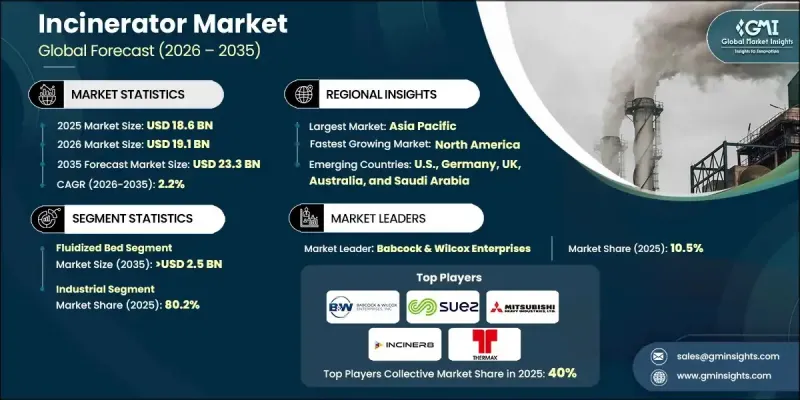
全球城市废弃物量不断成长,掩埋空间日益紧张,这些因素共同塑造了市场发展趋势。公共和私人废弃物业者正优先考虑减少垃圾量、进行卫生处理并确保可靠的处置能力,以满足长期的废弃物管理需求。焚烧系统与能源回收基础设施的整合日益紧密,使其能够在严格遵守排放法规的前提下,将废弃物转化为可用的热能和电力。现代化设施的设计目标是提高处理能力、提升热效率,并与区域供热网路相容。多元化的收入来源,包括处置费、发电、供热合约和资源回收,提高了收入稳定性。合约模式也在不断演进,以更好地应对原料波动和营运绩效。同时,环境目标也影响工厂的设计,更加重视生命排放减排、燃料替代以及对先进碳管理解决方案的准备。这些因素共同推动了焚烧产业的稳定成长,并强化了其在综合废弃物管理框架中的作用。
| 市场覆盖范围 | |
|---|---|
| 开始年份 | 2025 |
| 预测年份 | 2026-2035 |
| 起始值 | 186亿美元 |
| 预测金额 | 233亿美元 |
| 复合年增长率 | 2.2% |
预计到2035年,流体化床焚化炉市场规模将达25亿美元。由于该技术能够提供稳定的燃烧效率和均匀的热量分布,市场需求正在不断增长。凭藉其优异的热性能和更低的排放,这些系统正被越来越多地应用于各种废弃物处理领域。
2025年,工业应用领域占据了80.2%的市场份额,预计到2035年将达到180亿美元。成长的驱动力来自工业活动的扩张以及危险和不可可再生废弃物量的增加。工业营运商正在投资符合规范的废弃物处理解决方案,以确保不同废弃物的安全处理,同时支援现场能源回收和综合废弃物管理实践。
预计到 2025 年,美国焚化炉市场将占据 90.7% 的市场份额,达到 39 亿美元。市场成长的驱动力是现有设施的更新换代以及为配合城市基础设施发展和现代化建设而建造的更高容量的系统。
目录
第一章调查方法和范围
第二章执行摘要
第三章业界考察
- 生态系分析
- 原物料供应及采购分析
- 製造能力评估
- 供应链韧性与风险因素
- 配电网路分析
- 监管环境
- 产业影响因素
- 司机
- 产业潜在风险与挑战
- 成长潜力分析
- 波特分析
- 供应商的议价能力
- 买方的议价能力
- 新进入者的威胁
- 替代品的威胁
- PESTEL 分析
- 焚烧炉成本结构分析
- 新的机会与趋势
- 数位化和物联网集成
- 投资分析及未来展望
第四章 竞争情势
- 介绍
- 按地区分類的公司市占率分析
- 北美洲
- 欧洲
- 亚太地区
- 中东和非洲
- 拉丁美洲
- 战略仪錶板
- Key partnerships &collaborations
- Major M&A activities
- Product innovations &launches
- Market expansion strategies
- 策略倡议
- 竞争标竿分析
- 创新与科技趋势
第五章 2022-2035年依产品分類的市场规模及预测
- 迴转窑
- 流体化床
- 格特
- 静态炉
- 多炉灶
- 其他的
第六章 依最终用途分類的市场规模及预测(2022-2035年)
- 对于地方政府
- 工业的
第七章 2022-2035年各地区市场规模及预测
- 北美洲
- 我们
- 加拿大
- 欧洲
- 英国
- 法国
- 德国
- 义大利
- 瑞典
- 荷兰
- 俄罗斯
- 亚太地区
- 中国
- 澳洲
- 印度
- 日本
- 韩国
- 中东和非洲
- 卡达
- 阿拉伯聯合大公国
- 奈及利亚
- 沙乌地阿拉伯
- 南非
- 拉丁美洲
- 巴西
- 阿根廷
- 墨西哥
第八章 公司简介
- Alfa Therm
- Aswathi Industries
- Atlas Incinerators
- Babcock &Wilcox Enterprises
- CHUWASTAR
- Dutch Incinerators
- ECO Concepts
- For.Tec. Forniture Tecnologiche
- Haat Incinerator
- Igniss Energy
- Incinco
- Inciner8
- Keller Manufacturing
- KINC Mineral Technologies
- Maximus Envirotech
- MICROTEKNIK
- Mitsubishi Heavy Industries
- SUEZ
- Thermax
- Thermtech Industries
- Vikas Engineering
- Waste Spectrum
The Global Incinerator Market was valued at USD 18.6 billion in 2025 and is estimated to grow at a CAGR of 2.2% to reach USD 23.3 billion by 2035.
Market development is shaped by rising volumes of urban waste and increasing pressure on landfill availability worldwide. Public and private waste operators are prioritizing waste volume reduction, hygienic treatment, and dependable disposal capacity to support long-term waste management needs. Incineration systems are increasingly integrated with energy recovery infrastructure, enabling facilities to convert waste into usable heat and power while maintaining strict emission controls. Modern facilities are being designed with higher processing capacity, improved thermal efficiency, and compatibility with district energy networks. Revenue stability is improving as operators diversify income sources through disposal fees, electricity generation, heat supply agreements, and material recovery. Contractual models are evolving to better manage feedstock variability and operational performance. At the same time, environmental objectives are influencing plant design, with greater focus on lifecycle emission reduction, fuel substitution, and readiness for advanced carbon management solutions. These combined factors are supporting steady growth and reinforcing the role of incineration within integrated waste management frameworks.
| Market Scope | |
|---|---|
| Start Year | 2025 |
| Forecast Year | 2026-2035 |
| Start Value | $18.6 Billion |
| Forecast Value | $23.3 Billion |
| CAGR | 2.2% |
The fluidized bed incinerator segment is projected to reach USD 2.5 billion by 2035. Demand for this technology is increasing due to its ability to deliver consistent combustion efficiency and stable heat distribution. These systems are valued for improved thermal performance and reduced emission levels, supporting their adoption across multiple waste streams.
The industrial application segment held 80.2% share in 2025 and is expected to reach USD 18 billion by 2035. Growth is driven by expanding industrial activity and rising volumes of hazardous and non-recyclable waste. Industrial operators are investing in compliant disposal solutions that ensure safe handling of by-products while supporting on-site energy recovery and integrated waste management practices.
United States Incinerator Market accounted for 90.7% share in 2025 and generated USD 3.9 billion. Market growth is supported by upgrades to existing facilities and the construction of higher-capacity systems aligned with urban infrastructure development and modernization efforts.
Major companies operating in the Global Incinerator Market include Mitsubishi Heavy Industries, SUEZ, Babcock & Wilcox Enterprises, Thermax, Alfa Therm, Inciner8, Dutch Incinerators, Igniss Energy, Atlas Incinerators, Waste Spectrum, Keller Manufacturing, ECO Concepts, For.Tec. Forniture Tecnologiche, KINC Mineral Technologies, MICROTEKNIK, CHUWASTAR, Maximus Envirotech, Vikas Engineering, Aswathi Industries, Haat Incinerator, Thermtech Industries, and Incinco. Companies in the Global Incinerator Market are strengthening their competitive position through technology upgrades, efficiency optimization, and service diversification. Many players are investing in advanced combustion systems, energy recovery enhancements, and emission control technologies to meet evolving regulatory standards. Strategic partnerships with municipalities and industrial clients support long-term contracts and stable revenue streams. Firms are also expanding modular and scalable system offerings to address varying capacity requirements.
Table of Contents
Chapter 1 Methodology & Scope
- 1.1 Research approach
- 1.2 Quality commitments
- 1.2.1 GMI AI policy & data integrity commitment
- 1.2.1.1 Source consistency protocol
- 1.2.1 GMI AI policy & data integrity commitment
- 1.3 Research trail & confidence scoring
- 1.3.1 Research trail components
- 1.3.2 Scoring components
- 1.4 Data collection
- 1.4.1 Partial list of primary sources
- 1.5 Data mining sources
- 1.5.1 Paid sources
- 1.5.1.1 Sources, by region
- 1.5.1 Paid sources
- 1.6 Base estimates and calculations
- 1.6.1 Base year calculation for any one approach
- 1.7 Market estimates & forecasts parameters
- 1.8 Forecast model
- 1.8.1 Quantified market impact analysis
- 1.8.1.1 Mathematical impact of growth parameters on forecast
- 1.8.1 Quantified market impact analysis
- 1.9 Research transparency addendum
- 1.9.1 Source attribution framework
- 1.9.2 Quality assurance metrics
- 1.9.3 Our commitment to trust
- 1.10 Market definitions
Chapter 2 Executive Summary
- 2.1 Industry synopsis, 2022 - 2035
- 2.2 Business trends
- 2.3 Product trends
- 2.4 End use trends
- 2.5 Regional trends
Chapter 3 Industry Insights
- 3.1 Industry ecosystem analysis
- 3.1.1 Raw material availability & sourcing analysis
- 3.1.2 Manufacturing capacity assessment
- 3.1.3 Supply chain resilience & risk factors
- 3.1.4 Distribution network analysis
- 3.2 Regulatory landscape
- 3.3 Industry impact forces
- 3.3.1 Growth drivers
- 3.3.2 Industry pitfalls & challenges
- 3.4 Growth potential analysis
- 3.5 Porter';s analysis
- 3.5.1 Bargaining power of suppliers
- 3.5.2 Bargaining power of buyers
- 3.5.3 Threat of new entrants
- 3.5.4 Threat of substitutes
- 3.6 PESTEL analysis
- 3.6.1 Political factors
- 3.6.2 Economic factors
- 3.6.3 Social factors
- 3.6.4 Technological factors
- 3.6.5 Legal factors
- 3.6.6 Environmental factors
- 3.7 Cost structure analysis of incinerator
- 3.8 Emerging opportunities & trends
- 3.9 Digitalization and IoT integration
- 3.10 Investment analysis & future outlook
Chapter 4 Competitive Landscape, 2025
- 4.1 Introduction
- 4.2 Company market share analysis, by region, 2025
- 4.2.1 North America
- 4.2.2 Europe
- 4.2.3 Asia Pacific
- 4.2.4 Middle East & Africa
- 4.2.5 Latin America
- 4.3 Strategic dashboard
- 4.3.1 Key partnerships & collaborations
- 4.3.2 Major M&A activities
- 4.3.3 Product innovations & launches
- 4.3.4 Market expansion strategies
- 4.4 Strategic initiatives
- 4.5 Competitive benchmarking
- 4.6 Innovation & technology landscape
Chapter 5 Market Size and Forecast, By Product, 2022 - 2035 (USD Million)
- 5.1 Key trends
- 5.2 Rotary kiln
- 5.3 Fluidized bed
- 5.4 Grate
- 5.5 Static hearth
- 5.6 Multiple hearth
- 5.7 Others
Chapter 6 Market Size and Forecast, By End Use, 2022 - 2035 (USD Million)
- 6.1 Key trends
- 6.2 Municipal
- 6.3 Industrial
Chapter 7 Market Size and Forecast, By Region, 2022 - 2035 (USD Million)
- 7.1 Key trends
- 7.2 North America
- 7.2.1 U.S.
- 7.2.2 Canada
- 7.3 Europe
- 7.3.1 UK
- 7.3.2 France
- 7.3.3 Germany
- 7.3.4 Italy
- 7.3.5 Sweden
- 7.3.6 Netherlands
- 7.3.7 Russia
- 7.4 Asia Pacific
- 7.4.1 China
- 7.4.2 Australia
- 7.4.3 India
- 7.4.4 Japan
- 7.4.5 South Korea
- 7.5 Middle East & Africa
- 7.5.1 Qatar
- 7.5.2 UAE
- 7.5.3 Nigeria
- 7.5.4 Saudi Arabia
- 7.5.5 South Africa
- 7.6 Latin America
- 7.6.1 Brazil
- 7.6.2 Argentina
- 7.6.3 Mexico
Chapter 8 Company Profiles
- 8.1 Alfa Therm
- 8.2 Aswathi Industries
- 8.3 Atlas Incinerators
- 8.4 Babcock & Wilcox Enterprises
- 8.5 CHUWASTAR
- 8.6 Dutch Incinerators
- 8.7 ECO Concepts
- 8.8 For.Tec. Forniture Tecnologiche
- 8.9 Haat Incinerator
- 8.10 Igniss Energy
- 8.11 Incinco
- 8.12 Inciner8
- 8.13 Keller Manufacturing
- 8.14 KINC Mineral Technologies
- 8.15 Maximus Envirotech
- 8.16 MICROTEKNIK
- 8.17 Mitsubishi Heavy Industries
- 8.18 SUEZ
- 8.19 Thermax
- 8.20 Thermtech Industries
- 8.21 Vikas Engineering
- 8.22 Waste Spectrum


