


 |
市场调查报告书
商品编码
1928936
天然油多元醇市场机会、成长要素、产业趋势分析及2026年至2035年预测Natural Oil Polyols Market Opportunity, Growth Drivers, Industry Trend Analysis, and Forecast 2026 - 2035 |
||||||

全球天然油多元醇市场预计到 2025 年将达到 25 亿美元,到 2035 年将达到 60 亿美元,年复合成长率为 9.2%。
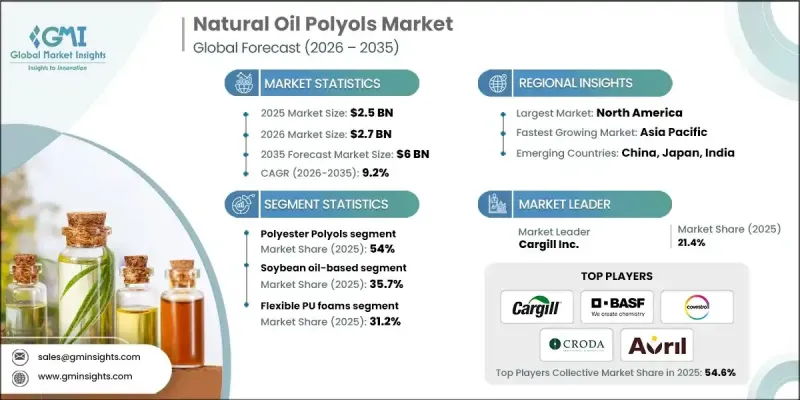
市场成长要素来自日益严格的环境法规、消费者对永续产品日益增长的需求,以及在汽车、建筑、家具和工业等领域不断扩大的应用。製造商正致力于研发生物基配方技术,以提升产品的机械、热学和化学性能,从而在实现高性能应用的同时减少碳排放。在全球环境法规不断演变和消费者对社会责任日益重视的推动下,对环保解决方案的需求不断增长,加速了生物基多元醇的应用。各行业正积极将天然来源的多元醇应用于聚氨酯泡棉、黏合剂、涂料和弹性体的生产,以提高永续性并减少碳足迹。用于高端泡棉、涂料、黏合剂和弹性体应用的生物基多元醇的最新进展,正帮助企业实现产品系列多元化,进军高端产品市场,并推动环保生产和采购流程的创新。
| 市场覆盖范围 | |
|---|---|
| 开始年份 | 2025 |
| 预测年份 | 2026-2035 |
| 起始值 | 25亿美元 |
| 预测金额 | 60亿美元 |
| 复合年增长率 | 9.2% |
预计从 2025 年到 2035 年,聚醚多元醇市场将以 10.3% 的复合年增长率成长。这一增长得益于消费者对永续、高性能材料(尤其是在汽车应用领域)日益增长的兴趣,以及生物基配方技术和可客製化多元醇功能的进步。
预计到 2025 年,柔性聚氨酯泡棉市占率将达到 31.2%,到 2035 年将以 7.1% 的复合年增长率成长。该细分市场受益于泡棉的柔软性、回弹性和环保特性,使其在床垫、靠垫和座椅等应用中广受欢迎。
预计2025年,北美天然油多元醇市场规模将达到8.218亿美元,并在预测期内保持强劲成长。美国和加拿大对永续材料的高接受度推动了对用于聚氨酯泡棉、黏合剂、涂料和密封剂的生物基多元醇的需求。政府支持绿色化学的倡议以及强大的研发生态系统进一步巩固了该地区的市场领先地位,并促进了环保替代品的采用。
目录
第一章调查方法和范围
第二章执行摘要
第三章业界考察
- 生态系分析
- 供应商情况
- 利润率
- 每个阶段的附加价值
- 影响价值链的因素
- 中断
- 产业影响因素
- 司机
- 多个产业对环境永续多元醇的需求不断增长
- 增加柔软性及硬质聚氨酯泡棉。
- 政府奖励促进生物基化学品和产品的推广
- 产业潜在风险与挑战
- 与石油基多元醇相比,生产成本较高
- 稳定、高品质的原料供应有限
- 与合成多元醇相比,其性能存在技术局限性
- 市场机会
- 对油漆、黏合剂、密封剂和弹性体的需求不断增长
- 人们对绿色建筑材料的兴趣日益浓厚,并且广泛应用。
- 扩大全球生物基化学品市场
- 司机
- 成长潜力分析
- 监管环境
- 北美洲
- 欧洲
- 亚太地区
- 拉丁美洲
- 中东和非洲
- 波特分析
- PESTEL 分析
- 价格趋势
- 按地区
- 按类型
- 未来市场趋势
- 科技与创新趋势
- 当前技术趋势
- 新兴技术
- 专利状态
- 贸易统计(HS编码)(註:仅提供主要国家的贸易统计)
- 主要进口国
- 主要出口国
- 永续性和环境方面
- 永续努力
- 减少废弃物策略
- 生产中的能源效率
- 环保倡议
- 考虑到碳足迹
第四章 竞争情势
- 介绍
- 公司市占率分析
- 按地区
- 北美洲
- 欧洲
- 亚太地区
- 拉丁美洲
- 中东和非洲
- 按地区
- 企业矩阵分析
- 主要市场公司的竞争分析
- 竞争定位矩阵
- 重大进展
- 併购
- 伙伴关係与合作
- 新产品发布
- 业务拓展计划
第五章 按类型分類的市场估算与预测,2022-2035年
- 聚酯多元醇
- 聚醚多元醇
6. 2022-2035年按来源分類的市场估计与预测
- 大豆油基
- 蓖麻油基
- 棕榈油基
- 菜籽/菜籽油
- 葵花籽油基底
- 其他的
第七章 按应用领域分類的市场估算与预测,2022-2035年
- 软聚氨酯泡棉
- 硬质聚氨酯泡棉
- 涂层
- 黏合剂
- 密封剂
- 弹性体
- 其他的
第八章 2022-2035年各地区市场估算与预测
- 北美洲
- 我们
- 加拿大
- 欧洲
- 德国
- 英国
- 法国
- 西班牙
- 义大利
- 其他欧洲地区
- 亚太地区
- 中国
- 印度
- 日本
- 澳洲
- 韩国
- 亚太其他地区
- 拉丁美洲
- 巴西
- 墨西哥
- 阿根廷
- 其他拉丁美洲地区
- 中东和非洲
- 沙乌地阿拉伯
- 南非
- 阿拉伯聯合大公国
- 其他中东和非洲地区
第九章:公司简介
- BASF SE
- Biobased Technologies LLC
- Cargill, Incorporated
- Covestro AG
- Croda International Plc
- Econic Technologies
- Emery Oleochemicals
- Global Bio-chem Technology Group
- Oleon Novance(arvil)
- The Dow Chemical Company
The Global Natural Oil Polyols Market was valued at USD 2.5 billion in 2025 and is estimated to grow at a CAGR of 9.2% to reach USD 6 billion by 2035.
The market is driven by stricter environmental regulations, rising consumer demand for sustainable products, and increasing use across automotive, construction, furniture, and industrial sectors. Manufacturers are focusing on bio-based formulations that improve mechanical, thermal, and chemical performance, enabling high-performance applications while reducing carbon emissions. The growing demand for eco-friendly solutions has accelerated the adoption of bio-polyols, fueled by global environmental legislation and consumer preference for socially responsible products. Industries are increasingly incorporating natural polyols in the production of polyurethane foams, adhesives, coatings, and elastomers to enhance sustainability and reduce their carbon footprint. Recent developments include bio-based polyols for premium foam, coating, adhesive, and elastomer applications, allowing companies to diversify portfolios, enter high-end product markets, and drive innovation in eco-conscious production and procurement processes.
| Market Scope | |
|---|---|
| Start Year | 2025 |
| Forecast Year | 2026-2035 |
| Start Value | $2.5 Billion |
| Forecast Value | $6 Billion |
| CAGR | 9.2% |
The polyether polyols segment is forecasted to grow at a CAGR of 10.3% between 2025 and 2035. Growth is supported by increasing consumer focus on sustainable, high-performance materials, especially in automotive applications, along with advances in bio-based formulation technologies and customizable polyol functionality.
The flexible polyurethane foams segment held a 31.2% share in 2025 and is expected to grow at a CAGR of 7.1% by 2035. The segment benefits from the foam's softness, resilience, and eco-friendly properties, making it popular in applications like mattresses, cushions, and seating.
North America Natural Oil Polyols Market reached USD 821.8 million in 2025 and is expected to show robust growth during the forecast period. The high adoption of sustainable materials in the U.S. and Canada drives demand for bio-based polyols used in PU foams, adhesives, coatings, and sealants. Government initiatives supporting green chemistry and strong R&D ecosystems further strengthen the region's market leadership and adoption of eco-friendly alternatives.
Major players operating in the Global Natural Oil Polyols Market include BASF SE, Biobased Technologies LLC, Cargill, Incorporated, Covestro AG, Croda International Plc, Econic Technologies, Emery Oleochemicals, Global Bio-chem Technology Group, Oleon Novance (Arvil), and The Dow Chemical Company. Companies in the Natural Oil Polyols Market are employing strategies to expand their market presence by focusing on R&D for high-performance, bio-based polyols and diversifying their product portfolios for premium applications. Collaborations with automotive, construction, and industrial manufacturers are boosting adoption across sectors. Firms are investing in sustainable production processes to reduce carbon footprints and improve eco-certifications, enhancing brand reputation. Regional expansion into North America, Europe, and Asia Pacific, combined with strategic acquisitions, strengthens market foothold.
Table of Contents
Chapter 1 Methodology & Scope
- 1.1 Market scope and definition
- 1.2 Research design
- 1.2.1 Research approach
- 1.2.2 Data collection methods
- 1.3 Data mining sources
- 1.3.1 Global
- 1.3.2 Regional/Country
- 1.4 Base estimates and calculations
- 1.4.1 Base year calculation
- 1.4.2 Key trends for market estimation
- 1.5 Primary research and validation
- 1.5.1 Primary sources
- 1.6 Forecast model
- 1.7 Research assumptions and limitations
Chapter 2 Executive Summary
- 2.1 Industry 3600 synopsis
- 2.2 Key market trends
- 2.2.1 Regional
- 2.2.2 Type
- 2.2.3 Source
- 2.2.4 Application
- 2.3 TAM Analysis, 2025-2034
- 2.4 CXO perspectives: Strategic imperatives
- 2.4.1 Executive decision points
- 2.4.2 Critical success factors
- 2.5 Future Outlook and Strategic Recommendations
Chapter 3 Industry Insights
- 3.1 Industry ecosystem analysis
- 3.1.1 Supplier landscape
- 3.1.2 Profit margin
- 3.1.3 Value addition at each stage
- 3.1.4 Factor affecting the value chain
- 3.1.5 Disruptions
- 3.2 Industry impact forces
- 3.2.1 Growth drivers
- 3.2.1.1 Rising demand for eco-friendly and sustainable polyols across multiple industries
- 3.2.1.2 Increasing usage of polyols in flexible and rigid polyurethane foams
- 3.2.1.3 Government incentives promoting bio-based chemicals and products
- 3.2.2 Industry pitfalls and challenges
- 3.2.2.1 High production costs compared to petroleum-based polyols
- 3.2.2.2 Limited availability of consistent, high-quality feedstocks
- 3.2.2.3 Technical limitations in performance compared to synthetic polyols
- 3.2.3 Market opportunities
- 3.2.3.1 Growing demand in coatings, adhesives, sealants, and elastomers
- 3.2.3.2 Increasing awareness and adoption of green building materials
- 3.2.3.3 Expansion of global bio-based chemical market
- 3.2.1 Growth drivers
- 3.3 Growth potential analysis
- 3.4 Regulatory landscape
- 3.4.1 North America
- 3.4.2 Europe
- 3.4.3 Asia Pacific
- 3.4.4 Latin America
- 3.4.5 Middle East & Africa
- 3.5 Porter';s analysis
- 3.6 PESTEL analysis
- 3.7 Price trends
- 3.7.1 By region
- 3.7.2 By type
- 3.8 Future market trends
- 3.9 Technology and Innovation landscape
- 3.9.1 Current technological trends
- 3.9.2 Emerging technologies
- 3.10 Patent Landscape
- 3.11 Trade statistics (HS code) ( Note: the trade statistics will be provided for key countries only)
- 3.11.1 Major importing countries
- 3.11.2 Major exporting countries
- 3.12 Sustainability and environmental aspects
- 3.12.1 Sustainable practices
- 3.12.2 Waste reduction strategies
- 3.12.3 Energy efficiency in production
- 3.12.4 Eco-friendly initiatives
- 3.13 Carbon footprint consideration
Chapter 4 Competitive Landscape, 2025
- 4.1 Introduction
- 4.2 Company market share analysis
- 4.2.1 By region
- 4.2.1.1 North America
- 4.2.1.2 Europe
- 4.2.1.3 Asia Pacific
- 4.2.1.4 LATAM
- 4.2.1.5 MEA
- 4.2.1 By region
- 4.3 Company matrix analysis
- 4.4 Competitive analysis of major market players
- 4.5 Competitive positioning matrix
- 4.6 Key developments
- 4.6.1 Mergers & acquisitions
- 4.6.2 Partnerships & collaborations
- 4.6.3 New Product Launches
- 4.6.4 Expansion Plans
Chapter 5 Market Estimates and Forecast, By Type, 2022-2035 (USD billion) (Kilo Tons)
- 5.1 Key trends
- 5.2 Polyester Polyols
- 5.3 Polyether Polyols
Chapter 6 Market Estimates and Forecast, By Source, 2022-2035 (USD billion) (Kilo Tons)
- 6.1 Key trends
- 6.2 Soybean Oil-Based
- 6.3 Castor Oil-Based
- 6.4 Palm Oil-Based
- 6.5 Canola/Rapeseed Oil-Based
- 6.6 Sunflower Oil-Based
- 6.7 Others
Chapter 7 Market Estimates and Forecast, By Application, 2022-2035 (USD billion) (Kilo Tons)
- 7.1 Key trends
- 7.2 Flexible PU Foams
- 7.3 Rigid PU Foams
- 7.4 Coatings
- 7.5 Adhesives
- 7.6 Sealants
- 7.7 Elastomers
- 7.8 Others
Chapter 8 Market Estimates and Forecast, By Region, 2022-2035 (USD billion) (Kilo Tons)
- 8.1 Key trends
- 8.2 North America
- 8.2.1 U.S.
- 8.2.2 Canada
- 8.3 Europe
- 8.3.1 Germany
- 8.3.2 UK
- 8.3.3 France
- 8.3.4 Spain
- 8.3.5 Italy
- 8.3.6 Rest of Europe
- 8.4 Asia Pacific
- 8.4.1 China
- 8.4.2 India
- 8.4.3 Japan
- 8.4.4 Australia
- 8.4.5 South Korea
- 8.4.6 Rest of Asia Pacific
- 8.5 Latin America
- 8.5.1 Brazil
- 8.5.2 Mexico
- 8.5.3 Argentina
- 8.5.4 Rest of Latin America
- 8.6 Middle East and Africa
- 8.6.1 Saudi Arabia
- 8.6.2 South Africa
- 8.6.3 UAE
- 8.6.4 Rest of Middle East and Africa
Chapter 9 Company Profiles
- 9.1 BASF SE
- 9.2 Biobased Technologies LLC
- 9.3 Cargill, Incorporated
- 9.4 Covestro AG
- 9.5 Croda International Plc
- 9.6 Econic Technologies
- 9.7 Emery Oleochemicals
- 9.8 Global Bio-chem Technology Group
- 9.9 Oleon Novance (arvil)
- 9.10 The Dow Chemical Company

 天然油脂多元醇(NOP)全球市场规模、份额、趋势和成长分析报告(2026-2034)
 天然油多元醇市场:按技术、原料、产品类型、应用和最终用途产业划分-2025-2032年全球预测
 2025年全球天然油多元醇市场报告