


 |
市场调查报告书
商品编码
1928938
铅酸蓄电池市场机会、成长要素、产业趋势分析及2026年至2035年预测Lead Acid Battery Market Opportunity, Growth Drivers, Industry Trend Analysis, and Forecast 2026 - 2035 |
||||||

全球铅酸蓄电池市场预计到 2025 年将达到 1,021 亿美元,到 2035 年将达到 1,406 亿美元,年复合成长率为 3.2%。
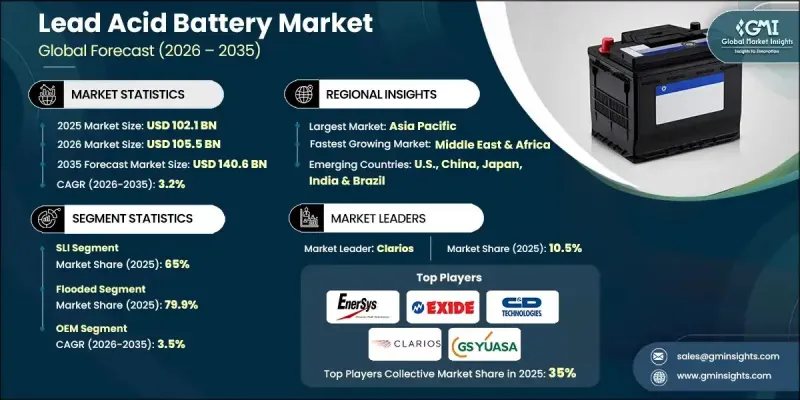
富液式和吸附式玻璃纤维隔板(AGM)电池技术的持续创新正在提升其在怠速熄火系统等辅助应用和其他功能性应用中的性能,从而扩大了整体市场潜力。电极设计和材料的进步,包括钙合金栅格和碳添加剂的应用,透过提高导电性、放电效率和循环寿命,进一步加速了市场成长。铅酸电池凭藉其可靠性、成本效益和可再生,仍然是储能领域的基础技术。儘管面临锂离子电池等替代技术的竞争,铅酸电池在需要可靠电源、高突波电流和久经考验的耐久性的应用中仍然占据主导地位。与再生能源系统的集成,使得在发电量低谷期能够储存剩余能源或电力,从而为商业和工业应用,特别是偏远和离网地区,提供经济、高效且可靠的储能解决方案,开闢了新的机会。
| 市场覆盖范围 | |
|---|---|
| 开始年份 | 2025 |
| 预测年份 | 2026-2035 |
| 起始值 | 1021亿美元 |
| 预测金额 | 1406亿美元 |
| 复合年增长率 | 3.2% |
预计2035年,固定式铅酸蓄电池市场规模将达220亿美元。这些蓄电池为电信、公共产业、资料中心和工业设施提供备用电源。其应用推广主要受关键基础设施应用中对电力系统可靠性、长寿命、成本效益和可回收性的需求所驱动。
预计到2025年,VRLA电池市场规模将达到205亿美元,其中包括免维护的密封式AGM电池和胶体电池。 VRLA电池广泛应用于电信、UPS系统、可再生能源装置和工业领域,具有供电稳定、寿命长、安全性高等优点,是关键应用和狭小空间应用的理想选择。
预计到2025年,美国铅酸蓄电池市场将占据85%的市场份额,市场规模将达到119亿美元。强劲的替换需求、基础设施建设的成长以及备用电源需求,共同维持了市场的稳定。 AGM电池和改良型电解铅酸蓄电池技术的进步,提高了电池的可靠性和性能;而完善的回收网络和实惠的价格,则进一步巩固了市场对铅酸蓄电池的持续青睐。
目录
第一章调查方法和范围
第二章执行摘要
第三章业界考察
- 生态系分析
- 原物料供应及采购分析
- 製造能力评估
- 供应链韧性与风险因素
- 配电网路分析
- 监管环境
- 产业影响因素
- 司机
- 产业潜在风险与挑战
- 成长潜力分析
- 波特分析
- 供应商的议价能力
- 买方的议价能力
- 新进入者的威胁
- 替代品的威胁
- PESTEL 分析
- 铅酸电池成本结构分析
- 价格趋势分析(美元/单位)
- 按地区
- 透过使用
- 新的机会与趋势
- 投资分析及未来展望
- 数位转型与产业4.0融合
- 可持续发展倡议与合规性
第四章 竞争情势
- 介绍
- 按地区分類的公司市占率分析
- 北美洲
- 欧洲
- 亚太地区
- 中东和非洲
- 拉丁美洲
- 战略仪錶板
- 策略倡议
- 重要伙伴关係与合作
- 重大併购活动
- 产品创新与新产品发布
- 市场扩大策略
- 竞争标竿分析
- 创新与永续性格局
第五章 依应用领域分類的市场规模及预测(2022-2035年)
- 固定式
- 电讯
- UPS
- 控制和开关设备
- 其他的
- 电力
- SLI
- 车
- 摩托车
第六章 依结构分類的市场规模及预测(2022-2035年)
- 开放型
- VRLA
- AGM
- 凝胶电池
第七章 依销售管道分類的市场规模及预测,2022-2035年
- OEM
- 售后市场
第八章 2022-2035年各地区市场规模及预测
- 北美洲
- 我们
- 加拿大
- 欧洲
- 德国
- 英国
- 法国
- 俄罗斯
- 义大利
- 西班牙
- 奥地利
- 荷兰
- 瑞典
- 亚太地区
- 中国
- 日本
- 印度
- 韩国
- 澳洲
- 印尼
- 马来西亚
- 泰国
- 菲律宾
- 越南
- 新加坡
- 中东和非洲
- 沙乌地阿拉伯
- 阿拉伯聯合大公国
- 伊朗
- 埃及
- 土耳其
- 摩洛哥
- 南非
- 奈及利亚
- 阿尔及利亚
- 拉丁美洲
- 巴西
- 阿根廷
- 墨西哥
- 智利
第九章:公司简介
- Amara Raja Energy &Mobility Limited
- Banner
- Camel Group Co.
- C&D Technologies
- Chaowei Power Holdings
- Clarios
- Crown Equipment Corporation
- CSB Battery
- Concorde Battery Corporation
- East Penn Manufacturing Company
- EnerSys
- EnergoAlliance
- Exide Industries
- First Battery
- Focus Technology Co., Ltd.
- GS Yuasa International
- HOPPECKE Battery
- Leoch International Technology
- MUTLU
- Narada
- Power-Sonic
- The Furukawa Battery Co., Ltd.
- Yokohama Batteries
- Zibo Torch Energy
The Global Lead Acid Battery Market was valued at USD 102.1 billion in 2025 and is estimated to grow at a CAGR of 3.2% to reach USD 140.6 billion by 2035.
Ongoing innovations in flooded batteries and absorbent glass mat (AGM) batteries are enhancing performance for auxiliary applications such as start-stop systems and other functional requirements, improving overall market potential. Advancements in electrode design and materials, including calcium alloy grids and carbon additives, are boosting conductivity, discharge efficiency, and cycle life, further accelerating growth. Lead-acid batteries remain a cornerstone of energy storage due to their reliability, cost-effectiveness, and recyclability. Despite competition from lithium-ion alternatives, these batteries dominate applications requiring dependable power, high surge currents, and proven durability. Their integration with renewable energy systems for storing excess power and supplying energy during low-production periods is expanding opportunities, particularly in remote and off-grid regions, by offering affordable, efficient, and resilient energy storage solutions for both commercial and industrial uses.
| Market Scope | |
|---|---|
| Start Year | 2025 |
| Forecast Year | 2026-2035 |
| Start Value | $102.1 Billion |
| Forecast Value | $140.6 Billion |
| CAGR | 3.2% |
The stationary lead-acid battery segment is expected to reach USD 22 billion by 2035. These batteries provide backup and standby power across telecom, utilities, data centers, and industrial facilities. Their adoption is driven by the need for grid reliability, long operational life, cost-effectiveness, and recyclability in critical infrastructure applications.
The VRLA batteries segment was valued at USD 20.5 billion in 2025, including sealed AGM and gel types that offer maintenance-free operation. They are widely deployed in telecom, UPS systems, renewable energy installations, and industrial sectors, delivering consistent, long-lasting power with high safety, making them ideal for critical or confined-space use.
U.S. Lead Acid Battery Market held 85% share, generating USD 11.9 billion in 2025. Strong replacement demand, infrastructure growth, and backup power requirements have maintained market stability. Advances in AGM and enhanced flooded battery technologies improve reliability and performance, while well-established recycling networks and affordability reinforce the continued preference for lead-acid energy solutions.
Major players operating in the Global Lead Acid Battery Market include Amara Raja Energy & Mobility, Banner, Camel Group, C&D Technologies, Chaowei Power Holdings, Clarios, Crown Equipment Corporation, CSB Battery, Concorde Battery Corporation, East Penn Manufacturing Company, EnerSys, EnergoAlliance, Exide Industries, First Battery, Focus Technology, GS Yuasa International, HOPPECKE Battery, Leoch International Technology, MUTLU, Narada, Power-Sonic, The Furukawa Battery, Yokohama Batteries, and Zibo Torch Energy. Companies in the Lead Acid Battery Market are focusing on technological innovation to improve cycle life, energy density, and efficiency of flooded, AGM, and gel batteries. Firms are forming strategic partnerships with OEMs, renewable energy providers, and telecom operators to expand adoption. Investments in advanced electrode materials, carbon additives, and maintenance-free technologies enhance product differentiation. Regional expansion, particularly in emerging markets, coupled with strengthening recycling networks, supports sustainable growth.
Table of Contents
Chapter 1 Methodology & Scope
- 1.1 Research approach
- 1.2 Quality commitments
- 1.2.1 GMI AI policy & data integrity commitment
- 1.2.1.1 Source consistency protocol
- 1.2.1 GMI AI policy & data integrity commitment
- 1.3 Research trail & confidence scoring
- 1.3.1 Research trail components
- 1.3.2 Scoring components
- 1.4 Data collection
- 1.4.1 Partial list of primary sources
- 1.5 Data mining sources
- 1.5.1 Paid sources
- 1.5.1.1 Sources, by region
- 1.5.1 Paid sources
- 1.6 Base estimates and calculations
- 1.6.1 Base year calculation for any one approach
- 1.7 Market estimates & forecasts parameters
- 1.8 Forecast model
- 1.8.1 Quantified market impact analysis
- 1.8.1.1 Mathematical impact of growth parameters on forecast
- 1.8.1 Quantified market impact analysis
- 1.9 Research transparency addendum
- 1.9.1 Source attribution framework
- 1.9.2 Quality assurance metrics
- 1.9.3 Our commitment to trust
- 1.10 Market definitions
Chapter 2 Executive Summary
- 2.1 Industry synopsis, 2022 - 2035
- 2.1.1 Business trends
- 2.1.2 Application trends
- 2.1.3 Construction trends
- 2.1.4 Sales channel trends
- 2.1.5 Regional trends
Chapter 3 Industry Insights
- 3.1 Industry ecosystem analysis
- 3.1.1 Raw material availability & sourcing analysis
- 3.1.2 Manufacturing capacity assessment
- 3.1.3 Supply chain resilience & risk factors
- 3.1.4 Distribution network analysis
- 3.2 Regulatory landscape
- 3.3 Industry impact forces
- 3.3.1 Growth drivers
- 3.3.2 Industry pitfalls & challenges
- 3.4 Growth potential analysis
- 3.5 Porter';s analysis
- 3.5.1 Bargaining power of suppliers
- 3.5.2 Bargaining power of buyers
- 3.5.3 Threat of new entrants
- 3.5.4 Threat of substitutes
- 3.6 PESTEL analysis
- 3.6.1 Political factors
- 3.6.2 Economic factors
- 3.6.3 Social factors
- 3.6.4 Technological factors
- 3.6.5 Legal factors
- 3.6.6 Environmental factors
- 3.7 Cost structure analysis of lead acid battery
- 3.8 Price trend analysis (USD/Unit)
- 3.8.1 By region
- 3.8.2 By application
- 3.9 Emerging opportunities & trends
- 3.10 Investment analysis & future prospects
- 3.11 Digital transformation & industry 4.0 integration
- 3.12 Sustainability initiatives & compliances
Chapter 4 Competitive Landscape, 2026
- 4.1 Introduction
- 4.2 Company market share analysis, by region, 2025
- 4.2.1 North America
- 4.2.2 Europe
- 4.2.3 Asia Pacific
- 4.2.4 Middle East & Africa
- 4.2.5 Latin America
- 4.3 Strategic dashboard
- 4.4 Strategic initiatives
- 4.4.1 Key partnerships & collaborations
- 4.4.2 Major M&A activities
- 4.4.3 Product innovations & launches
- 4.4.4 Market expansion strategies
- 4.5 Competitive benchmarking
- 4.6 Innovation & sustainability landscape
Chapter 5 Market Size and Forecast, By Application, 2022 - 2035 (USD Million & Million Units)
- 5.1 Key trends
- 5.2 Stationary
- 5.2.1 Telecommunications
- 5.2.2 UPS
- 5.2.3 Control & switchgear
- 5.2.4 Others
- 5.3 Motive
- 5.4 SLI
- 5.4.1 Automobiles
- 5.4.2 Motorcycles
Chapter 6 Market Size and Forecast, By Construction, 2022 - 2035 (USD Million & Million Units)
- 6.1 Key trends
- 6.2 Flooded
- 6.3 VRLA
- 6.3.1 AGM
- 6.3.2 GEL
Chapter 7 Market Size and Forecast, By Sales Channel, 2022 - 2035 (USD Million & Million Units)
- 7.1 Key trends
- 7.2 OEM
- 7.3 Aftermarket
Chapter 8 Market Size and Forecast, By Region, 2022 - 2035 (USD Million & Million Units)
- 8.1 Key trends
- 8.2 North America
- 8.2.1 U.S.
- 8.2.2 Canada
- 8.3 Europe
- 8.3.1 Germany
- 8.3.2 UK
- 8.3.3 France
- 8.3.4 Russia
- 8.3.5 Italy
- 8.3.6 Spain
- 8.3.7 Austria
- 8.3.8 Netherlands
- 8.3.9 Sweden
- 8.4 Asia Pacific
- 8.4.1 China
- 8.4.2 Japan
- 8.4.3 India
- 8.4.4 South Korea
- 8.4.5 Australia
- 8.4.6 Indonesia
- 8.4.7 Malaysia
- 8.4.8 Thailand
- 8.4.9 Philippines
- 8.4.10 Vietnam
- 8.4.11 Singapore
- 8.5 Middle East & Africa
- 8.5.1 Saudi Arabia
- 8.5.2 UAE
- 8.5.3 Iran
- 8.5.4 Egypt
- 8.5.5 Turkey
- 8.5.6 Morocco
- 8.5.7 South Africa
- 8.5.8 Nigeria
- 8.5.9 Algeria
- 8.6 Latin America
- 8.6.1 Brazil
- 8.6.2 Argentina
- 8.6.3 Mexico
- 8.6.4 Chile
Chapter 9 Company Profiles
- 9.1 Amara Raja Energy & Mobility Limited
- 9.2 Banner
- 9.3 Camel Group Co.
- 9.4 C&D Technologies
- 9.5 Chaowei Power Holdings
- 9.6 Clarios
- 9.7 Crown Equipment Corporation
- 9.8 CSB Battery
- 9.9 Concorde Battery Corporation
- 9.10 East Penn Manufacturing Company
- 9.11 EnerSys
- 9.12 EnergoAlliance
- 9.13 Exide Industries
- 9.14 First Battery
- 9.15 Focus Technology Co., Ltd.
- 9.16 GS Yuasa International
- 9.17 HOPPECKE Battery
- 9.18 Leoch International Technology
- 9.19 MUTLU
- 9.20 Narada
- 9.21 Power-Sonic
- 9.22 The Furukawa Battery Co., Ltd.
- 9.23 Yokohama Batteries
- 9.24 Zibo Torch Energy

 2026-2034年全球铅酸蓄电池市场规模、份额、趋势及成长分析报告
 铅酸蓄电池市场报告:按产品、製造方法、销售管道、应用和地区划分(2026-2034年)
 2026年全球固定式铅酸蓄电池市场报告2026年全球摩托车铅酸蓄电池市场报告2026年全球铅酸蓄电池市场报告
 全球固定式铅酸蓄电池市场-按技术、应用、地区和竞争格局分類的产业规模、份额、趋势、机会和预测(2021-2031年)工业用铅酸蓄电池市场 - 全球产业规模、份额、趋势、机会及预测(依产品、结构方法、销售管道、地区及竞争格局划分,2021-2031)铅酸蓄电池市场-全球产业规模、份额、趋势、机会及预测(依产品、结构方法、销售管道、应用、区域及竞争格局划分,2021-2031年)
 2026-2030年全球炭黑铅酸蓄电池市场全球铅酸蓄电池市场:市场规模、占有率、成长率、产业分析、依类型、应用和地区划分的考量、未来预测(2026-2034)