


 |
市场调查报告书
商品编码
1928949
工业灭菌设备市场机会、成长要素、产业趋势分析及2026年至2035年预测Industrial Pasteurizers Market Opportunity, Growth Drivers, Industry Trend Analysis, and Forecast 2026 - 2035 |
||||||

全球工业灭菌设备市场预计到 2025 年将达到 46 亿美元,到 2035 年将达到 79 亿美元,年复合成长率为 5.6%。
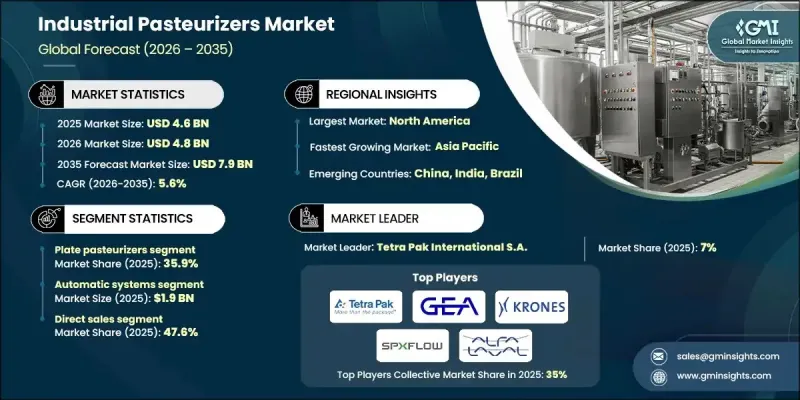
市场扩张得益于人们对食品安全、营运效率和永续加工方法的日益重视。主要製造商之间不断加剧的整合活动也影响着竞争格局,併购活动增强了创新能力并拓展了产品线。同时,传统的手工热处理工艺日益被认为效率低且对环境有害。现代热处理解决方案越来越受欢迎,因为先进的热回收和再生系统能够最大限度地减少能源消耗并降低对环境的影响。这些技术与流质食品生产产业普遍采用的永续性目标高度契合。北美对自动化液体处理和无菌填充设备的需求持续成长,而欧洲和亚太部分地区对食品饮料基础设施的投资增加,也提高了工业灭菌设备在当地市场的商业性可行性。
| 市场覆盖范围 | |
|---|---|
| 开始年份 | 2025 |
| 预测年份 | 2026-2035 |
| 起始值 | 46亿美元 |
| 预测金额 | 79亿美元 |
| 复合年增长率 | 5.6% |
到 2025 年,板式灭菌器市占率将达到 35.9%。由于这些系统能够在保持高效传热和降低能耗的同时处理大量物料,因此它们将继续广泛应用,尤其是在流质食品生产环境中。
预计到2025年,自动化灭菌系统细分市场将占据42.3%的市场份额,并创造19亿美元的收入。自动化正日益普及,因为它能够提高生产效率、改善营运安全性并降低对劳动力的依赖。先进的控制技术提高了系统的精度和可靠性,有助于企业在受监管行业中满足严格的品质和安全标准。
受自动化食品加工领域强劲投资和高端饮料生产扩张的推动,美国工业巴氏杀菌机市场预计到2035年将维持5.8%的复合年增长率。巴氏杀菌机在大规模乳製品分销网路中发挥关键作用,而自动化、高速加工解决方案在这些网路中的应用正日益普及。
目录
第一章调查方法和范围
第二章执行摘要
第三章业界考察
- 生态系分析
- 供应商情况
- 利润率
- 每个阶段的附加价值
- 影响价值链的因素
- 产业影响因素
- 司机
- 洁净标示和机能饮料的激增
- 严格的食品安全标准和《食品安全现代化法案》(FSMA)法规
- 永续性和热效率
- 产业潜在风险与挑战
- 初始投资额高,投资回收期长
- 现有设施维修的复杂性
- 机会
- 数位双胞胎和即时监测
- 混合式和模组化灭菌器
- 司机
- 成长潜力分析
- 未来市场趋势
- 科技与创新趋势
- 当前技术趋势
- 新兴技术
- 价格趋势
- 按地区
- 按类型
- 监管环境
- 标准和合规要求
- 区域法规结构
- 认证标准
- 波特分析
- PESTEL 分析
第四章 竞争情势
- 介绍
- 公司市占率分析
- 按地区
- 企业矩阵分析
- 主要市场公司的竞争分析
- 竞争定位矩阵
- 重大进展
- 併购
- 伙伴关係与合作
- 新产品发布
- 扩张计划
第五章 依产品类型分類的市场估算与预测,2022-2035年
- 板式灭菌器
- 隧道式灭菌器
- 大量灭菌器
- 高温短时 (HTST) 系统
- 其他的
6. 2022-2035年按营运方式分類的市场估计与预测
- 手动的
- 半自动
- 自动的
第七章 按技术分類的市场估计与预测,2022-2035年
- 电动消毒器
- 瓦斯消毒器
- 蒸气消毒器
第八章 依产能分類的市场估计与预测,2022-2035年
- 少于1000公升
- 1000至5000公升
- 超过5000公升
第九章 按应用领域分類的市场估算与预测,2022-2035年
- 乳製品业
- 牛奶和奶油
- 乳酪生产
- 酸奶生产
- 冰淇淋加工
- 饮料业
- 酒精饮料
- 不含酒精的饮料
- 食品加工
- 其他(药品、宠物食品等)
第十章 按分销管道分類的市场估算与预测,2022-2035年
- 直接地
- 间接
第十一章 2022-2035年各地区市场估计与预测
- 北美洲
- 我们
- 加拿大
- 欧洲
- 德国
- 英国
- 法国
- 义大利
- 西班牙
- 亚太地区
- 中国
- 日本
- 印度
- 澳洲
- 韩国
- 拉丁美洲
- 巴西
- 墨西哥
- 阿根廷
- 中东和非洲
- 南非
- 沙乌地阿拉伯
- 阿拉伯聯合大公国
第十二章:公司简介
- Alfa Laval AB
- Dion Engineering
- Feldmeier Equipment, Inc.
- GEA Group AG
- Hiperbaric
- HRS Heat Exchangers
- IDMC Limited
- JBT Corporation
- KHS Group
- Krones AG
- Milkron GmbH
- Paul Mueller Company
- Sidel
- SPX FLOW, Inc.
- Tetra Pak International SA
The Global Industrial Pasteurizers Market was valued at USD 4.6 billion in 2025 and is estimated to grow at a CAGR of 5.6% to reach USD 7.9 billion by 2035.
Market expansion is supported by rising awareness around food safety, operational efficiency, and sustainable processing practices. Growing consolidation activity among leading manufacturers is also influencing the competitive landscape, as mergers and acquisitions are strengthening innovation capabilities and expanding product offerings. At the same time, traditional manual heat treatment processes are increasingly viewed as inefficient and environmentally burdensome. Modern thermal processing solutions are gaining preference due to their ability to minimize energy usage and reduce environmental impact through advanced heat recovery and regenerative systems. These technologies align closely with the sustainability goals adopted across the liquid food production industry. Demand for automated liquid processing and aseptic filling facilities continues to rise in North America, while increasing investments in food and beverage infrastructure across Europe and parts of the Asia Pacific region are improving the commercial viability of industrial pasteurization equipment in local markets.
| Market Scope | |
|---|---|
| Start Year | 2025 |
| Forecast Year | 2026-2035 |
| Start Value | $4.6 Billion |
| Forecast Value | $7.9 Billion |
| CAGR | 5.6% |
The plate-based pasteurizers segment held 35.9% share in 2025. These systems remain widely adopted due to their ability to handle large processing volumes while maintaining efficient heat transfer and reduced energy consumption, particularly in liquid food production environments.
The automatic pasteurization systems segment accounted for 42.3% share in 2025 and generated USD 1.9 billion. Automation is increasingly favored as it enhances throughput, improves operational safety, and lowers labor dependency. Advanced control technologies are improving system accuracy and reliability, supporting compliance with strict quality and safety standards across regulated industries.
U.S. Industrial Pasteurizers Market held 5.8% CAGR through 2035, supported by strong investments in automated food processing and the expansion of premium beverage production. Pasteurization equipment plays a critical role in large-scale dairy distribution networks, where automated high-speed processing solutions are seeing increased adoption.
Leading companies active in the Global Industrial Pasteurizers Market include Tetra Pak International S.A., GEA Group AG, Alfa Laval AB, SPX FLOW, Inc., Krones AG, Sidel, JBT Corporation, KHS Group, Paul Mueller Company, Feldmeier Equipment, Inc., Milkron GmbH, HRS Heat Exchangers, IDMC Limited, Dion Engineering, and Hiperbaric. Companies operating in the Industrial Pasteurizers Market are reinforcing their market positions through technology upgrades, strategic partnerships, and portfolio diversification. Manufacturers are investing in energy-efficient designs and automation-ready systems to meet evolving customer requirements. Expansion into emerging markets and localized manufacturing strategies are helping improve market reach and cost competitiveness. Continuous investment in research and development is enabling companies to enhance system performance, reliability, and compliance with food safety standards.
Table of Contents
Chapter 1 Methodology and Scope
- 1.1 Market scope and definition
- 1.2 Research design
- 1.2.1 Research approach
- 1.2.2 Data collection methods
- 1.3 Data mining sources
- 1.3.1 Global
- 1.3.2 Regional/Country
- 1.4 Base estimates and calculations
- 1.4.1 Base year calculation
- 1.4.2 Key trends for market estimation
- 1.5 Primary research and validation
- 1.5.1 Primary sources
- 1.6 Forecast model
- 1.7 Research assumptions and limitations
Chapter 2 Executive Summary
- 2.1 Industry 3600 synopsis
- 2.2 Key market trends
- 2.2.1 Regional
- 2.2.2 Product type
- 2.2.3 Operation
- 2.2.4 Technology
- 2.2.5 Capacity
- 2.2.6 Application
- 2.2.7 Distribution channel
- 2.3 CXO perspectives: Strategic imperatives
- 2.3.1 Key decision points for industry executives
- 2.3.2 Critical success factors for market players
- 2.4 Future outlook and strategic recommendations
Chapter 3 Industry Insights
- 3.1 Industry ecosystem analysis
- 3.1.1 Supplier landscape
- 3.1.2 Profit margin
- 3.1.3 Value addition at each stage
- 3.1.4 Factor affecting the value chain
- 3.2 Industry impact forces
- 3.2.1 Growth drivers
- 3.2.1.1 Surge in clean-label and functional beverages
- 3.2.1.2 Strict food safety and FSMA regulations
- 3.2.1.3 Sustainability and thermal efficiency
- 3.2.2 Industry pitfalls & challenges
- 3.2.2.1 High initial CAPEX & long ROI
- 3.2.2.2 Complexity of retrofitting legacy sites
- 3.2.3 Opportunities
- 3.2.3.1 Digital twins and real-time monitoring
- 3.2.3.2 Hybrid and modular pasteurization units
- 3.2.1 Growth drivers
- 3.3 Growth potential analysis
- 3.4 Future market trends
- 3.5 Technology and innovation landscape
- 3.5.1 Current technological trends
- 3.5.2 Emerging technologies
- 3.6 Price trends
- 3.6.1 By region
- 3.6.2 By type
- 3.7 Regulatory landscape
- 3.7.1 Standards and compliance requirements
- 3.7.2 Regional regulatory frameworks
- 3.7.3 Certification standards
- 3.8 Porter';s analysis
- 3.9 PESTEL analysis
Chapter 4 Competitive Landscape, 2025
- 4.1 Introduction
- 4.2 Company market share analysis
- 4.2.1 By region
- 4.2.1.1 North America
- 4.2.1.2 Europe
- 4.2.1.3 Asia Pacific
- 4.2.1.4 Latin America
- 4.2.1.5 Middle East and Africa
- 4.2.1 By region
- 4.3 Company matrix analysis
- 4.4 Competitive analysis of major market players
- 4.5 Competitive positioning matrix
- 4.6 Key developments
- 4.6.1 Mergers & acquisitions
- 4.6.2 Partnerships & collaborations
- 4.6.3 New product launches
- 4.6.4 Expansion plans
Chapter 5 Market Estimates and Forecast, By Product Type, 2022 - 2035 (USD Billion) (Thousand Units)
- 5.1 Key trends
- 5.2 Plate pasteurizers
- 5.3 Tunnel pasteurizers
- 5.4 Batch pasteurizers
- 5.5 HTST (high temperature short time) systems
- 5.6 Others
Chapter 6 Market Estimates and Forecast, By Operation, 2022 - 2035 (USD Billion) (Thousand Units)
- 6.1 Key trends
- 6.2 Manual
- 6.3 Semi-automatic
- 6.4 Automatic
Chapter 7 Market Estimates and Forecast, By Technology, 2022 - 2035 (USD Billion) (Thousand Units)
- 7.1 Key trends
- 7.2 Electric pasteurizers
- 7.3 Gas pasteurizers
- 7.4 Steam pasteurizers
Chapter 8 Market Estimates and Forecast, By Capacity, 2022 - 2035 (USD Billion) (Thousand Units)
- 8.1 Key trends
- 8.2 Below 1000 litres
- 8.3 Between 1000-5000 litres
- 8.4 Above 5000 litres
Chapter 9 Market Estimates and Forecast, By Application, 2022 - 2035 (USD Billion) (Thousand Units)
- 9.1 Key trends
- 9.2 Dairy industry
- 9.2.1 Milk and cream
- 9.2.2 Cheese production
- 9.2.3 Yogurt manufacturing
- 9.2.4 Ice cream processing
- 9.3 Beverage industry
- 9.3.1 Alcoholic beverage
- 9.3.2 Non-Alcoholic beverage
- 9.4 Food processing
- 9.5 Others (pharmaceuticals, pet food, etc.)
Chapter 10 Market Estimates and Forecast, By Distribution Channel, 2022 - 2035 (USD Billion) (Thousand Units)
- 10.1 Key trends
- 10.2 Direct
- 10.3 Indirect
Chapter 11 Market Estimates and Forecast, By Region, 2022 - 2035 (USD Billion) (Thousand Units)
- 11.1 Key trends
- 11.2 North America
- 11.2.1 U.S.
- 11.2.2 Canada
- 11.3 Europe
- 11.3.1 Germany
- 11.3.2 UK
- 11.3.3 France
- 11.3.4 Italy
- 11.3.5 Spain
- 11.4 Asia Pacific
- 11.4.1 China
- 11.4.2 Japan
- 11.4.3 India
- 11.4.4 Australia
- 11.4.5 South Korea
- 11.5 Latin America
- 11.5.1 Brazil
- 11.5.2 Mexico
- 11.5.3 Argentina
- 11.6 Middle East and Africa
- 11.6.1 South Africa
- 11.6.2 Saudi Arabia
- 11.6.3 UAE
Chapter 12 Company Profiles
- 12.1 Alfa Laval AB
- 12.2 Dion Engineering
- 12.3 Feldmeier Equipment, Inc.
- 12.4 GEA Group AG
- 12.5 Hiperbaric
- 12.6 HRS Heat Exchangers
- 12.7 IDMC Limited
- 12.8 JBT Corporation
- 12.9 KHS Group
- 12.10 Krones AG
- 12.11 Milkron GmbH
- 12.12 Paul Mueller Company
- 12.13 Sidel
- 12.14 SPX FLOW, Inc.
- 12.15 Tetra Pak International S.A.

 乳品巴氏杀菌设备市场按类型、行动/固定式、技术、应用和最终用户划分-2025-2032年全球预测
 全球工业巴氏杀菌机市场
 巴氏灭菌器和灭菌器市场机会、成长动力、产业趋势分析和 2024 - 2032 年预测