


 |
市场调查报告书
商品编码
1928955
吸烟相关产品市场机会、成长要素、产业趋势分析及2026年至2035年预测Smoking Accessories Market Opportunity, Growth Drivers, Industry Trend Analysis, and Forecast 2026 - 2035 |
||||||

全球吸烟配件市场预计到 2025 年将达到 106 亿美元,预计到 2035 年将达到 205 亿美元,年复合成长率为 6.8%。
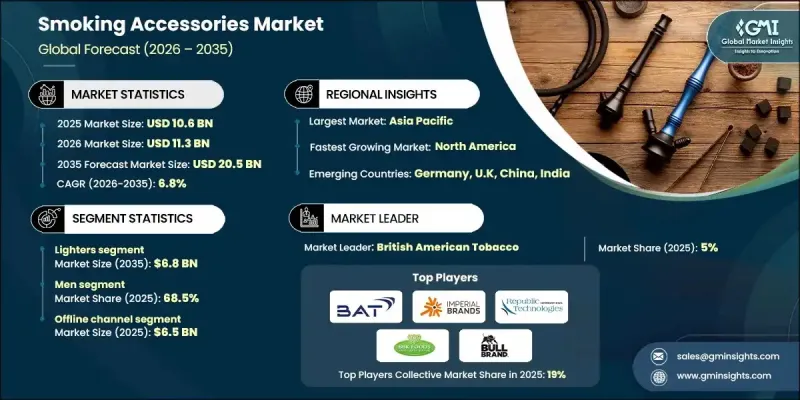
市场发展得益于庞大的消费群和种类繁多的吸烟辅助产品。製造商致力于产品差异化,将功能性和视觉吸引力相结合,提供符合不断变化的生活方式偏好的配件。客製化、奢华的饰面和以设计主导的创新正在帮助品牌吸引新旧客户。然而,市场面临着与日益增强的健康意识和消费者行为变化相关的结构性挑战。烟草替代品的日益普及限制了长期成长潜力。对烟草相关产品的监管压力也影响市场动态,对促销和分销的严格限制影响着购买模式。儘管有这些不利因素,现有消费者的稳定需求和持续的产品创新正在支撑市场扩张,尤其是在吸烟人口稳定且零售生态系统成熟的地区。
| 市场覆盖范围 | |
|---|---|
| 开始年份 | 2025 |
| 预测年份 | 2026-2035 |
| 起始值 | 106亿美元 |
| 预测金额 | 205亿美元 |
| 复合年增长率 | 6.8% |
预计到 2025 年,打火机市场的销售额将达到 35 亿美元,到 2035 年将达到 68 亿美元。需求成长反映了消费者偏好的变化以及替代吸烟产品的日益普及,这些都继续推动了打火机作为配套配件的使用。
到2025年,男性市场将占据68.5%的市场。由于全球超过70%的烟草消费者为男性,这一市场将继续保持其主导地位。传统的消费者偏好将继续影响购买行为,并强化对与长期吸烟习惯相关的配件的需求。
到 2025 年,美国吸烟配件市场将占据 78.1% 的市场份额。成长的动力来自大规模的成年消费群,预计到 2025 年将达到 4,920 万,这支撑了整体在实体店和数位平台上销售的配件支出。
目录
第一章调查方法和范围
第二章执行摘要
第三章业界考察
- 生态系分析
- 供应商情况
- 利润率
- 每个阶段的附加价值
- 影响价值链的因素
- 产业影响因素
- 司机
- 全球吸烟者人数不断增加
- 消费者自製香烟的趋势日益增长
- 推出多种口味
- 产业潜在风险与挑战
- 日益增长的健康问题
- 对烟草相关产品的监管日益严格
- 机会
- 永续吸烟配件的成长
- 透过电子商务和客製化拓展业务
- 司机
- 成长潜力分析
- 未来市场趋势
- 科技与创新趋势
- 当前技术趋势
- 新兴技术
- 价格趋势
- 依产品类型
- 按地区
- 监管环境
- 标准和合规要求
- 区域法规结构
- 认证标准
- 贸易统计(HS编码96140000)
- 主要进口国
- 主要出口国
- 差距分析
- 风险评估与缓解
- 波特分析
- PESTEL 分析
- 消费行为分析
- 购买模式
- 偏好分析
- 消费行为的区域差异
- 电子商务如何影响购买决策
第四章 竞争情势
- 介绍
- 公司市占率分析
- 按地区
- 企业矩阵分析
- 主要市场公司的竞争分析
- 竞争定位矩阵
- 重大进展
- 併购
- 伙伴关係与合作
- 新产品发布
- 扩张计划
第五章 依产品类型分類的市场估算与预测,2022-2035年
- 香烟盒和收纳容器
- 管道
- 干式管道
- 水管
- 水烟壶和烟枪
- 捲烟纸和烟捲
- 作家
- 丁烷喷枪打火机
- Zippo打火机
- 电线圈打火机
- 其他(电弧打火机、烟斗打火机等)
- 吸烟过滤嘴和纸质过滤嘴
- 烟灰缸
- 电子烟和雾化器
- 草药研磨机
- 其他(钝器、清洁工具等)
第六章 依价格区间分類的市场估计与预测,2022-2035年
- 低价位
- 中号
- 高的
7. 依最终用途分類的市场估计与预测,2022-2035 年
- 男性
- 女士
第八章 按分销管道分類的市场估算与预测,2022-2035年
- 线上销售
- 线下销售
第九章 2022-2035年各地区市场估算与预测
- 北美洲
- 我们
- 加拿大
- 欧洲
- 德国
- 法国
- 英国
- 义大利
- 西班牙
- 亚太地区
- 中国
- 印度
- 日本
- 韩国
- 澳洲
- 拉丁美洲
- 巴西
- 墨西哥
- 阿根廷
- 中东和非洲
- 南非
- 沙乌地阿拉伯
- 阿拉伯聯合大公国
第十章:公司简介
- BBK Tobacco &Foods
- Bull Brand
- British American Tobacco
- Curved Papers
- Elements
- Empire Glassworks
- Gizeh
- Greengo
- Imperial Brands
- Jinlin Smoking Accessories
- Moondust Paper
- OCB
- RAW
- Republic Technologies International
- Roor
The Global Smoking Accessories Market was valued at USD 10.6 billion in 2025 and is estimated to grow at a CAGR 6.8% to reach USD 20.5 billion by 2035.
Market development is supported by a broad consumer base and the availability of a diverse range of accessory products designed to complement smoking habits. Manufacturers are increasingly focusing on product differentiation by combining functionality with visual appeal, offering accessories that align with evolving lifestyle preferences. Customization, premium finishes, and design-led innovation are helping brands attract both new and repeat buyers. At the same time, the market faces structural challenges linked to rising health awareness and shifting consumer behavior. Growing adoption of alternatives designed to reduce tobacco consumption is limiting long-term growth potential. Regulatory pressure on tobacco-related products is also shaping market dynamics, as stricter controls on promotion and distribution influence purchasing patterns. Despite these headwinds, consistent demand from existing consumers and continued product innovation are supporting market expansion, particularly across regions with stable smoking populations and established retail ecosystems.
| Market Scope | |
|---|---|
| Start Year | 2025 |
| Forecast Year | 2026-2035 |
| Start Value | $10.6 billion |
| Forecast Value | $20.5 billion |
| CAGR | 6.8% |
The lighters segment generated USD 3.5 billion in 2025 and is expected to reach USD 6.8 billion by 2035. Demand growth reflects changing consumer preferences and the broader availability of alternative smoking formats, which continues to support lighter usage as a complementary accessory.
The men segment accounted for 68.5% share in 2025. The segment remains dominant, supported by the fact that more than 70% of global tobacco consumers are male. Traditional consumption preferences continue to influence purchasing behavior, reinforcing demand for accessories commonly associated with long-established smoking practices.
U.S. Smoking Accessories Market held 78.1% share in 2025. Growth is supported by a large adult consumer base, estimated at 49.2 million tobacco users in 2025, which sustains spending across accessories sold through physical retail and digital platforms.
Key companies operating in the Global Smoking Accessories Market include RAW, Imperial Brands, Republic Technologies International, OCB, BBK Tobacco & Foods, Gizeh, Roor, Elements, Jinlin Smoking Accessories, Curved Papers, Greengo, Empire Glassworks, Moondust Paper, Bull Brand, and British American Tobacco.
Companies in the Global Smoking Accessories Market are strengthening their positions through brand differentiation, product innovation, and expanded distribution strategies. Many players are focusing on premium and customized product offerings to enhance brand value and attract loyal customers. Expanding online sales channels and improving global retail reach are key priorities. Strategic partnerships with distributors and retailers help increase market visibility and availability. Manufacturers are also investing in packaging design and material quality to stand out in a competitive environment. Cost optimization and supply chain efficiency are being emphasized to protect margins amid regulatory and demand pressures. These strategies collectively support sustained presence and competitive positioning across regional and global markets.
Table of Contents
Chapter 1 Methodology & Scope
- 1.1 Market scope and definition
- 1.2 Research design
- 1.2.1 Research approach
- 1.2.2 Data collection methods
- 1.3 Data mining sources
- 1.3.1 Global
- 1.3.2 Regional/Country
- 1.4 Base estimates and calculations
- 1.4.1 Base year calculation
- 1.4.2 Key trends for market estimation
- 1.5 Primary research and validation
- 1.5.1 Primary sources
- 1.6 Forecast model
- 1.7 Research assumptions and limitations
Chapter 2 Executive Summary
- 2.1 Industry 3600 synopsis
- 2.2 Key market trends
- 2.2.1 Regional
- 2.2.2 Product Type
- 2.2.3 Pricing
- 2.2.4 End Use
- 2.2.5 Distribution channel
- 2.3 CXO perspectives: Strategic imperatives
- 2.3.1 Key decision points for industry executives
- 2.3.2 Critical success factors for market players
- 2.4 Future outlook and strategic recommendations
Chapter 3 Industry Insights
- 3.1 Industry ecosystem analysis
- 3.1.1 Supplier landscape
- 3.1.2 Profit margin
- 3.1.3 Value addition at each stage
- 3.1.4 Factor affecting the value chain
- 3.2 Industry impact forces
- 3.2.1 Growth drivers
- 3.2.1.1 Rise in number of smokers around the world
- 3.2.1.2 Increasing preference of consumers to make their own tobacco
- 3.2.1.3 Introduction of various flavors
- 3.2.2 Industry pitfalls & challenges
- 3.2.2.1 Increasing health concerns
- 3.2.2.2 Evolving strict regulations surrounding smoking-related products
- 3.2.3 Opportunities
- 3.2.3.1 Growth of eco-friendly & sustainable smoking accessories
- 3.2.3.2 Expansion through e-commerce & customization
- 3.2.1 Growth drivers
- 3.3 Growth potential analysis
- 3.4 Future market trends
- 3.5 Technology and innovation landscape
- 3.5.1 Current technological trends
- 3.5.2 Emerging technologies
- 3.6 Price trends
- 3.6.1 by product type
- 3.6.2 By region
- 3.7 Regulatory landscape
- 3.7.1 Standards and compliance requirements
- 3.7.2 Regional regulatory frameworks
- 3.7.3 Certification standards
- 3.8 Trade statistics (HS code 96140000)
- 3.8.1 Major importing countries
- 3.8.2 Major exporting countries
- 3.9 Gap analysis
- 3.10 Risk assessment and mitigation
- 3.11 Porter';s analysis
- 3.12 PESTEL analysis
- 3.13 Consumer behaviour analysis
- 3.13.1 Purchasing patterns
- 3.13.2 Preference analysis
- 3.13.3 Regional variations in consumer behaviour
- 3.13.4 Impact of e-commerce on buying decisions
Chapter 4 Competitive Landscape, 2025
- 4.1 Introduction
- 4.2 Company market share analysis
- 4.2.1 By region
- 4.2.1.1 North America
- 4.2.1.2 Europe
- 4.2.1.3 Asia Pacific
- 4.2.1.4 Latin America
- 4.2.1.5 Middle East and Africa
- 4.2.1 By region
- 4.3 Company matrix analysis
- 4.4 Competitive analysis of major market players
- 4.5 Competitive positioning matrix
- 4.6 Key developments
- 4.6.1 Mergers & acquisitions
- 4.6.2 Partnerships & collaborations
- 4.6.3 New product launches
- 4.6.4 Expansion plans
Chapter 5 Market Estimates & Forecast, By Product Type, 2022-2035 (USD Billion) (Million Units)
- 5.1 Key trends
- 5.2 Cigarette Cases & Storage Containers
- 5.3 Pipes
- 5.3.1 Dry Pipes
- 5.3.2 Water Pipes
- 5.4 Bubbler & Bongs
- 5.5 Rolling paper & Wraps
- 5.6 Lighters
- 5.6.1 Butane Torch Lighters
- 5.6.2 Zippo-Style Lighters
- 5.6.3 Electric Coil Lighters
- 5.6.4 Others (Arc Lighters, Pipe Lighters, etc.)
- 5.7 Smoking Filter & Paper Tip
- 5.8 Ashtrays
- 5.9 Vapes & Vaporizers
- 5.10 Herb Grinders
- 5.11 Others (Blunts, Cleaning tools, etc.)
Chapter 6 Market Estimates & Forecast, By Pricing, 2022-2035 (USD Billion) (Million Units)
- 6.1 Key trends
- 6.2 Low
- 6.3 Medium
- 6.4 High
Chapter 7 Market Estimates & Forecast, By End Use, 2022-2035 (USD Billion) (Million Units)
- 7.1 Key trends
- 7.2 Men
- 7.3 Women
Chapter 8 Market Estimates & Forecast, By Distribution Channel, 2022-2035 (USD Billion) (Million Units)
- 8.1 Key trends
- 8.2 Online sales
- 8.3 Offline sales
Chapter 9 Market Estimates & Forecast, By Region, 2022-2035 (USD Billion) (Million Units)
- 9.1 Key trends
- 9.2 North America
- 9.2.1 U.S.
- 9.2.2 Canada
- 9.3 Europe
- 9.3.1 Germany
- 9.3.2 France
- 9.3.3 UK
- 9.3.4 Italy
- 9.3.5 Spain
- 9.4 Asia Pacific
- 9.4.1 China
- 9.4.2 India
- 9.4.3 Japan
- 9.4.4 South Korea
- 9.4.5 Australia
- 9.5 Latin America
- 9.5.1 Brazil
- 9.5.2 Mexico
- 9.5.3 Argentina
- 9.6 MEA
- 9.6.1 South Africa
- 9.6.2 Saudi Arabia
- 9.6.3 UAE
Chapter 10 Company Profiles
- 10.1 BBK Tobacco & Foods
- 10.2 Bull Brand
- 10.3 British American Tobacco
- 10.4 Curved Papers
- 10.5 Elements
- 10.6 Empire Glassworks
- 10.7 Gizeh
- 10.8 Greengo
- 10.9 Imperial Brands
- 10.10 Jinlin Smoking Accessories
- 10.11 Moondust Paper
- 10.12 OCB
- 10.13 RAW
- 10.14 Republic Technologies International
- 10.15 Roor

 吸烟配件市场:2026-2032年全球市场预测(按产品类型、材质、价格范围、分销管道和销售形式划分)
 CBD软包装袋市场规模、份额和成长分析:按含量、类型、通路和地区划分-2026-2033年产业预测
 CBD软袋市场分析及预测(至2035年):按类型、产品类型、应用、形状、材料类型、最终用户、功能、技术和组件划分
 全球吸烟配件市场规模、份额、趋势和成长分析报告(2026-2034年)全球CBD袋装产品市场规模、份额、趋势及成长分析报告(2026-2034年)
 吸烟配件市场 - 全球产业规模、份额、趋势、机会及预测(按类型、分销管道、地区和竞争格局划分,2021-2031年)
 吸烟相关产品市场规模、份额和成长分析(按类型、通路和地区划分)—产业预测(2026-2033 年)
 CBD袋装的全球市场,规模,占有率,趋势,产业分析报告:含有量,各类型,各流通管道,各地区 - 市场预测,2025年~2034年
 吸烟配件市场报告:2031 年趋势、预测与竞争分析
 2024-2028年吸烟配件全球市场