


 |
市场调查报告书
商品编码
1928967
干式船舶洗涤器系统市场机会、成长要素、产业趋势分析及2026年至2035年预测Dry Marine Scrubber Systems Market Opportunity, Growth Drivers, Industry Trend Analysis, and Forecast 2026 - 2035 |
||||||

全球干式海洋洗涤器系统市场预计到 2025 年将达到 12 亿美元,到 2035 年将达到 29 亿美元,年复合成长率为 8.7%。
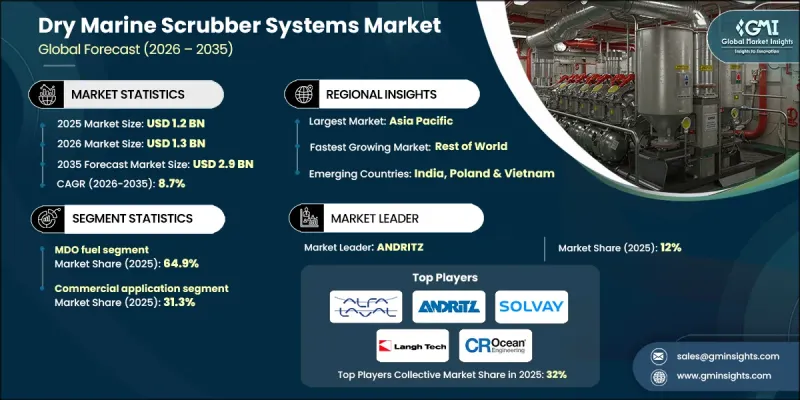
这一增长是由日益严格的排放法规推动的,这些法规正在重塑整个航运业的合规策略。船舶营运商正在采用干式洗涤器系统,以满足硫氧化物和氮氧化物的排放限制,同时控制营运成本并避免监管处罚。这些系统无需对引擎进行大规模改造即可实现合规,使其成为一种高效且具有商业性可行性的选择。干式洗涤器透过在有害废气成分排放到大气之前将其捕获,在减少空气污染物方面发挥关键作用。它们的使用有助于更清洁的航空营运业,改善港口周围的空气质量,并符合日益增长的永续性期望。对技术开发的持续投资正在提高所有船舶类型系统的效率、可靠性和适应性。专注于降低生命週期成本和简化操作的改进措施正被越来越多地采用。随着营运商在履行环境义务和盈利之间寻求平衡,干式洗涤器系统正成为现代船队战略中不可或缺的解决方案。
| 市场覆盖范围 | |
|---|---|
| 开始年份 | 2025 |
| 预测年份 | 2026-2035 |
| 起始值 | 12亿美元 |
| 预测金额 | 29亿美元 |
| 复合年增长率 | 8.7% |
预计到 2025 年,船用柴油市场份额将达到 64.9%,到 2035 年将以 8.5% 的复合年增长率增长。日益严格的硫排放法规以及燃料与干式洗涤器技术的兼容性支撑了市场需求,使得企业无需进行重大技术变革即可符合排放标准。
预计到 2035 年,休閒船舶领域将以 8.5% 的复合年增长率成长。推动这一成长的因素是,船东加大了对紧凑型排放气体控制解决方案的投资,这些解决方案能够帮助他们在满足监管标准的同时,保持空间效率和船舶设计。
预计到 2025 年,美国干式船舶洗涤器系统市场将占据 71.9% 的市场份额,到 2035 年将创造超过 4.7 亿美元的收入。强而有力的监管执法和零排放要求正在加速干式洗涤器的普及,使其成为首选的合规解决方案。
目录
第一章调查方法和范围
第二章执行摘要
第三章业界考察
- 产业生态系统
- 原物料供应及采购分析
- 製造能力评估
- 供应链韧性与风险因素
- 配电网路分析
- 监管环境
- 产业影响因素
- 司机
- 产业潜在风险与挑战
- 成长潜力分析
- 成本结构分析
- 波特分析
- 供应商的议价能力
- 买方的议价能力
- 新进入者的威胁
- 替代品的威胁
- PESTEL 分析
- 新的机会与趋势
- 数位化和物联网集成
- 拓展新兴市场
- 投资分析及未来展望
第四章 竞争情势
- 介绍
- 按地区分類的公司市占率分析
- 北美洲
- 欧洲
- 亚太地区
- 世界其他地区
- 战略仪錶板
- 策略倡议
- 企业标竿管理
- 创新与科技趋势
第五章 依燃料类型分類的市场规模及预测(2022-2035年)
- MDO
- MGO
- 杂交种
- 其他的
第六章 依应用领域分類的市场规模及预测(2022-2035年)
- 商业的
- 离岸
- 休閒
- 海军
- 其他的
第七章 2022-2035年各地区市场规模及预测
- 北美洲
- 我们
- 加拿大
- 欧洲
- 希腊
- 挪威
- 德国
- 英国
- 法国
- 荷兰
- 义大利
- 亚太地区
- 中国
- 韩国
- 日本
- 越南
- 印度
- 澳洲
- 世界其他地区
第八章 公司简介
- ANDRITZ
- Aarco Engineering Projects Pvt. Ltd.
- Albion Marine Solutions
- Alfa Laval
- 布伦塔格亚太有限公司
- Clean Marine
- CR Ocean Engineering
- DuPont Clean Technologies
- Ecospray Technologies
- Fuji Electric
- Langh Tech
- ME Production
- Nicro
- SAACKE
- Solvay
- VDL AEC Maritime
- Yara Marine Technologies
The Global Dry Marine Scrubber Systems Market was valued at USD 1.2 billion in 2025 and is estimated to grow at a CAGR of 8.7% to reach USD 2.9 billion by 2035.
Growth is driven by increasingly strict emission regulations that are reshaping compliance strategies across the maritime industry. Ship operators are adopting dry scrubber systems to meet sulfur and nitrogen oxide limits while managing operating costs and avoiding regulatory penalties. These systems enable compliance without extensive engine modifications, making them an efficient and commercially viable option. Dry marine scrubbers play a vital role in lowering atmospheric pollutants by capturing harmful exhaust components before release. Their use supports cleaner maritime operations, improves air quality around ports, and aligns with rising sustainability expectations. Continuous investment in technology development is enhancing system efficiency, reliability, and adaptability across vessel categories. Improvements focused on lowering lifecycle costs and simplifying operations are increasingly adopted. As operators balance environmental obligations with profitability, dry scrubber systems are becoming an essential solution within modern fleet strategies.
| Market Scope | |
|---|---|
| Start Year | 2025 |
| Forecast Year | 2026-2035 |
| Start Value | $1.2 Billion |
| Forecast Value | $2.9 Billion |
| CAGR | 8.7% |
The marine diesel oil segment accounted for 64.9% share in 2025 and is expected to grow at a CAGR of 8.5% through 2035. Demand is supported by tighter sulfur regulations and the fuel's compatibility with dry scrubber technology, allowing compliance without major technical changes.
The recreational vessel segment is projected to grow at a CAGR of 8.5% by 2035. Adoption is rising as owners invest in compact emission control solutions that meet regulatory standards while preserving space efficiency and vessel design.
U.S. Dry Marine Scrubber Systems Market held 71.9% share in 2025 and is expected to generate more than USD 470 million in revenue by 2035. Strong regulatory enforcement and zero-discharge requirements are accelerating adoption, positioning dry scrubbers as a preferred compliance solution.
Key companies operating in the Global Dry Marine Scrubber Systems Market include Alfa Laval, ANDRITZ, Yara Marine Technologies, Ecospray Technologies, DuPont Clean Technologies, Solvay, Fuji Electric, Langh Tech, Clean Marine, SAACKE, VDL AEC Maritime, Nicro, CR Ocean Engineering, ME Production, Brenntag Asia Pacific Pte Ltd, Albion Marine Solutions, and Aarco Engineering Projects Pvt. Ltd. Companies in the Global Dry Marine Scrubber Systems Market are strengthening their positions through technological innovation, strategic partnerships, and global service expansion. Manufacturers are investing in compact, high-efficiency designs that reduce installation complexity and operating costs. Many players are focusing on modular systems to support retrofitting across diverse vessel types. Expanding after-sales services, including maintenance and performance optimization, is helping improve long-term customer retention. Firms are also enhancing compliance support by aligning product offerings with evolving environmental regulations.
Table of Contents
Chapter 1 Methodology & Scope
- 1.1 Research design
- 1.1.1 Research approach
- 1.1.2 Data collection methods
- 1.2 Base estimates and calculations
- 1.2.1 Base year calculation
- 1.2.2 Market estimates & forecast parameters
- 1.3 Forecast
- 1.3.1 Key trends for market estimates
- 1.3.1.1 Quantified market impact analysis
- 1.3.2 Mathematical impact of growth parameters on forecast
- 1.3.3 Scenario analysis framework
- 1.3.1 Key trends for market estimates
- 1.4 Primary research and validation
- 1.4.1 Some of the primary sources (but not limited to)
- 1.5 Data mining sources
- 1.5.1 Paid Sources
- 1.5.2 Sources, by region
- 1.6 Research trail & scoring components
- 1.6.1 Research trail components
- 1.6.2 Scoring components
- 1.7 Research transparency addendum
- 1.7.1 Source attribution framework
- 1.7.2 Quality assurance metrics
- 1.7.3 Our commitment to trust
- 1.8 Market definitions
Chapter 2 Executive Summary
- 2.1 Industry synopsis, 2022 - 2035
- 2.2 Business trends
- 2.3 Fuel trends
- 2.4 Application trends
- 2.5 Regional trends
Chapter 3 Industry Insights
- 3.1 Industry ecosystem
- 3.1.1 Raw material availability & sourcing analysis
- 3.1.2 Manufacturing capacity assessment
- 3.1.3 Supply chain resilience & risk factors
- 3.1.4 Distribution network analysis
- 3.2 Regulatory landscape
- 3.3 Industry impact forces
- 3.3.1 Growth drivers
- 3.3.2 Industry pitfalls & challenges
- 3.4 Growth potential analysis
- 3.5 Cost structure analysis
- 3.6 Porter';s analysis
- 3.6.1 Bargaining power of suppliers
- 3.6.2 Bargaining power of buyers
- 3.6.3 Threat of new entrants
- 3.6.4 Threat of substitutes
- 3.7 PESTEL analysis
- 3.7.1 Political factors
- 3.7.2 Economic factors
- 3.7.3 Social factors
- 3.7.4 Technological factors
- 3.7.5 Legal factors
- 3.7.6 Environmental factors
- 3.8 Emerging opportunities & trends
- 3.8.1 Digitalization & IoT integration
- 3.8.2 Emerging market penetration
- 3.9 Investment analysis and future outlook
Chapter 4 Competitive landscape, 2025
- 4.1 Introduction
- 4.2 Company market share analysis, by region, 2025
- 4.2.1 North America
- 4.2.2 Europe
- 4.2.3 Asia Pacific
- 4.2.4 Rest of World
- 4.3 Strategic dashboard
- 4.4 Strategic initiatives
- 4.5 Company benchmarking
- 4.6 Innovation & technology landscape
Chapter 5 Market Size and Forecast, By Fuel, 2022 - 2035 (USD Million & Units)
- 5.1 Key trends
- 5.2 MDO
- 5.3 MGO
- 5.4 Hybrid
- 5.5 Others
Chapter 6 Market Size and Forecast, By Application, 2022 - 2035 (USD Million & Units)
- 6.1 Key trends
- 6.2 Commercial
- 6.3 Offshore
- 6.4 Recreational
- 6.5 Navy
- 6.6 Others
Chapter 7 Market Size and Forecast, By Region, 2022 - 2035 (USD Million & Units)
- 7.1 Key trends
- 7.2 North America
- 7.2.1 U.S.
- 7.2.2 Canada
- 7.3 Europe
- 7.3.1 Greece
- 7.3.2 Norway
- 7.3.3 Germany
- 7.3.4 UK
- 7.3.5 France
- 7.3.6 Netherlands
- 7.3.7 Italy
- 7.4 Asia Pacific
- 7.4.1 China
- 7.4.2 South Korea
- 7.4.3 Japan
- 7.4.4 Vietnam
- 7.4.5 India
- 7.4.6 Australia
- 7.5 Rest of World
Chapter 8 Company Profiles
- 8.1 ANDRITZ
- 8.2 Aarco Engineering Projects Pvt. Ltd.
- 8.3 Albion Marine Solutions
- 8.4 Alfa Laval
- 8.5 Brenntag Asia Pacific Pte Ltd
- 8.6 Clean Marine
- 8.7 CR Ocean Engineering
- 8.8 DuPont Clean Technologies
- 8.9 Ecospray Technologies
- 8.10 Fuji Electric
- 8.11 Langh Tech
- 8.12 ME Production
- 8.13 Nicro
- 8.14 SAACKE
- 8.15 Solvay
- 8.16 VDL AEC Maritime
- 8.17 Yara Marine Technologies

 船舶废气净化洗涤器市场:依洗涤器类型、洗涤器配置、安装方式、燃料类型及船舶类型划分,全球预测,2026-2032年船舶废气洗涤系统市场:依安装类型、系统类型、组件和最终用户划分,全球预测,2026-2032年船舶洗涤器市场:按洗涤器类型、船舶类型、安装类型、燃料类型、产量和销售管道,全球预测,2026-2032年船舶洗涤器市场:按船舶类型、技术、安装类型和最终用户划分,全球预测,2026-2032年船舶洗涤塔市场:按船舶类型、洗涤塔类型、技术、安装类型、最终用户和销售管道,全球预测,2026-2032年全球船舶湿式洗涤器系统市场(按洗涤器系统类型、船舶类型、安装类型、流动机制和分配管道划分)预测(2026-2032年)船舶湿式洗涤器市场:按类型、安装方式、应用、最终用途和分销管道划分,全球预测,2026-2032年
 全球船舶洗涤系统市场规模、份额、趋势和成长分析报告(2026-2034年)
 2026年全球船舶洗涤器系统市场报告
 休閒船舶洗涤器系统市场:机会、成长要素、产业趋势分析及预测(2026-2035年)