


 |
市场调查报告书
商品编码
1928991
汽车通风口市场成长机会、成长要素、产业趋势分析及2026年至2035年预测Automotive Vents Market Opportunity, Growth Drivers, Industry Trend Analysis, and Forecast 2026 - 2035 |
||||||

全球汽车通风口市场预计到 2025 年将达到 12.6 亿美元,到 2035 年将达到 21.2 亿美元,年复合成长率为 5.3%。
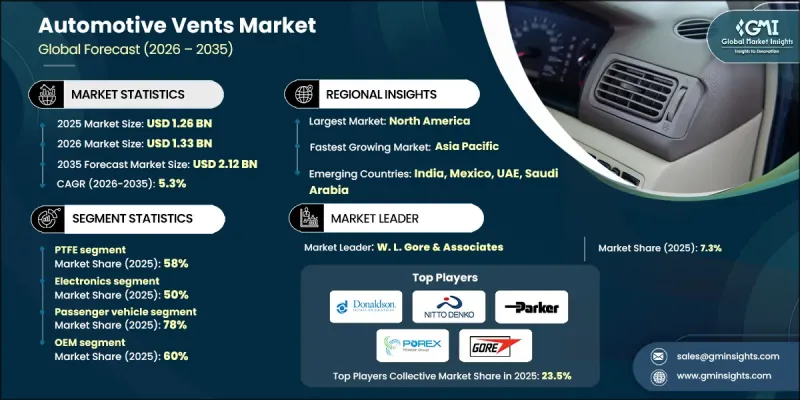
市场成长的驱动力在于电动车的加速普及以及对能够应对内部压力和温度波动的先进通风解决方案日益增长的需求。随着电动动力传动系统和高密度电池系统的普及,车辆结构需要可靠的通风系统来维持安全性、稳定性和性能。监管机构为提高电动车安全标准而施加的压力也进一步推动了该市场的创新。製造商正积极应对,开发能够适应温度和压力波动的尖端材料和智慧通风技术。这些进步有助于延长电池寿命、提高运作效率并提升车辆整体安全性。汽车供应商越来越关注专为电动动力系统、储能单元和高性能电子元件设计的通风系统。对环境合规性和碳减排的日益重视也影响着产品设计,推动着既能满足不断变化的汽车需求又能支持永续性目标的解决方案的出现。
| 市场覆盖范围 | |
|---|---|
| 开始年份 | 2025 |
| 预测年份 | 2026-2035 |
| 起始值 | 12.6亿美元 |
| 预测金额 | 21.2亿美元 |
| 复合年增长率 | 5.3% |
预计到2025年,聚四氟乙烯(PTFE)市占率将达到58%,并在2026年至2035年间以6%的复合年增长率成长。 PTFE基材料具有优异的耐化学性、耐湿性和耐热性,使其成为通风应用的首选材料。随着复杂空调系统、电池组和电力电子设备的日益集成,对能够在各种运行环境下保持性能的耐用膜的需求也随之增长。
预计到2025年,电子产品领域将占50%的市场份额,并在2026年至2035年间以6.3%的复合年增长率成长。汽车製造商正越来越多地采用电子控制通风系统,该系统可根据车内和车外环境动态调节气流。这些系统可提高舒适性、提升能源效率,并与车辆软体平台无缝整合。
预计到 2025 年,美国汽车通风口市场将占全球 86% 的份额,价值将达到 2.492 亿美元。先进内装系统的广泛应用以及电动和混合动力汽车渗透率的不断提高,持续推动全部区域对先进通风解决方案的需求。
目录
第一章调查方法和范围
第二章执行摘要
第三章业界考察
- 生态系分析
- 供应商情况
- 利润率分析
- 成本结构
- 每个阶段的附加价值
- 影响价值链的因素
- 中断
- 产业影响因素
- 司机
- 汽车产量和销售成长
- 高级汽车内装
- 电动汽车的快速普及
- 智慧空调系统的进步
- 产业潜在风险与挑战
- 大众市场车辆的成本敏感性
- 设计复杂性与整合挑战
- 市场机会
- 专用电动车通风解决方案的成长
- 亚太地区汽车产量不断成长
- 电子通风口和主动通风口
- 售后市场更换需求
- 成长潜力分析
- 监管环境
- 北美洲
- 美国国家公路交通安全管理局(NHTSA)法规
- 美国环保署(EPA)排放标准
- 加州空气资源委员会 (CARB) 标准
- 欧洲
- 欧盟一般安全法规(EU GSR)
- 欧盟报废车辆指令(ELV)
- 欧盟委员会乘用车安全标准
- 欧盟型式核准流程
- 亚太地区
- 中国国家汽车安全标准
- 印度标准局(BIS)
- 国土交通省(MLIT)规章
- 东协汽车安全标准
- 拉丁美洲
- 巴西国家交通运输局(DENATRAN)标准
- 阿根廷国家道路安全局 (ANSV) 法规
- 墨西哥通讯与运输部部 (SCT) 条例
- 南方共同市场车辆安全标准协调
- 中东和非洲
- 阿联酋联邦机动车安全法
- 沙乌地阿拉伯标准组织(SASO)车辆安全法规
- 南非标准局(SABS)机动车辆法规
- 北美洲
- 波特分析
- PESTEL 分析
- 科技与创新趋势
- 当前技术趋势
- 新兴技术
- 价格趋势
- 按地区
- 副产品
- 生产统计
- 生产基地
- 消费基础
- 进出口
- 成本細項分析
- 专利分析
- 永续性和环境方面
- 永续实践
- 减少废弃物策略
- 生产中的能源效率
- 环保倡议
- 碳足迹考量
- 定价、平均售价 (ASP) 和商业模式
- OEM整合与平台经济性
- 硬体和电子元件的成本和价值分配
- 电动车通风口的经济与安全价值
- 更换週期和售后市场需求驱动因素
第四章 竞争情势
- 介绍
- 公司市占率分析
- 北美洲
- 欧洲
- 亚太地区
- 拉丁美洲
- 中东和非洲
- 主要市场公司的竞争分析
- 竞争定位矩阵
- 战略展望矩阵
- 重大进展
- 併购
- 伙伴关係与合作
- 新产品发布
- 企业扩张计画和资金筹措
第五章 按材料分類的市场估算与预测,2022-2035年
- 聚四氟乙烯(PTFE)
- 聚丙烯(PP)
- 聚乙烯(PE)
第六章 按应用领域分類的市场估算与预测,2022-2035年
- 动力传动系统部件
- 电子设备
- 照明
- 内部和外部部件
7. 2022-2035年按推进方式分類的市场估计与预测
- 汽油
- 柴油引擎
- 电池式电动车(BEV)
- 插电式混合动力汽车(PHEV)
- HEV
- 其他的
第八章 按车辆类型分類的市场估算与预测,2022-2035年
- 搭乘用车
- 掀背车
- 轿车
- SUV
- 商用车辆
- 轻型商用车(LCV)
- 中型商用车(MCV)
- 重型商用车(HCV)
9. 按排气口分類的市场估算与预测,2022-2035 年
- 通风口
- 过滤器通风口
- 黏合通风口
第十章 按分销管道分類的市场估算与预测,2022-2035年
- OEM
- 售后市场
第十一章 依功能分類的市场估计与预测,2022-2035年
- 空调通风口
- 进气口
- 排气口
- 舱室通风口
第十二章 按机制分類的市场估计与预测,2022-2035年
- 手动的
- 电子设备
第十三章 2022-2035年各地区市场估算与预测
- 北美洲
- 我们
- 加拿大
- 欧洲
- 英国
- 德国
- 法国
- 义大利
- 西班牙
- 俄罗斯
- 丹麦
- 亚太地区
- 中国
- 印度
- 日本
- 韩国
- ANZ
- 新加坡
- 拉丁美洲
- 巴西
- 阿根廷
- 墨西哥
- 中东和非洲
- 阿拉伯聯合大公国
- 沙乌地阿拉伯
- 南非
第十四章:公司简介
- 世界公司
- Donaldson
- ITW Automotive
- MANN+HUMMEL
- Nifco
- Nitto Denko
- Parker Hannifin
- Porex
- Toyoda Gosei
- WL Gore
- 区域玩家
- Ascencione
- Berghof
- Interstate Specialty Products
- LTI Atlanta
- Matikon
- Novares
- PorVent
- Weber
- 新兴企业
- CREHERIT
- Hangzhou IPRO
- Shenzhen Milvent
The Global Automotive Vents Market was valued at USD 1.26 billion in 2025 and is estimated to grow at a CAGR of 5.3% to reach USD 2.12 billion by 2035.
Market growth is supported by the accelerating adoption of electric vehicles and the rising need for advanced venting solutions capable of managing internal pressure and thermal variation. As electrified powertrains and high-density battery systems become more common, vehicle architectures require reliable venting to maintain safety, stability, and performance. Regulatory pressure aimed at improving electric vehicle safety standards is further driving innovation in this market. Manufacturers are responding by developing advanced materials and intelligent venting technologies that adapt to fluctuating thermal and pressure conditions. These advancements are contributing to improved battery lifespan, operational efficiency, and overall vehicle safety. Automotive suppliers are increasingly focusing on venting systems specifically engineered for electric drivetrains, energy storage units, and high-performance electronic components. Rising emphasis on environmental compliance and carbon reduction is also influencing product design, encouraging solutions that support sustainability goals while meeting evolving automotive requirements.
| Market Scope | |
|---|---|
| Start Year | 2025 |
| Forecast Year | 2026-2035 |
| Start Value | $1.26 Billion |
| Forecast Value | $2.12 Billion |
| CAGR | 5.3% |
The PTFE segment held 58% share in 2025 and is projected to grow at a CAGR of 6% from 2026 to 2035. Strong resistance to chemicals, moisture, and heat has positioned PTFE-based materials as a preferred choice for venting applications. Increasing integration of complex climate control systems, battery packs, and power electronics is driving demand for durable membranes that maintain performance across varied operating environments.
The electronics segment accounted for 50% share in 2025 and is expected to grow at a CAGR of 6.3% from 2026 to 2035. Vehicle manufacturers are increasingly adopting electronically controlled vent systems that dynamically regulate airflow based on internal and external conditions. These systems support enhanced comfort, energy efficiency, and seamless integration with vehicle software platforms.
United States Automotive Vents Market held 86% share and generated USD 249.2 million in 2025. High adoption of advanced interior systems and growing penetration of electric and hybrid vehicles continue to increase demand for sophisticated venting solutions across the region.
Key companies operating in the Global Automotive Vents Market include W. L. Gore & Associates, Donaldson, Parker Hannifin, Nitto Denko, Porex, Nifco, Berghof, Weber, Ascencione, and CREHERIT. Companies in the Automotive Vents Market are strengthening their competitive position through material innovation, product customization, and alignment with electrification trends. Many players are investing in research to develop membranes with higher durability, improved airflow control, and enhanced thermal resistance. Expanding product portfolios to address electric, hybrid, and high-performance vehicle platforms is a central strategy. Manufacturers are also focusing on compliance with environmental and safety regulations to support global market access. Strategic collaborations with automotive OEMs are helping suppliers integrate venting solutions early in vehicle design cycles.
Table of Contents
Chapter 1 Methodology & Scope
- 1.1 Research approach
- 1.2 Quality Commitments
- 1.2.1 GMI AI policy & data integrity commitment
- 1.2.1.1 Source consistency protocol
- 1.2.1 GMI AI policy & data integrity commitment
- 1.3 Research Trail & Confidence Scoring
- 1.3.1 Research Trail Components
- 1.3.2 Scoring Components
- 1.4 Data Collection
- 1.4.1 Partial list of primary sources
- 1.5 Data mining sources
- 1.5.1 Paid sources
- 1.5.1.1 Sources, by region
- 1.5.1 Paid sources
- 1.6 Base estimates and calculations
- 1.6.1 Base year calculation for any one approach
- 1.7 Forecast model
- 1.7.1 Quantified market impact analysis
- 1.7.1.1 Mathematical impact of growth parameters on forecast
- 1.7.1 Quantified market impact analysis
- 1.8 Research transparency addendum
- 1.8.1 Source attribution framework
- 1.8.2 Quality assurance metrics
- 1.8.3 Our commitment to trust
Chapter 2 Executive Summary
- 2.1 Industry 3600 synopsis, 2022 - 2035
- 2.2 Key market trends
- 2.2.1 Regional
- 2.2.2 Material
- 2.2.3 Application
- 2.2.4 Propulsion
- 2.2.5 Vehicle
- 2.2.6 Vent
- 2.2.7 Distribution channel
- 2.2.8 Functionality
- 2.2.9 Mechanism
- 2.3 TAM Analysis, 2026-2035
- 2.4 CXO perspectives: Strategic imperatives
- 2.4.1 Executive decision points
- 2.4.2 Critical success factors
- 2.5 Future outlook and strategic recommendations
Chapter 3 Industry Insights
- 3.1 Industry ecosystem analysis
- 3.1.1 Supplier landscape
- 3.1.2 Profit margin analysis
- 3.1.3 Cost structure
- 3.1.4 Value addition at each stage
- 3.1.5 Factor affecting the value chain
- 3.1.6 Disruptions
- 3.2 Industry impact forces
- 3.2.1.1 Growth drivers
- 3.2.1.2 Increasing vehicle production and sales
- 3.2.1.3 Premiumization of vehicle interiors
- 3.2.1.4 Rapid adoption of electric vehicles
- 3.2.1.5 Advancements in smart HVAC systems
- 3.2.2 Industry pitfalls and challenges
- 3.2.2.1 Cost sensitivity in mass-market vehicles
- 3.2.2.2 Design complexity and integration challenges
- 3.2.3 Market opportunities
- 3.2.3.1 Growth of EV-specific vent solutions
- 3.2.3.2 Rising automotive production in APAC
- 3.2.3.3 Adoption of electronic and active vents
- 3.2.3.4 Aftermarket replacement demand
- 3.3 Growth potential analysis
- 3.4 Regulatory landscape
- 3.4.1 North America
- 3.4.1.1 U.S. National Highway Traffic Safety Administration (NHTSA) Regulations
- 3.4.1.2 Environmental Protection Agency (EPA) Emission Standards
- 3.4.1.3 California Air Resources Board (CARB) Standards
- 3.4.2 Europe
- 3.4.2.1 European Union General Safety Regulation (EU GSR)
- 3.4.2.2 EU Directive on End-of-Life Vehicles (ELV)
- 3.4.2.3 European Commission Safety Standards for Passenger Vehicles
- 3.4.2.4 European Union Type Approval Process
- 3.4.3 Asia Pacific
- 3.4.3.1 China National Standards for Vehicle Safety
- 3.4.3.2 India Bureau of Indian Standards (BIS)
- 3.4.3.3 Japan Ministry of Land, Infrastructure, Transport and Tourism (MLIT) Regulations
- 3.4.3.4 ASEAN Automotive Safety Standards
- 3.4.4 Latin America
- 3.4.4.1 Brazil National Traffic Department (DENATRAN) Standards
- 3.4.4.2 Argentina National Road Safety Agency (ANSV) Regulations
- 3.4.4.3 Mexico Secretariat of Communications and Transport (SCT) Regulations
- 3.4.4.4 MERCOSUR Harmonization of Vehicle Safety Standards
- 3.4.5 Middle East & Africa
- 3.4.5.1 UAE Federal Vehicle Safety Law
- 3.4.5.2 Saudi Arabian Standards Organization (SASO) Vehicle Safety Regulations
- 3.4.5.3 South African Bureau of Standards (SABS) AUTOMOTIVE REGULATIONS
- 3.4.1 North America
- 3.5 Porter';s analysis
- 3.6 PESTEL analysis
- 3.7 Technology and innovation landscape
- 3.7.1 Current technological trends
- 3.7.2 Emerging technologies
- 3.8 Price trends
- 3.8.1 By region
- 3.8.2 By product
- 3.9 Production statistics
- 3.9.1 Production hubs
- 3.9.2 Consumption hubs
- 3.9.3 Export and import
- 3.10 Cost breakdown analysis
- 3.11 Patent analysis
- 3.12 Sustainability and environmental aspects
- 3.12.1 Sustainable practices
- 3.12.2 Waste reduction strategies
- 3.12.3 Energy efficiency in production
- 3.12.4 Eco-friendly Initiatives
- 3.12.5 Carbon footprint considerations
- 3.13 Pricing, ASP & Commercial Models
- 3.14 OEM Integration & Platform Economics
- 3.15 Hardware vs Electronics Cost & Value Split
- 3.16 EV-Focused Vent Economics & Safety Value
- 3.17 Replacement Cycles & Aftermarket Demand Drivers
Chapter 4 Competitive Landscape, 2025
- 4.1 Introduction
- 4.2 Company market share analysis
- 4.2.1 North America
- 4.2.2 Europe
- 4.2.3 Asia Pacific
- 4.2.4 LATAM
- 4.2.5 MEA
- 4.3 Competitive analysis of major market players
- 4.4 Competitive positioning matrix
- 4.5 Strategic outlook matrix
- 4.6 Key developments
- 4.6.1 Mergers & acquisitions
- 4.6.2 Partnerships & collaborations
- 4.6.3 New Product Launches
- 4.6.4 Expansion Plans and funding
Chapter 5 Market Estimates & Forecast, By Material, 2022 - 2035 ($Mn, Units)
- 5.1 Key trends
- 5.2 Polytetrafluoroethylene (PTFE)
- 5.3 Polypropylene (PP)
- 5.4 Polyethylene (PE)
Chapter 6 Market Estimates & Forecast, By Application, 2022 - 2035 ($Mn, Units)
- 6.1 Key trends
- 6.2 Powertrain Components
- 6.3 Electronics
- 6.4 Lighting
- 6.5 Interior and Exterior Components
Chapter 7 Market Estimates & Forecast, By Propulsion, 2022 - 2035 ($Mn, Units)
- 7.1 Key trends
- 7.2 Gasoline
- 7.3 Diesel
- 7.4 BEV
- 7.5 PHEV
- 7.6 HEV
- 7.7 Others
Chapter 8 Market Estimates & Forecast, By Vehicle, 2022 - 2035 ($Mn, Units)
- 8.1 Key trends
- 8.2 Passenger vehicle
- 8.2.1 Hatchback
- 8.2.2 Sedan
- 8.2.3 SUV
- 8.3 Commercial vehicle
- 8.3.1 Light commercial vehicle (LCV)
- 8.3.2 Medium commercial vehicle (MCV)
- 8.3.3 Heavy commercial vehicle (HCV)
Chapter 9 Market Estimates & Forecast, By Vent, 2022 - 2035 ($Mn, Units)
- 9.1 Key trends
- 9.2 Cap vents
- 9.3 Filter vents
- 9.4 Adhesive vents
Chapter 10 Market Estimates & Forecast, By Distribution Channel, 2022 - 2035 ($Mn, Units)
- 10.1 Key trends
- 10.2 OEM
- 10.3 Aftermarket
Chapter 11 Market Estimates & Forecast, By Functionality, 2022 - 2035 ($Mn, Units)
- 11.1 Key trends
- 11.2 Climate Control Vents
- 11.3 Air Intake Vents
- 11.4 Exhaust Vents
- 11.5 Cabin Ventilation Vents
Chapter 12 Market Estimates & Forecast, By Mechanism, 2022 - 2035 ($Mn, Units)
- 12.1 Key trends
- 12.2 Manual
- 12.3 Electronic
Chapter 13 Market Estimates & Forecast, By Region, 2022 - 2035 ($Mn, Units)
- 13.1 Key trends
- 13.2 North America
- 13.2.1 US
- 13.2.2 Canada
- 13.3 Europe
- 13.3.1 UK
- 13.3.2 Germany
- 13.3.3 France
- 13.3.4 Italy
- 13.3.5 Spain
- 13.3.6 Russia
- 13.3.7 Denmark
- 13.4 Asia Pacific
- 13.4.1 China
- 13.4.2 India
- 13.4.3 Japan
- 13.4.4 South Korea
- 13.4.5 ANZ
- 13.4.6 Singapore
- 13.5 Latin America
- 13.5.1 Brazil
- 13.5.2 Argentina
- 13.5.3 Mexico
- 13.6 MEA
- 13.6.1 UAE
- 13.6.2 Saudi Arabia
- 13.6.3 South Africa
Chapter 14 Company Profiles
- 14.1 Global Players
- 14.1.1 Donaldson
- 14.1.2 ITW Automotive
- 14.1.3 MANN+HUMMEL
- 14.1.4 Nifco
- 14.1.5 Nitto Denko
- 14.1.6 Parker Hannifin
- 14.1.7 Porex
- 14.1.8 Toyoda Gosei
- 14.1.9 W. L. Gore
- 14.2 Regional Players
- 14.2.1 Ascencione
- 14.2.2 Berghof
- 14.2.3 Interstate Specialty Products
- 14.2.4 LTI Atlanta
- 14.2.5 Matikon
- 14.2.6 Novares
- 14.2.7 PorVent
- 14.2.8 Weber
- 14.3 Emerging Players
- 14.3.1 CREHERIT
- 14.3.2 Hangzhou IPRO
- 14.3.3 Shenzhen Milvent


