


 |
市场调查报告书
商品编码
1928993
玻璃餐具市场机会、成长要素、产业趋势分析及预测(2026年至2035年)Glass Tableware Market Opportunity, Growth Drivers, Industry Trend Analysis, and Forecast 2026 - 2035 |
||||||

全球玻璃餐具市场预计到 2025 年将达到 140 亿美元,到 2035 年将达到 207 亿美元,年复合成长率为 4%。
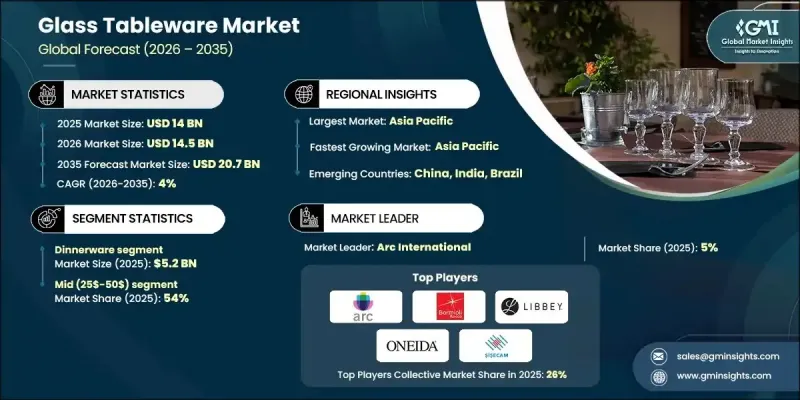
随着生活方式的改变、饮食习惯的演变以及人们对美观家居用品日益增长的兴趣,市场也不断演变,这些因素共同影响着消费者的购买决策。消费者越来越青睐兼具日常实用性和精緻设计的餐具,反映出人们普遍希望提升居家用餐体验。随着人们居家时间的增多,玻璃器皿不再只是功能性物品,更成为展现个人品味与室内风格的途径。这种对美学的日益关注促使製造商在保持产品耐用性和实用性的同时,不断创新,推出更具现代感的造型、纹理和饰面。餐饮服务业在塑造需求模式方面发挥关键作用,餐饮服务商优先考虑能够提升食物摆盘效果并提升用餐体验的餐具。这种影响迫使供应商拓展产品系列,以满足不同的服务环境,从而推动设计的持续演进和市场的持续扩张。
| 市场覆盖范围 | |
|---|---|
| 开始年份 | 2025 |
| 预测年份 | 2026-2035 |
| 起始值 | 140亿美元 |
| 预测金额 | 207亿美元 |
| 复合年增长率 | 4% |
截至2025年,价格在25美元至50美元之间的中端价位产品占了54%的市场。此价位产品兼具价格优势与品质,对许多消费者极具吸引力。这类产品通常性能可靠、功能齐全、经久耐用,且价格远低于奢侈品。随着成本绩效性价比的消费者越来越倾向选择功能齐全、风格时尚且价格合理的产品,中阶价位产品的需求持续成长。
预计到2025年,餐具市场规模将达到52亿美元,餐具仍然是餐桌上的核心,从日常用餐到特殊场合都不可或缺。消费者越来越倾向于兼具实用性和精緻美感的整体餐桌布置,这推动了餐具的持续更换。居家用餐、社交聚会以及赏心悦目的食物摆盘日益流行,也持续提振市场需求。製造商正积极响应这一趋势,推出兼具耐用性和现代设计的多功能餐具系列,使产品能够轻鬆驾驭从休閒到正式的各种场合。
预计到2025年,美国玻璃餐具市场将占据77%的市场份额,销售额将达到29亿美元,反映出美国消费者强大的购买力和成熟的零售基础设施。推动市场需求的因素包括:重视居家用餐体验的文化,以及不断升级餐具的蓬勃发展的饭店餐饮业。玻璃加工技术的持续进步,包括强度和透明度的提升,不断增强了产品的吸引力。这些因素使美国成为重要的收入来源,并支撑着住宅和商业领域的长期成长。
目录
第一章调查方法和范围
第二章执行摘要
第三章业界考察
- 生态系分析
- 供应商情况
- 利润率
- 每个阶段的附加价值
- 影响价值链的因素
- 产业影响因素
- 司机
- 饭店和餐饮服务业的扩张
- 消费者对赏心悦目的高端餐饮体验的需求日益增长
- 人们越来越倾向于选择永续和环保材料。
- 产业潜在风险与挑战
- 原料和生产成本上涨
- 损失风险和物流复杂性
- 机会
- 由于酒店业的扩张,亚太地区具有强劲的成长潜力。
- 玻璃製造技术和产品创新的进步
- 司机
- 成长潜力分析
- 关键市场趋势与颠覆性因素
- 未来市场趋势
- 风险及缓解分析
- 科技与创新趋势
- 当前技术趋势
- 新兴技术
- 价格趋势
- 按地区
- 依产品类型
- 监管环境
- 北美洲
- 欧洲
- 亚太地区
- 中东和非洲
- 拉丁美洲
- 波特分析
- PESTEL 分析
- 消费行为分析
- 购买模式
- 偏好分析
- 消费行为的区域差异
- 电子商务如何影响购买决策
第四章 竞争情势
- 介绍
- 公司市占率分析
- 按地区
- 企业矩阵分析
- 主要市场公司的竞争分析
- 竞争定位矩阵
- 重大进展
- 併购
- 伙伴关係与合作
- 新产品发布
- 扩张计划
第五章 依产品类型分類的市场估算与预测,2022-2035年
- 餐具
- 餐具
- 盘子
- 碗
- 汤匙和叉子
- 其他的
- 餐具
- 盛菜碗
- 托盘
- 拼盘
- 茶壶
- 饮具
- 眼镜
- 杯子
- 马克杯
- 鸡尾酒杯
- 小酒杯
- 不倒翁
- 其他的
第六章 2022-2035年按价格区间分類的市场估计与预测
- 价格低廉(25美元以下)
- 中檔价位(25-50美元)
- 高价位(超过 50 美元)
第七章 市场规模估算与预测(2022-2035年)
- 商业的
- 餐饮(饭店、餐厅、咖啡厅)
- 餐饮服务
- 酒吧和酒馆
- 水疗美容中心
- 零售商
- 其他的
- 家用
第八章 按分销管道分類的市场估算与预测,2022-2035年
- 在线的
- 离线
第九章 2022-2035年各地区市场估算与预测
- 北美洲
- 我们
- 加拿大
- 欧洲
- 德国
- 英国
- 法国
- 义大利
- 西班牙
- 土耳其
- 亚太地区
- 中国
- 日本
- 印度
- 澳洲
- 韩国
- 拉丁美洲
- 巴西
- 墨西哥
- 阿根廷
- 中东和非洲
- 南非
- 沙乌地阿拉伯
- 阿拉伯聯合大公国
第十章:公司简介
- Anchor Hocking LLC
- Arc International
- Bormioli Rocco SpA
- Borosil
- LaOpala RG Ltd.
- Lenox Corporation
- Libbey Inc.
- Oneida
- Pasabahce
- Sisecam Glassware
- Utopia Tableware LTD
- WMF
- Villeroy &Boch AG
- Krosno Glass SA
- Ocean Glass Public Company Limited
The Global Glass Tableware Market was valued at USD 14 billion in 2025 and is estimated to grow at a CAGR of 4% to reach USD 20.7 billion by 2035.
The market continues to evolve as changing lifestyles, shifting dining preferences, and growing interest in visually appealing home products influence purchasing decisions. Consumers increasingly prefer tableware that delivers everyday usability and refined design, reflecting a broader desire to elevate home dining experiences. As more time is spent at home, glass tableware has become an expression of personal taste and interior styling, rather than a purely functional item. This growing focus on aesthetics has encouraged manufacturers to innovate with contemporary shapes, textures, and finishes while maintaining durability and practicality. The hospitality sector plays a vital role in shaping demand patterns, as foodservice operators prioritize tableware that enhances presentation and complements dining experiences. This influence has prompted suppliers to broaden their product portfolios to meet diverse serving environments, driving continuous design evolution and supporting consistent market expansion.
| Market Scope | |
|---|---|
| Start Year | 2025 |
| Forecast Year | 2026-2035 |
| Start Value | $14 Billion |
| Forecast Value | $20.7 Billion |
| CAGR | 4% |
The mid-priced range between USD 25 and USD 50 segment held 54% share in 2025. This segment benefits from a strong balance between affordability and perceived quality, making it highly attractive to a broad consumer base. Products in this price bracket typically offer reliable performance, modern features, and acceptable durability without the premium pricing associated with high-end alternatives. As value-conscious consumers increasingly seek products that deliver functionality and style at reasonable costs, the mid-range category continues to gain traction.
The dinnerware segment generated USD 5.2 billion in 2025, as it remains central to both everyday dining and special occasions. Consumers increasingly favor coordinated table settings that balance functionality with refined appearance, encouraging steady replacement and upgrade cycles. The rising popularity of home dining, social gatherings, and visually appealing meal presentation continues to strengthen demand. Manufacturers are responding by offering versatile dinnerware collections that combine durability with contemporary styling, allowing products to transition easily between casual and formal use.
U.S. Glass Tableware Market accounted for 77% share and generated USD 2.9 billion in 2025, reflecting strong consumer purchasing power and mature retail infrastructure. Demand is reinforced by a culture that values quality dining experiences at home as well as a robust hospitality industry that consistently upgrades tableware. Ongoing advancements in glass processing, including improved strength and clarity, continue to enhance product appeal. These factors position the U.S. as a key revenue contributor while sustaining long-term growth across both residential and commercial segments.
Key companies active in the Global Glass Tableware Market include Arc International, Libbey Inc., Villeroy & Boch AG, Pasabahce, Anchor Hocking LLC, Sisecam Glassware, WMF, Oneida, Bormioli Rocco S.p.A, Borosil, LaOpala RG Ltd., Ocean Glass Public Company Limited, Krosno Glass S.A., Lenox Corporation, and Utopia Tableware LTD. Companies operating in the Glass Tableware Market focus on design innovation, material enhancement, and brand positioning to strengthen their market presence. Many players invest in developing scratch-resistant, lightweight, and durable glass solutions to meet evolving consumer expectations. Sustainability initiatives, including eco-friendly production processes and recyclable materials, are increasingly central to long-term strategies. Firms also expand distribution through omnichannel retail models, balancing strong offline presence with growing online sales.
Table of Contents
Chapter 1 Methodology and Scope
- 1.1 Market scope and definition
- 1.2 Research design
- 1.2.1 Research approach
- 1.2.2 Data collection methods
- 1.3 Data mining sources
- 1.3.1 Global
- 1.3.2 Regional/Country
- 1.4 Base estimates and calculations
- 1.4.1 Base year calculation
- 1.4.2 Key trends for market estimation
- 1.5 Primary research and validation
- 1.5.1 Primary sources
- 1.6 Forecast model
- 1.7 Research assumptions and limitations
Chapter 2 Executive Summary
- 2.1 Industry 360° synopsis
- 2.2 Key market trends
- 2.2.1 By regional
- 2.2.2 By product type
- 2.2.3 By price range
- 2.2.4 By end Use
- 2.2.5 By distribution channel
- 2.3 CXO perspectives: Strategic imperatives
- 2.3.1 Key decision points for industry executives
- 2.3.2 Critical success factors for market players
- 2.4 Future outlook and strategic recommendations
Chapter 3 Industry Insights
- 3.1 Industry ecosystem analysis
- 3.1.1 Supplier landscape
- 3.1.2 Profit margin
- 3.1.3 Value addition at each stage
- 3.1.4 Factor affecting the value chain
- 3.2 Industry impact forces
- 3.2.1 Growth drivers
- 3.2.1.1 Expansion of the hospitality and foodservice industry
- 3.2.1.2 Rising consumer shift toward aesthetic and premium dining experiences
- 3.2.1.3 Growing preference for sustainable and eco-friendly materials
- 3.2.2 Industry pitfalls & challenges
- 3.2.2.1 Rising costs of raw materials and production
- 3.2.2.2 Vulnerability to breakage and logistics complexity
- 3.2.3 Opportunities
- 3.2.3.1 Strong growth potential in Asia-Pacific due to hospitality expansion
- 3.2.3.2 Advancements in glass manufacturing and product innovation
- 3.2.1 Growth drivers
- 3.3 Growth potential analysis
- 3.4 Major market trends and disruption
- 3.5 Future market trends
- 3.6 Risk and mitigation analysis
- 3.7 Technology and innovation landscape
- 3.7.1 Current technological trends
- 3.7.2 Emerging technologies
- 3.8 Price trends
- 3.8.1 By region
- 3.8.2 By product type
- 3.9 Regulatory landscape
- 3.9.1 North America
- 3.9.2 Europe
- 3.9.3 Asia-Pacific
- 3.9.4 Middle East and Africa
- 3.9.5 Latin America
- 3.10 Porter';s analysis
- 3.11 PESTEL analysis
- 3.12 Consumer behaviour analysis
- 3.12.1 Purchasing patterns
- 3.12.2 Preference analysis
- 3.12.3 Regional variations in consumer behavior
- 3.12.4 Impact of e-commerce on buying decisions
Chapter 4 Competitive Landscape, 2025
- 4.1 Introduction
- 4.2 Company market share analysis
- 4.2.1 By region
- 4.2.1.1 North America
- 4.2.1.2 Europe
- 4.2.1.3 Asia Pacific
- 4.2.1.4 Latin America
- 4.2.1.5 Middle East and Africa
- 4.2.1 By region
- 4.3 Company matrix analysis
- 4.4 Competitive analysis of major market players
- 4.5 Competitive positioning matrix
- 4.6 Key developments
- 4.6.1 Mergers & acquisitions
- 4.6.2 Partnerships & collaborations
- 4.6.3 New product launches
- 4.6.4 Expansion plans
Chapter 5 Market Estimates & Forecast, By Product Type, 2022-2035 (USD Billion) (Thousand Units)
- 5.1 Key trends
- 5.2 Dinnerware
- 5.2.1 Dinner sets
- 5.2.2 Plates
- 5.2.3 Bowls
- 5.2.4 Spoons & forks
- 5.2.5 Others
- 5.3 Serve-ware
- 5.3.1 Serving bowls
- 5.3.2 Serving trays
- 5.3.3 Platters
- 5.3.4 Teapots
- 5.4 Drinkware
- 5.4.1 Glasses
- 5.4.2 Cups
- 5.4.3 Mugs
- 5.4.4 Cocktail glasses
- 5.4.5 Shot glasses
- 5.4.6 Tumblers
- 5.5 Others
Chapter 6 Market Estimates & Forecast, By Price Range, 2022-2035 (USD Billion) (Thousand Units)
- 6.1 Key trends
- 6.2 Low (<25$)
- 6.3 Mid(25$-50$)
- 6.4 High (>50$)
Chapter 7 Market Estimates & Forecast, By Size, 2022-2035 (USD Billion) (Thousand Units)
- 7.1 Key trends
- 7.2 Commercial
- 7.2.1 HoReCa
- 7.2.2 Catering services
- 7.2.3 Bars & pubs
- 7.2.4 Spa & beauty centers
- 7.2.5 Retailers
- 7.2.6 Others
- 7.3 Household
Chapter 8 Market Estimates & Forecast, By Distribution Channel, 2022-2035 (USD Billion) (Thousand Units)
- 8.1 Key trends
- 8.2 Online
- 8.3 Offline
Chapter 9 Market Estimates and Forecast, By Region, 2022 - 2035 (USD Billion) (Thousand Units)
- 9.1 Key trends
- 9.2 North America
- 9.2.1 U.S.
- 9.2.2 Canada
- 9.3 Europe
- 9.3.1 Germany
- 9.3.2 UK
- 9.3.3 France
- 9.3.4 Italy
- 9.3.5 Spain
- 9.3.6 Turkey
- 9.4 Asia Pacific
- 9.4.1 China
- 9.4.2 Japan
- 9.4.3 India
- 9.4.4 Australia
- 9.4.5 South Korea
- 9.5 Latin America
- 9.5.1 Brazil
- 9.5.2 Mexico
- 9.5.3 Argentina
- 9.6 Middle East and Africa
- 9.6.1 South Africa
- 9.6.2 Saudi Arabia
- 9.6.3 UAE
Chapter 10 Company Profiles
- 10.1 Anchor Hocking LLC
- 10.2 Arc International
- 10.3 Bormioli Rocco S.p.A
- 10.4 Borosil
- 10.5 LaOpala RG Ltd.
- 10.6 Lenox Corporation
- 10.7 Libbey Inc.
- 10.8 Oneida
- 10.9 Pasabahce
- 10.10 Sisecam Glassware
- 10.11 Utopia Tableware LTD
- 10.12 WMF
- 10.13 Villeroy & Boch AG
- 10.14 Krosno Glass S.A.
- 10.15 Ocean Glass Public Company Limited

 全球玻璃餐具市场规模、份额、趋势和成长分析报告(2026-2034年)
 玻璃餐具市场-全球产业规模、份额、趋势、机会及预测(依产品、应用、销售管道、地区及竞争格局划分,2021-2031年)
 玻璃餐具市场规模、份额及成长分析(依材质、款式、产品、应用、通路及地区划分)-2026-2033年产业预测
 按产品类型和地区分類的玻璃餐具市场
 2025 年至 2029 年全球玻璃餐具市场
 玻璃餐具市场;类型 - 餐具、饮具、服务用具、其他最终用途 - 住宅、商业(酒店和餐厅、酒吧、咖啡馆等); - 2024-2034 年全球产业分析、规模、份额、成长、趋势与预测