


 |
市场调查报告书
商品编码
1936483
分散式通风系统市场:机会、成长要素、产业趋势分析及2026年至2035年预测Decentralized Ventilation Systems Market Opportunity, Growth Drivers, Industry Trend Analysis, and Forecast 2026 - 2035 |
||||||

全球分散式通风系统市场预计到 2025 年将达到 99 亿美元,到 2035 年将达到 184 亿美元,年复合成长率为 6.4%。
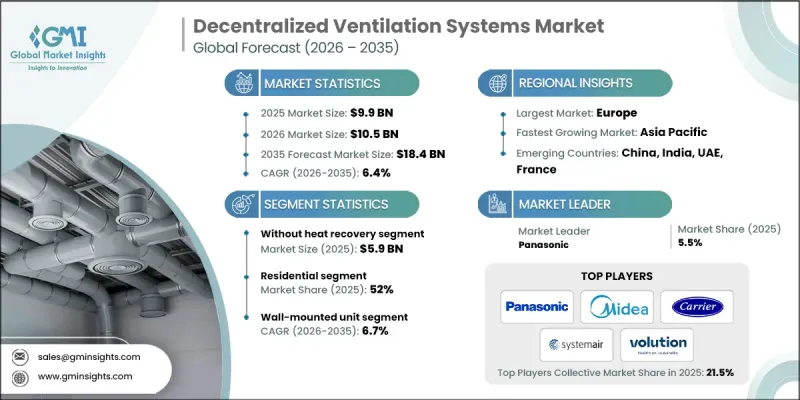
市场扩张得益于人们对室内空气品质及其对健康和福祉的直接影响的日益关注。随着空气污染日益严重,住宅和商业建筑越来越多地采用分散式通风系统,重视其提供定向通风和改善空气循环的能力。随着全球节能建筑实践的推广,强调建筑能源效率和通风标准的法规结构不断强化市场需求。快速的城市发展和永续建设活动也在推动市场成长,灵活的、针对特定房间的通风解决方案在现代建筑中日益受到重视。业界的技术进步进一步提升了市场的吸引力,智慧通风系统利用感测器和自动化技术,根据即时状况调节气流,从而提高效率和居住者舒适度。
| 市场覆盖范围 | |
|---|---|
| 开始年份 | 2025 |
| 预测年份 | 2026-2035 |
| 起始值 | 99亿美元 |
| 预测金额 | 184亿美元 |
| 复合年增长率 | 6.4% |
预计2026年至2035年间,热回收市场将以6.7%的复合年增长率成长。人们对排放减排的日益关注正在加速住宅、商业和工业领域的热回收系统应用。这些系统能够最大限度地减少能源损失,维持室内空气质量,同时符合严格的能源效率法规。
预计到2025年,住宅市场将占52%的市场份额,并在2035年之前保持6.7%的复合年增长率。人们对健康生活环境的日益关注、节能技术的广泛应用以及都市区住宅开发的不断扩张,将继续推动这一增长。政府主导的永续性倡议和建筑节能政策也促使住宅投资先进的通风解决方案。
预计到2025年,美国分散式通风系统市场将占据80%的市场份额,市场规模将达到15亿美元。市场成长的主要驱动力是人们对空气品质日益增长的关注以及日益严格的监管要求。儘管由于节能型居住解决方案的普及,住宅需求依然强劲,但商业建筑越来越注重确保可控气流,以提升居住者舒适度和营运效率。
目录
第一章调查方法和范围
第二章执行摘要
第三章业界考察
- 生态系分析
- 供应商情况
- 利润率
- 每个阶段的附加价值
- 影响价值链的因素
- 产业影响因素
- 司机
- 产业潜在风险与挑战
- 机会
- 成长潜力分析
- 未来市场趋势
- 科技与创新趋势
- 当前技术趋势
- 新兴技术
- 价格趋势
- 按地区
- 依系统类型
- 监管环境
- 标准和合规要求
- 区域法规结构
- 认证标准
- 波特五力分析
- PESTEL 分析
第四章 竞争情势
- 介绍
- 公司市占率分析
- 按地区
- 企业矩阵分析
- 主要市场公司的竞争分析
- 竞争定位矩阵
- 重大进展
- 併购
- 伙伴关係与合作
- 新产品发布
- 扩张计划
第五章 依系统类型分類的市场估算与预测,2022-2035年
- 热回收
- 无热回收
第六章 按类型分類的市场估算与预测,2022-2035年
- 水平单元
- 直立式单元
7. 按安装类型分類的市场估算与预测,2022-2035 年
- 吸顶式单元
- 壁挂式单元
- 落地式单元
- 其他(例如,视窗整合式等)
第八章 按应用领域分類的市场估算与预测,2022-2035年
- 新建工程
- 维修
第九章 依最终用户分類的市场估算与预测,2022-2035年
- 住宅
- 商业的
- 办公室
- 学校
- 医疗设施
- 其他(零售商店等)
- 工业的
第十章 按分销管道分類的市场估算与预测,2022-2035年
- 直销
- 间接销售
第十一章 2022-2035年各地区市场估计与预测
- 北美洲
- 我们
- 加拿大
- 欧洲
- 德国
- 英国
- 法国
- 西班牙
- 义大利
- 荷兰
- 亚太地区
- 中国
- 日本
- 印度
- 澳洲
- 韩国
- 拉丁美洲
- 巴西
- 墨西哥
- 阿根廷
- 中东和非洲
- 南非
- 沙乌地阿拉伯
- 阿拉伯聯合大公国
第十二章:公司简介
- Daikin
- Midea
- Panasonic
- Carrier
- Systemair
- Gree Electric
- Volution Group
- Mitsubishi Electric
- Johnson Controls
- LG Electronics
- Zehnder
- Lindab
- Broan-NuTone
- Haier
- RenewAire
The Global Decentralized Ventilation Systems Market was valued at USD 9.9 billion in 2025 and is estimated to grow at a CAGR of 6.4% to reach USD 18.4 billion by 2035.
Market expansion is supported by rising awareness of indoor air quality and its direct impact on health and well-being. Growing exposure to air pollution has increased adoption across residential and commercial buildings, where decentralized systems are preferred for their ability to deliver targeted ventilation and improved air circulation. Regulatory frameworks emphasizing energy efficiency and ventilation standards in buildings continue to strengthen demand, as governments worldwide promote energy-conscious construction practices. Rapid urban development and sustained construction activity are also reinforcing growth, as modern buildings increasingly prioritize flexible, room-specific ventilation solutions. Technological progress within the industry is further enhancing market attractiveness, with smart ventilation systems using sensors and automation to regulate airflow based on real-time conditions, improving both efficiency and occupant comfort.
| Market Scope | |
|---|---|
| Start Year | 2025 |
| Forecast Year | 2026-2035 |
| Start Value | $9.9 Billion |
| Forecast Value | $18.4 Billion |
| CAGR | 6.4% |
The heat recovery segment is projected to grow at a CAGR of 6.7% from 2026 to 2035. Rising focus on energy conservation and emissions reduction is accelerating adoption across residential, commercial, and industrial environments, as these systems preserve indoor air quality while minimizing energy losses and complying with strict efficiency mandates.
The residential segment accounted for 52% share in 2025 and is forecast to grow at a CAGR of 6.7% through 2035. Increased awareness of healthy living environments, combined with higher adoption of energy-saving technologies and expanding urban housing developments, continues to support growth. Government-led sustainability initiatives and building efficiency policies are also encouraging homeowners to invest in advanced ventilation solutions.
United States Decentralized Ventilation Systems Market held an 80% share and generated USD 1.5 billion in 2025. Market growth is driven by heightened air quality awareness and strict regulatory requirements. Residential demand remains strong due to growing acceptance of energy-efficient living solutions, while commercial spaces increasingly prioritize controlled airflow to support occupant comfort and operational efficiency.
Key players in the Global Decentralized Ventilation Systems Market include Daikin, Panasonic, Mitsubishi Electric, LG Electronics, Carrier, Midea, Gree Electric, Johnson Controls, Systemair, Volution Group, Zehnder, Lindab, Broan-NuTone, Haier, and RenewAire. Companies in the decentralized ventilation systems market are strengthening their competitive position by focusing on product innovation, smart system integration, and energy-efficient designs aligned with evolving building regulations. Manufacturers are investing in sensor-enabled and automated ventilation technologies to meet demand for intelligent indoor climate control. Strategic partnerships with construction firms and real estate developers are expanding market reach, while localization of manufacturing and supply chains is helping reduce costs and improve responsiveness. Firms are also emphasizing sustainability by developing low-energy and eco-friendly solutions that align with green building initiatives.
Table of Contents
Chapter 1 Methodology and scope
- 1.1 Market scope and definition
- 1.2 Research design
- 1.2.1 Research approach
- 1.2.2 Data collection methods
- 1.3 Data mining sources
- 1.3.1 Global
- 1.3.2 Regional/country
- 1.4 Base estimates and calculations
- 1.4.1 Base year calculation
- 1.4.2 Key trends for market estimation
- 1.5 Primary research and validation
- 1.5.1 Primary sources
- 1.6 Forecast model
- 1.7 Research assumptions and limitations
Chapter 2 Executive summary
- 2.1 Industry 360° synopsis
- 2.2 Key market trends
- 2.2.1 Regional
- 2.2.2 System Type
- 2.2.3 Type
- 2.2.4 Installation Types
- 2.2.5 Application
- 2.2.6 End Users
- 2.2.7 Distribution Channel
- 2.3 CXO perspectives: strategic imperatives
- 2.3.1 Key decision points for industry executives
- 2.3.2 Critical success factors for market players
- 2.4 Future outlook and strategic recommendations
Chapter 3 Industry insights
- 3.1 Industry ecosystem analysis
- 3.1.1 Supplier landscape
- 3.1.2 Profit margin
- 3.1.3 Value addition at each stage
- 3.1.4 Factor affecting the value chain
- 3.2 Industry impact forces
- 3.2.1 Growth drivers
- 3.2.2 Industry pitfalls & challenges
- 3.2.3 Opportunities
- 3.3 Growth potential analysis
- 3.4 Future market trends
- 3.5 Technology and innovation landscape
- 3.5.1 Current technological trends
- 3.5.2 Emerging technologies
- 3.6 Price trends
- 3.6.1 By region
- 3.6.2 By system type
- 3.7 Regulatory landscape
- 3.7.1 Standards and compliance requirements
- 3.7.2 Regional regulatory frameworks
- 3.7.3 Certification standards
- 3.8 Porter's analysis
- 3.9 PESTEL analysis
Chapter 4 Competitive landscape, 2025
- 4.1 Introduction
- 4.2 Company market share analysis
- 4.2.1 By region
- 4.2.1.1 North America
- 4.2.1.2 Europe
- 4.2.1.3 Asia Pacific
- 4.2.1.4 Latin America
- 4.2.1.5 MEA
- 4.2.1 By region
- 4.3 Company matrix analysis
- 4.4 Competitive analysis of major market players
- 4.5 Competitive positioning matrix
- 4.6 Key developments
- 4.6.1 Mergers & acquisitions
- 4.6.2 Partnerships & collaborations
- 4.6.3 New product launches
- 4.6.4 Expansion plans
Chapter 5 Market Estimates & Forecast, By System Type, 2022 - 2035 ($Billion, Thousand Units)
- 5.1 Key trends
- 5.2 Heat recovery
- 5.3 Without heat recovery
Chapter 6 Market Estimates & Forecast, By Type, 2022 - 2035 ($Billion, Thousand Units)
- 6.1 Key trends
- 6.2 Horizontal units
- 6.3 Vertical units
Chapter 7 Market Estimates & Forecast, By Installation Types, 2022 - 2035 ($Billion, Thousand Units)
- 7.1 Key trends
- 7.2 Ceiling-mounted unit
- 7.3 Wall-mounted unit
- 7.4 Floor-mounted unit
- 7.5 Others (window-integrated etc.)
Chapter 8 Market Estimates & Forecast, By Application, 2022 - 2035 ($Billion, Thousand Units)
- 8.1 Key trends
- 8.2 New construction
- 8.3 Retrofit
Chapter 9 Market Estimates & Forecast, By End Users, 2022 - 2035 ($Billion, Thousand Units)
- 9.1 Key trends
- 9.2 Residential
- 9.3 Commercial
- 9.3.1 Offices
- 9.3.2 Schools
- 9.3.3 Healthcare facilities
- 9.3.4 Others (retail stores etc.)
- 9.4 Industrial
Chapter 10 Market Estimates & Forecast, By Distribution Channel, 2022 - 2035 ($Billion, Thousand Units)
- 10.1 Key trends
- 10.2 Direct sales
- 10.3 Indirect sales
Chapter 11 Market Estimates & Forecast, By Region, 2022 - 2035 ($Billion, Thousand Units)
- 11.1 Key trends
- 11.2 North America
- 11.2.1 U.S.
- 11.2.2 Canada
- 11.3 Europe
- 11.3.1 Germany
- 11.3.2 UK
- 11.3.3 France
- 11.3.4 Spain
- 11.3.5 Italy
- 11.3.6 Netherlands
- 11.4 Asia Pacific
- 11.4.1 China
- 11.4.2 Japan
- 11.4.3 India
- 11.4.4 Australia
- 11.4.5 South Korea
- 11.5 Latin America
- 11.5.1 Brazil
- 11.5.2 Mexico
- 11.5.3 Argentina
- 11.6 MEA
- 11.6.1 South Africa
- 11.6.2 Saudi Arabia
- 11.6.3 UAE
Chapter 12 Company Profiles
- 12.1 Daikin
- 12.2 Midea
- 12.3 Panasonic
- 12.4 Carrier
- 12.5 Systemair
- 12.6 Gree Electric
- 12.7 Volution Group
- 12.8 Mitsubishi Electric
- 12.9 Johnson Controls
- 12.10 LG Electronics
- 12.11 Zehnder
- 12.12 Lindab
- 12.13 Broan-NuTone
- 12.14 Haier
- 12.15 RenewAire

 2026年全球美髮沙龙通风系统市场报告
 防雾霾新风通风扇市场:依产品类型、安装方式、过滤技术、应用领域、最终用户划分,全球预测(2026-2032年)全球屋顶上吹式通风扇市场(按通风扇类型、最终用途产业、驱动类型、材料、安装类型和风量划分)预测(2026-2032年)商用喷射扩散器市场按类型、材料、应用、分销管道和最终用户划分,全球预测(2026-2032)2026年全球通风、暖气、空调和商用冷冻设备市场报告2026年全球通风系统市场报告
 热疗呼吸器市场 - 全球产业规模、份额、趋势、机会、预测:按产品类型、最终用户、地区和竞争对手划分,2021-2031年船舶通风系统市场 - 全球产业规模、份额、趋势、机会及按类型、应用、地区和竞争格局分類的预测(2021-2031年)
 通风系统市场规模、占有率、成长及全球产业分析:依类型、应用和地区划分的洞察与预测(2026-2034)
 中国通风市场(2025)