


 |
市场调查报告书
商品编码
1936484
阻燃剂市场机会、成长要素、产业趋势分析及2026年至2035年预测Flame Retardants Market Opportunity, Growth Drivers, Industry Trend Analysis, and Forecast 2026 - 2035 |
||||||

全球阻燃剂市场预计到 2025 年将达到 98 亿美元,到 2035 年将达到 177 亿美元,年复合成长率为 6.1%。
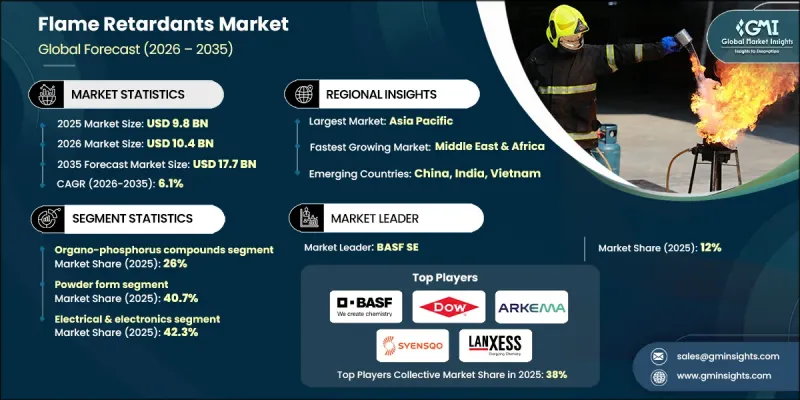
市场成长主要受严格的消防安全法规、快速的都市化以及建筑、电气电子和交通运输行业日益增长的需求所驱动。阻燃剂在降低火灾风险方面发挥关键作用,其作用机制包括延缓点燃、抑制火焰蔓延和减少烟雾产生,适用于包括塑胶、纤维、发泡体和涂料在内的多种材料。随着基础设施建设的不断改进、电气化程度的提高以及电子设备的广泛应用,耐火材料的重要性显着提升。同时,住宅、商业和工业设施公共标准的不断提高也持续推动对先进阻燃解决方案的需求。
| 市场覆盖范围 | |
|---|---|
| 开始年份 | 2025 |
| 预测年份 | 2026-2035 |
| 起始值 | 98亿美元 |
| 预测金额 | 177亿美元 |
| 复合年增长率 | 6.1% |
随着监管机构和终端用户日益重视永续性、低毒性和可回收性,市场正经历着向环保无卤化阻燃剂的重大转变。製造商正日益关注磷基、无机和聚合物结合型阻燃体系,这些体系既能满足不断发展的环境法规标准,又能提供有效的防火保护。封装和分散技术的进步进一步提高了阻燃剂的性能稳定性及其与现代聚合物的兼容性。这些创新在电动车、可再生能源系统和智慧基础设施等高成长产业尤其重要,因为在这些产业中,防火安全至关重要,对材料性能的要求也日益严格。
按类型划分,有机磷酸酯类化合物预计到2025年将占据26%的市场。这些化合物因其优异的阻燃性能、在多种聚合物系统中的通用性以及相比传统卤代产品更高的合规性而被广泛应用。有机磷酸酯类阻燃剂广泛应用于工程塑胶、发泡体、涂料和电子元件等领域,这些领域对低烟和高热稳定性要求极高。其在无卤组合药物中的日益普及符合全球永续性目标,进一步巩固了其市场主导地位。
以最终用途划分,到2025年,电气和电子设备产业将占据42.3%的市场。这主要得益于家用电器机壳、电路基板、连接器以及电线电缆等部件中阻燃剂使用量的不断增长,以满足日益严格的防火安全和性能标准。家用电器、资料中心、智慧型设备和电力基础设施的快速发展,推动了对能够承受高温、电应力和长期运作的高性能阻燃材料的需求。随着电子元件变得越来越小巧、越来越复杂,对既能确保安全又不影响功能的先进阻燃解决方案的需求也日益增长。
预计2025年,美国阻燃剂市场规模将达20亿美元。北美地区的成长主要由美国推动,美国成熟的电子製造业基础支撑着稳定的需求,无卤材料在布线、绝缘和电路保护应用中的采用率不断提高。强劲的建筑活动持续推动耐火材料的使用,而汽车生产的持续成长也进一步支撑了消费。 UL-94和NFPA等消防安全标准的严格执行、先进磷基化合物技术的引入以及完善的合规体系,不断巩固美国的市场地位。陶氏化学、雅宝公司和科莱恩等主要製造商在保障供应安全和巩固美国在区域市场的地位方面发挥核心作用。
目录
第一章调查方法和范围
第二章执行摘要
第三章业界考察
- 生态系分析
- 供应商情况
- 利润率
- 每个阶段的附加价值
- 影响价值链的因素
- 中断
- 产业影响因素
- 司机
- 产业潜在风险与挑战
- 市场机会
- 成长潜力分析
- 监管环境
- 北美洲
- 欧洲
- 亚太地区
- 拉丁美洲
- 中东和非洲
- 波特五力分析
- PESTEL 分析
- 科技与创新趋势
- 当前技术趋势
- 新兴技术
- 价格趋势
- 按地区
- 按类型
- 未来市场趋势
- 科技与创新趋势
- 当前技术趋势
- 新兴技术
- 专利状态
- 贸易统计(HS编码)
- 主要进口国
- 主要出口国
- 永续性和环境方面
- 永续努力
- 减少废弃物策略
- 生产中的能源效率
- 环保倡议
- 考虑到碳足迹
第四章 竞争情势
- 介绍
- 公司市占率分析
- 按地区
- 北美洲
- 欧洲
- 亚太地区
- 拉丁美洲
- 中东和非洲
- 按地区
- 企业矩阵分析
- 主要市场公司的竞争分析
- 竞争定位矩阵
- 重大进展
- 併购
- 伙伴关係与合作
- 新产品发布
- 扩张计划
第五章 按类型分類的市场估算与预测,2022-2035年
- 溴化物
- 十溴二苯基醚(DecaBDE)
- 六溴环十二烷(HBCD)
- TBBPA(四溴双酚A)
- DBDPE(十溴二苯乙烷)
- 其他溴化化合物
- 氯代化合物
- 氯化石蜡
- 德氯烷加
- 其他氯代化合物
- 锑化合物(ATO)
- 氢氧化铝(ATH)
- ATH粉末
- ATH母粒
- 多种涂层ATH
- 有机磷化合物
- DOPO(9,10-二氢-9-氧杂-10-磷杂菲-10-氧化物)
- RDP(间苯二酚双(二苯基磷酸酯))
- TPP(磷酸三苯酯)
- 多聚磷酸铵
- 其他磷化合物
- 硼酸锌
- 技术级硼酸锌(2ZnO・3B2O3・3.5H2O)
- 脱水硼酸锌
- 锡酸锌
- 标准级锡酸锌
- 高纯度
- 其他特种化学品
- 氢氧化镁
- 三聚氰胺氰尿酸盐
- 可膨胀石墨
- 新兴特殊化合物
第六章 依产品类型分類的市场估算与预测,2022-2035年
- 粉状
- 技术级粉末
- 微粉
- 表面涂层粉末
- 颗粒/丸剂
- 母粒颗粒
- 颗粒状
- 液态
- 液态磷化合物
- 滷代液FRS
- 封装形式
- 微胶囊化磷阻燃剂
- 先进分散技术
7. 依最终用途分類的市场估计与预测,2022-2035 年
- 建筑材料
- 隔热材料
- 建筑板材
- 泡沫和密封剂
- 防火涂料
- 电气和电子设备
- 家用电子电器机壳
- 电路基板和元件
- 连接器和开关
- 电线电缆
- 电源线
- 数据和通信电缆
- 汽车线束
- 运输
- 汽车应用
- 航太应用
- 铁路和海运应用
- 纺织品和室内装饰
- 商用家具
- 汽车内装
- 防护纺织品
- 黏合剂和密封剂
- 结构性黏着剂
- 防火密封胶
- 其他用途
- 纸张/包装
- 橡胶应用
- 新兴应用
第八章 2022-2035年各地区市场估算与预测
- 北美洲
- 我们
- 加拿大
- 欧洲
- 德国
- 英国
- 法国
- 西班牙
- 义大利
- 其他欧洲地区
- 亚太地区
- 中国
- 印度
- 日本
- 澳洲
- 韩国
- 亚太其他地区
- 拉丁美洲
- 巴西
- 墨西哥
- 阿根廷
- 其他拉丁美洲地区
- 中东和非洲
- 沙乌地阿拉伯
- 南非
- 阿拉伯聯合大公国
- 其他中东和非洲地区
第九章:公司简介
- Albemarle Corporation
- Dow Inc.
- Nouryon
- ICL Group Ltd.
- LANXESS AG
- BASF SE
- Clariant AG
- Tomiyama Pure Chemical
- Eti Maden
- Hangzhou JLS Flame Retardants Chemical Co., Ltd.
- Zhejiang Wansheng Co., Ltd.
- Nabaltec AG
- Valtris
- Rio Tinto
- Syensqo
- Huber Engineered Materials
- Tosoh Corporation
- Avient Corporation
- Daihachi Chemical
- Italmatch Chemicals
- William Blythe Ltd.
- Zibo Hengjin Chemical Co., Ltd.
- ADEKA Corporation
- Jiangsu Yoke Technology Co., Ltd.
- Arkema
The Global Flame Retardants Market was valued at USD 9.8 billion in 2025 and is estimated to grow at a CAGR of 6.1% to reach USD 17.7 billion by 2035.
Market growth is driven by stringent fire safety regulations, rapid urbanization, and rising demand from construction, electrical & electronics, and transportation industries. Flame retardants play a critical role in reducing fire-related risks by delaying ignition, slowing flame spread, and minimizing smoke generation across a wide range of materials, including plastics, textiles, foams, and coatings. Increasing infrastructure development, electrification, and the proliferation of electronic devices have significantly elevated the importance of fire-resistant materials. At the same time, regulatory pressure to improve public safety standards across residential, commercial, and industrial settings continues to support sustained demand for advanced flame-retardant solutions.
| Market Scope | |
|---|---|
| Start Year | 2025 |
| Forecast Year | 2026-2035 |
| Start Value | $9.8 Billion |
| Forecast Value | $17.7 Billion |
| CAGR | 6.1% |
The market is witnessing a pronounced shift toward environmentally friendly and halogen-free flame retardants, as regulatory agencies and end users prioritize sustainability, reduced toxicity, and recyclability. Manufacturers are increasingly focusing on phosphorus-based, inorganic, and polymer-bound flame-retardant systems that offer effective fire protection while meeting evolving environmental compliance norms. Technological advancements in encapsulation and dispersion technologies have further enhanced performance consistency and compatibility with modern polymers. These innovations are particularly relevant for high-growth applications such as electric vehicles, renewable energy systems, and smart infrastructure, where fire safety is critical and material performance requirements are increasingly stringent.
By type, the organo-phosphorus compounds segment held 26% share in 2025. These compounds are widely adopted due to their excellent flame-retardant efficiency, versatility across multiple polymer systems, and strong regulatory acceptance compared to traditional halogenated products. Organo-phosphorus flame retardants are extensively used in engineering plastics, foams, coatings, and electronic components, where low smoke emission and high thermal stability are essential. Their growing use in halogen-free formulations aligns well with global sustainability goals, further reinforcing their leadership position in the market.
In terms of end use, the electrical & electronics segment held 42.3% share in 2025, driven by the increasing use of flame retardants in consumer electronics housings, circuit boards, connectors, wires, and cables to meet strict fire safety and performance standards. Rapid growth in consumer electronics, data centers, smart devices, and power infrastructure has amplified demand for high-performance flame-retardant materials that can withstand heat, electrical stress, and long operational lifecycles. As electronic components become smaller and more powerful, the need for advanced flame-retardant solutions that ensure safety without compromising functionality continues to rise.
U.S. Flame Retardants Market generated USD 2 billion in 2025. Growth across North America is largely anchored in the United States, where steady demand is supported by a mature electronics manufacturing base that increasingly adopts halogen-free materials for wiring, insulation, and circuit protection. Strong activity in construction continues to drive the use of fire-resistant materials, while ongoing automotive production further reinforces consumption. Strict enforcement of fire safety regulations such as UL-94 and NFPA standards, along with the adoption of advanced phosphorus-based formulations and well-established compliance frameworks, continues to strengthen the country's market standing. Leading manufacturers including Dow Inc., Albemarle Corporation, and Clariant AG play a central role in maintaining supply stability and reinforcing the U.S. position within the regional market.
Key players operating in the Global Flame Retardants Market include BASF SE, Albemarle Corporation, ICL Group Ltd., LANXESS AG, Clariant AG, Avient Corporation, Arkema, Syensqo, Nabaltec AG, and Huber Engineered Materials. These companies maintain strong market positions through broad product portfolios, global manufacturing footprints, and deep technical expertise across multiple end-use industries. Companies in the Flame Retardants Market are strengthening their market foothold through product innovation, sustainability-focused R&D, and strategic partnerships with end-use industries. Leading players are investing in the development of halogen-free, low-smoke, and polymer-bound flame retardants to address tightening environmental regulations and customer sustainability goals. Expansion into high-growth regions, particularly Asia Pacific, through local manufacturing and distribution networks remains a key strategy. Firms are also enhancing application engineering support and regulatory compliance services to help customers meet complex fire safety standards.
Table of Contents
Chapter 1 Methodology & Scope
- 1.1 Market scope and definition
- 1.2 Research design
- 1.2.1 Research approach
- 1.2.2 Data collection methods
- 1.3 Data mining sources
- 1.3.1 Global
- 1.3.2 Regional/Country
- 1.4 Base estimates and calculations
- 1.4.1 Base year calculation
- 1.4.2 Key trends for market estimation
- 1.5 Primary research and validation
- 1.5.1 Primary sources
- 1.6 Forecast model
- 1.7 Research assumptions and limitations
Chapter 2 Executive Summary
- 2.1 Industry 360° synopsis
- 2.2 Key market trends
- 2.2.1 Product
- 2.2.2 Material type
- 2.2.3 Application
- 2.2.4 Regional
- 2.3 TAM Analysis, 2026-2035
- 2.4 CXO perspectives: Strategic imperatives
- 2.4.1 Executive decision points
- 2.4.2 Critical success factors
- 2.5 Future outlook and strategic recommendations
Chapter 3 Industry Insights
- 3.1 Industry ecosystem analysis
- 3.1.1 Supplier landscape
- 3.1.2 Profit margin
- 3.1.3 Value addition at each stage
- 3.1.4 Factor affecting the value chain
- 3.1.5 Disruptions
- 3.2 Industry impact forces
- 3.2.1 Growth drivers
- 3.2.2 Industry pitfalls and challenges
- 3.2.3 Market opportunities
- 3.3 Growth potential analysis
- 3.4 Regulatory landscape
- 3.4.1 North America
- 3.4.2 Europe
- 3.4.3 Asia Pacific
- 3.4.4 Latin America
- 3.4.5 Middle East & Africa
- 3.5 Porter's analysis
- 3.6 PESTEL analysis
- 3.7 Technology and innovation landscape
- 3.7.1 Current technological trends
- 3.7.2 Emerging technologies
- 3.8 Price trends
- 3.8.1 By region
- 3.8.2 By type
- 3.9 Future market trends
- 3.10 Technology and innovation landscape
- 3.10.1 Current technological trends
- 3.10.2 Emerging technologies
- 3.11 Patent landscape
- 3.12 Trade statistics (HS code)
- 3.12.1 Major importing countries
- 3.12.2 Major exporting countries
- 3.13 Sustainability and environmental aspects
- 3.13.1 Sustainable practices
- 3.13.2 Waste reduction strategies
- 3.13.3 Energy efficiency in production
- 3.13.4 Eco-friendly initiatives
- 3.14 Carbon footprint consideration
Chapter 4 Competitive Landscape, 2025
- 4.1 Introduction
- 4.2 Company market share analysis
- 4.2.1 By region
- 4.2.1.1 North America
- 4.2.1.2 Europe
- 4.2.1.3 Asia Pacific
- 4.2.1.4 LATAM
- 4.2.1.5 MEA
- 4.2.1 By region
- 4.3 Company matrix analysis
- 4.4 Competitive analysis of major market players
- 4.5 Competitive positioning matrix
- 4.6 Key developments
- 4.6.1 Mergers & acquisitions
- 4.6.2 Partnerships & collaborations
- 4.6.3 New product launches
- 4.6.4 Expansion plans
Chapter 5 Market Estimates and Forecast, By Type, 2022-2035 (USD Million) (Kilo Tons)
- 5.1 Key trends
- 5.2 Brominated compounds
- 5.2.1 DecaBDE (decabromodiphenyl ether)
- 5.2.2 HBCD (hexabromocyclododecane)
- 5.2.3 TBBPA (tetrabromobisphenol A)
- 5.2.4 DBDPE (decabromodiphenyl ethane)
- 5.2.5 Other brominated compounds
- 5.3 Chlorinated compounds
- 5.3.1 Chlorinated paraffins
- 5.3.2 Dechlorane plus
- 5.3.3 Other chlorinated compounds
- 5.4 Antimony compounds (ATO)
- 5.5 Aluminum trihydroxide (ATH)
- 5.5.1 ATH powder
- 5.5.2 ATH masterbatch
- 5.5.3 Coated ATH variants
- 5.6 Organo-phosphorus compounds
- 5.6.1 DOPO (9,10-dihydro-9-oxa-10-phosphaphenanthrene-10-oxide)
- 5.6.2 RDP (resorcinol bis(diphenylphosphate))
- 5.6.3 TPP (triphenyl phosphate)
- 5.6.4 Ammonium polyphosphate
- 5.6.5 Other phosphorus compounds
- 5.7 Zinc borate
- 5.7.1 Technical grade zinc borate (2ZnO·3B2O3·3.5H2O)
- 5.7.2 Dehydrated zinc borate
- 5.8 Zinc stannate
- 5.8.1 Standard grade zinc stannate
- 5.8.2 High-purity grades
- 5.9 Other specialty chemicals
- 5.9.1 Magnesium hydroxide
- 5.9.2 Melamine cyanurate
- 5.9.3 Expandable graphite
- 5.9.4 Emerging specialty compounds
Chapter 6 Market Estimates and Forecast, By Product Form, 2022-2035 (USD Million) (Kilo Tons)
- 6.1 Key trends
- 6.2 Powder form
- 6.2.1 Technical-grade powder
- 6.2.2 Micronized powder
- 6.2.3 Surface-coated powder
- 6.3 Granules/pellets
- 6.3.1 Masterbatch granules
- 6.3.2 Pelletized forms
- 6.4 Liquid form
- 6.4.1 Liquid phosphorus compounds
- 6.4.2 Halogenated liquid FRS
- 6.5 Encapsulated form
- 6.5.1 Microencapsulated FRS
- 6.5.2 Advanced dispersion technologies
Chapter 7 Market Estimates and Forecast, By End Use, 2022-2035 (USD Million) (Kilo Tons)
- 7.1 Construction materials
- 7.1.1 Insulation materials
- 7.1.2 Building panels and boards
- 7.1.3 Foams and sealants
- 7.1.4 Fire-rated paints and coatings
- 7.2 Electrical & electronics
- 7.2.1 Consumer electronics housings
- 7.2.2 Circuit boards and components
- 7.2.3 Connectors and switches
- 7.3 Wires & cables
- 7.3.1 Power cables
- 7.3.2 Data and telecom cables
- 7.3.3 Automotive wiring
- 7.4 Transportation
- 7.4.1 Automotive end uses
- 7.4.2 Aerospace end uses
- 7.4.3 Rail and marine end uses
- 7.5 Textiles & upholstery
- 7.5.1 Contract furnishings
- 7.5.2 Automotive interiors
- 7.5.3 Protective textiles
- 7.6 Adhesives & sealants
- 7.6.1 Structural adhesives
- 7.6.2 Fire-rated sealants
- 7.7 Other end uses
- 7.7.1 Paper and packaging
- 7.7.2 Rubber end uses
- 7.7.3 Emerging end uses
Chapter 8 Market Estimates and Forecast, By Region, 2022-2035 (USD Million) (Kilo Tons)
- 8.1 Key trends
- 8.2 North America
- 8.2.1 U.S.
- 8.2.2 Canada
- 8.3 Europe
- 8.3.1 Germany
- 8.3.2 UK
- 8.3.3 France
- 8.3.4 Spain
- 8.3.5 Italy
- 8.3.6 Rest of Europe
- 8.4 Asia Pacific
- 8.4.1 China
- 8.4.2 India
- 8.4.3 Japan
- 8.4.4 Australia
- 8.4.5 South Korea
- 8.4.6 Rest of Asia Pacific
- 8.5 Latin America
- 8.5.1 Brazil
- 8.5.2 Mexico
- 8.5.3 Argentina
- 8.5.4 Rest of Latin America
- 8.6 Middle East and Africa
- 8.6.1 Saudi Arabia
- 8.6.2 South Africa
- 8.6.3 UAE
- 8.6.4 Rest of Middle East and Africa
Chapter 9 Company Profiles
- 9.1 Albemarle Corporation
- 9.2 Dow Inc.
- 9.3 Nouryon
- 9.4 ICL Group Ltd.
- 9.5 LANXESS AG
- 9.6 BASF SE
- 9.7 Clariant AG
- 9.8 Tomiyama Pure Chemical
- 9.9 Eti Maden
- 9.10 Hangzhou JLS Flame Retardants Chemical Co., Ltd.
- 9.11 Zhejiang Wansheng Co., Ltd.
- 9.12 Nabaltec AG
- 9.13 Valtris
- 9.14 Rio Tinto
- 9.15 Syensqo
- 9.16 Huber Engineered Materials
- 9.17 Tosoh Corporation
- 9.18 Avient Corporation
- 9.19 Daihachi Chemical
- 9.20 Italmatch Chemicals
- 9.21 William Blythe Ltd.
- 9.22 Zibo Hengjin Chemical Co., Ltd.
- 9.23 ADEKA Corporation
- 9.24 Jiangsu Yoke Technology Co., Ltd.
- 9.25 Arkema

 阻燃热塑性塑胶市场:2026-2032年全球市场预测(依聚合物类型、终端用途产业、阻燃类型、增强类型、製造流程和形状划分)
 下一代阻燃剂市场预测至2034年:按类型、应用、最终用户和地区分類的全球分析现场阻燃处理服务市场:依服务类型、阻燃剂类型、应用领域及最终用户产业划分-2026-2032年全球市场预测硅基阻燃剂市场:按类型、形态、通路、应用和最终用途划分-2026年至2032年全球预测
 2026-2034年全球锑酸钠市场规模、份额、趋势和成长分析报告
 2026年全球阻燃剂市场报告
 阻燃剂市场-全球产业规模、份额、趋势、机会及预测(按类型、聚合物、应用、地区和竞争格局划分,2021-2031年)飞机阻燃薄膜市场-全球产业规模、份额、趋势、机会及预测(依飞机类型、材料种类、毯材种类、地区及竞争格局划分,2021-2031年)电池电解阻燃剂市场(按电池类型、形式、化学成分和应用划分)—2026-2032年全球预测阻燃电缆市场:按类型、绝缘材料、电压、导体材料、安装方式、应用领域和销售管道,全球预测,2026-2032年