


 |
市场调查报告书
商品编码
1936488
鱼类驱虫药市场机会、成长要素、产业趋势分析及预测(2026年至2035年)Fish Anthelmintics Drugs Market Opportunity, Growth Drivers, Industry Trend Analysis, and Forecast 2026 - 2035 |
||||||

全球鱼类驱虫药市场预计到 2025 年将达到 2.56 亿美元,到 2035 年将达到 4.305 亿美元,年复合成长率为 5.3%。
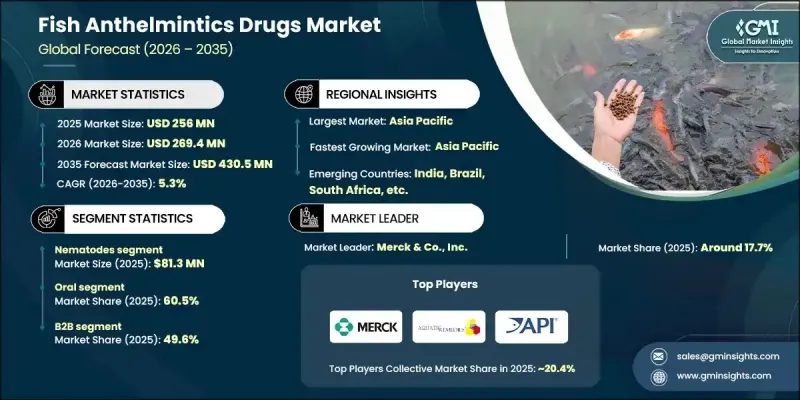
市场成长的驱动因素包括水产养殖业的快速扩张、养殖鱼类寄生虫感染的日益增加以及对高品质水产品需求的不断增长。驱虫药在控制线虫、绦虫和吸虫等体内寄生虫方面发挥关键作用,这些寄生虫会对鱼类的健康、生长和存活率产生负面影响。随着水产养殖业为满足全球蛋白质需求而不断集约化,有效的寄生虫控制对于最大限度地减少经济损失和确保永续的水产养殖至关重要。对鱼类健康管理和生物安全的日益重视,促使商业水产养殖设施中鱼类驱虫药的使用量显着增加。寄生虫感染不仅会降低饲料转换率和增重,还会增加死亡率,直接影响养殖场的盈利。因此,水产养殖生产者正加大对预防和治疗方案的投资,以维护其养殖鱼类的健康。一些国家的监管机构也建议控制兽药的使用,以提高食品安全标准,这进一步促进了市场成长。此外,製剂技术的进步促成了更有针对性、残留可控、环境安全的驱虫药的研发,提高了治疗效果并符合监管标准。
| 市场覆盖范围 | |
|---|---|
| 开始年份 | 2025 |
| 预测年份 | 2026-2035 |
| 起始值 | 2.56亿美元 |
| 预测金额 | 4.305亿美元 |
| 复合年增长率 | 5.3% |
按药物类别划分,市场可分为苯并咪唑酮、大环内酯类、吡喹酮类和其他类药物,其中苯并咪唑酮类药物预计在2025年将创造6550万美元的销售额。苯并咪唑酮因其对胃肠道线虫和吸虫具有广谱疗效、成本效益高且可透过饲料轻鬆给药而广受欢迎。这些药物透过抑制寄生虫的代谢和能量产生,在有效控制寄生虫的同时,也能维持对鱼类的可接受安全范围。它们在淡水和海水养殖系统中的广泛应用巩固了主导地位。
2025年,B2B市场占据49.6%的市场份额,这主要得益于商业养鱼场、孵化场、综合水产养殖生产商和大型水产品出口商的强劲需求。这些买家优先考虑可靠且有效率的驱虫解决方案,以控制高密度养殖环境中的寄生虫感染,因为这些环境的感染风险较高。 B2B客户通常透过兽药供应商、水产养殖经销商或与生产商直接签订合约来批量采购鱼类驱虫药,以确保稳定的供应和成本效益。
亚太地区鱼类驱虫药市场预计到2025年将达到1.93亿美元,主要驱动因素包括该地区大规模水产养殖生产、水产品消费量的成长以及商业水产养殖业务的扩张。中国、印度、越南和印尼等国凭藉其广泛的内陆和沿海水产养殖活动,成为该市场的主要贡献者。现代鱼类健康管理方法的日益普及,以及政府为提高水产养殖生产力和疾病控製而采取的倡议,正推动该地区动物用药品使用量的显着增长。
目录
第一章调查方法和范围
第二章执行摘要
第三章业界考察
- 生态系分析
- 产业影响因素
- 司机
- 水产养殖产量增加
- 寄生虫病迅速增加
- 缓释製剂与联合治疗的开发
- 严格的食品安全法规
- 产业潜在风险与挑战
- 新动物用药品的严格核准流程
- 人们对水体中药物残留的担忧
- 机会
- 新兴市场水产养殖的快速成长
- 整合智慧监测系统用于寄生虫检测和标靶药物治疗
- 司机
- 成长潜力分析
- 监管环境
- 北美洲
- 我们
- 加拿大
- 欧洲
- 亚太地区
- 北美洲
- 技术格局
- 当前技术趋势
- 新兴技术
- 投资环境
- 专利分析
- 定价分析
- 供应链分析
- 波特五力分析
- PESTEL 分析
- 未来市场趋势
第四章 竞争情势
- 介绍
- 企业矩阵分析
- 公司市占率分析
- 主要市场公司的竞争分析
- 竞争定位矩阵
- 重大进展
- 併购
- 伙伴关係与合作
- 新产品发布
- 扩张计划
5. 2022-2035年按药物类别分類的市场估算与预测
- 奎诺酮
- 苯并咪唑酮
- 大环内酯
- 其他药物类别
第六章 依目标寄生虫分類的市场估算与预测,2022-2035年
- 线虫
- 吸虫
- 混合感染
- 绦虫
7. 按配方分類的市场估计和预测,2022-2035 年
- 口服
- 浸没
- 注射
第八章 按分销管道分類的市场估算与预测,2022-2035年
- B2B
- 兽医院药房
- 零售店
- 电子商务
第九章 2022-2035年各地区市场估算与预测
- 北美洲
- 我们
- 加拿大
- 欧洲
- 挪威
- 土耳其
- 德国
- 英国
- 法国
- 西班牙
- 义大利
- 荷兰
- 亚太地区
- 中国
- 印度
- 印尼
- 越南
- 日本
- 韩国
- 澳洲
- 拉丁美洲
- 巴西
- 墨西哥
- 阿根廷
- 中东和非洲
- 埃及
- 南非
- 沙乌地阿拉伯
- 阿拉伯聯合大公国
第十章:公司简介
- API
- Aquarium Products India
- Aquatic Remedies
- Centurion HEALTHCARE
- Hikari
- KOI PHARMA
- Kyoritsu Seiyaku Corporation
- Merck &Co., Inc.
- NATIONAL FISH PHARMACEUTICALS USA
- Syndel
The Global Fish Anthelmintics Drugs Market was valued at USD 256 million in 2025 and is estimated to grow at a CAGR of 5.3% to reach USD 430.5 million by 2035.
Market growth is driven by the rapid expansion of aquaculture, the increasing prevalence of parasitic infestations in farmed fish, and rising demand for high-quality seafood. Anthelmintic drugs play a critical role in controlling internal parasitic worms such as nematodes, cestodes, and trematodes that negatively impact fish health, growth rates, and survival. As aquaculture operations intensify to meet global protein demand, effective parasite management has become essential to minimize economic losses and ensure sustainable fish farming practices. The growing emphasis on fish health management and biosecurity has significantly increased the adoption of fish anthelmintics across commercial aquaculture facilities. Parasitic infections not only reduce feed efficiency and weight gain but also increase mortality rates, directly affecting farm profitability. As a result, aquaculture producers are increasingly investing in preventive and therapeutic drug solutions to maintain stock health. Regulatory bodies in several countries are also encouraging the controlled use of veterinary pharmaceuticals to improve food safety standards, further supporting market growth. Additionally, advancements in formulation technologies have led to more targeted, residue-controlled, and environmentally safer anthelmintic drugs, improving treatment outcomes and compliance with regulatory norms.
| Market Scope | |
|---|---|
| Start Year | 2025 |
| Forecast Year | 2026-2035 |
| Start Value | $256 Million |
| Forecast Value | $430.5 Million |
| CAGR | 5.3% |
Based on drug class, the market is segmented into benzimidazoles, macrocyclic lactones, praziquantel, and others, with the benzimidazoles segment generating USD 65.5 million in 2025. Benzimidazoles are widely preferred due to their broad-spectrum efficacy against gastrointestinal nematodes and trematodes, cost-effectiveness, and ease of administration through medicated feed. These drugs interfere with parasite metabolism and energy production, leading to effective parasite elimination while maintaining acceptable safety margins for fish. Their extensive use in both freshwater and marine aquaculture systems has solidified their leading market position.
The B2B segment held 49.6% share in 2025, driven by strong demand from commercial aquaculture farms, hatcheries, integrated fish producers, and large-scale seafood exporters. These buyers prioritize reliable, high-efficacy anthelmintic solutions to manage parasite outbreaks in high-density farming environments where infection risks are elevated. B2B customers typically procure fish anthelmintics in bulk through veterinary suppliers, aquaculture input distributors, and direct manufacturer contracts, ensuring consistent supply and cost efficiency
Asia Pacific Fish Anthelmintics Drugs Market reached USD 193 million in 2025, supported by the region's large-scale aquaculture production, growing seafood consumption, and expanding commercial fish farming operations. Countries such as China, India, Vietnam, and Indonesia are major contributors, owing to their extensive inland and coastal aquaculture activities. The increasing adoption of modern fish health management practices, combined with government initiatives to improve aquaculture productivity and disease control, has significantly boosted the use of veterinary drugs in the region.
Key players operating in the Global Fish Anthelmintics Drugs Market include Zoetis Inc., Elanco Animal Health, Merck & Co. (MSD Animal Health), Virbac, Vetoquinol, Ceva Sante Animale, Huvepharma, and Phibro Animal Health Corporation. Companies operating in the Fish Anthelmintics Drugs Market are focusing on product innovation, strategic partnerships, and geographic expansion to strengthen their market presence. Leading players are investing heavily in research and development to introduce advanced formulations with improved efficacy, reduced environmental impact, and lower drug residue levels to meet stringent regulatory standards. Collaborations with aquaculture farms, feed manufacturers, and veterinary networks enable companies to expand distribution and improve farmer awareness. Many firms are also targeting emerging aquaculture markets in Asia Pacific and Latin America through localized manufacturing and pricing strategies. Additionally, companies are emphasizing sustainable parasite management solutions, including integrated health management programs, to build long-term customer relationships and reinforce their competitive positioning.
Table of Contents
Chapter 1 Methodology and Scope
- 1.1 Market scope and definition
- 1.2 Research design
- 1.2.1 Research approach
- 1.2.2 Data collection methods
- 1.3 Data mining sources
- 1.3.1 Global
- 1.3.2 Regional/Country
- 1.4 Base estimates and calculations
- 1.4.1 Base year calculation
- 1.4.2 Key trends for market estimation
- 1.5 Primary research and validation
- 1.5.1 Primary sources
- 1.6 Forecast model
- 1.7 Research assumptions and limitations
Chapter 2 Executive Summary
- 2.1 Industry 3600 synopsis
- 2.2 Key market trends
- 2.2.1 Regional trends
- 2.2.2 Drug class trends
- 2.2.3 Target parasite trends
- 2.2.4 Formulation trends
- 2.2.5 Distribution channel trends
- 2.3 CXO perspectives: Strategic imperatives
- 2.3.1 Key decision points for industry executives
- 2.3.2 Critical success factors for market players
- 2.4 Future outlook and strategic recommendations
Chapter 3 Industry Insights
- 3.1 Industry ecosystem analysis
- 3.2 Industry impact forces
- 3.2.1 Growth drivers
- 3.2.1.1 Rising production of aquaculture
- 3.2.1.2 Surging prevalence of parasitic diseases
- 3.2.1.3 Development of long-acting formulations and combination therapies
- 3.2.1.4 Stringent food safety regulations
- 3.2.2 Industry pitfalls and challenges
- 3.2.2.1 Strict approval processes for new veterinary drugs
- 3.2.2.2 Concerns regarding residual drugs in water bodies
- 3.2.3 Opportunities
- 3.2.3.1 Rapid aquaculture growth in emerging markets
- 3.2.3.2 Integration of smart monitoring systems for parasite detection and targeted drug use
- 3.2.1 Growth drivers
- 3.3 Growth potential analysis
- 3.4 Regulatory landscape
- 3.4.1 North America
- 3.4.1.1 U.S.
- 3.4.1.2 Canada
- 3.4.2 Europe
- 3.4.3 Asia Pacific
- 3.4.1 North America
- 3.5 Technological landscape
- 3.5.1 Current technological trends
- 3.5.2 Emerging technologies
- 3.6 Investment landscape
- 3.7 Patent analysis
- 3.8 Pricing analysis
- 3.9 Supply chain analysis
- 3.10 Porter's analysis
- 3.11 PESTEL analysis
- 3.12 Future market trends
Chapter 4 Competitive Landscape, 2025
- 4.1 Introduction
- 4.2 Company matrix analysis
- 4.3 Company market share analysis
- 4.4 Competitive analysis of major market players
- 4.5 Competitive positioning matrix
- 4.6 Key developments
- 4.6.1 Mergers & acquisitions
- 4.6.2 Partnerships & collaborations
- 4.6.3 New product launches
- 4.6.4 Expansion plans
Chapter 5 Market Estimates and Forecast, By Drug Class, 2022 - 2035 ($ Mn)
- 5.1 Key trends
- 5.2 Pyrazinoisoquinolones
- 5.3 Benzimidazoles
- 5.4 Macrocyclic lactones
- 5.5 Other drug classes
Chapter 6 Market Estimates and Forecast, By Target Parasite, 2022 - 2035 ($ Mn)
- 6.1 Key trends
- 6.2 Nematodes
- 6.3 Trematodes
- 6.4 Mixed infections
- 6.5 Cestodes
Chapter 7 Market Estimates and Forecast, By Formulation, 2022 - 2035 ($ Mn)
- 7.1 Key trends
- 7.2 Oral
- 7.3 Immersion
- 7.4 Injectable
Chapter 8 Market Estimates and Forecast, By Distribution Channel, 2022 - 2035 ($ Mn)
- 8.1 Key trends
- 8.2 B2B
- 8.3 Veterinary pharmacy
- 8.4 Retail stores
- 8.5 E-commerce
Chapter 9 Market Estimates and Forecast, By Region, 2022 - 2035 ($ Mn)
- 9.1 Key trends
- 9.2 North America
- 9.2.1 U.S.
- 9.2.2 Canada
- 9.3 Europe
- 9.3.1 Norway
- 9.3.2 Turkey
- 9.3.3 Germany
- 9.3.4 UK
- 9.3.5 France
- 9.3.6 Spain
- 9.3.7 Italy
- 9.3.8 Netherlands
- 9.4 Asia Pacific
- 9.4.1 China
- 9.4.2 India
- 9.4.3 Indonesia
- 9.4.4 Vietnam
- 9.4.5 Japan
- 9.4.6 South Korea
- 9.4.7 Australia
- 9.5 Latin America
- 9.5.1 Brazil
- 9.5.2 Mexico
- 9.5.3 Argentina
- 9.6 MEA
- 9.6.1 Egypt
- 9.6.2 South Africa
- 9.6.3 Saudi Arabia
- 9.6.4 UAE
Chapter 10 Company Profiles
- 10.1 API
- 10.2 Aquarium Products India
- 10.3 Aquatic Remedies
- 10.4 Centurion HEALTHCARE
- 10.5 Hikari
- 10.6 KOI PHARMA
- 10.7 Kyoritsu Seiyaku Corporation
- 10.8 Merck & Co., Inc.
- 10.9 NATIONAL FISH PHARMACEUTICALS U.S.A.
- 10.10 Syndel

 茴香脑三硫磷市场:依产品类型、给药途径、应用、最终用户和分销管道划分-2026-2032年全球预测颗粒状沸石市场:依产品类型、包装类型、应用、通路和最终用途划分-2026-2032年全球预测製药破碎机市场:按机器类型、材料类型、销售管道、应用、最终用户划分,全球预测(2026-2032)
 医药和生物技术产业分销协议:2020-2026製药和生物技术领域的生产和供应协议(2021-2026)
 医药市场规模、份额和成长分析:按分子类型、产品类型、给药途径、疾病类型和地区划分-2026-2033年产业预测
 2035年医药市场分析及预测:类型、产品类型、服务、技术、应用、剂型、最终用户、流程、实施方案、设备新斯的明甲硫酸盐注射液市场分析及预测(至2035年):按类型、产品类型、应用、最终用户、技术、实施类型、製程、组件和设备划分
 2026-2034年全球医药和生物技术领域人工智慧(AI)市场规模、份额、趋势和成长分析报告硫酸卡那霉素注射剂市场按剂量、剂型、用途、最终用户和分销管道划分-全球预测(2026-2032 年)