


 |
市场调查报告书
商品编码
1936491
工业排放监测与控制系统市场:机会、成长要素、产业趋势分析及2026年至2035年预测Industrial Emission Monitoring and Control System Market Opportunity, Growth Drivers, Industry Trend Analysis, and Forecast 2026 - 2035 |
||||||

全球工业排放监测和控制系统市场预计到 2025 年将达到 78 亿美元,到 2035 年将达到 155 亿美元,年复合成长率为 7.1%。
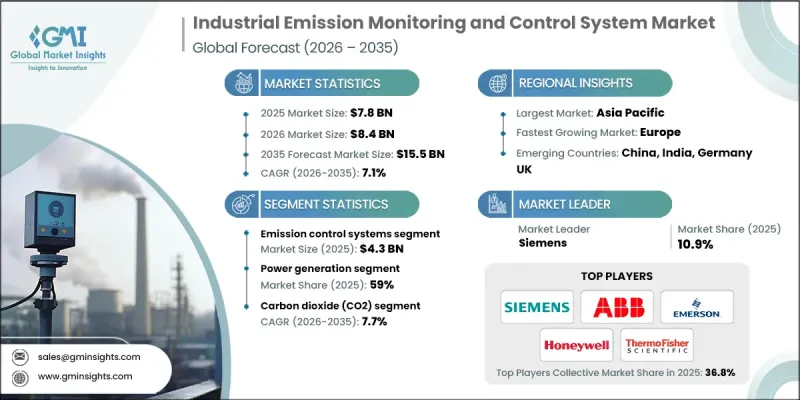
由于旨在限制工业排放和减少环境污染的日益严格的环境法规,市场正在不断扩张。该地区各国政府正在强制执行合规要求,鼓励各行业采用先进的排放监控和控制技术。因此,製造商正在投资能够提供准确、即时排放数据的先进系统。包括人工智慧 (AI) 和互联监测平台在内的技术进步正在提高系统效能并促进其应用。能源和电力产业仍然是工业排放的主要来源,也是监控和控制解决方案需求的重要驱动力。向清洁能源发电的持续转型以及发电设施中排放技术的应用,正在创造强劲的成长机会。儘管市场面临高资本投资和升级旧有系统相关的技术复杂性等挑战,但政府的激励措施和财政支持计划正在抵消这些障碍,并促进更广泛的应用。
| 市场覆盖范围 | |
|---|---|
| 开始年份 | 2025 |
| 预测年份 | 2026-2035 |
| 起始值 | 78亿美元 |
| 预测金额 | 155亿美元 |
| 复合年增长率 | 7.1% |
预计2026年至2035年间,排放监测系统市场将以7.3%的复合年增长率成长。互联感测器和先进数据分析技术的集成,实现了连续监测、即时报告和更高的合规准确性。工业界日益重视减少温室气体排放和空气污染物,直接推动了对监测和控制解决方案的需求。监管机构正在加强环境框架并推广更清洁的生产方式,进一步加速了现代排放控制技术在工业设施中的应用。
预计2026年至2035年间,二氧化碳排放市场将以7.7%的复合年增长率成长。人们对气候变迁和全球暖化日益增长的关注,促使人们更加重视二氧化碳排放的测量和管理。世界各国政府正在实施碳定价机制和排放责任政策,强制要求各产业更严格追踪和管理其二氧化碳排放。这种监管压力使得二氧化碳监测成为工业排放管理策略的关键组成部分。
预计2025年,美国工业排放监控与控制系统市场规模将达到18亿美元,占77%的市占率。美国市场的成长得益于联邦政府制定的严格环境法规和执法架构。法律要求工业设施持续监测、报告并减少排放。此外,企业永续性倡议和日益增强的环境责任意识也正在加速各行业对排放监控解决方案的投资。
目录
第一章调查方法和范围
第二章执行摘要
第三章业界考察
- 生态系分析
- 供应商情况
- 利润率
- 每个阶段的附加价值
- 影响价值链的因素
- 产业影响因素
- 司机
- 产业潜在风险与挑战
- 机会
- 成长潜力分析
- 未来市场趋势
- 科技与创新趋势
- 当前技术趋势
- 新兴技术
- 价格趋势
- 按地区
- 依系统类型
- 监管环境
- 标准和合规要求
- 区域法规结构
- 认证标准
- 波特五力分析
- PESTEL 分析
第四章 竞争情势
- 介绍
- 公司市占率分析
- 按地区
- 企业矩阵分析
- 主要市场公司的竞争分析
- 竞争定位矩阵
- 重大进展
- 併购
- 伙伴关係与合作
- 新产品发布
- 扩张计划
第五章 依系统类型分類的市场估算与预测,2022-2035年
- 排放监测系统
- 连续排放监测系统(CEMS)
- 预测性排放监测系统(PEMS)
- 排放气体控制系统
- 静电除尘设备(ESP)
- 洗涤器(排烟脱硫设备)
- 催化剂体系
- 袋滤式集尘器/袋式除尘器
- 吸附剂注入系统
- 其他(热氧化设备、旋风分离器等)
6. 按污染物类型分類的市场估计与预测,2022-2035 年
- 氮氧化物(NOx)
- 硫氧化物(SOx/SO2)
- 二氧化碳(CO2)
- 甲烷
- 颗粒物
- 其他成分(THC、汞等)
7. 2022-2035年按最终用途产业分類的市场估算与预测
- 发电
- 石油和天然气
- 化工/石油化工
- 金属和采矿
- 纸浆和造纸
- 製药
- 其他(船等)
第八章 按分销管道分類的市场估算与预测,2022-2035年
- 直销
- 间接销售
第九章 2022-2035年各地区市场估算与预测
- 北美洲
- 我们
- 加拿大
- 欧洲
- 德国
- 英国
- 法国
- 西班牙
- 义大利
- 荷兰
- 亚太地区
- 中国
- 日本
- 印度
- 澳洲
- 韩国
- 拉丁美洲
- 巴西
- 墨西哥
- 阿根廷
- 中东和非洲
- 南非
- 沙乌地阿拉伯
- 阿拉伯聯合大公国
第十章:公司简介
- ABB
- AMETEK
- Durag Group
- Emerson Electric
- Endress+Hauser
- Forbes Marshall
- Honeywell International
- Horiba
- Kawasaki Heavy Industries
- Kongsberg
- Mitsubishi Heavy Industries
- Siemens
- Teledyne Technologies
- Thermo Fisher Scientific
- Yokogawa Electric
The Global Industrial Emission Monitoring and Control System Market was valued at USD 7.8 billion in 2025 and is estimated to grow at a CAGR of 7.1% to reach USD 15.5 billion by 2035.
Market expansion is driven by increasingly strict environmental regulations aimed at limiting industrial emissions and reducing environmental pollution. Governments across regions are enforcing compliance requirements that encourage industries to adopt advanced emission monitoring and control technologies. As a result, manufacturers are investing in sophisticated systems capable of delivering accurate, real-time emission data. Technological advancements, including the integration of artificial intelligence and connected monitoring platforms, are enhancing system performance and driving adoption. The energy and power sector remains one of the largest contributors to industrial emissions, making it a key demand generator for monitoring and control solutions. Ongoing transitions toward cleaner energy generation and the implementation of emission reduction technologies in power facilities are creating strong growth opportunities. While the market faces challenges such as high capital investment requirements and technical complexity in upgrading legacy systems, supportive government incentives and financial assistance programs are helping offset these barriers and encouraging broader adoption.
| Market Scope | |
|---|---|
| Start Year | 2025 |
| Forecast Year | 2026-2035 |
| Start Value | $7.8 Billion |
| Forecast Value | $15.5 Billion |
| CAGR | 7.1% |
The emission monitoring systems segment will grow at a CAGR of 7.3% during 2026 to 2035. The incorporation of connected sensors and advanced data analytics is improving continuous monitoring, real-time reporting, and compliance accuracy. Industries are placing greater emphasis on reducing greenhouse gas emissions and airborne pollutants, which is directly increasing demand for monitoring and control solutions. Regulatory authorities are strengthening environmental frameworks and promoting cleaner production practices, further accelerating the deployment of modern emission control technologies across industrial facilities.
The carbon dioxide segment is projected to grow at a CAGR of 7.7% from 2026 to 2035. Heightened awareness around climate change and global temperature rise has intensified the focus on carbon dioxide emission measurement and management. Governments worldwide are implementing carbon pricing mechanisms and emission accountability policies, compelling industries to track and control CO2 output more rigorously. This regulatory pressure is making CO2 monitoring a critical component of industrial emission management strategies.
United States Industrial Emission Monitoring and Control System Market accounted for 77% share and generated USD 1.8 billion in 2025. Market growth in the country is supported by stringent environmental regulations and enforcement frameworks established by federal authorities. Legislative mandates require industrial facilities to measure, report, and reduce emissions consistently. Additionally, rising corporate focus on sustainability initiatives and environmental responsibility is accelerating investment in emission monitoring solutions across multiple industries.
Key companies operating in the Global Industrial Emission Monitoring and Control System Market include Siemens, ABB, Emerson Electric, Honeywell International, Yokogawa Electric, Thermo Fisher Scientific, Endress+Hauser, Mitsubishi Heavy Industries, Horiba, Teledyne Technologies, AMETEK, Kongsberg, Kawasaki Heavy Industries, Durag Group, and Forbes Marshall. Companies in the Industrial Emission Monitoring and Control System Market are strengthening their market position through technology innovation, strategic partnerships, and geographic expansion. Leading players are investing heavily in research and development to enhance system accuracy, automation, and digital integration. Many are expanding their product portfolios to offer customized solutions tailored to specific industrial applications.
Table of Contents
Chapter 1 Methodology and scope
- 1.1 Market scope and definition
- 1.2 Research design
- 1.2.1 Research approach
- 1.2.2 Data collection methods
- 1.3 Data mining sources
- 1.3.1 Global
- 1.3.2 Regional/country
- 1.4 Base estimates and calculations
- 1.4.1 Base year calculation
- 1.4.2 Key trends for market estimation
- 1.5 Primary research and validation
- 1.5.1 Primary sources
- 1.6 Forecast model
- 1.7 Research assumptions and limitations
Chapter 2 Executive summary
- 2.1 Industry 360° synopsis
- 2.2 Key market trends
- 2.2.1 Regional
- 2.2.2 System Type
- 2.2.3 Pollutant Type
- 2.2.4 End Use Industry
- 2.2.5 Distribution Channel
- 2.3 CXO perspectives: strategic imperatives
- 2.3.1 Key decision points for industry executives
- 2.3.2 Critical success factors for market players
- 2.4 Future outlook and strategic recommendations
Chapter 3 Industry insights
- 3.1 Industry ecosystem analysis
- 3.1.1 Supplier landscape
- 3.1.2 Profit margin
- 3.1.3 Value addition at each stage
- 3.1.4 Factor affecting the value chain
- 3.2 Industry impact forces
- 3.2.1 Growth drivers
- 3.2.2 Industry pitfalls & challenges
- 3.2.3 Opportunities
- 3.3 Growth potential analysis
- 3.4 Future market trends
- 3.5 Technology and innovation landscape
- 3.5.1 Current technological trends
- 3.5.2 Emerging technologies
- 3.6 Price trends
- 3.6.1 By region
- 3.6.2 By system type
- 3.7 Regulatory landscape
- 3.7.1 Standards and compliance requirements
- 3.7.2 Regional regulatory frameworks
- 3.7.3 Certification standards
- 3.8 Porter's analysis
- 3.9 PESTEL analysis
Chapter 4 Competitive landscape, 2025
- 4.1 Introduction
- 4.2 Company market share analysis
- 4.2.1 By region
- 4.2.1.1 North America
- 4.2.1.2 Europe
- 4.2.1.3 Asia Pacific
- 4.2.1.4 Latin America
- 4.2.1.5 MEA
- 4.2.1 By region
- 4.3 Company matrix analysis
- 4.4 Competitive analysis of major market players
- 4.5 Competitive positioning matrix
- 4.6 Key developments
- 4.6.1 Mergers & acquisitions
- 4.6.2 Partnerships & collaborations
- 4.6.3 New product launches
- 4.6.4 Expansion plans
Chapter 5 Market Estimates & Forecast, By System Type, 2022 - 2035 ($Billion, Thousand Units)
- 5.1 Key trends
- 5.2 Emission monitoring systems
- 5.2.1 Continuous emission monitoring system (CEMS)
- 5.2.2 Predictive emission monitoring system (PEMS)
- 5.3 Emission control systems
- 5.3.1 Electrostatic precipitators (ESP)
- 5.3.2 Scrubbers (FGD systems)
- 5.3.3 Catalytic systems
- 5.3.4 Fabric filters/baghouses
- 5.3.5 Sorbent injection systems
- 5.3.6 Others (thermal oxidizers, cyclones etc.)
Chapter 6 Market Estimates & Forecast, By Pollutant Type, 2022 - 2035 ($Billion, Thousand Units)
- 6.1 Key trends
- 6.2 Nitrogen Oxides (NOx)
- 6.3 Sulfur Oxides (SOx/SO2)
- 6.4 Carbon Dioxide (CO2)
- 6.5 Methane
- 6.6 Particulate Matter
- 6.7 Others (THC, mercury etc.)
Chapter 7 Market Estimates & Forecast, By End Use Industry, 2022 - 2035 ($Billion, Thousand Units)
- 7.1 Key trends
- 7.2 Power Generation
- 7.3 Oil & Gas
- 7.4 Chemical & Petrochemical
- 7.5 Metals & Mining
- 7.6 Pulp & Paper
- 7.7 Pharmaceuticals
- 7.8 Others (marine etc.)
Chapter 8 Market Estimates & Forecast, By Distribution Channel, 2022 - 2035 ($Billion, Thousand Units)
- 8.1 Key trends
- 8.2 Direct sales
- 8.3 Indirect sales
Chapter 9 Market Estimates & Forecast, By Region, 2022 - 2035 ($Billion, Thousand Units)
- 9.1 Key trends
- 9.2 North America
- 9.2.1 U.S.
- 9.2.2 Canada
- 9.3 Europe
- 9.3.1 Germany
- 9.3.2 UK
- 9.3.3 France
- 9.3.4 Spain
- 9.3.5 Italy
- 9.3.6 Netherlands
- 9.4 Asia Pacific
- 9.4.1 China
- 9.4.2 Japan
- 9.4.3 India
- 9.4.4 Australia
- 9.4.5 South Korea
- 9.5 Latin America
- 9.5.1 Brazil
- 9.5.2 Mexico
- 9.5.3 Argentina
- 9.6 MEA
- 9.6.1 South Africa
- 9.6.2 Saudi Arabia
- 9.6.3 UAE
Chapter 10 Company Profiles
- 10.1 ABB
- 10.2 AMETEK
- 10.3 Durag Group
- 10.4 Emerson Electric
- 10.5 Endress+Hauser
- 10.6 Forbes Marshall
- 10.7 Honeywell International
- 10.8 Horiba
- 10.9 Kawasaki Heavy Industries
- 10.10 Kongsberg
- 10.11 Mitsubishi Heavy Industries
- 10.12 Siemens
- 10.13 Teledyne Technologies
- 10.14 Thermo Fisher Scientific
- 10.15 Yokogawa Electric

 2026年全球连续排放监测系统市场报告
 2026-2030年全球海事排放监测系统市场
 排放监测系统 (EMS) 市场分析及预测(至 2035 年):按类型、产品类型、服务、技术、组件、应用、部署类型、最终用户、功能和安装类型划分连续排放监测系统市场分析及预测(至2035年):按类型、产品类型、服务、技术、组件、应用、部署类型、最终用户和功能划分2026年全球排放监测系统市场报告
 连续排放监测系统市场规模、占有率、成长及全球产业分析:依类型、应用和地区划分的洞察与预测(2026-2034年)
 排放监测系统市场 - 全球产业规模、份额、趋势、机会及预测(依排放类型、监测技术、终端用户产业、地区及竞争格局划分,2021-2031年)
 光声光谱线上监测系统市场:按应用、最终用户、技术和组件划分,全球预测,2026-2032年
 排放监测系统市场规模、份额和成长分析(按产品、排放类型、系统类型、产业垂直领域和地区划分)-2026-2033年产业预测预测性排放监测系统市场-全球产业规模、份额、趋势、机会和预测,按产业、组件、部署方式、地区和竞争格局划分,2020-2030年预测