


 |
市场调查报告书
商品编码
1936493
汽车神经自我调整触觉回馈组件市场机会、成长要素、产业趋势分析及预测(2026-2035年)In-Vehicle Neuroadaptive Haptic Feedback Component Market Opportunity, Growth Drivers, Industry Trend Analysis, and Forecast 2026 - 2035 |
||||||

全球汽车自我调整触觉回馈组件市场预计到 2025 年将达到 1.704 亿美元,到 2035 年将达到 5.619 亿美元,年复合成长率为 13.2%。
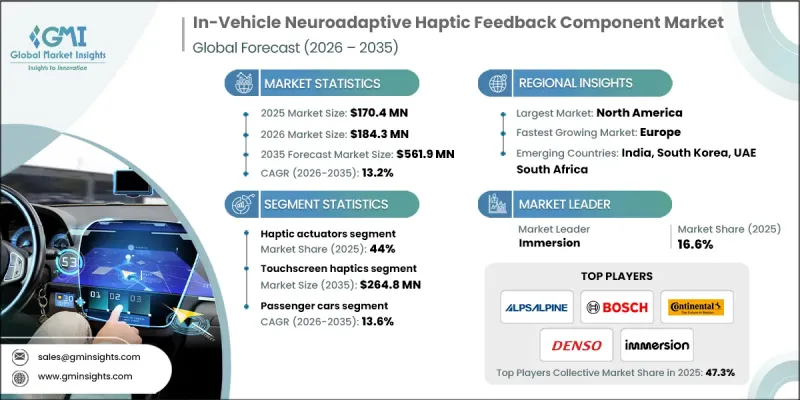
市场成长的驱动力在于人们越来越关注驾驶者的警觉性、即时反应能力以及减少车内认知和视觉干扰。汽车製造商正优先开发能够帮助驾驶员根据不断变化的心理和环境状况快速感知并即时做出反应的系统。神经自适应触觉回馈组件能够根据即时生物识别数据和情境输入调整触觉回馈,帮助驾驶者保持警觉和专注,避免分心。这项转变与智慧驾驶辅助技术和软体主导内装的普及相吻合,实体按钮正逐渐被数位介面所取代。随着内装设计日益简约和萤幕化,触觉回馈在增强安全提示和提升易用性方面发挥关键作用。在高阶车型领域,这种需求尤其突出,因为先进的人机互动是实现差异化的关键。随着汽车设计不断向直觉和自适应介面发展,神经自适应触觉回馈组件在平衡系统复杂性、易用性和驾驶安全性方面变得至关重要。
| 市场覆盖范围 | |
|---|---|
| 开始年份 | 2025 |
| 预测年份 | 2026-2035 |
| 起始值 | 1.704亿美元 |
| 预测金额 | 5.619亿美元 |
| 复合年增长率 | 13.2% |
触觉致动器市场占据44%的市场份额,预计到2025年将创造7,500万美元的收入。致动器仍然是神经适应性触觉系统的重要组成部分,因为它们可以将电子讯号转化为驾驶者可以即时感知的物理感觉。儘管感测和软体层面取得了进步,但其与车辆多个控制和介面点的广泛整合将维持稳定的需求。
预计到 2025 年,触控萤幕触觉回馈市场份额将达到 48.4%,到 2035 年将达到 2.648 亿美元。随着数位显示器成为车内主要控制介面,将触觉回馈整合到触控式介面中的需求日益增长,以支援直觉操作并最大限度地减少驾驶员分心。
美国汽车神经自适应触觉回馈组件市场预计到2025年将达到4,710万美元。美国高度重视道路安全,并大力推广驾驶辅助技术,使其成为先进车载感测解决方案的领先采用者。由于大量车辆已配备智慧安全系统,美国将继续为神经自适应触觉技术提供强劲的成长基础。
目录
第一章调查方法
第二章执行摘要
第三章业界考察
- 生态系分析
- 供应商情况
- 利润率
- 成本结构
- 每个阶段的附加价值
- 影响价值链的因素
- 中断
- 产业影响因素
- 司机
- 日益重视驾驶状态感知与认知安全
- 自动驾驶和半自动驾驶能力的成长
- 原始设备製造商 (OEM) 推动差异化车载用户体验
- 对即时自适应人机互动的需求
- 产业潜在风险与挑战
- 神经适应性回馈整合的系统复杂性很高
- 将触觉回馈校准以适应个体认知差异所面临的挑战
- 市场机会
- 与驾驶员监控系统集成
- 开发软体定义且可升级的触觉演算法
- 在高端电动车和软体优先型汽车平臺的应用
- 未来认知型和响应型汽车人机互动的标准化
- 司机
- 成长潜力分析
- 监管环境
- 北美洲
- 美国国家公路交通安全管理局(NHTSA)
- 联邦机动车辆安全标准(FMVSS)
- 美国汽车工程师协会(SAE International)
- 加拿大运输部
- 欧洲
- 欧盟委员会(EC)
- 欧盟车辆类型认证机构(EU VTA)
- 德国联邦汽车运输管理局(KBA)
- 亚太地区
- 公路运输和公路部(MoRTH)
- 中国汽车技术研究中心(CATARC)
- 南韩交通安全管理局(TS)
- 拉丁美洲
- 国家运输管理局
- 巴西汽车製造商协会(ANFAVEA)
- 中东和非洲
- 海湾合作委员会标准组织(GSO)
- 南非标准局 (SABS)
- 沙乌地阿拉伯标准、计量和品质组织(SASO)
- 北美洲
- 波特五力分析
- PESTEL 分析
- 技术与创新展望
- 当前技术趋势
- 新兴技术
- 价格趋势
- 按地区
- 副产品
- 成本細項分析
- 永续性和环境影响
- 环境影响评估
- 社会影响力和社区参与
- 公司管治与企业社会责任
- 永续金融与投资趋势
- 系统结构和技术栈分析
- 自我调整触觉系统的架构
- 硬体层(感测器、致动器、控制器)
- 中介软体层(讯号处理、驱动软体)
- 应用层(人机介面整合、使用者应用)
- 系统延迟和性能要求
- 与ADAS和自动驾驶系统的集成
- ADAS与触觉回馈之间的协同作用
- 与自动驾驶水平的集成
- 感测器与ADAS系统的融合
- 安全关键型触觉回馈延迟要求
- 网路安全、资料隐私和功能安全的考虑
- 案例研究
- 未来前景与机会
第四章 竞争情势
- 介绍
- 公司市占率分析
- 北美洲
- 欧洲
- 亚太地区
- 拉丁美洲
- 中东和非洲
- 主要市场公司的竞争分析
- 竞争定位矩阵
- 战略展望矩阵
- 重大进展
- 併购
- 伙伴关係与合作
- 新产品发布
- 企业扩张计画和资金筹措
第五章 按组件分類的市场估算与预测,2022-2035年
- 触觉致致动器
- 电磁致动器
- 压电致动器
- 超音波相位阵列
- 神经适应性感测器
- 脑电图(EEG)感测器
- 心电图(ECG)感测器
- 眼动追踪感应器
- 压力和握力感测器
- 控制电子设备
- 软体和演算法
第六章 2022-2035年按产品分類的市场估算与预测
- 触控萤幕触觉回馈
- 方向盘回馈系统
- 基于片材的触觉模组
- 其他的
第七章 依车辆类型分類的市场估计与预测,2022-2035年
- 搭乘用车
- 掀背车
- SUV
- 轿车
- 商用车辆
- 轻型商用车(LCV)
- MCV
- 重型商用车(HCV)
第八章 按车辆类型分類的市场估算与预测,2022-2035年
- 经济型/入门级
- 中型车
- 豪华/高级汽车
9. 按自动驾驶等级分類的市场估算与预测,2022-2035 年
- 半自动驾驶汽车
- 全自动驾驶汽车
第十章 依应用领域分類的市场估计与预测,2022-2035年
- 驾驶辅助系统(ADAS)
- 资讯娱乐系统
- 安全和警报系统
- 舒适性和个性化系统
- 导航系统
第十一章 依销售管道分類的市场估计与预测,2022-2035年
- OEM
- 售后市场
第十二章 2022-2035年各地区市场估算与预测
- 北美洲
- 我们
- 加拿大
- 欧洲
- 德国
- 英国
- 法国
- 义大利
- 西班牙
- 俄罗斯
- 捷克共和国
- 比利时
- 荷兰
- 亚太地区
- 中国
- 印度
- 日本
- 韩国
- 澳洲
- 新加坡
- 马来西亚
- 印尼
- 越南
- 泰国
- 拉丁美洲
- 巴西
- 墨西哥
- 阿根廷
- 哥伦比亚
- 中东和非洲
- 南非
- 沙乌地阿拉伯
- 阿拉伯聯合大公国
第十三章:公司简介
- 世界公司
- Cirrus Logic
- Continental
- DENSO
- Panasonic
- Robert Bosch
- TDK
- Texas Instruments
- Valeo
- Visteon
- ZF Friedrichshafen
- 当地公司
- Alps Alpine
- Autoliv
- Clarion
- Harman
- Hyundai Mobis
- Johnson Electric
- Yazaki
- 新兴企业
- AAC Technologies
- HaptX
- Immersion
- Microchip
- ON Semiconductor
- Precision
- Synaptics
- Ultraleap
The Global In-Vehicle Neuroadaptive Haptic Feedback Component Market was valued at USD 170.4 million in 2025 and is estimated to grow at a CAGR of 13.2% to reach USD 561.9 million by 2035.
Market growth is driven by the rising focus on driver attention, real-time responsiveness, and the reduction of cognitive and visual distractions inside vehicles. Automakers are prioritizing systems that support rapid driver awareness and immediate physical response based on changing mental and environmental conditions. Neuroadaptive haptic feedback components rely on real-time biometric and contextual inputs to adjust tactile responses, helping drivers remain alert and engaged without diverting their focus. This shift aligns with the broader adoption of intelligent driver-support technologies and software-driven vehicle interiors, where physical buttons are increasingly replaced by digital interfaces. As vehicle cabins become more minimalistic and screen-oriented, tactile feedback plays a critical role in reinforcing safety cues and usability. Demand is especially strong in premium vehicle categories, where advanced human-machine interaction is a key differentiator. As automotive design continues to evolve toward intuitive and adaptive interfaces, neuroadaptive haptic feedback components are becoming essential for balancing system complexity with ease of use and driving safety.
| Market Scope | |
|---|---|
| Start Year | 2025 |
| Forecast Year | 2026-2035 |
| Start Value | $170.4 Million |
| Forecast Value | $561.9 Million |
| CAGR | 13.2% |
The haptic actuators segment held 44% share, generating USD 75 million in 2025. Actuators remain fundamental to neuroadaptive haptic systems because they transform electronic signals into physical sensations that drivers can perceive instantly. Their widespread integration across multiple vehicle control and interface points sustains consistent demand, regardless of progress in sensing or software layers.
The touchscreen haptics segment held 48.4% share in 2025 and is forecast to reach USD 264.8 million by 2035. As digital displays become the primary control surface within vehicles, tactile feedback integrated into touch-based interfaces is increasingly necessary to support intuitive operation and minimize driver distraction.
U.S In-Vehicle Neuroadaptive Haptic Feedback Component Market reached USD 47.1 million in 2025. Strong emphasis on road safety and high penetration of driver-assistance technologies have positioned the country as a leading adopter of advanced in-vehicle sensing solutions. With a large share of vehicles already equipped with intelligent safety systems, the U.S. continues to provide a strong growth platform for neuroadaptive haptic technologies.
Key companies operating in the In-Vehicle Neuroadaptive Haptic Feedback Component Market include Bosch, Continental, Valeo, Alps Alpine, ZF, Denso, Immersion, Hyundai Mobis, TDK, Ultraleap, and Cirrus Logic. Companies active in the in-vehicle neuroadaptive haptic feedback component market are strengthening their market position through continuous innovation in hardware-software integration and adaptive interface design. Many players are investing in advanced signal processing, real-time analytics, and AI-enabled feedback algorithms to improve responsiveness and personalization. Strategic collaborations with automotive manufacturers and platform developers are helping accelerate system integration into next-generation vehicles. Firms are also focusing on scalable component designs that support multiple vehicle categories while maintaining performance consistency. Expanding intellectual property portfolios, enhancing compatibility with digital cockpit architectures, and aligning solutions with evolving safety standards remain core priorities.
Table of Contents
Chapter 1 Methodology
- 1.1 Research approach
- 1.2 Quality commitments
- 1.2.1 GMI AI policy & data integrity commitment
- 1.3 Research trail & confidence scoring
- 1.3.1 Research trail components
- 1.3.2 Scoring components
- 1.4 Data collection
- 1.4.1 Partial list of primary sources
- 1.5 Data mining sources
- 1.5.1 Paid sources
- 1.6 Base estimates and calculations
- 1.6.1 Base year calculation
- 1.7 Forecast model
- 1.8 Research transparency addendum
Chapter 2 Executive Summary
- 2.1 Industry 3600 synopsis
- 2.2 Key market trends
- 2.2.1 Regional
- 2.2.2 Component
- 2.2.3 Product
- 2.2.4 Vehicle
- 2.2.5 Vehicle class
- 2.2.6 Autonomy level
- 2.2.7 Application
- 2.2.8 Sales channel
- 2.3 TAM analysis, 2026-2035
- 2.4 CXO perspectives: Strategic imperatives
- 2.4.1 Executive decision points
- 2.4.2 Critical success factors
- 2.5 Future outlook and recommendations
Chapter 3 Industry Insights
- 3.1 Industry ecosystem analysis
- 3.1.1 Supplier landscape
- 3.1.2 Profit margin
- 3.1.3 Cost structure
- 3.1.4 Value addition at each stage
- 3.1.5 Factor affecting the value chain
- 3.1.6 Disruptions
- 3.2 Industry impact forces
- 3.2.1 Growth drivers
- 3.2.1.1 Increasing focus on driver state awareness and cognitive safety
- 3.2.1.2 Growth of autonomous and semi-autonomous driving features
- 3.2.1.3 OEM push for differentiated in-cabin user experience
- 3.2.1.4 Demand for real-time adaptive human-machine interaction
- 3.2.2 Industry pitfalls and challenges
- 3.2.2.1 High system complexity of neuro-adaptive feedback integration
- 3.2.2.2 Challenges in calibrating haptics to individual cognitive variability
- 3.2.3 Market opportunities
- 3.2.3.1 Integration with driver monitoring systems
- 3.2.3.2 Development of software-defined and upgradable haptic algorithms
- 3.2.3.3 Adoption in premium EV and software-first vehicle platforms
- 3.2.3.4 Future standardization of cognitive-responsive automotive HMIs
- 3.2.1 Growth drivers
- 3.3 Growth potential analysis
- 3.4 Regulatory landscape
- 3.4.1 North America
- 3.4.1.1 National Highway Traffic Safety Administration (NHTSA)
- 3.4.1.2 Federal Motor Vehicle Safety Standards (FMVSS)
- 3.4.1.3 Society of Automotive Engineers (SAE International)
- 3.4.1.4 Transport Canada
- 3.4.2 Europe
- 3.4.2.1 European Commission (EC)
- 3.4.2.2 European Union Vehicle Type-Approval Authorities (EU VTA)
- 3.4.2.3 German Federal Motor Transport Authority (KBA)
- 3.4.3 Asia Pacific
- 3.4.3.1 Ministry of Road Transport and Highways (MoRTH)
- 3.4.3.2 China Automotive Technology & Research Center (CATARC)
- 3.4.3.3 Korea Transportation Safety Authority (TS)
- 3.4.4 Latin America
- 3.4.4.1 National Traffic Department
- 3.4.4.2 Brazilian Association of Automotive Vehicle Manufacturers (ANFAVEA)
- 3.4.5 Middle East & Africa
- 3.4.5.1 GCC Standardization Organization (GSO)
- 3.4.5.2 South African Bureau of Standards (SABS)
- 3.4.5.3 Saudi Standards, Metrology and Quality Organization (SASO)
- 3.4.1 North America
- 3.5 Porter's analysis
- 3.6 PESTEL analysis
- 3.7 Technology and innovation landscape
- 3.7.1 Current technological trends
- 3.7.2 Emerging technologies
- 3.8 Price trends
- 3.8.1 By region
- 3.8.2 By product
- 3.9 Cost breakdown analysis
- 3.10 Sustainability and environmental impact
- 3.10.1 Environmental impact assessment
- 3.10.2 Social impact & community benefits
- 3.10.3 Governance & corporate responsibility
- 3.10.4 Sustainable finance & investment trends
- 3.11 System Architecture & Technology Stack Analysis
- 3.11.1 Neuroadaptive haptic system architecture
- 3.11.2 Hardware layer (sensors, actuators, controllers)
- 3.11.3 Middleware layer (signal processing, driver software)
- 3.11.4 Application layer (HMI integration, user applications)
- 3.11.5 System latency & performance requirements
- 3.12 Integration with ADAS & autonomous driving systems
- 3.12.1 ADAS-haptic feedback synergy
- 3.12.2 Autonomous driving level integration
- 3.12.3 Sensor fusion with ADAS systems
- 3.12.4 Latency requirements for safety-critical haptics
- 3.13 Cybersecurity, data privacy & functional safety considerations
- 3.14 Case studies
- 3.15 Future outlook & opportunities
Chapter 4 Competitive Landscape, 2025
- 4.1 Introduction
- 4.2 Company market share analysis
- 4.2.1 North America
- 4.2.2 Europe
- 4.2.3 Asia Pacific
- 4.2.4 LATAM
- 4.2.5 MEA
- 4.3 Competitive analysis of major market players
- 4.4 Competitive positioning matrix
- 4.5 Strategic outlook matrix
- 4.6 Key developments
- 4.6.1 Mergers & acquisitions
- 4.6.2 Partnerships & collaborations
- 4.6.3 New product launches
- 4.6.4 Expansion plans and funding
Chapter 5 Market Estimates & Forecast, By Component, 2022 - 2035 ($Mn)
- 5.1 Key trends
- 5.2 Haptic actuators
- 5.2.1 Electromagnetic actuators
- 5.2.2 Piezoelectric actuators
- 5.2.3 Ultrasonic phased arrays
- 5.3 Neuroadaptive sensors
- 5.3.1 EEG (Electroencephalography) sensors
- 5.3.2 ECG (Electrocardiography) sensors
- 5.3.3 Eye-tracking sensors
- 5.3.4 Pressure & grip sensors
- 5.4 Control electronics
- 5.5 Software & algorithms
Chapter 6 Market Estimates & Forecast, By Product, 2022 - 2035 ($Mn)
- 6.1 Key trends
- 6.2 Touchscreen haptics
- 6.3 Steering wheel feedback systems
- 6.4 Seat-based haptic modules
- 6.5 Others
Chapter 7 Market Estimates & Forecast, By Vehicle, 2022 - 2035 ($Mn)
- 7.1 Key trends
- 7.2 Passenger cars
- 7.2.1 Hatchback
- 7.2.2 SUV
- 7.2.3 Sedan
- 7.3 Commercial vehicles
- 7.3.1 LCV
- 7.3.2 MCV
- 7.3.3 HCV
Chapter 8 Market Estimates & Forecast, By Vehicle Class, 2022 - 2035 ($Mn)
- 8.1 Key trends
- 8.2 Economy/entry-level
- 8.3 Mid-range
- 8.4 Luxury/premium
Chapter 9 Market Estimates & Forecast, By Autonomy Level, 2022 - 2035 ($Mn)
- 9.1 Key trends
- 9.2 Semi-autonomous vehicles
- 9.3 Fully autonomous vehicles
Chapter 10 Market Estimates & Forecast, By Application, 2022 - 2035 ($Mn)
- 10.1 Key trends
- 10.2 Driver assistance systems (ADAS)
- 10.3 Infotainment systems
- 10.4 Safety & warning systems
- 10.5 Comfort & personalization systems
- 10.6 Navigation systems
Chapter 11 Market Estimates & Forecast, By Sales Channel, 2022 - 2035 ($Mn)
- 11.1 Key trends
- 11.2 OEM
- 11.3 Aftermarket
Chapter 12 Market Estimates & Forecast, By Region, 2022 - 2035 ($Mn)
- 12.1 Key trends
- 12.2 North America
- 12.2.1 US
- 12.2.2 Canada
- 12.3 Europe
- 12.3.1 Germany
- 12.3.2 UK
- 12.3.3 France
- 12.3.4 Italy
- 12.3.5 Spain
- 12.3.6 Russia
- 12.3.7 Czech Republic
- 12.3.8 Belgium
- 12.3.9 Netherlands
- 12.4 Asia Pacific
- 12.4.1 China
- 12.4.2 India
- 12.4.3 Japan
- 12.4.4 South Korea
- 12.4.5 Australia
- 12.4.6 Singapore
- 12.4.7 Malaysia
- 12.4.8 Indonesia
- 12.4.9 Vietnam
- 12.4.10 Thailand
- 12.5 Latin America
- 12.5.1 Brazil
- 12.5.2 Mexico
- 12.5.3 Argentina
- 12.5.4 Colombia
- 12.6 MEA
- 12.6.1 South Africa
- 12.6.2 Saudi Arabia
- 12.6.3 UAE
Chapter 13 Company Profiles
- 13.1 Global players
- 13.1.1 Cirrus Logic
- 13.1.2 Continental
- 13.1.3 DENSO
- 13.1.4 Panasonic
- 13.1.5 Robert Bosch
- 13.1.6 TDK
- 13.1.7 Texas Instruments
- 13.1.8 Valeo
- 13.1.9 Visteon
- 13.1.10 ZF Friedrichshafen
- 13.2 Regional players
- 13.2.1 Alps Alpine
- 13.2.2 Autoliv
- 13.2.3 Clarion
- 13.2.4 Harman
- 13.2.5 Hyundai Mobis
- 13.2.6 Johnson Electric
- 13.2.7 Yazaki
- 13.3 Emerging players
- 13.3.1 AAC Technologies
- 13.3.2 HaptX
- 13.3.3 Immersion
- 13.3.4 Microchip
- 13.3.5 ON Semiconductor
- 13.3.6 Precision
- 13.3.7 Synaptics
- 13.3.8 Ultraleap

 触觉技术市场:按组件、技术类型、连接方式、应用和最终用户划分-2026年至2032年全球市场预测触觉回馈手术环境市场:按设备类型、组件、回馈方式、应用和最终用户划分-2026-2032年全球市场预测
 2026年全球触觉技术市场报告
 触觉技术市场分析及预测(至2035年):依类型、产品类型、服务、技术、组件、应用、设备、最终用户、功能及安装类型划分
 触觉技术市场报告:按组件、回馈、技术、应用和地区划分,2026-2034 年2026年全球表面触觉技术市场报告2026年全球触觉设备市场报告
 全球触觉技术市场:市场规模、占有率、成长率、产业分析、依类型、应用和地区划分的分析及预测(2026-2034)
 触觉技术市场-全球产业规模、份额、趋势、机会和预测,按组件类型、回馈类型、应用、地区和竞争格局划分,2021-2031年预测
 全球触觉技术市场:市场规模、份额、趋势分析(按回馈类型、致动器技术、组件、应用和地区划分)、展望和预测(2025-2032 年)