


 |
市场调查报告书
商品编码
1936503
藻类衍生化学品市场机会、成长要素、产业趋势分析及2026年至2035年预测Algae Based Chemical Market Opportunity, Growth Drivers, Industry Trend Analysis, and Forecast 2026 - 2035 |
||||||

全球藻类衍生化学品市场预计到 2025 年将达到 41 亿美元,到 2035 年将达到 95 亿美元,年复合成长率为 8.5%。
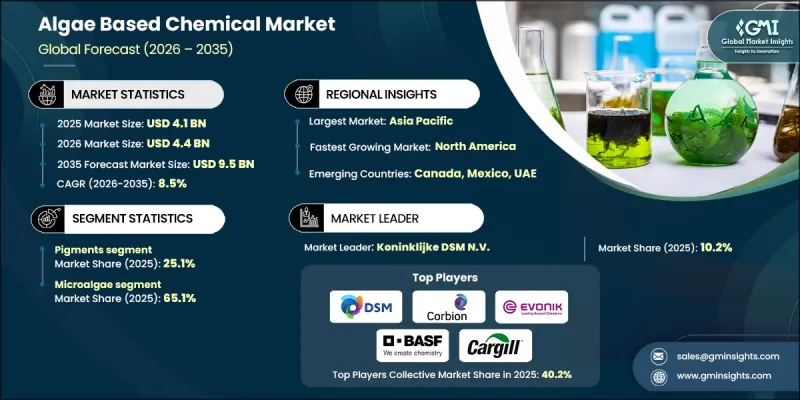
藻类衍生化学品涵盖范围广泛,包括燃料、聚合物、营养物质以及其他用于医疗保健、农业、能源和工业製造的生物活性物质。市场扩张主要受生物来源和非传统来源永续原料需求成长的驱动。世界各国政府正积极透过资助计画、研究激励措施和法规结构来支持生物经济,促进向可再生资源的转型。亚洲目前是最大的市场,这得益于对藻类养殖和加工基础设施的大力投资。北美市场正经历快速扩张,这主要得益于技术创新、永续製造资金的增加以及消费者对环保产品日益增长的偏好。有利的生物技术环境,加上不断完善的法规和公共投资,正在加速商业化进程。先进製造和生命科学领域应用的不断拓展,进一步增强了藻类衍生化学品解决方案的长期成长前景。
| 市场覆盖范围 | |
|---|---|
| 开始年份 | 2025 |
| 预测年份 | 2026-2035 |
| 起始值 | 41亿美元 |
| 预测金额 | 95亿美元 |
| 复合年增长率 | 8.5% |
预计到2025年,颜料市占率将达到25.1%,并在2035年之前以8.6%的复合年增长率成长。各行业对天然来源着色剂的需求日益增长,这些着色剂在安全性、性能、可靠性和可持续性方面均优于传统替代品。监管压力和消费者对洁净标示产品的偏好进一步推动了多个终端市场对永续性的采用。
预计到2025年,微藻类市占率将达到65.1%。其主导地位归功于其高生产力以及在单一生产系统中生产多种高价值化学品的能力。高效率的土地利用和低用水需求使得微藻类在营养保健品、化妆品和能源相关应用领域的大规模商业化部署方面极具吸引力。
预计2026年至2035年,北美藻类衍生化学品市场将以8.6%的复合年增长率成长。这一成长主要得益于永续加工方法的创新、对循环经济原则的日益重视以及消费者对合成化学品环境影响的认识不断提高。各大品牌正持续将藻类衍生成分纳入产品系列,以回应永续性和监管要求。
目录
第一章调查方法和范围
第二章执行摘要
第三章业界考察
- 生态系分析
- 供应商情况
- 利润率
- 每个阶段的附加价值
- 影响价值链的因素
- 中断
- 产业影响因素
- 司机
- 对永续和植物来源原料的需求日益增长
- 提高消费者对健康和保健的意识
- 加强对生质燃料和可再生能源的监管支持
- 产业潜在风险与挑战
- 高昂的生产和加工成本
- 扩充性挑战和资本密集基础设施
- 市场机会
- 生质塑胶及其在循环经济中的新应用
- 与污水处理和碳捕获的集成
- 司机
- 成长潜力分析
- 监管环境
- 北美洲
- 欧洲
- 亚太地区
- 拉丁美洲
- 中东和非洲
- 波特五力分析
- PESTEL 分析
- 价格趋势
- 按地区
- 依产品类型
- 未来市场趋势
- 科技与创新趋势
- 当前技术趋势
- 新兴技术
- 专利状态
- 贸易统计(HS编码)
- 主要进口国
- 主要出口国
- 永续性和环境方面
- 永续努力
- 减少废弃物策略
- 生产中的能源效率
- 环保倡议
- 考虑到碳足迹
第四章 竞争情势
- 介绍
- 公司市占率分析
- 按地区
- 北美洲
- 欧洲
- 亚太地区
- 拉丁美洲
- 中东和非洲
- 按地区
- 企业矩阵分析
- 主要市场公司的竞争分析
- 竞争定位矩阵
- 重大进展
- 併购
- 伙伴关係与合作
- 新产品发布
- 业务拓展计划
第五章 依产品类型分類的市场估算与预测,2022-2035年
- 颜料
- 多醣
- Omega-3脂肪酸
- 蛋白质和胺基酸
- 生质燃料
- 生质塑胶
- 其他的
6. 2022-2035年按藻类类型分類的市场估算与预测
- 微藻类
- 螺旋藻
- 小球藻
- 雨生红球菌
- 其他的
- 大型藻类
- 褐藻
- 红藻
- 绿藻
第七章 按应用领域分類的市场估算与预测,2022-2035年
- 食品/饮料
- 天然色素
- 增稠剂和稳定剂
- 营养资讯
- 营养保健品和膳食补充剂
- Omega-3补充剂
- 蛋白粉
- 抗氧化补充剂
- 製药
- 化妆品和个人护理
- 护肤品
- 护髮产品
- 抗衰老製剂
- 饲料和水产养殖
- 生质燃料和能源
- 农业/肥料
- 其他的
第八章 2022-2035年各地区市场估算与预测
- 北美洲
- 我们
- 加拿大
- 欧洲
- 德国
- 英国
- 法国
- 西班牙
- 义大利
- 其他欧洲地区
- 亚太地区
- 中国
- 印度
- 日本
- 澳洲
- 韩国
- 亚太其他地区
- 拉丁美洲
- 巴西
- 墨西哥
- 阿根廷
- 其他拉丁美洲地区
- 中东和非洲
- 沙乌地阿拉伯
- 南非
- 阿拉伯聯合大公国
- 其他中东和非洲地区
第九章:公司简介
- Aliga ApS
- BASF SE
- Cabio Biotech
- Cargill, Incorporated
- Cellana Inc
- Corbion
- Cyanotech Corporation
- Earthrise Nutritionals LLC
- Evonik Industries AG
- Koninklijke DSM NV
- Parry Nutraceuticals
The Global Algae Based Chemical Market was valued at USD 4.1 billion in 2025 and is estimated to grow at a CAGR of 8.5% to reach USD 9.5 billion by 2035.
Algae-derived chemicals cover a broad range of outputs, including fuels, polymers, nutritional compounds, and other bioactive materials used across healthcare, agriculture, energy, and industrial manufacturing. Market expansion is strongly influenced by the rising demand for sustainable ingredients from both biological and non-traditional sources. Governments worldwide actively support the bioeconomy through funding programs, research incentives, and regulatory frameworks that encourage the transition toward renewable resources. Asia currently represents the largest regional market, supported by strong investments in algae cultivation and processing infrastructure. North America is emerging rapidly due to technological innovation, increased funding for sustainable manufacturing, and a growing consumer preference for environmentally responsible products. A supportive biotechnology ecosystem, reinforced by progressive regulations and public investment, accelerates commercialization. Expanding applications across advanced manufacturing and life-science sectors further strengthen long-term growth prospects for algae-based chemical solutions.
| Market Scope | |
|---|---|
| Start Year | 2025 |
| Forecast Year | 2026-2035 |
| Start Value | $4.1 Billion |
| Forecast Value | $9.5 Billion |
| CAGR | 8.5% |
The pigments segment held 25.1% share in 2025 and is projected to grow at a CAGR of 8.6% through 2035. Demand increases across industries seeking naturally derived colorants that offer safety, performance, reliability, and sustainability advantages compared to conventional alternatives. Regulatory pressure and consumer preference for clean-label products further support adoption in multiple end-use markets.
The microalgae segment held a share of 65.1% in 2025. Their dominance is driven by high productivity rates and the ability to generate multiple high-value chemical outputs within a single production system. Efficient land use and lower water requirements make microalgae particularly attractive for large-scale commercial deployment across nutraceutical, cosmetic, and energy-related applications.
North America Algae Based Chemical Market is forecast to grow at a CAGR of 8.6% from 2026 to 2035. Growth is supported by innovation in sustainable processing methods, increased emphasis on circular economy principles, and rising consumer awareness of the environmental impact of synthetic chemicals. Brands continue to integrate algae-derived inputs into product portfolios to align with sustainability commitments and regulatory expectations.
Key companies operating in the Global Algae Based Chemical Market include BASF SE, Corbion, Cargill Incorporated, Koninklijke DSM N.V., Evonik Industries AG, Cyanotech Corporation, Earthrise Nutritionals LLC, Cellana Inc, Parry Nutraceuticals, Aliga ApS, and Cabio Biotech. Companies in the algae-based chemical market strengthen their competitive position by investing in scalable cultivation technologies and advanced processing techniques to improve yield and cost efficiency. Strategic collaborations with research institutions accelerate product innovation and application development. Many players focus on expanding downstream integration to capture higher value across the supply chain. Emphasis on sustainability certifications and regulatory compliance enhances customer trust and market acceptance. Geographic expansion into high-growth regions supports revenue diversification. Continuous investment in biotechnology, strain optimization, and process automation improves product consistency and commercial viability.
Table of Contents
Chapter 1 Methodology & Scope
- 1.1 Market scope and definition
- 1.2 Research design
- 1.2.1 Research approach
- 1.2.2 Data collection methods
- 1.3 Data mining sources
- 1.3.1 Global
- 1.3.2 Regional/Country
- 1.4 Base estimates and calculations
- 1.4.1 Base year calculation
- 1.4.2 Key trends for market estimation
- 1.5 Primary research and validation
- 1.5.1 Primary sources
- 1.6 Forecast model
- 1.7 Research assumptions and limitations
Chapter 2 Executive Summary
- 2.1 Industry 360° synopsis
- 2.2 Key market trends
- 2.2.1 Regional
- 2.2.2 Product type
- 2.2.3 Algae type
- 2.2.4 Application
- 2.3 TAM Analysis, 2026-2035
- 2.4 CXO perspectives: Strategic imperatives
- 2.4.1 Executive decision points
- 2.4.2 Critical success factors
- 2.5 Future Outlook and Strategic Recommendations
Chapter 3 Industry Insights
- 3.1 Industry ecosystem analysis
- 3.1.1 Supplier landscape
- 3.1.2 Profit margin
- 3.1.3 Value addition at each stage
- 3.1.4 Factor affecting the value chain
- 3.1.5 Disruptions
- 3.2 Industry impact forces
- 3.2.1 Growth drivers
- 3.2.1.1 Growing demand for sustainable & plant-based ingredients
- 3.2.1.2 Rising consumer awareness of health & wellness
- 3.2.1.3 Increasing regulatory support for biofuels & renewable energy
- 3.2.2 Industry pitfalls and challenges
- 3.2.2.1 High production & processing costs
- 3.2.2.2 Scalability challenges & capital-intensive infrastructure
- 3.2.3 Market opportunities
- 3.2.3.1 Emerging applications in bioplastics & circular economy
- 3.2.3.2 Integration with wastewater treatment & carbon capture
- 3.2.1 Growth drivers
- 3.3 Growth potential analysis
- 3.4 Regulatory landscape
- 3.4.1 North America
- 3.4.2 Europe
- 3.4.3 Asia Pacific
- 3.4.4 Latin America
- 3.4.5 Middle East & Africa
- 3.5 Porter's analysis
- 3.6 PESTEL analysis
- 3.7 Price trends
- 3.7.1 By region
- 3.7.2 By product type
- 3.8 Future market trends
- 3.9 Technology and innovation landscape
- 3.9.1 Current technological trends
- 3.9.2 Emerging technologies
- 3.10 Patent Landscape
- 3.11 Trade statistics (HS code)
- 3.11.1 Major importing countries
- 3.11.2 Major exporting countries
- 3.12 Sustainability and environmental aspects
- 3.12.1 Sustainable practices
- 3.12.2 Waste reduction strategies
- 3.12.3 Energy efficiency in production
- 3.12.4 Eco-friendly initiatives
- 3.13 Carbon footprint consideration
Chapter 4 Competitive Landscape, 2025
- 4.1 Introduction
- 4.2 Company market share analysis
- 4.2.1 By region
- 4.2.1.1 North America
- 4.2.1.2 Europe
- 4.2.1.3 Asia Pacific
- 4.2.1.4 LATAM
- 4.2.1.5 MEA
- 4.2.1 By region
- 4.3 Company matrix analysis
- 4.4 Competitive analysis of major market players
- 4.5 Competitive positioning matrix
- 4.6 Key developments
- 4.6.1 Mergers & acquisitions
- 4.6.2 Partnerships & collaborations
- 4.6.3 New Product Launches
- 4.6.4 Expansion Plans
Chapter 5 Market Estimates and Forecast, By Product Type, 2022-2035 (USD Billion) (Kilo Tons)
- 5.1 Key trends
- 5.2 Pigments
- 5.3 Polysaccharides
- 5.4 Omega-3 fatty acids
- 5.5 Proteins & amino acids
- 5.6 Biofuels
- 5.7 Bioplastics
- 5.8 Others
Chapter 6 Market Estimates and Forecast, By Algae Type, 2022-2035 (USD Billion) (Kilo Tons)
- 6.1 Key trends
- 6.2 Microalgae
- 6.2.1 Spirulina
- 6.2.2 Chlorella
- 6.2.3 Haematococcus pluvialis
- 6.2.4 Others
- 6.3 Macroalgae
- 6.3.1 Brown seaweeds
- 6.3.2 Red seaweeds
- 6.3.3 Green seaweeds
Chapter 7 Market Estimates and Forecast, By Application, 2022-2035 (USD Billion) (Kilo Tons)
- 7.1 Key trends
- 7.2 Food & beverages
- 7.2.1 Natural colorants
- 7.2.2 Thickeners & stabilizers
- 7.2.3 Nutritional ingredients
- 7.3 Nutraceuticals & dietary supplements
- 7.3.1 Omega-3 supplements
- 7.3.2 Protein powders
- 7.3.3 Antioxidant supplements
- 7.4 Pharmaceuticals
- 7.5 Cosmetics & personal care
- 7.5.1 Skin care products
- 7.5.2 Hair care products
- 7.5.3 Anti-aging formulations
- 7.6 Animal feed & aquaculture
- 7.7 Biofuels & energy
- 7.8 Agriculture & fertilizers
- 7.9 Others
Chapter 8 Market Estimates and Forecast, By Region, 2022-2035 (USD Billion) (Kilo Tons)
- 8.1 Key trends
- 8.2 North America
- 8.2.1 U.S.
- 8.2.2 Canada
- 8.3 Europe
- 8.3.1 Germany
- 8.3.2 UK
- 8.3.3 France
- 8.3.4 Spain
- 8.3.5 Italy
- 8.3.6 Rest of Europe
- 8.4 Asia Pacific
- 8.4.1 China
- 8.4.2 India
- 8.4.3 Japan
- 8.4.4 Australia
- 8.4.5 South Korea
- 8.4.6 Rest of Asia Pacific
- 8.5 Latin America
- 8.5.1 Brazil
- 8.5.2 Mexico
- 8.5.3 Argentina
- 8.5.4 Rest of Latin America
- 8.6 Middle East and Africa
- 8.6.1 Saudi Arabia
- 8.6.2 South Africa
- 8.6.3 UAE
- 8.6.4 Rest of Middle East and Africa
Chapter 9 Company Profiles
- 9.1 Aliga ApS
- 9.2 BASF SE
- 9.3 Cabio Biotech
- 9.4 Cargill, Incorporated
- 9.5 Cellana Inc
- 9.6 Corbion
- 9.7 Cyanotech Corporation
- 9.8 Earthrise Nutritionals LLC
- 9.9 Evonik Industries AG
- 9.10 Koninklijke DSM N.V.
- 9.11 Parry Nutraceuticals

 全球复杂生物酵素产品市场(按应用、酵素类别、剂型、最终用户和分销管道划分)预测(2026-2032年)
 角鲨烷基乳化剂市场规模、份额和成长分析:按产品类型、配方类型、最终用途、分销管道和地区划分-2026-2033年产业预测
 2026年全球生物基消毒剂市场报告
 生物基泡棉市场分析及预测(至2035年):依类型、产品类型、应用、技术、材料类型、最终用户、製程、功能、安装类型划分
 2026-2034年全球生物基油衍生产品市场规模、份额、趋势和成长分析报告2026年全球生物化学市场报告
 生物催化丙烯酰胺(BioACM)市场-全球产业规模、份额、趋势、机会、预测:按应用、地区和竞争格局划分,2021-2031年泡壳包装回收市场:依树脂类型、回收製程、收集管道和应用划分,全球预测(2026-2032年)生物基渗透油市场按产品类型、终端用户产业和分销管道划分-2026-2032年全球预测生物基聚合物添加剂市场(按添加剂类型、聚合物类型、原料、终端用途产业和应用划分)-全球预测,2026-2032年