


 |
市场调查报告书
商品编码
1936506
垂直农业自动化系统市场机会、成长要素、产业趋势分析及2026年至2035年预测Vertical Farming Automation System Market Opportunity, Growth Drivers, Industry Trend Analysis, and Forecast 2026 - 2035 |
||||||

全球垂直农业自动化系统市场预计到 2025 年将达到 8.171 亿美元,到 2035 年将达到 15.3 亿美元,年复合成长率为 6.5%。
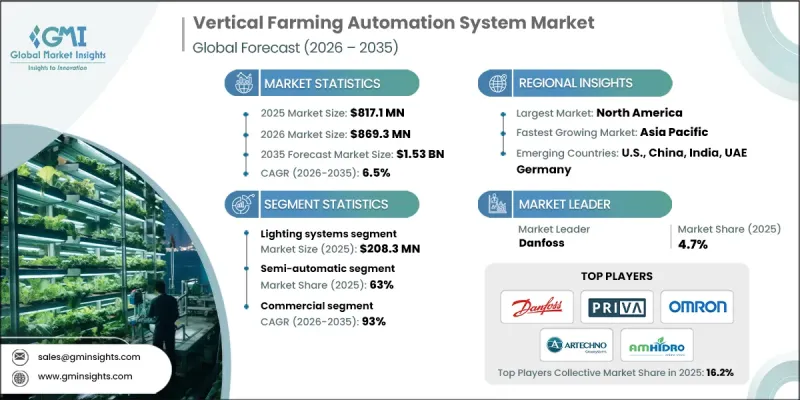
在有限的空间内,最大限度地提高作物产量并最大限度地减少资源消耗的需求是推动垂直农业成长的动力。垂直农业依靠堆迭式种植系统,能够在实现高产量的同时减少用水量和对化学肥料的依赖。自动化技术在提高这些可控环境中的生产力、稳定性和营运效率方面发挥核心作用。政府支持和财政奖励促进了永续农业实践,也推动了市场扩张。人们对提高用水效率和减少土地利用等环境效益的认识不断提高,正在推动垂直农业在各个地区的普及。先进的照明技术在垂直农业中仍然至关重要,因为它利用人工光源来模拟各种作物的最佳生长条件。现代LED解决方案能够精确控制光照强度和频谱,同时最大限度地减少发热量,缩短与作物的安装距离,并提高空间利用率。动态照明系统加速作物生长週期,提高产量质量,并在整个种植阶段优化营养供给。
| 市场覆盖范围 | |
|---|---|
| 开始年份 | 2025 |
| 预测年份 | 2026-2035 |
| 起始值 | 8.171亿美元 |
| 预测金额 | 15.3亿美元 |
| 复合年增长率 | 6.5% |
预计到2025年,照明系统市场规模将达到2.083亿美元,2026年至2035年的复合年增长率(CAGR)为6.7%。垂直农业对精准环境控制的需求是推动市场成长的主要因素。气候控制解决方案能够调节温度、湿度和二氧化碳水平,确保作物均匀生长。智慧气候控制技术的进步提高了系统效率,同时降低了营运成本。照明仍然是影响植物生长、产量和品质的关键因素。节能型LED技术因其对不同作物类型和生长阶段的适应性而持续受到欢迎。
预计2026年至2035年间,商业领域将以93%的复合年增长率成长。商业营运越来越依赖自动化来支援大规模食品生产、降低劳动强度并维持作物品质的稳定性。机器人、人工智慧和互联繫统等技术有助于优化产量和提高营运可靠性。
到2025年,美国垂直农业自动化系统市场规模预计将达到3.201亿美元,占77%的市场。市场成长的主要驱动力是都市化加快、对永续食品体系的需求以及提高农业效率的必要性。城市农业解决方案的日益普及使得食品生产更贴近消费地,从而降低了物流复杂性,并提高了食品供应的新鲜度。
目录
第一章调查方法和范围
第二章执行摘要
第三章业界考察
- 生态系分析
- 供应商情况
- 利润率
- 每个阶段的附加价值
- 影响价值链的因素
- 产业影响因素
- 司机
- 产业潜在风险与挑战
- 机会
- 成长潜力分析
- 未来市场趋势
- 科技与创新趋势
- 当前技术趋势
- 新兴技术
- 价格趋势
- 按地区
- 依系统类型
- 监管环境
- 标准和合规要求
- 区域法规结构
- 认证标准
- 波特五力分析
- PESTEL 分析
第四章 竞争情势
- 介绍
- 公司市占率分析
- 按地区
- 企业矩阵分析
- 主要市场公司的竞争分析
- 竞争定位矩阵
- 重大进展
- 併购
- 伙伴关係与合作
- 新产品发布
- 扩张计划
第五章 依系统类型分類的市场估算与预测,2022-2035年
- 空调系统
- 暖通空调系统
- 除湿机
- 加湿系统
- 通风系统
- 其他(二氧化碳注入/浓缩系统等)
- 照明系统
- LED栽培照明系统
- 萤光照明系统
- 其他(照明和配电设备等)
- 灌溉和施肥系统
- 滴灌系统
- 自动加药装置
- 水过滤和处理系统
- 其他(营养液培养系统等)
- 感测器和监控硬体
- 环境感测器
- 光测量感测器
- 气体感测器
- 其他(水质感测器等)
- 其他(机器人自动化系统等)
第六章 依技术类型分類的市场估算与预测,2022-2035年
- 水耕法
- 气耕
- 水耕法
7. 依自动化程度分類的市场估算与预测,2022-2035 年
- 半自动
- 全自动
第八章 依作物类型分類的市场估算与预测,2022-2035年
- 绿叶蔬菜和香草
- 水果和蔬菜
- 花卉和观赏植物
- 其他(药用植物等)
第九章 依最终用户分類的市场估算与预测,2022-2035年
- 供个人/住宅使用
- 商业的
- 零售和酒店业
- 餐厅
- 杂货店
- 其他(研究机构、教育机构等)
第十章 按分销管道分類的市场估算与预测,2022-2035年
- 直销
- 间接销售
第十一章 2022-2035年各地区市场估计与预测
- 北美洲
- 我们
- 加拿大
- 欧洲
- 德国
- 英国
- 法国
- 西班牙
- 义大利
- 荷兰
- 亚太地区
- 中国
- 日本
- 印度
- 澳洲
- 韩国
- 拉丁美洲
- 巴西
- 墨西哥
- 阿根廷
- 中东和非洲
- 南非
- 沙乌地阿拉伯
- 阿拉伯聯合大公国
第十二章:公司简介
- American Hydroponics
- Arianetech
- Artechno Growsystems
- AutoStore
- Danfoss
- Green Automation
- Heliospectra
- Jungheinrich
- Logiqs
- Modula USA
- OMRON Corporation
- Priva
- Signify Holding
- Swisslog
- TTA
The Global Vertical Farming Automation System Market was valued at USD 817.1 million in 2025 and is estimated to grow at a CAGR of 6.5% to reach USD 1.53 billion by 2035.
Growth is driven by the need to maximize crop output in constrained spaces while reducing resource consumption. Vertical farming relies on stacked cultivation systems that allow higher yields with lower water usage and reduced dependency on chemical inputs. Automation plays a central role in improving productivity, consistency, and operational efficiency across these controlled environments. Supportive government initiatives and financial incentives that encourage sustainable farming practices further contribute to market expansion. Awareness of environmental benefits, such as water efficiency and reduced land use, strengthens adoption across regions. Advanced lighting technologies remain essential to vertical farming, as artificial illumination replicates optimal growth conditions for different crops. Modern LED solutions enable precise control of light intensity and spectrum while minimizing heat output, allowing closer placement to crops and improved space utilization. Dynamic lighting systems enhance growth cycles, improve yield quality, and support nutrient optimization throughout cultivation stages.
| Market Scope | |
|---|---|
| Start Year | 2025 |
| Forecast Year | 2026-2035 |
| Start Value | $817.1 Million |
| Forecast Value | $1.53 Billion |
| CAGR | 6.5% |
The lighting systems segment generated USD 208.3 million in 2025 and is expected to grow at a CAGR of 6.7% during 2026-2035. Demand rises alongside the need for accurate environmental management within vertical farms. Climate control solutions regulate temperature, humidity, and carbon dioxide levels to ensure uniform crop development. Advancements in intelligent climate management improve system efficiency while lowering operating costs. Lighting remains a critical component because it directly influences plant development, productivity, and quality. Energy-efficient LED technologies continue gaining preference due to their adaptability across crop types and growth phases.
The commercial segment is projected to grow at a CAGR of 93% from 2026 to 2035. Commercial operations increasingly depend on automation to support large-scale food production, reduce labor intensity, and maintain consistent crop quality. Technologies such as robotics, artificial intelligence, and connected systems support yield optimization and operational reliability.
United States Vertical Farming Automation System Market held 77% share, generating USD 320.1 million in 2025. Growth is supported by rising urbanization, demand for sustainable food systems, and the need to enhance agricultural efficiency. Increased adoption of urban farming solutions brings food production closer to consumption centers, reducing logistical complexity and improving supply freshness.
Key companies operating in the Global Vertical Farming Automation System Market include Signify Holding, Danfoss, OMRON Corporation, Heliospectra, Swisslog, American Hydroponics, Priva, AutoStore, Jungheinrich, Artechno Growsystems, Green Automation, Modula USA, Logiqs, Arianetech, and TTA. Companies in the vertical farming automation system market strengthen their market position by investing in advanced automation technologies that improve precision, scalability, and energy efficiency. Many focus on integrating AI-driven monitoring systems to optimize growing conditions and reduce operational costs. Strategic partnerships with agricultural operators help accelerate system adoption and customization. Manufacturers emphasize modular system designs to support flexible deployment and future expansion. Continuous innovation in lighting, climate control, and data analytics enhances performance differentiation. Expanding global distribution networks and offering long-term technical support further reinforce customer confidence.
Table of Contents
Chapter 1 Methodology and scope
- 1.1 Market scope and definition
- 1.2 Research design
- 1.2.1 Research approach
- 1.2.2 Data collection methods
- 1.3 Data mining sources
- 1.3.1 Global
- 1.3.2 Regional/country
- 1.4 Base estimates and calculations
- 1.4.1 Base year calculation
- 1.4.2 Key trends for market estimation
- 1.5 Primary research and validation
- 1.5.1 Primary sources
- 1.6 Forecast model
- 1.7 Research assumptions and limitations
Chapter 2 Executive summary
- 2.1 Industry 360° synopsis
- 2.2 Key market trends
- 2.2.1 Regional
- 2.2.2 System Type
- 2.2.3 Technology Type
- 2.2.4 Automation Level
- 2.2.5 Crop Type
- 2.2.6 End Users
- 2.2.7 Distribution Channel
- 2.3 CXO perspectives: strategic imperatives
- 2.3.1 Key decision points for industry executives
- 2.3.2 Critical success factors for market players
- 2.4 Future outlook and strategic recommendations
Chapter 3 Industry insights
- 3.1 Industry ecosystem analysis
- 3.1.1 Supplier landscape
- 3.1.2 Profit margin
- 3.1.3 Value addition at each stage
- 3.1.4 Factor affecting the value chain
- 3.2 Industry impact forces
- 3.2.1 Growth drivers
- 3.2.2 Industry pitfalls & challenges
- 3.2.3 Opportunities
- 3.3 Growth potential analysis
- 3.4 Future market trends
- 3.5 Technology and innovation landscape
- 3.5.1 Current technological trends
- 3.5.2 Emerging technologies
- 3.6 Price trends
- 3.6.1 By region
- 3.6.2 By system type
- 3.7 Regulatory landscape
- 3.7.1 Standards and compliance requirements
- 3.7.2 Regional regulatory frameworks
- 3.7.3 Certification standards
- 3.8 Porter's analysis
- 3.9 PESTEL analysis
Chapter 4 Competitive landscape, 2025
- 4.1 Introduction
- 4.2 Company market share analysis
- 4.2.1 By region
- 4.2.1.1 North America
- 4.2.1.2 Europe
- 4.2.1.3 Asia Pacific
- 4.2.1.4 Latin America
- 4.2.1.5 MEA
- 4.2.1 By region
- 4.3 Company matrix analysis
- 4.4 Competitive analysis of major market players
- 4.5 Competitive positioning matrix
- 4.6 Key developments
- 4.6.1 Mergers & acquisitions
- 4.6.2 Partnerships & collaborations
- 4.6.3 New product launches
- 4.6.4 Expansion plans
Chapter 5 Market Estimates & Forecast, By System Type, 2022 - 2035 ($Million, Thousand Units)
- 5.1 Key trends
- 5.2 Climate control systems
- 5.2.1 HVAC systems
- 5.2.2 Dehumidifiers
- 5.2.3 Humidification systems
- 5.2.4 Ventilation systems
- 5.2.5 Others (Co2 injection/enrichment systems etc.)
- 5.3 Lighting systems
- 5.3.1 LED grow light systems
- 5.3.2 Fluorescent light systems
- 5.3.3 Others (light distribution hardware etc.)
- 5.4 Irrigation & fertigation systems
- 5.4.1 Drip irrigation systems
- 5.4.2 Automated dosing equipment
- 5.4.3 Water filtration & treatment systems
- 5.4.4 Others (nutrient film technique systems etc.)
- 5.5 Sensor & monitoring hardware
- 5.5.1 Environmental sensors
- 5.5.2 Light measurement sensors
- 5.5.3 Gas sensors
- 5.5.4 Others (water quality sensors etc.)
- 5.6 Others (robotic automation systems etc.)
Chapter 6 Market Estimates & Forecast, By Technology Type, 2022 - 2035 ($Million, Thousand Units)
- 6.1 Key trends
- 6.2 Hydroponics
- 6.3 Aeroponics
- 6.4 Aquaponics
Chapter 7 Market Estimates & Forecast, By Automation Level, 2022 - 2035 ($Million, Thousand Units)
- 7.1 Key trends
- 7.2 Semi-automatic
- 7.3 Fully automatic
Chapter 8 Market Estimates & Forecast, By Crop Type, 2022 - 2035 ($Million, Thousand Units)
- 8.1 Key trends
- 8.2 Leafy greens & herbs
- 8.3 Fruiting vegetables
- 8.4 Flowers & ornamentals
- 8.5 Others (medicinal plants etc.)
Chapter 9 Market Estimates & Forecast, By End Users, 2022 - 2035 ($Million, Thousand Units)
- 9.1 Key trends
- 9.2 Individual/residential
- 9.3 Commercial
- 9.3.1 Retail & Hospitality
- 9.3.2 Restaurants
- 9.3.3 Grocery stores
- 9.3.4 Others (research & educational institutions etc.)
Chapter 10 Market Estimates & Forecast, By Distribution Channel, 2022 - 2035 ($Million, Thousand Units)
- 10.1 Key trends
- 10.2 Direct sales
- 10.3 Indirect sales
Chapter 11 Market Estimates & Forecast, By Region, 2022 - 2035 ($Million, Thousand Units)
- 11.1 Key trends
- 11.2 North America
- 11.2.1 U.S.
- 11.2.2 Canada
- 11.3 Europe
- 11.3.1 Germany
- 11.3.2 UK
- 11.3.3 France
- 11.3.4 Spain
- 11.3.5 Italy
- 11.3.6 Netherlands
- 11.4 Asia Pacific
- 11.4.1 China
- 11.4.2 Japan
- 11.4.3 India
- 11.4.4 Australia
- 11.4.5 South Korea
- 11.5 Latin America
- 11.5.1 Brazil
- 11.5.2 Mexico
- 11.5.3 Argentina
- 11.6 MEA
- 11.6.1 South Africa
- 11.6.2 Saudi Arabia
- 11.6.3 UAE
Chapter 12 Company Profiles
- 12.1 American Hydroponics
- 12.2 Arianetech
- 12.3 Artechno Growsystems
- 12.4 AutoStore
- 12.5 Danfoss
- 12.6 Green Automation
- 12.7 Heliospectra
- 12.8 Jungheinrich
- 12.9 Logiqs
- 12.10 Modula USA
- 12.11 OMRON Corporation
- 12.12 Priva
- 12.13 Signify Holding
- 12.14 Swisslog
- 12.15 TTA

