


 |
市场调查报告书
商品编码
1936511
工业水消毒剂市场机会、成长要素、产业趋势分析及2026年至2035年预测Biocides For Industrial Water Market Opportunity, Growth Drivers, Industry Trend Analysis, and Forecast 2026 - 2035 |
||||||

全球工业水除生物剂市场预计到 2025 年将达到 21 亿美元,到 2035 年将达到 37 亿美元,年复合成长率为 5.9%。
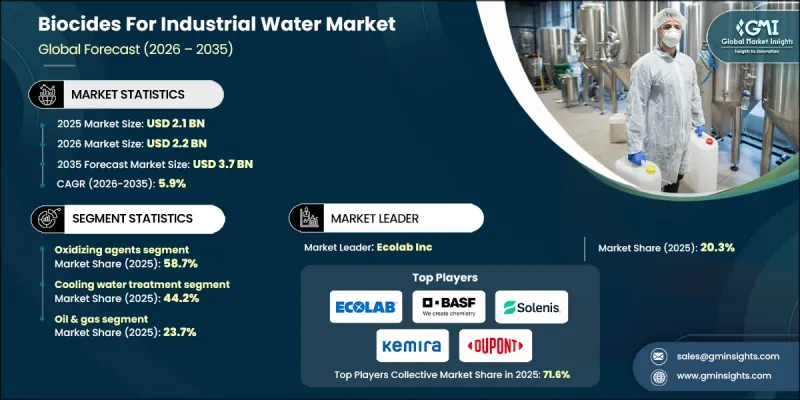
快速的工业化、日益严格的环境法规以及对永续水资源管理实践的日益重视,共同推动了这一成长。工业水处理杀菌剂对于抑制微生物生长、防止生物膜形成、维持各产业系统效率至关重要。氧化型杀菌剂因其在去除水循环系统中的细菌、真菌和生物膜沉积物方面的显着效果,仍然是应用最广泛的杀菌剂。同时,非氧化型杀菌剂在腐蚀防护和建筑用水系统等领域的应用也日益受到关注。不断增加的监管压力和永续性措施也加速了环保植物来源杀菌剂的研发,这些杀菌剂能够减少对环境的影响,并吸引那些优先考虑绿色营运的产业。锅炉水处理、製程用水和污水处理等高价值应用推动了对杀菌剂的稳定需求,尤其是在那些对水资源再利用和严格的品质标准要求极高的行业。
| 市场覆盖范围 | |
|---|---|
| 开始年份 | 2025 |
| 预测年份 | 2026-2035 |
| 起始值 | 21亿美元 |
| 预测金额 | 37亿美元 |
| 复合年增长率 | 5.9% |
2025年,氧化性消毒剂市占率达到58.7%,预计到2035年将以5.3%的复合年增长率成长。氯、溴、二氧化氯、过氧乙酸和臭氧等化合物因其在抑制工业冷却水和锅炉水系统中的微生物污染和生物膜形成方面的卓越功效,正在推动这一细分市场的发展。
冷却水处理领域占市场份额的 44.2%,预计从 2026 年到 2035 年将以 5.1% 的复合年增长率成长。冷却水系统需要持续的抗菌处理以维持运作效率,而工业的持续成长和水质法规的不断完善,尤其是在新兴经济体,将继续推动该领域的需求。
预计到2025年,北美工业水消毒剂市场规模将达到4.982亿美元,并在预测期内保持稳定成长。该地区市场已趋于成熟,符合监管要求、技术先进且环保的消毒剂已被广泛采用。美国环保署(EPA)的法规、工业水回用计划以及电力、化学、食品饮料生产等行业的永续性倡议均推动了市场成长。数位化水处理解决方案进一步提高了营运效率,并促进了环保配方的应用。
目录
第一章调查方法和范围
第二章执行摘要
第三章业界考察
- 生态系分析
- 供应商情况
- 利润率
- 每个阶段的附加价值
- 影响价值链的因素
- 中断
- 产业影响因素
- 司机
- 严格的水质法规
- 扩大工业用水再利用和零液体排放(ZLD)
- 新兴经济体的工业化
- 产业潜在风险与挑战
- 复杂除生物剂登记
- 原料成本波动
- 环境和生态毒理学问题
- 市场机会
- 尚未开发的污水处理市场
- 对环保消毒剂的需求日益增长
- 数位水处理优化
- 司机
- 成长潜力分析
- 监管环境
- 北美洲
- 欧洲
- 亚太地区
- 拉丁美洲
- 中东和非洲
- 波特五力分析
- PESTEL 分析
- 价格趋势
- 按地区
- 依产品类型
- 未来市场趋势
- 科技与创新趋势
- 当前技术趋势
- 新兴技术
- 专利状态
- 贸易统计(HS编码)
- 主要进口国
- 主要出口国
- 永续性和环境方面
- 永续努力
- 减少废弃物策略
- 生产中的能源效率
- 环保倡议
- 考虑到碳足迹
第四章 竞争情势
- 介绍
- 公司市占率分析
- 按地区
- 北美洲
- 欧洲
- 亚太地区
- 拉丁美洲
- 中东和非洲
- 按地区
- 企业矩阵分析
- 主要市场公司的竞争分析
- 竞争定位矩阵
- 重大进展
- 併购
- 伙伴关係与合作
- 新产品发布
- 业务拓展计划
第五章 依产品类型分類的市场估算与预测,2022-2035年
- 氧化消毒剂
- 氯基
- 溴基
- 二氧化氯
- 过氧乙酸
- 臭氧
- 其他的
- 非氧化性消毒剂
- 戊二醛
- 异噻唑啉酮
- 季铵化合物(季铵盐)
- DBNPA
- Bronopol
- 其他的
第六章 按应用领域分類的市场估算与预测,2022-2035年
- 冷却水处理
- 锅炉水处理
- 製程水处理
- 污水及废水处理
- 其他的
7. 按最终用户分類的市场估计和预测,2022-2035 年
- 石油和天然气
- 发电
- 纸浆和造纸
- 化工/石油化工
- 食品/饮料
- 采矿和冶金
- 製药
- 纺织品和皮革
- 其他的
第八章 2022-2035年各地区市场估算与预测
- 北美洲
- 我们
- 加拿大
- 欧洲
- 德国
- 英国
- 法国
- 西班牙
- 义大利
- 其他欧洲地区
- 亚太地区
- 中国
- 印度
- 日本
- 澳洲
- 韩国
- 亚太其他地区
- 拉丁美洲
- 巴西
- 墨西哥
- 阿根廷
- 其他拉丁美洲地区
- 中东和非洲
- 沙乌地阿拉伯
- 南非
- 阿拉伯聯合大公国
- 其他中东和非洲地区
第九章:公司简介
- B&V Chemicals Ltd.
- BASF SE
- Dupont
- Ecolab Inc.(Nalco Water Division)
- Italmatch Chemicals SpA(Advanced Water Solutions)
- Kemira Oyj
- Kurita Water Industries Ltd.(Kurita-GK Chemical)
- Lanxess AG
- Nouryon Chemicals Holding BV
- Solenis LLC
The Global Biocides For Industrial Water Market was valued at USD 2.1 billion in 2025 and is estimated to grow at a CAGR of 5.9% to reach USD 3.7 billion by 2035.
This growth is fueled by rapid industrialization, stricter environmental regulations, and increasing emphasis on sustainable water management practices. Industrial water treatment biocides are critical for controlling microbial growth, preventing biofilms, and maintaining system efficiency across various sectors. Oxidizing biocides remain the most widely adopted due to their proven effectiveness in eliminating bacteria, fungi, and biofilm deposits from water circuits. Meanwhile, non-oxidizing biocides are gaining traction for applications such as corrosion prevention and construction water systems. Rising regulatory pressures and sustainability initiatives are also accelerating the development of eco-friendly and plant-based biocides, which reduce environmental impact and appeal to industries prioritizing green operations. High-value applications such as boiler treatments, process water, and wastewater treatment are driving consistent demand, particularly in industries where water reuse and strict quality standards are essential.
| Market Scope | |
|---|---|
| Start Year | 2025 |
| Forecast Year | 2026-2035 |
| Start Value | $2.1 Billion |
| Forecast Value | $3.7 Billion |
| CAGR | 5.9% |
The oxidizing biocides segment held 58.7% share in 2025 and is projected to grow at a CAGR of 5.3% through 2035. Compounds such as chlorine, bromine, chlorine dioxide, peracetic acid, and ozone lead the segment due to their exceptional efficacy in controlling microbial contamination and biofilm formation in industrial cooling and boiler water systems.
The cooling water treatment segment held 44.2% share and is expected to grow at a CAGR of 5.1% from 2026 to 2035. Cooling water systems require continuous antimicrobial treatment to maintain operational efficiency, and ongoing industrial growth, especially in emerging economies, along with stricter water quality regulations, will continue to drive demand in this segment.
North America Biocides For Industrial Water Market reached USD 498.2 million in 2025 and is expected to experience steady growth throughout the forecast period. The region represents a mature market where regulatory-compliant, technologically advanced, and environmentally friendly biocides are widely implemented. Growth is supported by EPA regulations, industrial water reuse projects, and sustainability mandates in sectors such as power generation, chemical processing, and food and beverage production. Digital water treatment solutions are further enhancing operational efficiency and driving the adoption of eco-friendly formulations.
Key players operating in the Global Biocides For Industrial Water Market include BASF SE, Kemira Oyj, DuPont, Nouryon Chemicals Holding B.V., B&V Chemicals Ltd., Kurita Water Industries Ltd., Lanxess AG, Ecolab Inc. (Nalco Water Division), Italmatch Chemicals SpA (Advanced Water Solutions), and Solenis LLC. Leading companies in the biocides for industrial water market are employing strategies to strengthen their presence and market foothold through innovation, partnerships, and operational efficiency. These strategies include developing eco-friendly and plant-based products to meet sustainability regulations, investing in R&D for next-generation biocide formulations, and forming strategic alliances with industrial end-users to ensure long-term contracts. Companies are also expanding regional production facilities to reduce lead times and logistics costs, implementing digital water treatment platforms for monitoring and efficiency, and optimizing supply chains to secure raw material availability.
Table of Contents
Chapter 1 Methodology & Scope
- 1.1 Research approach
- 1.2 Quality Commitments
- 1.2.1 GMI AI policy & data integrity commitment
- 1.2.1.1 Source consistency protocol
- 1.2.1 GMI AI policy & data integrity commitment
- 1.3 Research Trail & Confidence Scoring
- 1.3.1 Research Trail Components
- 1.3.2 Scoring Components
- 1.4 Data Collection
- 1.4.1 Partial list of primary sources
- 1.5 Data mining sources
- 1.5.1 Paid sources
- 1.5.1.1 Sources, by region
- 1.5.1 Paid sources
- 1.6 Base estimates and calculations
- 1.6.1 Base year calculation for any one approach
- 1.7 Forecast model
- 1.7.1 Quantified market impact analysis
- 1.7.1.1 Mathematical impact of growth parameters on forecast
- 1.7.1 Quantified market impact analysis
- 1.8 Research transparency addendum
- 1.8.1 Source attribution framework
- 1.8.2 Quality assurance metrics
- 1.8.3 Our commitment to trust
Chapter 2 Executive Summary
- 2.1 Industry 360° synopsis
- 2.2 Key market trends
- 2.2.1 Regional
- 2.2.2 Product Type
- 2.2.3 Application
- 2.2.4 End User
- 2.3 TAM Analysis, 2025-2034
- 2.4 CXO perspectives: Strategic imperatives
- 2.4.1 Executive decision points
- 2.4.2 Critical success factors
- 2.5 Future Outlook and Strategic Recommendations
Chapter 3 Industry Insights
- 3.1 Industry ecosystem analysis
- 3.1.1 Supplier landscape
- 3.1.2 Profit margin
- 3.1.3 Value addition at each stage
- 3.1.4 Factor affecting the value chain
- 3.1.5 Disruptions
- 3.2 Industry impact forces
- 3.2.1 Growth drivers
- 3.2.1.1 Stringent Water Quality Regulations
- 3.2.1.2 Rising Industrial Water Reuse & ZLD
- 3.2.1.3 Industrialization in Emerging Economies
- 3.2.2 Industry pitfalls and challenges
- 3.2.2.1 Complex Biocide Registration
- 3.2.2.2 Volatile Raw Material Costs
- 3.2.2.3 Environmental & Ecotoxicity Concerns
- 3.2.3 Market opportunities
- 3.2.3.1 Untapped Wastewater Treatment Market
- 3.2.3.2 Rising Demand for Eco-Friendly Biocides
- 3.2.3.3 Digital Water Treatment Optimization
- 3.2.1 Growth drivers
- 3.3 Growth potential analysis
- 3.4 Regulatory landscape
- 3.4.1 North America
- 3.4.2 Europe
- 3.4.3 Asia Pacific
- 3.4.4 Latin America
- 3.4.5 Middle East & Africa
- 3.5 Porter's analysis
- 3.6 PESTEL analysis
- 3.7 Price trends
- 3.7.1 By region
- 3.7.2 By product type
- 3.8 Future market trends
- 3.9 Technology and Innovation landscape
- 3.9.1 Current technological trends
- 3.9.2 Emerging technologies
- 3.10 Patent Landscape
- 3.11 Trade statistics (HS code)
- 3.11.1 Major importing countries
- 3.11.2 Major exporting countries
- 3.12 Sustainability and environmental aspects
- 3.12.1 Sustainable practices
- 3.12.2 Waste reduction strategies
- 3.12.3 Energy efficiency in production
- 3.12.4 Eco-friendly initiatives
- 3.13 Carbon footprint consideration
Chapter 4 Competitive Landscape, 2025
- 4.1 Introduction
- 4.2 Company market share analysis
- 4.2.1 By region
- 4.2.1.1 North America
- 4.2.1.2 Europe
- 4.2.1.3 Asia Pacific
- 4.2.1.4 LATAM
- 4.2.1.5 MEA
- 4.2.1 By region
- 4.3 Company matrix analysis
- 4.4 Competitive analysis of major market players
- 4.5 Competitive positioning matrix
- 4.6 Key developments
- 4.6.1 Mergers & acquisitions
- 4.6.2 Partnerships & collaborations
- 4.6.3 New Product Launches
- 4.6.4 Expansion Plans
Chapter 5 Market Estimates and Forecast, By Product Type, 2022-2035 (USD Billion) (Kilo Tons)
- 5.1 Key trends
- 5.2 Oxidizing Biocides
- 5.2.1 Chlorine-Based
- 5.2.2 Bromine-Based
- 5.2.3 Chlorine Dioxide
- 5.2.4 Peracetic Acid
- 5.2.5 Ozone
- 5.2.6 Others
- 5.3 Non-Oxidizing Biocides
- 5.3.1 Glutaraldehyde
- 5.3.2 Isothiazolinones
- 5.3.3 Quaternary Ammonium Compounds (Quats)
- 5.3.4 DBNPA
- 5.3.5 Bronopol
- 5.3.6 Others
Chapter 6 Market Estimates and Forecast, By Application, 2022-2035 (USD Billion) (Kilo Tons)
- 6.1 Key trends
- 6.2 Cooling Water Treatment
- 6.3 Boiler Water Treatment
- 6.4 Process Water Treatment
- 6.5 Wastewater & Effluent Treatment
- 6.6 Others
Chapter 7 Market Estimates and Forecast, By End User, 2022-2035 (USD Billion) (Kilo Tons)
- 7.1 Key trends
- 7.2 Oil & Gas
- 7.3 Power Generation
- 7.4 Pulp & Paper
- 7.5 Chemical & Petrochemical
- 7.6 Food & Beverage
- 7.7 Mining & Metallurgy
- 7.8 Pharmaceuticals
- 7.9 Textile & Leather
- 7.10 Others
Chapter 8 Market Estimates and Forecast, By Region, 2022-2035 (USD Billion) (Kilo Tons)
- 8.1 Key trends
- 8.2 North America
- 8.2.1 U.S.
- 8.2.2 Canada
- 8.3 Europe
- 8.3.1 Germany
- 8.3.2 UK
- 8.3.3 France
- 8.3.4 Spain
- 8.3.5 Italy
- 8.3.6 Rest of Europe
- 8.4 Asia Pacific
- 8.4.1 China
- 8.4.2 India
- 8.4.3 Japan
- 8.4.4 Australia
- 8.4.5 South Korea
- 8.4.6 Rest of Asia Pacific
- 8.5 Latin America
- 8.5.1 Brazil
- 8.5.2 Mexico
- 8.5.3 Argentina
- 8.5.4 Rest of Latin America
- 8.6 Middle East and Africa
- 8.6.1 Saudi Arabia
- 8.6.2 South Africa
- 8.6.3 UAE
- 8.6.4 Rest of Middle East and Africa
Chapter 9 Company Profiles
- 9.1 B&V Chemicals Ltd.
- 9.2 BASF SE
- 9.3 Dupont
- 9.4 Ecolab Inc. (Nalco Water Division)
- 9.5 Italmatch Chemicals SpA (Advanced Water Solutions)
- 9.6 Kemira Oyj
- 9.7 Kurita Water Industries Ltd. (Kurita-GK Chemical)
- 9.8 Lanxess AG
- 9.9 Nouryon Chemicals Holding B.V.
- 9.10 Solenis LLC

 水处理消毒剂市场:依产品、配方、功能、给药方法、销售管道和应用划分-2026-2032年全球市场预测除生物剂市场:依类型、形态、溶解度、原料、应用及通路划分-2026-2032年全球市场预测RO膜专用快速消毒剂市场:按技术、膜材料、运行模式、压力类型、应用和最终用户划分,全球预测,2026-2032年
 2026-2034年全球除生物剂市场规模、份额、趋势和成长分析报告
 除生物剂市场分析与预测:按地区和应用划分(至2034年)
 2026年全球除生物剂市场报告
 杀菌剂市场 - 全球产业规模、份额、趋势、机会及预测(按等级、类型、最终用户、地区和竞争格局划分),2021-2031年
 全球杀菌剂市场评估:按类型、应用、最终用途和地区划分,机会与预测(2018-2032 年)
 日本杀菌剂市场报告(按类型、应用和地区划分,2026-2034年)
 除生物剂市场规模、份额和成长分析(按类型、产品类型、应用和地区划分)-2026-2033年产业预测