


 |
市场调查报告书
商品编码
1936514
工业焚化市场机会、成长驱动因素、产业趋势分析及预测(2026-2035年)Industrial Burner on Incineration Market Opportunity, Growth Drivers, Industry Trend Analysis, and Forecast 2026 - 2035 |
||||||

全球工业焚化市场预计到 2025 年将达到 3.82 亿美元,到 2035 年将达到 8.06 亿美元,年复合成长率为 7.9%。
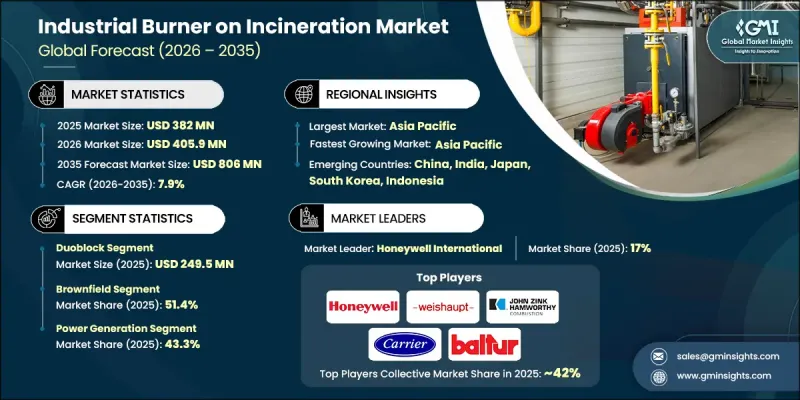
市场成长的驱动力废弃物化学、医疗和製造业等行业产生的危险废弃物和工业废弃物的增加,这些废弃物需要可靠且合规的处置方法。焚烧系统中的工业燃烧器对于符合法规和环境保护至关重要,因为它们能够确保有毒化合物的完全运作并最大限度地减少有害排放。由于废弃物产生量的增加,废弃物的运作时间也随之延长,因此对能够精确维持最佳温度的耐用高效能燃烧器系统的需求日益增长。现代燃烧器能够更好地控制燃烧过程,从而提高安全性、运作可靠性和排放效率。废弃物管理设施营运商正加大对先进燃烧器解决方案的投资,以实现经济高效且可靠的性能,同时满足监管标准。
| 市场覆盖范围 | |
|---|---|
| 开始年份 | 2025 |
| 预测年份 | 2026-2035 |
| 起始金额 | 3.82亿美元 |
| 预测金额 | 8.06亿美元 |
| 复合年增长率 | 7.9% |
双块燃烧器市场预计到2025年将达到2.495亿美元,并在2035年之前以7.4%的复合年增长率成长。双块燃烧器将燃烧器和风扇整合于一体,确保了精确的空燃混合、稳定的火焰控制和高效的燃烧。其紧凑的结构简化了安装和维护,使其成为工业焚烧炉、危险废弃物处理设施和垃圾焚化发电发电厂的理想选择。工业废弃物的不断增长以及对符合环保法规的节能解决方案日益增长的需求,正在推动双块燃烧器在各个地区的普及应用。
2025年,发电领域占了43.3%的市场份额,预计2026年至2035年将以7.9%的复合年增长率成长。燃烧器在火力发电厂和垃圾焚化发电发电厂中至关重要,它能确保稳定的火焰性能、高效的热能产生和最小化的排放气体。不断增长的电力需求、可再生和替代能源计划的扩展以及严格的环境法规正在推动高性能燃烧器的应用。在高热负载下持续可靠运作的需求使得工业燃烧器成为能源生产的关键,进一步巩固了发电领域的领先地位。
中国工业焚化炉市场预计到2025年将达到5,090万美元,2026年至2035年复合年增长率将达8.3%。快速的工业化进程、不断增长的城市垃圾和危险废弃物,以及废弃物焚化发电厂和化工厂的扩张,正在推动对大容量焚烧炉的需求。政府推行的排放控制和高效废弃物管理政策也进一步促进了市场渗透。工业领域需要可靠、高性能且能够在连续运作条件下处理多种燃料的焚化炉。都市化和不断完善的城市废弃物基础设施也为中国市场的持续成长做出了贡献。
目录
第一章调查方法和范围
第二章执行摘要
第三章业界考察
- 生态系分析
- 供应商情况
- 利润率
- 每个阶段的附加价值
- 影响价值链的因素
- 产业影响因素
- 司机
- 废弃物安全处置的危险废弃物和工业废弃物日益增多。
- 扩大从工业废弃物和市政垃圾中回收能源的设施
- 加强有关废弃物处置和排放的环境法规
- 挑战与困难
- 先进低排放燃烧器系统的高昂资本成本
- 公众对焚烧设施的反对和监管审查
- 机会
- 开发超低氮氧化物和高效能燃烧器技术
- 对老旧焚烧炉维修以符合更新法规的需求日益增长
- 司机
- 成长潜力分析
- 未来市场趋势
- 科技与创新趋势
- 当前技术趋势
- 新兴技术
- 价格趋势
- 按地区
- 副产品
- 监管环境
- 标准和合规要求
- 区域法规结构
- 认证标准
- 波特五力分析
- PESTEL 分析
第四章 竞争情势
- 介绍
- 公司市占率分析
- 按地区
- 北美洲
- 欧洲
- 亚太地区
- 拉丁美洲
- 中东和非洲
- 按地区
- 企业矩阵分析
- 主要市场公司的竞争分析
- 竞争定位矩阵
- 重大进展
- 併购
- 伙伴关係与合作
- 新产品发布
- 扩张计划
第五章 2022年至2035年按燃烧器设计分類的市场估算与预测
- 单体块
- 双区块
第六章 按设备类型分類的市场估算与预测,2022-2035年
- 现有设施
- 新开发项目
第七章 依功率范围分類的市场估计与预测,2022-2035年
- 小于300千瓦
- 300 kW~1 MW
- 1~5 MW
- 5~20MW
- 20~50MW
- 50兆瓦或以上
第八章 依最终用途产业分類的市场估算与预测,2022-2035年
- 发电
- 化工/石油化工
- 金属加工
- 食品加工
- 纺织业
- 纸浆和造纸
- 其他的
第九章 2022-2035年各地区市场估算与预测
- 北美洲
- 我们
- 加拿大
- 欧洲
- 德国
- 英国
- 法国
- 义大利
- 西班牙
- 亚太地区
- 中国
- 印度
- 日本
- 韩国
- 澳洲
- 拉丁美洲
- 巴西
- 墨西哥
- 阿根廷
- 中东和非洲
- 沙乌地阿拉伯
- 阿拉伯聯合大公国
- 南非
第十章:公司简介
- Alfa Laval
- Babcock Wanson
- Baltur
- Bloom Engineering Company
- Carrier
- Fives Group
- Forbes Marshall Pvt. Ltd.
- Honeywell International
- John Zink Hamworthy Combustion
- Limpsfield Combustion Engineering
- Max Weishaupt
- Miura America Co.
- Oilon Group Oy
- QED Combustion
- Selas Heat Technology Company
The Global Industrial Burner on Incineration Market was valued at USD 382 million in 2025 and is estimated to grow at a CAGR of 7.9% to reach USD 806 million by 2035.
The market growth is driven by rising volumes of hazardous and industrial waste across chemical, healthcare, and manufacturing sectors, which require reliable and compliant disposal methods. Industrial burners in incineration systems ensure complete combustion of toxic compounds and minimize harmful emissions, making them critical for regulatory compliance and environmental protection. As waste generation intensifies, operational hours for incinerators increase, creating demand for durable and efficient burner systems capable of maintaining optimal temperature with precision. Modern burners offer superior control over combustion processes, improving safety, operational reliability, and emission efficiency. Waste management facility operators are increasingly investing in advanced burner solutions to meet regulatory standards while achieving cost-effective and dependable performance.
| Market Scope | |
|---|---|
| Start Year | 2025 |
| Forecast Year | 2026-2035 |
| Start Value | $382 Million |
| Forecast Value | $806 Million |
| CAGR | 7.9% |
The duoblock burner segment accounted for USD 249.5 million in 2025 and is expected to grow at a CAGR of 7.4% through 2035. Duoblock designs integrate the burner and fan into a single unit, ensuring precise air-fuel mixing, stable flame control, and highly efficient combustion. Their compact construction simplifies installation and maintenance, making them ideal for industrial incinerators, hazardous waste treatment facilities, and waste-to-energy plants. Rising industrial waste volumes and the push for energy-efficient, environmentally compliant solutions are driving the adoption of duoblock burners across regions.
The power generation segment held a 43.3% share in 2025 and is projected to grow at a CAGR of 7.9% from 2026 to 2035. Burners are essential in thermal power plants and waste-to-energy facilities to ensure stable flame performance, efficient heat generation, and minimized emissions. Increasing electricity demand, growth in renewable and alternative energy initiatives, and stringent environmental regulations are fueling the adoption of high-performance burners. The requirement for continuous, reliable operation under high thermal loads makes industrial burners indispensable for energy production, reinforcing the dominance of the power generation segment.
China Industrial Burner on Incineration Market reached USD 50.9 million in 2025 and is expected to grow at a CAGR of 8.3% between 2026 and 2035. Rapid industrialization, increasing municipal and hazardous waste, and expansion of waste-to-energy and chemical plants are driving demand for high-capacity burners. Government policies promoting emission control and efficient waste management further support market adoption. Industrial sectors require burners that are reliable, high-performing, and capable of handling multiple fuel types under continuous operations. Urbanization and growing municipal waste treatment infrastructure also contribute to sustained market growth in China.
Key players in the Global Industrial Burner on Incineration Market include Babcock Wanson, Alfa Laval, Bloom Engineering Company, Selas Heat Technology Company, Carrier, Miura America Co., Fives Group, John Zink Hamworthy Combustion, Limpsfield Combustion Engineering, Honeywell International, Baltur, Forbes Marshall Pvt. Ltd., Max Weishaupt, Oilon Group Oy, and QED Combustion. Companies in the industrial burner on incineration market focus on strategies such as expanding regional distribution networks and increasing manufacturing capacities to meet growing demand. R&D investments enable the development of energy-efficient, low-emission burner systems with enhanced precision and durability. Strategic partnerships and collaborations with waste management operators and energy facilities strengthen market reach. Firms are integrating advanced combustion technologies and automated controls to optimize performance, reduce operational downtime, and comply with regulatory standards.
Table of Contents
Chapter 1 Methodology & Scope
- 1.1 Market scope and definition
- 1.2 Research design
- 1.2.1 Research approach
- 1.2.2 Data collection methods
- 1.3 Data mining sources
- 1.3.1 Global
- 1.3.2 Regional/Country
- 1.4 Base estimates and calculations
- 1.4.1 Base year calculation
- 1.4.2 Key trends for market estimation
- 1.5 Primary research and validation
- 1.5.1 Primary sources
- 1.6 Forecast model
- 1.7 Research assumptions and limitations
Chapter 2 Executive Summary
- 2.1 Industry 360° synopsis
- 2.2 Key market trends
- 2.2.1 Regional
- 2.2.2 Burner design
- 2.2.3 Installation
- 2.2.4 Power Range
- 2.2.5 End Use Industry
- 2.3 CXO perspectives: Strategic imperatives
- 2.3.1 Key decision points for industry executives
- 2.3.2 Critical success factors for market players
- 2.4 Future outlook and strategic recommendations
Chapter 3 Industry Insights
- 3.1 Industry ecosystem analysis
- 3.1.1 Supplier landscape
- 3.1.2 Profit margin
- 3.1.3 Value addition at each stage
- 3.1.4 Factor affecting the value chain
- 3.2 Industry impact forces
- 3.2.1 Growth drivers
- 3.2.1.1 Rising volumes of hazardous and industrial waste requiring safe disposal
- 3.2.1.2 Expansion of industrial and municipal waste-to-energy facilities
- 3.2.1.3 Stricter environmental regulations on waste treatment and emission control
- 3.2.2 Pitfalls & Challenges
- 3.2.2.1 High capital cost of advanced low-emission burner systems
- 3.2.2.2 Public opposition and regulatory scrutiny toward incineration facilities
- 3.2.3 Opportunities
- 3.2.3.1 Development of ultra-low NOx and high-efficiency burner technologies
- 3.2.3.2 Retrofit demand for aging incinerators to meet updated regulations
- 3.2.1 Growth drivers
- 3.3 Growth potential analysis
- 3.4 Future market trends
- 3.5 Technology and innovation landscape
- 3.5.1 Current technological trends
- 3.5.2 Emerging technologies
- 3.6 Price trends
- 3.6.1 By region
- 3.6.2 By product
- 3.7 Regulatory landscape
- 3.7.1 Standards and compliance requirements
- 3.7.2 Regional regulatory frameworks
- 3.7.3 Certification standards
- 3.8 Porter's analysis
- 3.9 PESTEL analysis
Chapter 4 Competitive Landscape, 2025
- 4.1 Introduction
- 4.2 Company market share analysis
- 4.2.1 By Region
- 4.2.1.1 North America
- 4.2.1.2 Europe
- 4.2.1.3 Asia Pacific
- 4.2.1.4 Latin America
- 4.2.1.5 Middle East & Africa
- 4.2.1 By Region
- 4.3 Company matrix analysis
- 4.4 Competitive analysis of major market players
- 4.5 Competitive positioning matrix
- 4.6 Key developments
- 4.6.1 Mergers & acquisitions
- 4.6.2 Partnerships & collaborations
- 4.6.3 New product launches
- 4.6.4 Expansion plans
Chapter 5 Market Estimates & Forecast, By Burner Design, 2022 - 2035, (USD Million) (Thousand Units)
- 5.1 Key trends
- 5.2 Monoblock
- 5.3 Duoblock
Chapter 6 Market Estimates & Forecast, By Installation, 2022 - 2035, (USD Million) (Thousand Units)
- 6.1 Key trends
- 6.2 Brownfield
- 6.3 Greenfield
Chapter 7 Market Estimates & Forecast, By Power Range, 2022 - 2035, (USD Million) (Thousand Units)
- 7.1 Key trends
- 7.2 < 300 kW
- 7.3 300 kW - 1 MW
- 7.4 1 - 5 MW
- 7.5 5 - 20MW
- 7.6 20 - 50 MW
- 7.7 > 50 MW
Chapter 8 Market Estimates & Forecast, By End Use Industry, 2022 - 2035, (USD Million) (Thousand Units)
- 8.1 Key trends
- 8.2 Power generation
- 8.3 Chemical and petrochemical
- 8.4 Metalworking
- 8.5 Food processing
- 8.6 Textile
- 8.7 Pulp and paper
- 8.8 Others
Chapter 9 Market Estimates & Forecast, By Region, 2022 - 2035, (USD Million) (Thousand Units)
- 9.1 Key trends
- 9.2 North America
- 9.2.1 U.S.
- 9.2.2 Canada
- 9.3 Europe
- 9.3.1 Germany
- 9.3.2 UK
- 9.3.3 France
- 9.3.4 Italy
- 9.3.5 Spain
- 9.4 Asia Pacific
- 9.4.1 China
- 9.4.2 India
- 9.4.3 Japan
- 9.4.4 South Korea
- 9.4.5 Australia
- 9.5 Latin America
- 9.5.1 Brazil
- 9.5.2 Mexico
- 9.5.3 Argentina
- 9.6 MEA
- 9.6.1 Saudi Arabia
- 9.6.2 UAE
- 9.6.3 South Africa
Chapter 10 Company Profiles
- 10.1 Alfa Laval
- 10.2 Babcock Wanson
- 10.3 Baltur
- 10.4 Bloom Engineering Company
- 10.5 Carrier
- 10.6 Fives Group
- 10.7 Forbes Marshall Pvt. Ltd.
- 10.8 Honeywell International
- 10.9 John Zink Hamworthy Combustion
- 10.10 Limpsfield Combustion Engineering
- 10.11 Max Weishaupt
- 10.12 Miura America Co.
- 10.13 Oilon Group Oy
- 10.14 QED Combustion
- 10.15 Selas Heat Technology Company

 2026年全球工业燃烧器市场报告
 工业枪式燃烧器市场:依燃料类型、技术、安装方式、容量、应用、最终用户和通路划分,全球预测,2026-2032年预混合料燃烧器市场:依燃料类型、应用、终端用户产业及通路划分,全球预测,2026-2032年点火燃烧器市场:依产品类型、燃料类型、最终用户和分销管道划分,全球预测,2026-2032年低氮真空热水器市场按应用、燃料类型、终端用户产业、容量、分销管道和安装量划分,全球预测(2026-2032年)
 全球工业燃烧器市场,2026-2030年
 工业燃烧器:全球市占率排名、总销售额和需求预测(2025-2031年)
 工业燃烧器市场-全球产业规模、份额、趋势、机会和预测,按燃烧器类型、燃料类型、应用、地区和竞争情况细分,2020-2030 年预测
 全球高温工业燃烧器市场
 工业燃烧器市场按燃料类型、燃烧器类型、工作温度和地区划分