


 |
市场调查报告书
商品编码
1936515
汽车传动轴市场机会、成长要素、产业趋势分析及2026年至2035年预测Automotive Drive Shaft Market Opportunity, Growth Drivers, Industry Trend Analysis, and Forecast 2026 - 2035 |
||||||

全球汽车传动轴市场预计到 2025 年将达到 118 亿美元,到 2035 年将达到 189 亿美元,年复合成长率为 4.9%。
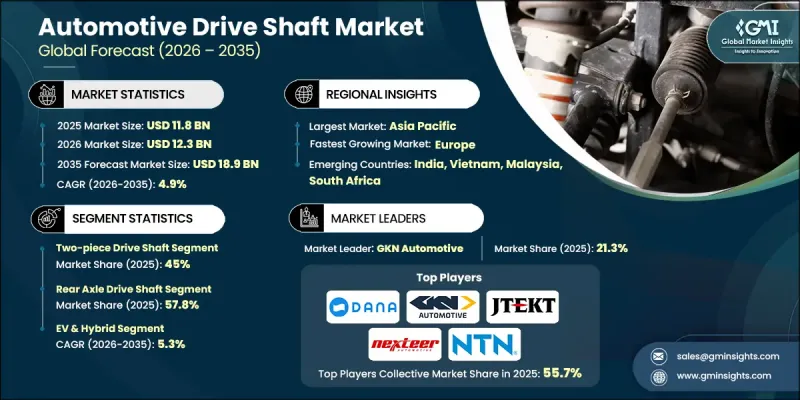
市场成长与全球乘用车和商用车产量的成长密切相关。随着汽车产量的增加,对关键传动系统零件的需求也随之增长,这使得传动轴成为现代汽车製造的关键要素。这些部件在动力传输中发挥着至关重要的作用,是车辆传动系统和变速系统不可或缺的一部分。汽车产业电气化程度的不断提高进一步推动了市场成长动能。电动和混合动力汽车平台需要专门设计的传动轴来适应其独特的扭力特性和紧凑的动力传动系统布局。传统汽车和电动车产量的持续成长正在增强长期需求。为应对监管压力和效率目标,汽车製造商优先考虑轻量化,这加速了传动系统零件的技术创新。同时,售后市场也为市场扩张做出了重大贡献。老旧车辆的替换零件需求维持了对传统和先进传动轴解决方案的需求。
| 市场覆盖范围 | |
|---|---|
| 开始年份 | 2025 |
| 预测年份 | 2026-2035 |
| 起始值 | 118亿美元 |
| 预测金额 | 189亿美元 |
| 复合年增长率 | 4.9% |
製造商正加速向轻量化结构转型,采用能够提升效率和车辆动态性能的替代材料。减轻零件重量有助于提高燃油经济性和性能,同时也有助于满足排放气体法规的要求。在对效率要求严格的地区,这些尖端材料的应用尤其普遍。随着车辆使用寿命的延长,售后市场也持续受益,推动了各种材料类型的零件的稳定更换需求。
截至2025年,两段式传动轴市占率达45%,市场规模达53亿美元。这种设计广泛应用于需要较长传动轴的车辆,尤其是在高需求的实用型和商用车领域。其模组化设计使其易于安装、操作简单、维护高效,进而在全球市场广受欢迎。
预计到2025年,后轴传动轴细分市场将占据57.8%的市场份额,到2035年市场规模将达到103亿美元。后轮驱动和全轮驱动架构在多个车型类别中的广泛应用持续支撑着市场需求。后轴结构具有结构优势,设计复杂度更低,使其成为重型车辆的首选,尤其是在对实用型交通工具需求旺盛的地区。
预计到2025年,美国汽车传动轴市场规模将达到12.8亿美元。美国本土製造商持续采用尖端材料和精密生产技术,以提高传动轴的强度重量比和整体效率。燃油效率和减排的监管压力仍然是影响零件设计和材料选择的关键因素。
目录
第一章调查方法
第二章执行摘要
第三章业界考察
- 生态系分析
- 供应商情况
- 利润率
- 成本结构
- 每个阶段的附加价值
- 影响价值链的因素
- 中断
- 产业影响因素
- 司机
- 全球汽车产量和销售成长
- 电池式电动车(BEV)中的电力驱动桥集成
- 采用轻量材料提高燃油效率
- 向后轮驱动和全轮驱动(AWD)SUV的转变
- 产业潜在风险与挑战
- 市场饱和和激烈的价格竞争
- 内燃机乘用车的销量正在下降
- 市场机会
- 为电动和混合动力汽车製化传动轴
- 碳纤维复合材料技术的商业化
- 新兴国家售后市场的成长
- 非洲和拉丁美洲尚未开发的市场
- 司机
- 成长潜力分析
- 监管环境
- 北美洲
- 美国国家公路交通安全管理局(NHTSA)
- 美国环保署(EPA)
- 美国汽车工程师协会(SAE International)
- 加拿大运输部
- 职业安全与健康管理局(OSHA)
- 欧洲
- 欧盟委员会(EC)
- 欧洲汽车製造商协会 (ACEA)
- 欧洲标准化委员会(CEN)
- 亚太地区
- 国土交通省
- 中华人民共和国工业与资讯化部(工信部)
- 印度汽车研究协会(ARAI)
- 拉丁美洲
- 国家计量、品质和技术研究院(INMETRO)
- 墨西哥经济部秘书处(SE)
- 阿根廷国家交通安全局(ANTSV)
- 中东和非洲
- 海湾合作委员会标准组织(GSO)
- 南非标准局 (SABS)
- 沙乌地阿拉伯标准、计量和品质组织(SASO)
- 北美洲
- 波特五力分析
- PESTEL 分析
- 科技与创新趋势
- 当前技术趋势
- 新兴技术
- 价格趋势
- 按地区
- 副产品
- 生产统计
- 生产基地
- 消费基础
- 出口和进口
- 成本細項分析
- 永续性和环境影响
- 环境影响评估
- 社会影响力和社区服务
- 公司管治与企业社会责任
- 永续金融与投资趋势
- 产品生命週期分析
- 传动轴生命週期阶段
- 按材料生命週期
- 失效模式和生命週期限制因素
- 预测性维护和生命週期延长
- 报废车辆的处置与回收
- 电动车和混合动力汽车的影响分析
- 电动车动力传动系统架构及其对传动轴的影响
- 电动车专用传动轴要求
- 混合动力汽车传动轴的复杂性
- 不断变化的竞争格局
- 案例研究
- OEM传动系统架构映射
- 传动系统部件的系统级交互
- NVH性能和车辆动力学的基准
- 售后市场故障模式及更换经济性
- 未来前景与机会
第四章 竞争情势
- 介绍
- 公司市占率分析
- 北美洲
- 欧洲
- 亚太地区
- 拉丁美洲
- 中东和非洲
- 主要市场公司的竞争分析
- 竞争定位矩阵
- 战略展望矩阵
- 重大进展
- 併购
- 伙伴关係与合作
- 新产品发布
- 企业扩张计画和资金筹措
第五章 市场估计与预测:依轴划分,2022-2035年
- 单驱动轴
- 两段式传动轴
- 滑入式管路驱动轴
第六章 按职位分類的市场估算与预测,2022-2035年
- 前桥驱动轴
- 后轴驱动轴
7. 按设计结构分類的市场估算与预测,2022-2035 年
- 中空传动轴
- 刚性/实心驱动轴
第八章 按材料分類的市场估算与预测,2022-2035年
- 钢材
- 铝
- 碳纤维
第九章 依车辆类型分類的市场估计与预测,2022-2035年
- 搭乘用车
- SUV
- 轿车
- 掀背车
- 商用车辆
- 轻型商用车(LCV)
- MCV
- 重型商用车(HCV)
- 摩托车
第十章 2022-2035年按推进方式分類的市场估计与预测
- 内燃机(ICE)
- 电动车和混合动力汽车
- 电池式电动车(BEV)
- 混合动力电动车(HEV)
- 插电式混合动力车(PHEV)
第十一章 依销售管道分類的市场估计与预测,2022-2035年
- OEM
- 售后市场
第十二章 2022-2035年各地区市场估算与预测
- 北美洲
- 我们
- 加拿大
- 欧洲
- 德国
- 英国
- 法国
- 义大利
- 西班牙
- 俄罗斯
- 捷克共和国
- 比利时
- 荷兰
- 亚太地区
- 中国
- 印度
- 日本
- 韩国
- 澳洲
- 新加坡
- 马来西亚
- 印尼
- 越南
- 泰国
- 拉丁美洲
- 巴西
- 墨西哥
- 阿根廷
- 哥伦比亚
- 中东和非洲
- 南非
- 沙乌地阿拉伯
- 阿拉伯聯合大公国
第十三章:公司简介
- 世界玩家
- GKN Automotive
- Dana
- American Axle &Manufacturing(AAM)
- NTN
- Nexteer
- JTEKT
- Hyundai WIA
- IFA
- Neapco
- Schaeffler
- 本地製造商
- Wanxiang Qianchao
- Xuchang Yuandong Driveshaft
- 欧洲轨道交通
- EDS-ALL DRIVESHAFT
- GuangZhou JunChi AutoParts
- Drexler Automotive
- Dorman Products
- Quigley
- 新兴製造商
- GSP Automotive
- The Timken
- Comer Industries
- GNA Drivelines
- Schaeffler
- Elbe
- Amalga Composites
The Global Automotive Drive Shaft Market was valued at USD 11.8 billion in 2025 and is estimated to grow at a CAGR of 4.9% to reach USD 18.9 billion by 2035.
Market growth is tied to rising global vehicle production across passenger and commercial categories. As vehicle output increases, demand for essential drivetrain components continues to rise, positioning drive shafts as a critical element in modern automotive architecture. These components play a vital role in power transmission, making them indispensable to vehicle driveline and transmission systems. Expanding electrification across the automotive industry further supports market momentum, as electric and hybrid platforms require drive shafts engineered to manage distinct torque profiles and compact powertrain layouts. Continued growth in both conventional and electrified vehicle manufacturing reinforces long-term demand. Automakers are also responding to regulatory pressure and efficiency targets by prioritizing weight reduction, which is accelerating innovation across drivetrain components. In parallel, the aftermarket segment contributes significantly to market expansion as aging vehicles require replacement parts, sustaining consistent demand for both traditional and advanced drive shaft solutions.
| Market Scope | |
|---|---|
| Start Year | 2025 |
| Forecast Year | 2026-2035 |
| Start Value | $11.8 Billion |
| Forecast Value | $18.9 Billion |
| CAGR | 4.9% |
Manufacturers are increasingly shifting toward lightweight construction by adopting alternative materials that improve efficiency and vehicle dynamics. Reduced component weight enhances fuel economy and performance while supporting compliance with emissions standards. Adoption of these advanced materials is particularly strong in regions with stringent efficiency requirements. The aftermarket continues to benefit from vehicle longevity, driving steady replacement demand across diverse material types.
The two-piece drive shafts segment held 45% share in 2025 and generated USD 5.3 billion. This configuration is widely adopted in vehicles requiring extended driveline lengths, particularly in higher-demand utility and commercial segments. Modular construction supports easier installation, simplified handling, and more efficient maintenance, contributing to its widespread acceptance across global markets.
The rear axle drive shafts segment accounted for 57.8% share in 2025 and is projected to reach USD 10.3 billion by 2035. Strong adoption of rear-wheel and all-wheel drive architectures across multiple vehicle categories continues to support demand. Rear axle configurations offer structural advantages and reduced engineering complexity, making them a preferred choice in larger vehicles, particularly in regions with strong demand for utility-focused transportation.
U.S. Automotive Drive Shaft Market reached USD 1.28 billion in 2025. Domestic manufacturers continue to adopt advanced materials and refined production techniques to enhance strength-to-weight ratios and overall efficiency. Regulatory pressure related to fuel efficiency and emissions reduction remains a key driver influencing component design and material selection.
Major companies operating in the Global Automotive Drive Shaft Market include GKN Automotive, Dana, American Axle & Manufacturing, NTN, Nexteer Automotive, Neapco, JTEKT, Hyundai WIA, Wanxiang Qianchao, and IFA. To strengthen their foothold, companies in the automotive drive shaft industry focus on material innovation, production efficiency, and strategic partnerships with vehicle manufacturers. Investment in lightweight engineering enables compliance with efficiency standards while improving performance. Portfolio diversification across vehicle types and drivetrain architectures allows suppliers to serve both conventional and electrified platforms. Expansion of aftermarket offerings supports recurring revenue streams. Manufacturers also prioritize automation and precision manufacturing to enhance quality and reduce costs.
Table of Contents
Chapter 1 Methodology
- 1.1 Research approach
- 1.2 Quality commitments
- 1.2.1 GMI AI policy & data integrity commitment
- 1.3 Research trail & confidence scoring
- 1.3.1 Research trail components
- 1.3.2 Scoring components
- 1.4 Data collection
- 1.4.1 Partial list of primary sources
- 1.5 Data mining sources
- 1.5.1 Paid sources
- 1.6 Base estimates and calculations
- 1.6.1 Base year calculation
- 1.7 Forecast model
- 1.8 Research transparency addendum
Chapter 2 Executive Summary
- 2.1 Industry 360° synopsis
- 2.2 Key market trends
- 2.2.1 Regional
- 2.2.2 Shaft
- 2.2.3 Position
- 2.2.4 Design Structure
- 2.2.5 Material
- 2.2.6 Vehicle
- 2.2.7 Propulsion
- 2.2.8 Sales Channel
- 2.3 TAM analysis, 2026-2035
- 2.4 CXO perspectives: Strategic imperatives
- 2.4.1 Executive decision points
- 2.4.2 Critical success factors
- 2.5 Future outlook and recommendations
Chapter 3 Industry Insights
- 3.1 Industry ecosystem analysis
- 3.1.1 Supplier landscape
- 3.1.2 Profit margin
- 3.1.3 Cost structure
- 3.1.4 Value addition at each stage
- 3.1.5 Factor affecting the value chain
- 3.1.6 Disruptions
- 3.2 Industry impact forces
- 3.2.1 Growth drivers
- 3.2.1.1 Increasing global vehicle production & sales
- 3.2.1.2 E-axle integration in battery electric vehicles (BEVs)
- 3.2.1.3 Lightweight material adoption for fuel efficiency
- 3.2.1.4 Shift toward rear-wheel & all-wheel-drive (AWD) SUVs
- 3.2.2 Industry pitfalls and challenges
- 3.2.2.1 Market saturation & intense price competition
- 3.2.2.2 Declining internal combustion engine (ICE) passenger car sales
- 3.2.3 Market opportunities
- 3.2.3.1 Electric & hybrid vehicle drive shaft customization
- 3.2.3.2 Carbon fiber composite technology commercialization
- 3.2.3.3 Aftermarket growth in emerging economies
- 3.2.3.4 White-space markets in Africa & Latin America
- 3.2.1 Growth drivers
- 3.3 Growth potential analysis
- 3.4 Regulatory landscape
- 3.4.1 North America
- 3.4.1.1 National Highway Traffic Safety Administration (NHTSA)
- 3.4.1.2 EPA (Environmental Protection Agency)
- 3.4.1.3 Society of Automotive Engineers (SAE International)
- 3.4.1.4 Transport Canada
- 3.4.1.5 Occupational Safety and Health Administration (OSHA)
- 3.4.2 Europe
- 3.4.2.1 European Commission (EC)
- 3.4.2.2 European Automobile Manufacturers’ Association (ACEA)
- 3.4.2.3 European Committee for Standardization (CEN)
- 3.4.3 Asia Pacific
- 3.4.3.1 Ministry of Land, Infrastructure, Transport and Tourism (MLIT), Japan
- 3.4.3.2 Ministry of Industry and Information Technology (MIIT), China
- 3.4.3.3 Automotive Research Association of India (ARAI)
- 3.4.4 Latin America
- 3.4.4.1 National Institute of Metrology, Quality and Technology (INMETRO)
- 3.4.4.2 Secretariat of Economy (SE), Mexico
- 3.4.4.3 National Traffic Safety Agency (ANTSV), Argentina
- 3.4.5 Middle East & Africa
- 3.4.5.1 GCC Standardization Organization (GSO)
- 3.4.5.2 South African Bureau of Standards (SABS)
- 3.4.5.3 Saudi Standards, Metrology and Quality Organization (SASO)
- 3.4.1 North America
- 3.5 Porter's analysis
- 3.6 PESTEL analysis
- 3.7 Technology and innovation landscape
- 3.7.1 Current technological trends
- 3.7.2 Emerging technologies
- 3.8 Price trends
- 3.8.1 By region
- 3.8.2 By product
- 3.9 Production statistics
- 3.9.1 Production hubs
- 3.9.2 Consumption hubs
- 3.9.3 Export and import
- 3.10 Cost breakdown analysis
- 3.11 Sustainability and environmental impact
- 3.11.1 Environmental impact assessment
- 3.11.2 Social impact & community benefits
- 3.11.3 Governance & corporate responsibility
- 3.11.4 Sustainable finance & investment trends
- 3.12 Product lifecycle analysis
- 3.12.1 Drive shaft lifecycle stages
- 3.12.2 Lifecycle by material
- 3.12.3 Failure modes & lifecycle limiting factors
- 3.12.4 Predictive maintenance & lifecycle extension
- 3.12.5 End-of-life disposal & recycling
- 3.13 Electric & Hybrid Vehicle Impact Analysis
- 3.13.1 EV Drivetrain Architecture & Drive Shaft Implications
- 3.13.2 EV-Specific Drive Shaft Requirements
- 3.13.3 Hybrid Vehicle Drive Shaft Complexity
- 3.13.4 Competitive Landscape Transformation
- 3.14 Case studies
- 3.15 OEM drivetrain architecture mapping
- 3.16 System-level driveline component interaction
- 3.17 NVH Performance & Vehicle Dynamics Benchmarking
- 3.18 Aftermarket Failure Modes & Replacement Economics
- 3.19 Future outlook & opportunities
Chapter 4 Competitive Landscape, 2025
- 4.1 Introduction
- 4.2 Company market share analysis
- 4.2.1 North America
- 4.2.2 Europe
- 4.2.3 Asia Pacific
- 4.2.4 LATAM
- 4.2.5 MEA
- 4.3 Competitive analysis of major market players
- 4.4 Competitive positioning matrix
- 4.5 Strategic outlook matrix
- 4.6 Key developments
- 4.6.1 Mergers & acquisitions
- 4.6.2 Partnerships & collaborations
- 4.6.3 New product launches
- 4.6.4 Expansion plans and funding
Chapter 5 Market Estimates & Forecast, By Shaft, 2022 - 2035 ($Bn, Units)
- 5.1 Key trends
- 5.2 Single-Piece Drive Shaft
- 5.3 Two-Piece Drive Shaft
- 5.4 Slip-in-Tube Drive Shaft
Chapter 6 Market Estimates & Forecast, By Position, 2022 - 2035 ($Bn, Units)
- 6.1 Key trends
- 6.2 Front Axle Drive Shaft
- 6.3 Rear Axle Drive Shaft
Chapter 7 Market Estimates & Forecast, By Design Structure, 2022 - 2035 ($Bn, Units)
- 7.1 Key trends
- 7.2 Hollow Drive Shaft
- 7.3 Rigid/Solid Drive Shaft
Chapter 8 Market Estimates & Forecast, By Material, 2022 - 2035 ($Bn, Units)
- 8.1 Key trends
- 8.2 Steel
- 8.3 Aluminum
- 8.4 Carbon Fiber
Chapter 9 Market Estimates & Forecast, By Vehicle, 2022 - 2035 ($Bn, Units)
- 9.1 Key trends
- 9.2 Passenger cars
- 9.2.1 SUV
- 9.2.2 Sedan
- 9.2.3 Hatchback
- 9.3 Commercial vehicles
- 9.3.1 LCV
- 9.3.2 MCV
- 9.3.3 HCV
- 9.4 Two wheelers
Chapter 10 Market Estimates & Forecast, By Propulsion, 2022 - 2035 ($Bn, Units)
- 10.1 Key trends
- 10.2 Internal Combustion Engine (ICE)
- 10.3 EV & Hybrid
- 10.3.1 Battery Electric Vehicle (BEV)
- 10.3.2 Hybrid Electric Vehicle (HEV)
- 10.3.3 Plug-in Hybrid Electric Vehicle (PHEV)
Chapter 11 Market Estimates & Forecast, By Sales Channel, 2022 - 2035 ($Bn, Units)
- 11.1 Key trends
- 11.2 Original Equipment Manufacturer (OEM)
- 11.3 Aftermarket
Chapter 12 Market Estimates & Forecast, By Region, 2022 - 2035 ($Bn, Units)
- 12.1 Key trends
- 12.2 North America
- 12.2.1 US
- 12.2.2 Canada
- 12.3 Europe
- 12.3.1 Germany
- 12.3.2 UK
- 12.3.3 France
- 12.3.4 Italy
- 12.3.5 Spain
- 12.3.6 Russia
- 12.3.7 Czech Republic
- 12.3.8 Belgium
- 12.3.9 Netherlands
- 12.4 Asia Pacific
- 12.4.1 China
- 12.4.2 India
- 12.4.3 Japan
- 12.4.4 South Korea
- 12.4.5 Australia
- 12.4.6 Singapore
- 12.4.7 Malaysia
- 12.4.8 Indonesia
- 12.4.9 Vietnam
- 12.4.10 Thailand
- 12.5 Latin America
- 12.5.1 Brazil
- 12.5.2 Mexico
- 12.5.3 Argentina
- 12.5.4 Colombia
- 12.6 MEA
- 12.6.1 South Africa
- 12.6.2 Saudi Arabia
- 12.6.3 UAE
Chapter 13 Company Profiles
- 13.1 Global players
- 13.1.1 GKN Automotive
- 13.1.2 Dana
- 13.1.3 American Axle & Manufacturing (AAM)
- 13.1.4 NTN
- 13.1.5 Nexteer
- 13.1.6 JTEKT
- 13.1.7 Hyundai WIA
- 13.1.8 IFA
- 13.1.9 Neapco
- 13.1.10 Schaeffler
- 13.2 Regional players
- 13.2.1 Wanxiang Qianchao
- 13.2.2 Xuchang Yuandong Driveshaft
- 13.2.3 TrakMotive Europe
- 13.2.4 EDS - ALL DRIVESHAFT
- 13.2.5 GuangZhou JunChi AutoParts
- 13.2.6 Drexler Automotive
- 13.2.7 Dorman Products
- 13.2.8 Quigley
- 13.3 Emerging players
- 13.3.1 GSP Automotive
- 13.3.2 The Timken
- 13.3.3 Comer Industries
- 13.3.4 GNA Drivelines
- 13.3.5 Schaeffler
- 13.3.6 Elbe
- 13.3.7 Amalga Composites

 汽车传动轴全球市场规模、份额、趋势和成长分析报告(2026-2034)
 汽车传动轴:市场占有率分析、产业趋势与统计、成长预测(2026-2031)
 电机轴市场按应用、类型、材料、直径范围、涂层、销售管道和最终用途行业划分,全球预测(2026-2032年)
 汽车传动轴市场规模、份额和成长分析(按设计类型、地点类型、车辆类型、销售管道和地区划分)-2026-2033年产业预测轴带式发电机市场-2025年至2030年预测
![汽车传动轴市场 - [传动轴类型:单件式、多件式;驱动系统:两轮驱动(全轴、半轴)、四轮驱动] - 全球产业分析、规模、份额、成长、趋势及预测,2025-2035 年](/sample/img/cover/42/default_cover_6.png) 汽车传动轴市场 - [传动轴类型:单件式、多件式;驱动系统:两轮驱动(全轴、半轴)、四轮驱动] - 全球产业分析、规模、份额、成长、趋势及预测,2025-2035 年
汽车传动轴市场 - [传动轴类型:单件式、多件式;驱动系统:两轮驱动(全轴、半轴)、四轮驱动] - 全球产业分析、规模、份额、成长、趋势及预测,2025-2035 年 汽车用驱动轴的全球市场的评估:各车辆类型,不同设计,位置,各地区,机会,预测(2018年~2032年)
 汽车传动轴市场 - 全球产业规模、份额、趋势、机会和预测,按设计类型、位置类型、车辆类型、地区和竞争细分,2019-2029F
 等速传动轴市场报告:2030 年趋势、预测与竞争分析全球汽车传动轴市场规模(按地区、范围和预测)