


 |
市场调查报告书
商品编码
1936541
汽车及航太用钢市场机会、成长要素、产业趋势分析及2026年至2035年预测Automotive and Aerospace Steel Market Opportunity, Growth Drivers, Industry Trend Analysis, and Forecast 2026 - 2035 |
||||||

全球汽车和航太用钢市场预计到 2025 年将达到 1,515 亿美元,到 2035 年将达到 2,277 亿美元,年复合成长率为 4%。
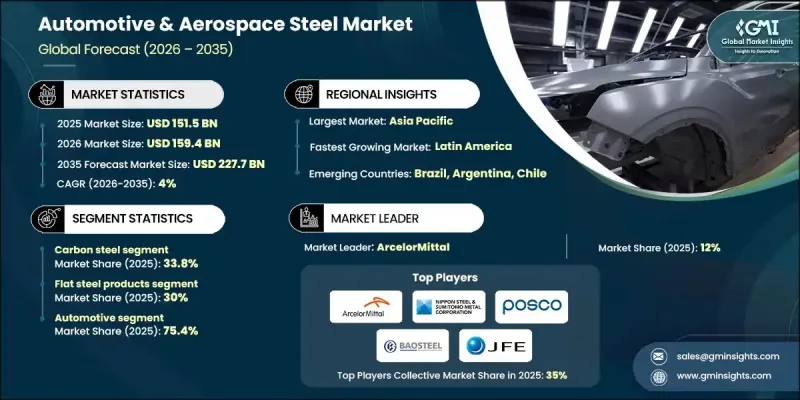
航空航太市场正经历结构变革时期,其驱动力是不断增长的高性能材料需求,以满足不断发展的交通运输和航太需求。虽然航太用钢的市场份额(按销量计)小于汽车用钢,但由于其依赖专为极端性能条件设计的高强度特种钢种,因此每吨钢材的价值要高得多。对下一代汽车和节能型飞机平台的加速投资,推动了对具有卓越耐腐蚀性、疲劳耐久性和结构可靠性的先进高强度钢和特殊合金的需求。在汽车产业,更严格的排放气体法规和减重要求迫使製造商在不牺牲安全性的前提下减轻车辆重量。因此,钢铁製造商越来越多地供应针对车身结构和安全关键部件优化的先进钢种,使製造商能够在满足法规要求的同时,保持成本效益和结构完整性。
| 市场覆盖范围 | |
|---|---|
| 开始年份 | 2025 |
| 预测年份 | 2026-2035 |
| 起始值 | 1515亿美元 |
| 预测金额 | 2277亿美元 |
| 复合年增长率 | 4% |
预计到2025年,碳钢市占率将达到33.8%,并在2035年之前以3.8%的复合年增长率成长。其广泛应用得益于低廉的生产成本、优异的可回收性以及适用于各种汽车和航太结构应用。在对成本高度敏感的汽车领域,碳钢继续发挥主导作用,因为经济性、耐用性和易製造性仍然是关键考虑因素。其优异的强度成本比使其非常适合用于冲压件、加强件和承重结构,尤其是在对性能要求不高的情况下。
预计到2025年,汽车业将占钢铁市场份额的75.4%,并在2026年至2035年间以3.8%的复合年增长率成长。汽车製造业是钢铁消费的最大来源,这主要得益于全球汽车产量的持续成长以及单车材料用量的增加。钢铁仍然是所有汽车平臺的核心结构材料,其在安全系统、结构加固和电动车(EV)架构中的应用日益广泛。对碰撞性能、电池保护和结构刚性日益增长的重视,正在增强汽车产业对钢铁的长期需求。
预计2025年,欧洲汽车和航太用钢市场规模将达330亿美元,在预测期内维持强劲成长。区域扩张得益于以应对气候变迁为重点的产业政策、低排放钢铁生产的日益普及以及对先进钢材需求的不断增长。该地区的汽车製造商正在增加低碳钢和先进高强度钢的采购,以实现其排放目标。同时,航太领域也持续受到民用和国防航空专案投资的推动。这些因素共同支撑了多种高价值应用领域对钢铁的稳定需求。
目录
第一章调查方法和范围
第二章执行摘要
第三章业界考察
- 生态系分析
- 供应商情况
- 利润率
- 每个阶段的附加价值
- 影响价值链的因素
- 中断
- 产业影响因素
- 司机
- 产业潜在风险与挑战
- 市场机会
- 成长潜力分析
- 监管环境
- 北美洲
- 欧洲
- 亚太地区
- 拉丁美洲
- 中东和非洲
- 波特五力分析
- PESTEL 分析
- 价格趋势
- 按地区
- 依材料类型
- 未来市场趋势
- 科技与创新趋势
- 当前技术趋势
- 新兴技术
- 专利状态
- 贸易统计(HS编码)(註:仅提供主要国家的贸易统计)
- 主要进口国
- 主要出口国
- 永续性和环境方面
- 永续努力
- 减少废弃物策略
- 生产中的能源效率
- 环保倡议
- 考虑到碳足迹
第四章 竞争情势
- 介绍
- 公司市占率分析
- 按地区
- 北美洲
- 欧洲
- 亚太地区
- 拉丁美洲
- 中东和非洲
- 按地区
- 企业矩阵分析
- 主要市场公司的竞争分析
- 竞争定位矩阵
- 重大进展
- 併购
- 伙伴关係与合作
- 新产品发布
- 业务拓展计划
第五章 按材质的市场估算与预测,2022-2035年
- 碳钢
- 合金钢
- 不銹钢
- 工具钢
- 先进高强度钢(AHSS)
- 马氏体时效钢
- 其他的
第六章 依产品类型分類的市场估算与预测,2022-2035年
- 扁钢产品
- 轧延钢板和钢卷
- 轧延钢板和钢捲
- 镀锌钢板(GI,GA)
- 电镀锌钢板
- 长钢材
- 线材
- 钢筋
- 结构钢截面
- 管道和管材
- 无缝管
- 焊接管
- 精密管
- 钢筋/线材
- 圆棒
- 扁钢
- 方形桿和六角形桿
- 锻件
- 自由锻造产品
- 闭式模锻
- 环形锻件
- 铸件
- 失蜡铸造
- 砂型铸造
- 压铸
- 钢板/钢材
- 淬火回火钢板
- 耐磨钢板
- 压力容器用钢板
- 包覆和涂层钢
- 镀锌钢板
- 镀铝钢板
- 有机涂层钢板
- 箔材和带材
- 超薄箔
- 层压条
第七章 按应用领域分類的市场估算与预测,2022-2035年
- 车
- 素车(BIW)
- 底盘和悬吊
- 动力传动系统和引擎部件
- 排气系统
- 传动系统部件
- 安全结构
- 电动汽车零件
- 结构加固
- 内装和座椅
- 紧固件和小零件
- 其他的
- 航太
- 飞机结构
- 起落架系统
- 喷射发动机部件
- 液压和燃油系统
- 紧固件和连接器
- 客房内部结构
- 军用和国防飞机部件
- 太空船和卫星零件
- 其他的
第八章 2022-2035年各地区市场估算与预测
- 北美洲
- 我们
- 加拿大
- 欧洲
- 德国
- 英国
- 法国
- 西班牙
- 义大利
- 其他欧洲地区
- 亚太地区
- 中国
- 印度
- 日本
- 澳洲
- 韩国
- 亚太其他地区
- 拉丁美洲
- 巴西
- 墨西哥
- 阿根廷
- 其他拉丁美洲地区
- 中东和非洲
- 沙乌地阿拉伯
- 南非
- 阿拉伯聯合大公国
- 其他中东和非洲地区
第九章:公司简介
- Acerinox SA
- ArcelorMittal
- Baosteel Group
- Celsa Steel UK
- China Steel Corporation
- Commercial Metals Company
- Daido Steel Co., Ltd.
- Essar Steel
- Gerdau S/A
- Hyundai Steel
- JFE Steel Corporation
- Jiangsu Shagang Group
- Jindal Steel &Power Ltd.
- Kobe Steel. Ltd.
- Mechel OAO
- Nippon Steel &Sumitomo Metal Corporation
- NJR Steel
- Nucor Corporation
- Outokumpu Oyj
- POSCO
- Steel Authority of India Limited(SAIL)
- Steel Dynamics, Inc.
- Tata Steel
- ThyssenKrupp AG
- United States Steel Corporation
- Others
The Global Automotive & Aerospace Steel Market was valued at USD 151.5 billion in 2025 and is estimated to grow at a CAGR of 4% to reach USD 227.7 billion by 2035.
The market is undergoing a period of structural transformation driven by rising demand for high-performance materials that support evolving mobility and aerospace requirements. While aerospace steel represents a smaller share by volume compared to automotive applications, it delivers significantly higher value per ton due to its reliance on specialized, high-strength steel grades engineered for extreme performance conditions. Investments in next-generation vehicles and more fuel-efficient aircraft platforms are accelerating demand for advanced high-strength steels and specialty alloys offering superior corrosion resistance, fatigue endurance, and structural reliability. In the automotive sector, tightening emissions regulations and lightweighting mandates are pushing manufacturers to reduce vehicle mass without compromising safety. As a result, steel producers are increasingly supplying advanced grades optimized for body structures and safety-critical components, enabling manufacturers to meet regulatory compliance while maintaining cost efficiency and structural integrity.
| Market Scope | |
|---|---|
| Start Year | 2025 |
| Forecast Year | 2026-2035 |
| Start Value | $151.5 Billion |
| Forecast Value | $227.7 Billion |
| CAGR | 4% |
The carbon steel segment accounted for 33.8% share in 2025 and is expected to grow at a CAGR of 3.8% through 2035. Its widespread adoption is supported by low production costs, strong recyclability, and adaptability across a wide range of automotive and aerospace structural applications. Carbon steel continues to play a dominant role in cost-sensitive vehicle segments where affordability, durability, and manufacturability remain primary considerations. Its favorable strength-to-cost ratio makes it suitable for stamped components, reinforcements, and load-bearing structures when ultra-high performance is not required.
The automotive segment held 75.4% share in 2025 and is forecast to grow at a CAGR of 3.8% from 2026 to 2035. Automotive manufacturing represents the largest source of steel consumption, supported by sustained global vehicle production and increasing material intensity per vehicle. Steel remains a core structural material across vehicle platforms, with rising use in safety systems, structural reinforcements, and electric vehicle architectures. The growing emphasis on crash performance, battery protection, and structural rigidity is reinforcing long-term steel demand within the automotive sector.
Europe Automotive & Aerospace Steel Market generated USD 33 billion in 2025 and is expected to register strong growth over the forecast period. Regional expansion is supported by climate-focused industrial policies, increasing adoption of low-emission steel production, and rising demand for advanced steel grades. Automotive manufacturers in the region are increasingly sourcing low-carbon and advanced high-strength steels to align with emission reduction targets, while aerospace activity continues to benefit from sustained investment in commercial and defense aviation programs. These factors collectively support steady steel demand across multiple high-value applications.
Key companies operating in the Global Automotive & Aerospace Steel Market include ArcelorMittal, POSCO, Tata Steel, Nucor Corporation, Hyundai Steel, Nippon Steel & Sumitomo Metal Corporation, ThyssenKrupp AG, United States Steel Corporation, JFE Steel Corporation, Baosteel Group, Gerdau S/A, Steel Dynamics, Inc., China Steel Corporation, Outokumpu Oyj, Acerinox S.A., Kobe Steel, Ltd., Jindal Steel & Power Ltd., Daido Steel Co., Ltd., Commercial Metals Company, NJR Steel, Celsa Steel UK, Mechel OAO, Jiangsu Shagang Group, Steel Authority of India Limited, and Essar Steel. Companies in the automotive and aerospace steel market are strengthening their market position by investing in advanced metallurgy and next-generation steel grades that balance strength, weight reduction, and sustainability. Manufacturers are expanding production of advanced high-strength and specialty steels to meet evolving OEM specifications. Strategic partnerships with automotive and aerospace manufacturers are helping secure long-term supply contracts and improve product customization. Firms are also investing in low-carbon steelmaking technologies to align with regulatory requirements and sustainability goals.
Table of Contents
Chapter 1 Methodology & Scope
- 1.1 Market scope and definition
- 1.2 Research design
- 1.2.1 Research approach
- 1.2.2 Data collection methods
- 1.3 Data mining sources
- 1.3.1 Global
- 1.3.2 Regional/Country
- 1.4 Base estimates and calculations
- 1.4.1 Base year calculation
- 1.4.2 Key trends for market estimation
- 1.5 Primary research and validation
- 1.5.1 Primary sources
- 1.6 Forecast model
- 1.7 Research assumptions and limitations
Chapter 2 Executive Summary
- 2.1 Industry 360° synopsis
- 2.2 Key market trends
- 2.2.1 Regional
- 2.2.2 Material type
- 2.2.3 Product form
- 2.2.4 Application
- 2.3 TAM Analysis, 2026-2035
- 2.4 CXO perspectives: Strategic imperatives
- 2.4.1 Executive decision points
- 2.4.2 Critical success factors
- 2.5 Future outlook and strategic recommendations
Chapter 3 Industry Insights
- 3.1 Industry ecosystem analysis
- 3.1.1 Supplier landscape
- 3.1.2 Profit margin
- 3.1.3 Value addition at each stage
- 3.1.4 Factor affecting the value chain
- 3.1.5 Disruptions
- 3.2 Industry impact forces
- 3.2.1 Growth drivers
- 3.2.2 Industry pitfalls and challenges
- 3.2.3 Market opportunities
- 3.3 Growth potential analysis
- 3.4 Regulatory landscape
- 3.4.1 North America
- 3.4.2 Europe
- 3.4.3 Asia Pacific
- 3.4.4 Latin America
- 3.4.5 Middle East & Africa
- 3.5 Porter's analysis
- 3.6 PESTEL analysis
- 3.7 Price trends
- 3.7.1 By region
- 3.7.2 By material type
- 3.8 Future market trends
- 3.9 Technology and Innovation landscape
- 3.9.1 Current technological trends
- 3.9.2 Emerging technologies
- 3.10 Patent Landscape
- 3.11 Trade statistics (HS code) ( Note: the trade statistics will be provided for key countries only)
- 3.11.1 Major importing countries
- 3.11.2 Major exporting countries
- 3.12 Sustainability and environmental aspects
- 3.12.1 Sustainable practices
- 3.12.2 Waste reduction strategies
- 3.12.3 Energy efficiency in production
- 3.12.4 Eco-friendly initiatives
- 3.13 Carbon footprint consideration
Chapter 4 Competitive Landscape, 2025
- 4.1 Introduction
- 4.2 Company market share analysis
- 4.2.1 By region
- 4.2.1.1 North America
- 4.2.1.2 Europe
- 4.2.1.3 Asia Pacific
- 4.2.1.4 LATAM
- 4.2.1.5 MEA
- 4.2.1 By region
- 4.3 Company matrix analysis
- 4.4 Competitive analysis of major market players
- 4.5 Competitive positioning matrix
- 4.6 Key developments
- 4.6.1 Mergers & acquisitions
- 4.6.2 Partnerships & collaborations
- 4.6.3 New Product Launches
- 4.6.4 Expansion Plans
Chapter 5 Market Estimates and Forecast, By Material Type, 2022-2035 (USD Billion) (Kilo Tons)
- 5.1 Key trends
- 5.2 Carbon Steel
- 5.3 Alloy Steel
- 5.4 Stainless Steel
- 5.5 Tool Steel
- 5.6 Advanced High-Strength Steel (AHSS)
- 5.7 Maraging Steel
- 5.8 Others
Chapter 6 Market Estimates and Forecast, By Product Form, 2022-2035 (USD Billion) (Kilo Tons)
- 6.1 Key trends
- 6.2 Flat Steel Products
- 6.2.1 Hot Rolled Sheets/Coils
- 6.2.2 Cold Rolled Sheets/Coils
- 6.2.3 Galvanized Steel (GI, GA)
- 6.2.4 Electro-Galvanized Sheets
- 6.3 Long Steel Products
- 6.3.1 Wire Rods
- 6.3.2 Rebars
- 6.3.3 Structural Sections
- 6.4 Pipes & Tubes
- 6.4.1 Seamless Pipes
- 6.4.2 Welded Pipes
- 6.4.3 Precision Tubes
- 6.5 Bars & Rods
- 6.5.1 Round Bars
- 6.5.2 Flat Bars
- 6.5.3 Square/Hex Bars
- 6.6 Forgings
- 6.6.1 Open-Die Forgings
- 6.6.2 Closed-Die Forgings
- 6.6.3 Ring Forgings
- 6.7 Castings
- 6.7.1 Investment Castings
- 6.7.2 Sand Castings
- 6.7.3 Die Castings
- 6.8 Plates & Sheets
- 6.8.1 Quenched & Tempered Plates
- 6.8.2 Abrasion-Resistant Plates
- 6.8.3 Pressure Vessel Plates
- 6.9 Clad & Coated Steel
- 6.9.1 Zinc-Coated Steel
- 6.9.2 Aluminum-Coated Steel
- 6.9.3 Organic Coated Steel
- 6.10 Foils & Strips
- 6.10.1 Ultra-Thin Foils
- 6.10.2 Laminated Strips
Chapter 7 Market Estimates and Forecast, By Application, 2022-2035 (USD Billion) (Kilo Tons)
- 7.1 Key trends
- 7.2 Automotive
- 7.2.1 Body-in-White (BIW)
- 7.2.2 Chassis & Suspension
- 7.2.3 Powertrain & Engine Components
- 7.2.4 Exhaust System
- 7.2.5 Drivetrain Components
- 7.2.6 Safety Structures
- 7.2.7 EV Components
- 7.2.8 Structural Reinforcements
- 7.2.9 Interiors & Seating
- 7.2.10 Fasteners & Small Components
- 7.2.11 Others
- 7.3 Aerospace
- 7.3.1 Airframe Structures
- 7.3.2 Landing Gear Systems
- 7.3.3 Jet Engine Components
- 7.3.4 Hydraulic & Fuel Systems
- 7.3.5 Fasteners & Connectors
- 7.3.6 Cabin Interior Structures
- 7.3.7 Military & Defense Aircraft Components
- 7.3.8 Spacecraft & Satellite Components
- 7.3.9 Others
Chapter 8 Market Estimates and Forecast, By Region, 2022-2035 (USD Billion) (Kilo Tons)
- 8.1 Key trends
- 8.2 North America
- 8.2.1 U.S.
- 8.2.2 Canada
- 8.3 Europe
- 8.3.1 Germany
- 8.3.2 UK
- 8.3.3 France
- 8.3.4 Spain
- 8.3.5 Italy
- 8.3.6 Rest of Europe
- 8.4 Asia Pacific
- 8.4.1 China
- 8.4.2 India
- 8.4.3 Japan
- 8.4.4 Australia
- 8.4.5 South Korea
- 8.4.6 Rest of Asia Pacific
- 8.5 Latin America
- 8.5.1 Brazil
- 8.5.2 Mexico
- 8.5.3 Argentina
- 8.5.4 Rest of Latin America
- 8.6 Middle East and Africa
- 8.6.1 Saudi Arabia
- 8.6.2 South Africa
- 8.6.3 UAE
- 8.6.4 Rest of Middle East and Africa
Chapter 9 Company Profiles
- 9.1 Acerinox S.A.
- 9.2 ArcelorMittal
- 9.3 Baosteel Group
- 9.4 Celsa Steel UK
- 9.5 China Steel Corporation
- 9.6 Commercial Metals Company
- 9.7 Daido Steel Co., Ltd.
- 9.8 Essar Steel
- 9.9 Gerdau S/A
- 9.10 Hyundai Steel
- 9.11 JFE Steel Corporation
- 9.12 Jiangsu Shagang Group
- 9.13 Jindal Steel & Power Ltd.
- 9.14 Kobe Steel. Ltd.
- 9.15 Mechel OAO
- 9.16 Nippon Steel & Sumitomo Metal Corporation
- 9.17 NJR Steel
- 9.18 Nucor Corporation
- 9.19 Outokumpu Oyj
- 9.20 POSCO
- 9.21 Steel Authority of India Limited (SAIL)
- 9.22 Steel Dynamics, Inc.
- 9.23 Tata Steel
- 9.24 ThyssenKrupp AG
- 9.25 United States Steel Corporation
- 9.26 Others

 2026年全球汽车用不銹钢市场报告
 汽车用不銹钢管市场:依产品类型、车辆类型和应用划分-2026-2032年全球市场预测汽车用钢市场:按产品类型、形状、製造流程、应用和最终用途划分,全球预测,2026-2032年航太与汽车旋转密封市场:依产品类型、材料类型、设计、应用、最终用途产业和分销管道划分,全球预测,2026-2032年2026年全球汽车用钢市场报告
 汽车不銹钢市场-全球产业规模、份额、趋势、机会及预测(按车辆类型、类型、最终用户、地区和竞争格局划分,2021-2031年)高纯度不銹钢管市场按等级、管材类型、工艺类型、壁厚、表面处理、尺寸范围、最终用途和分销渠道划分,全球预测,2026-2032年汽车不銹钢管市场-全球产业规模、份额、趋势、机会和预测(按应用、产品、地区和竞争细分,2020-2030 年)
 汽车用钢市场,按产品、按工艺、按车辆、按应用、按国家和地区 - 2025 年至 2032 年全球行业分析、市场规模、市场份额及预测
 全球不銹钢汽车管市场