


 |
市场调查报告书
商品编码
1936547
冷冻卵子及胚胎库市场机会、成长要素、产业趋势分析及2026年至2035年预测Egg Freezing and Embryo Banking Market Opportunity, Growth Drivers, Industry Trend Analysis, and Forecast 2026 - 2035 |
||||||

全球卵子冷冻和胚胎库市场预计到 2025 年价值 51 亿美元,预计到 2035 年将达到 136 亿美元,年复合成长率为 10.3%。
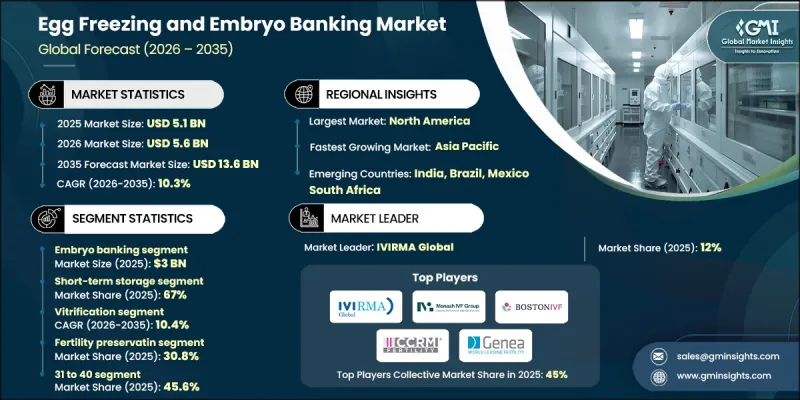
在全球范围内,个人和夫妇对生育治疗的认知和社会接受度不断提高,推动了市场成长。冷冻保存技术的进步显着改善了保存效果,增强了人们对长期生育计画的信心。同时,全球不孕症持续上升,对辅助生殖解决方案的需求也持续成长。生育诊所的扩张、医疗网络间合作的加强以及更多资助项目的推出,进一步加速了市场普及。卵子冷冻和胚胎库使个人能够保存生育能力,并在生育计划方面拥有更大的灵活性。由于生活方式的改变、医疗方面的考虑以及职业责任等因素影响生育决策,越来越多的人选择这些解决方案。随着生殖医学更加以患者为中心,技术也日益先进,生育力保存服务正从小众服务转变为主流医疗保健选择,预计将在已开发经济体和新兴经济体实现长期市场成长。
| 市场覆盖范围 | |
|---|---|
| 开始年份 | 2025 |
| 预测年份 | 2026-2035 |
| 起始值 | 51亿美元 |
| 预测金额 | 136亿美元 |
| 复合年增长率 | 10.3% |
预计到2025年,胚胎库市场规模将达到30亿美元,2026年至2035年的复合年增长率将达到10.2%。该市场透过保存具有活性的胚胎以供未来使用,为长期生育计画提供支持,与未受精卵储存相比,可提供更高的操作确定性。希望推迟生育的人群以及接受影响生育能力的医疗手术的人群对胚胎库的需求持续增长。
预计到 2025 年,短期储存领域将占市场份额的 67%,到 2035 年将以 10.2% 的复合年增长率成长。短期储存解决方案广泛应用于积极的生育治疗週期以及影响生殖健康的暂时性医疗状况,这使得该领域成为一个稳定的收入来源。
亚太地区卵子冷冻和胚胎库市场预计到2025年将达到17亿美元,呈现强劲的市场成长动能。人们意识的提高、计划生育时间的改变以及辅助生殖技术的普及,都推动了全部区域需求的成长。
目录
第一章调查方法和范围
第二章执行摘要
第三章业界考察
- 生态系分析
- 产业影响因素
- 司机
- 提高女性和夫妇对生育力保存选择的认识和接受度
- 冷冻保存技术的进步
- 全球不孕不育率上升
- 生育诊所和伴侣数量增加
- 产业潜在风险与挑战
- 卵子冷冻和胚胎储存高成本
- 关于冷冻卵子和胚胎的使用和处置的伦理和法律问题
- 市场机会
- 拓展新兴市场
- 扩大保险范围
- 司机
- 成长潜力分析
- 监管环境
- 技术进步
- 当前技术趋势
- 新兴技术
- 救赎方案
- 2024年定价分析
- 未来市场趋势
- 波特五力分析
- PESTEL 分析
第四章 竞争情势
- 介绍
- 公司市占率分析
- 企业矩阵分析
- 主要市场公司的竞争分析
- 竞争定位矩阵
- 重大进展
- 併购
- 合作伙伴关係和合资企业
- 新产品发布
- 扩张计划
第五章 依服务类型分類的市场估算与预测,2022-2035年
- 冷冻卵子
- 胚胎库
6. 按储存期分類的市场估算与预测,2022-2035 年
- 短期储存
- 长期储存
第七章 按技术分類的市场估计与预测,2022-2035年
- 玻璃化
- 慢速冷冻
第八章 按应用领域分類的市场估算与预测,2022-2035年
- 生育力保存治疗
- 捐卵子/捐胚胎计划
- 基因筛检
- 肿瘤生育力
第九章 按年龄组别分類的市场估计与预测,2022-2035年
- 30岁以下
- 31至40岁
- 41岁或以上
第十章 2022-2035年各地区市场估计与预测
- 北美洲
- 我们
- 加拿大
- 欧洲
- 德国
- 英国
- 法国
- 西班牙
- 义大利
- 荷兰
- 亚太地区
- 中国
- 印度
- 日本
- 澳洲
- 韩国
- 拉丁美洲
- 巴西
- 墨西哥
- 阿根廷
- 中东和非洲
- 沙乌地阿拉伯
- 南非
- 阿拉伯聯合大公国
第十一章 公司简介
- Boston IVF
- Carrot
- CCRM Fertility
- Cryos International
- Extend Fertility
- Genea Pty
- IVIRMA
- Monash IVF Group
- New Hope IVF &Fertility Clinic
- Ovation Fertility
- Progyny
- ReproTech
- RMA Network
- Shady Grove Fertility
- Spring Fertility
- WINFertility
The Global Egg Freezing and Embryo Banking Market was valued at USD 5.1 billion in 2025 and is estimated to grow at a CAGR of 10.3% to reach USD 13.6 billion by 2035.
Market growth is supported by rising awareness and broader social acceptance of fertility preservation among individuals and couples worldwide. Advancements in cryopreservation technologies have significantly improved storage outcomes, increasing confidence in long-term reproductive planning. At the same time, infertility rates continue to rise globally, creating sustained demand for assisted reproductive solutions. Expansion of fertility clinics, stronger collaboration across healthcare networks, and growing availability of supportive financial programs are further accelerating market adoption. Egg freezing and embryo banking allow individuals to preserve reproductive potential and plan parenthood timelines more flexibly. These solutions are increasingly chosen due to lifestyle changes, medical considerations, and professional commitments that influence reproductive decisions. As reproductive healthcare becomes more patient-centric and technologically advanced, fertility preservation services are transitioning from niche offerings to mainstream medical options, positioning the market for long-term growth across both developed and emerging economies.
| Market Scope | |
|---|---|
| Start Year | 2025 |
| Forecast Year | 2026-2035 |
| Start Value | $5.1 Billion |
| Forecast Value | $13.6 Billion |
| CAGR | 10.3% |
The embryo banking segment generated USD 3 billion in 2025 and is expected to grow at a CAGR of 10.2% during 2026-2035. This segment supports long-term reproductive planning by enabling preserved embryos to remain viable for future use, offering higher procedural certainty compared to unfertilized preservation methods. Demand continues to increase among individuals seeking delayed parenthood or undergoing fertility-impacting medical treatments.
The short-term storage segment accounted for 67% share in 2025 and is forecast to grow at a CAGR of 10.2% through 2035. Short-duration storage solutions are widely used during active fertility treatment cycles or temporary medical conditions that affect reproductive health, making this segment a consistent revenue contributor.
Asia Pacific Egg Freezing and Embryo Banking Market was valued at USD 1.7 billion in 2025 and is experiencing strong market momentum. Growing awareness, shifting family planning timelines, and improving access to assisted reproductive healthcare are contributing to rising demand across the region.
Key companies operating in the Global Egg Freezing and Embryo Banking Market include IVIRMA, Progyny, Monash IVF Group, Shady Grove Fertility, Cryos International, Boston IVF, ReproTech, Genea Pty Limited, RMA Network, Extend Fertility, WINFertility, Ovation Fertility, CCRM Fertility, Spring Fertility, New Hope IVF & Fertility Clinic, and Carrot. Companies in the egg freezing and embryo banking market are strengthening their market position through service expansion, technology investment, and strategic collaborations. Many providers are enhancing cryopreservation protocols to improve storage reliability and clinical outcomes. Expansion of clinic networks and partnerships with healthcare systems is helping improve geographic reach and patient access. Firms are also focusing on transparent pricing models, patient education platforms, and digital engagement tools to improve awareness and trust. Investment in data management and laboratory automation is supporting operational efficiency.
Table of Contents
Chapter 1 Methodology and Scope
- 1.1 Market scope and definition
- 1.2 Research design
- 1.2.1 Research approach
- 1.2.2 Data collection methods
- 1.3 Data mining sources
- 1.3.1 Global
- 1.3.2 Regional/country
- 1.4 Base estimates and calculations
- 1.4.1 Base year calculation
- 1.4.2 Key trends for market estimation
- 1.5 Primary research and validation
- 1.5.1 Primary sources
- 1.6 Forecast model
- 1.7 Research assumptions and limitations
Chapter 2 Executive Summary
- 2.1 Industry 360° synopsis
- 2.2 Key market trends
- 2.2.1 Regional trends
- 2.2.2 Service type trends
- 2.2.3 Storage duration trends
- 2.2.4 Technology trends
- 2.2.5 Application trends
- 2.2.6 Age group trends
- 2.3 CXO perspectives: Strategic imperatives
- 2.3.1 Key decision points for industry executives
- 2.3.2 Critical success factors for market players
- 2.4 Future outlook and strategic recommendations
Chapter 3 Industry Insights
- 3.1 Industry ecosystem analysis
- 3.2 Industry impact forces
- 3.2.1 Growth drivers
- 3.2.1.1 Growing awareness and acceptance of fertility preservation options among women and couples
- 3.2.1.2 Advancements in cryopreservation techniques
- 3.2.1.3 Rising global infertility rates
- 3.2.1.4 Increasing number of fertility clinics and partnerships
- 3.2.2 Industry Pitfalls and Challenges
- 3.2.2.1 High cost of egg freezing and embryo banking
- 3.2.2.2 Ethical and legal issues surrounding the use and disposition of frozen eggs and embryos
- 3.2.3 Market Opportunities
- 3.2.3.1 Expansion into emerging markets
- 3.2.3.2 Insurance coverage expansion
- 3.2.1 Growth drivers
- 3.3 Growth potential analysis
- 3.4 Regulatory landscape
- 3.5 Technological advancements
- 3.5.1 Current technological trends
- 3.5.2 Emerging technologies
- 3.6 Reimbursement scenario
- 3.7 Pricing analysis, 2024
- 3.8 Future market trends
- 3.9 Porter's analysis
- 3.10 PESTEL analysis
Chapter 4 Competitive Landscape, 2025
- 4.1 Introduction
- 4.2 Company market share analysis
- 4.3 Company matrix analysis
- 4.4 Competitive analysis of major market players
- 4.5 Competitive positioning matrix
- 4.6 Key developments
- 4.6.1 Mergers and acquisitions
- 4.6.2 Partnerships and collaborations
- 4.6.3 New product launches
- 4.6.4 Expansion plans
Chapter 5 Market Estimates and Forecast, By Service Type, 2022 - 2035 ($ Mn)
- 5.1 Key trends
- 5.2 Egg freezing
- 5.3 Embryo banking
Chapter 6 Market Estimates and Forecast, By Storage duration, 2022 - 2035 ($ Mn)
- 6.1 Key trends
- 6.2 Short-term storage
- 6.3 Long-term storage
Chapter 7 Market Estimates and Forecast, By Technology, 2022 - 2035 ($ Mn)
- 7.1 Key trends
- 7.2 Vitrification
- 7.3 Slow freezing
Chapter 8 Market Estimates and Forecast, By Application, 2022 - 2035 ($ Mn)
- 8.1 Key trends
- 8.2 Fertility preservation
- 8.3 Donor egg/embryo programs
- 8.4 Genetic screening
- 8.5 Oncofertility
Chapter 9 Market Estimates and Forecast, By Age Group, 2022 - 2035 ($ Mn)
- 9.1 Key trends
- 9.2 Under 30
- 9.3 31 to 40
- 9.4 Over 41
Chapter 10 Market Estimates and Forecast, By Region, 2022 - 2035 ($ Mn)
- 10.1 Key trends
- 10.2 North America
- 10.2.1 U.S.
- 10.2.2 Canada
- 10.3 Europe
- 10.3.1 Germany
- 10.3.2 UK
- 10.3.3 France
- 10.3.4 Spain
- 10.3.5 Italy
- 10.3.6 Netherlands
- 10.4 Asia Pacific
- 10.4.1 China
- 10.4.2 India
- 10.4.3 Japan
- 10.4.4 Australia
- 10.4.5 South Korea
- 10.5 Latin America
- 10.5.1 Brazil
- 10.5.2 Mexico
- 10.5.3 Argentina
- 10.6 Middle East and Africa
- 10.6.1 Saudi Arabia
- 10.6.2 South Africa
- 10.6.3 UAE
Chapter 11 Company Profiles
- 11.1 Boston IVF
- 11.2 Carrot
- 11.3 CCRM Fertility
- 11.4 Cryos International
- 11.5 Extend Fertility
- 11.6 Genea Pty
- 11.7 IVIRMA
- 11.8 Monash IVF Group
- 11.9 New Hope IVF & Fertility Clinic
- 11.10 Ovation Fertility
- 11.11 Progyny
- 11.12 ReproTech
- 11.13 RMA Network
- 11.14 Shady Grove Fertility
- 11.15 Spring Fertility
- 11.16 WINFertility


