


 |
市场调查报告书
商品编码
1936552
汽车车轮市场机会、成长要素、产业趋势分析及预测(2026年至2035年)Automotive Wheel Market Opportunity, Growth Drivers, Industry Trend Analysis, and Forecast 2026 - 2035 |
||||||

全球汽车车轮市场预计到 2025 年将达到 408 亿美元,到 2035 年将达到 699 亿美元,年复合成长率为 5.2%。
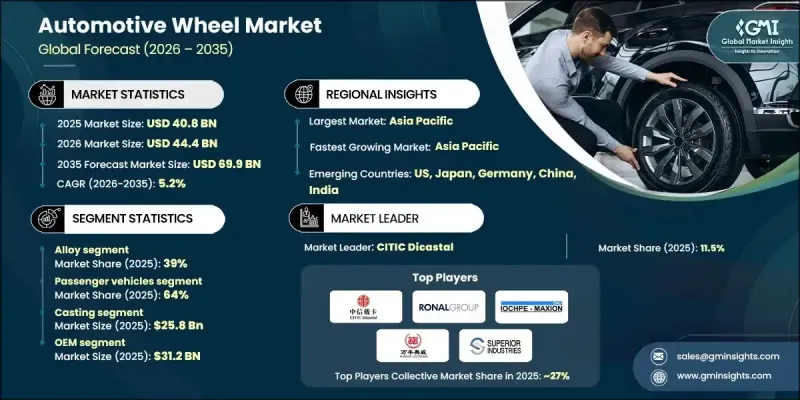
全球汽车产量不断增长,消费者对高端高性能汽车的需求日益浓厚,以及轮毂设计和製造技术的持续创新,正推动着市场稳步成长。汽车製造商越来越重视效率、耐用性和视觉吸引力,促使不同车型的轮圈规格重塑。在製造商致力于提升车辆动力性能和燃油效率的同时,为了满足更严格的排放气体和性能标准,轻量化材料的应用也迅速普及。电气化进一步重新定义了轮毂设计,因为电动车需要能够承受更高车重并保持空气动力学效率以延长续航里程的轮毂。这种转变推动了具有更佳气流管理和更强结构完整性的先进设计的应用。同时,不断发展的製造技术和精密工程技术提高了轮毂的一致性、承载能力和整体性能,从而支持了OEM和售后市场管道的长期市场扩张。
| 市场覆盖范围 | |
|---|---|
| 开始年份 | 2025 |
| 预测年份 | 2026-2035 |
| 起始值 | 408亿美元 |
| 预测金额 | 699亿美元 |
| 复合年增长率 | 5.2% |
预计到2025年,合金轮圈市占率将达到39%,并在2035年之前以4.3%的复合年增长率成长。合金轮圈因其能够提升车辆的操控性、煞车性和乘坐舒适性,同时显着降低车身重量而广泛应用。这些优势使其成为乘用车的理想选择,尤其是在中檔和豪华车市场,因为在这些市场中,设计差异化和效率是购车决策的关键因素。製造流程的不断进步,使得合金轮圈的生产成本得以降低,同时也能提升其强度、耐久性和美观性。
预计到2025年,乘用车市占率将达到64%,并在2026年至2035年间以4.5%的复合年增长率成长。高产量、对外观设计日益增长的需求以及不断提高的性能预期,持续支撑着这个细分市场。 SUV和跨界车的日益普及,推动了对更大尺寸轮圈、更高有效载荷能力和更高级内饰的需求。此外,该领域的电气化趋势也迫使製造商开发能够承受更高扭力、能量回收煞车和增加车辆重量,同时又不影响效率的轮毂。
预计到2025年,美国汽车轮圈市场规模将达到90亿美元。 SUV、皮卡和高性能汽车的强劲需求持续推动市场成长,因为这些车型通常需要更大直径的轮毂和更高价值的材料。国内汽车产量的成长以及实力雄厚的汽车製造商的存在,进一步强化了对先进轮圈解决方案的需求,尤其是在铝合金轮圈和锻造轮圈领域。
目录
第一章调查方法和范围
第二章执行摘要
第三章业界考察
- 生态系分析
- 供应商情况
- 原物料供应商
- 车轮製造和加工
- OEM
- 售后市场
- 最终用途
- 成本结构
- 利润率
- 每个过程都增加了价值
- 影响供应链的因素
- 颠覆者
- 供应商情况
- 影响因素
- 司机
- SUV和高阶车型的需求不断增长
- 售后客製化市场的成长
- 技术进步与製造创新
- 商用及非公路用车辆车队扩张
- 产业潜在风险与挑战
- 原物料价格波动
- 高资本投资需求
- 市场机会
- 新兴市场和在地化策略
- 优质化和智慧车轮技术
- 轻质永续材料的发展
- 司机
- 成长潜力分析
- 监管环境
- 北美洲
- 企业平均燃油经济性 (CAFE)
- 美国环保署车辆排放气体与减重法规
- 美墨加协定汽车原产地规则
- 加州空气资源委员会 (CARB) 零排放车辆 (ZEV) 和材料合规标准
- 欧洲
- 欧盟汽车和货车二氧化碳排放性能标准
- 欧洲7号车辆排放气体法规
- 适合55岁的气候行动方案
- REACH法规和报废车辆指令
- 亚太地区
- 中国第六排放气体法规
- 中国的新能源汽车政策框架
- 印度第六阶段排放气体标准(BS-VI)
- 日本燃油效率标准计画排名第一
- 拉丁美洲
- PROCONVE排放标准(巴西)
- 阿根廷汽车排放气体法规与安全标准
- 墨西哥NOM汽车排放气体标准
- 中东和非洲
- 海湾合作委员会地区的车辆燃油经济性与排放气体法规
- 南非汽车生产发展计画(APDP)
- 国内电动车推广与产业本土化政策
- 北美洲
- 波特五力分析
- PESTEL 分析
- 科技与创新趋势
- 当前技术趋势
- 新兴技术
- 定价分析
- 副产品
- 按地区
- 成本細項分析
- 专利分析
- 生产统计
- 生产基地
- 消费基础
- 出口和进口
- 永续性和环境方面
- 永续实践
- 减少废弃物策略
- 生产中的能源效率
- 环保倡议
- 碳足迹考量
- OEM采购和采购策略
- 电动汽车车轮设计和性能要求
- 电动车的负载和扭矩要求
- 空气动力学轮毂设计与续航里程优化
- NVH降低和结构刚度
- 再生煞车对车轮耐久性的影响
- 电动车平台标准化对轮圈尺寸的影响
- 售后市场经济与客製化趋势
- 与原厂轮毂相比,价格溢价比较
- 客製化饰面、涂层和美学需求
- 高性能轮圈 vs. 外观升级
- 製造能力和运转率分析
- 各区域的装置容量
- 运转率(原厂配套与售后市场)
- 现有工厂扩建计划和新工厂扩建计划
- 锻造和旋压成形能力方面的瓶颈
- 供应链风险与韧性
第四章 竞争情势
- 介绍
- 公司市占率分析
- 北美洲
- 欧洲
- 亚太地区
- 拉丁美洲
- 中东和非洲
- 主要市场公司的竞争分析
- 竞争定位矩阵
- 战略展望矩阵
- 重大进展
- 併购
- 伙伴关係与合作
- 新产品发布
- 企业扩张计画和资金筹措
第五章 按材料分類的市场估算与预测,2022-2035年
- 钢材
- 合金
- 碳纤维
- 铝
第六章 依车辆类型分類的市场估计与预测,2022-2035年
- 搭乘用车
- 掀背车
- 轿车
- SUV/跨界车
- 商用车辆
- 轻型商用车(LCV)
- 中型商用车(MCV)
- 重型商用车(HCV)
- 越野车
7. 按製造流程分類的市场估算与预测,2022-2035 年
- 铸件
- 锻造
- 旋压成形
第八章 按轮圈尺寸分類的市场估算与预测,2022-2035年
- 13到15英寸
- 16 至 18 英寸
- 19 至 21 英寸
- 21吋或以上
第九章 依销售管道分類的市场估计与预测,2022-2035年
- OEM
- 售后市场
第十章 2022-2035年各地区市场估计与预测
- 北美洲
- 我们
- 加拿大
- 欧洲
- 德国
- 英国
- 法国
- 义大利
- 西班牙
- 俄罗斯
- 北欧国家
- 比荷卢经济联盟
- 亚太地区
- 中国
- 印度
- 日本
- 澳洲
- 韩国
- 菲律宾
- 印尼
- 新加坡
- 拉丁美洲
- 巴西
- 墨西哥
- 阿根廷
- 智利
- 中东和非洲
- 南非
- 沙乌地阿拉伯
- 阿拉伯聯合大公国
第十一章 公司简介
- Global leaders
- CITIC Dicastal
- Iochpe-Maxion
- RONAL
- Zhejiang Wanfeng Auto Wheel
- Superior Industries International
- Borbet
- Accuride
- Enkei
- RAYS
- Topy Industries
- 本地製造商
- ALCAR
- Mangels Industrial
- Uniwheel
- Lizhong
- Central Motor Wheel
- Jantsa Wheel
- Steel Strips Wheels
- Maxion Janta Wheels
- YHI International
- Kosei Aluminum
- 新兴製造商
- Zhongnan Aluminum Wheel
- Handan Hongda Auto Parts
- Samhwa Wheels
- AAM India Wheels
The Global Automotive Wheel Market was valued at USD 40.8 billion in 2025 and is estimated to grow at a CAGR of 5.2% to reach USD 69.9 billion by 2035.
The market is witnessing steady momentum due to rising global vehicle production, growing consumer inclination toward premium and performance-focused vehicles, and continuous innovation in wheel design and manufacturing technologies. Automakers are increasingly emphasizing efficiency, durability, and visual appeal, which is reshaping wheel specifications across vehicle categories. Lightweight materials are gaining strong traction as manufacturers focus on improving vehicle dynamics and fuel efficiency while meeting stricter emission and performance standards. Electrification is further redefining wheel engineering, as electric vehicles demand wheels that can support higher vehicle weights while maintaining aerodynamic efficiency to extend driving range. This shift is encouraging the adoption of advanced designs with improved airflow management and enhanced structural integrity. In parallel, evolving manufacturing techniques and precision engineering enable higher consistency, improved load-bearing capacity, and better overall performance, supporting long-term market expansion across both OEM and aftermarket channels.
| Market Scope | |
|---|---|
| Start Year | 2025 |
| Forecast Year | 2026-2035 |
| Start Value | $40.8 Billion |
| Forecast Value | $69.9 Billion |
| CAGR | 5.2% |
The alloy wheel segment held 39% share in 2025 and is expected to grow at a CAGR of 4.3% through 2035. Alloy wheels are widely adopted due to their ability to significantly reduce vehicle weight while improving handling, braking performance, and ride comfort. These advantages make them highly attractive for passenger vehicles, especially in mid-range and premium categories where design differentiation and efficiency play a critical role in purchasing decisions. Ongoing advancements in manufacturing processes are enabling cost-effective production while delivering enhanced strength, durability, and refined aesthetics.
The passenger vehicles segment accounted for 64% share in 2025 and is projected to grow at a CAGR of 4.5% between 2026 and 2035. High production volumes, increasing demand for visually appealing designs, and rising expectations for performance continue to support this segment. The growing popularity of SUVs and crossovers is driving demand for larger wheel sizes, higher load capacities, and premium finishes. Electrification within this segment is also pushing manufacturers to develop wheels capable of handling higher torque, regenerative braking forces, and increased curb weights without compromising efficiency.
U.S. Automotive Wheel Market reached USD 9 billion in 2025. Strong demand for SUVs, pickup trucks, and performance vehicles continues to support market growth, as these vehicles typically require larger wheel diameters and higher-value materials. Domestic vehicle production and a strong OEM presence further reinforce demand for advanced wheel solutions, particularly in aluminum and forged wheel categories.
Key players in the Global Automotive Wheel Market include CITIC Dicastal, Iochpe-Maxion, Ronal, Enkei, Borbet, Superior Industries International, BBS Autotechnik, Prime Wheel, Topy Industries, Zhejiang Wanfeng Auto Wheel, and Accuride. Companies in the automotive wheel market are strengthening their market position by investing heavily in lightweight material development, advanced manufacturing technologies, and precision engineering. Strategic collaborations with OEMs enable early integration of customized wheel designs into new vehicle platforms, including electric and performance vehicles. Manufacturers are expanding production capacities and regional footprints to improve supply chain resilience and reduce delivery timelines. Increased focus on premium finishes, aerodynamic optimization, and sustainability-driven materials is helping companies differentiate their offerings.
Table of Contents
Chapter 1 Methodology & Scope
- 1.1 Research approach
- 1.2 Quality Commitments
- 1.2.1 GMI AI policy & data integrity commitment
- 1.3 Research Trail & Confidence Scoring
- 1.3.1 Research Trail Components
- 1.3.2 Scoring Components
- 1.4 Data Collection
- 1.4.1 Partial list of primary sources
- 1.5 Data mining sources
- 1.5.1 Paid sources
- 1.6 Base estimates and calculations
- 1.6.1 Base year calculation for any one approach
- 1.7 Forecast model
- 1.8 Research transparency addendum
Chapter 2 Executive Summary
- 2.1 Industry 3600 synopsis, 2022-2035
- 2.2 Key market trends
- 2.2.1 Regional
- 2.2.2 Material
- 2.2.3 Vehicle
- 2.2.4 Manufacturing process
- 2.2.5 Rim size
- 2.2.6 Sales channel
- 2.3 TAM Analysis, 2026-2035
- 2.4 CXO perspectives: Strategic imperatives
- 2.4.1 Key decision points for industry executives
- 2.4.2 Critical success factors for market players
- 2.5 Future outlook and strategic recommendations
Chapter 3 Industry Insights
- 3.1 Industry ecosystem analysis
- 3.1.1 Supplier landscape
- 3.1.1.1 Raw material supplier
- 3.1.1.2 Wheel Manufacturing & Processing
- 3.1.1.3 OEM
- 3.1.1.4 Aftermarket
- 3.1.1.5 End use
- 3.1.2 Cost structure
- 3.1.3 Profit margin
- 3.1.4 Value addition at each stage
- 3.1.5 Factors impacting the supply chain
- 3.1.6 Disruptors
- 3.1.1 Supplier landscape
- 3.2 Impact on forces
- 3.2.1 Growth drivers
- 3.2.1.1 Rising demand for SUVs and premium vehicles
- 3.2.1.2 Growth in aftermarket customization
- 3.2.1.3 Technological advancements and manufacturing innovation
- 3.2.1.4 Expansion of commercial and off-highway vehicle fleets
- 3.2.2 Industry pitfalls & challenges
- 3.2.2.1 Volatility in raw material prices
- 3.2.2.2 High capital investment requirements
- 3.2.3 Market opportunities
- 3.2.3.1 Emerging markets and localization strategies
- 3.2.3.2 Premiumization and smart wheel technologies
- 3.2.3.3 Growth of lightweight and sustainable materials
- 3.2.1 Growth drivers
- 3.3 Growth potential analysis
- 3.4 Regulatory landscape
- 3.4.1 North America
- 3.4.1.1 Corporate Average Fuel Economy (CAFE) Standards
- 3.4.1.2 EPA Vehicle Emissions & Lightweighting Regulations
- 3.4.1.3 USMCA Automotive Rules of Origin
- 3.4.1.4 CARB Zero-Emission Vehicle (ZEV) & Materials Compliance Standards
- 3.4.2 Europe
- 3.4.2.1 EU CO2 Emission Performance Standards for Passenger Cars and Vans
- 3.4.2.2 Euro 7 Vehicle Emission Regulations
- 3.4.2.3 Fit for 55 Climate Package
- 3.4.2.4 REACH & End-of-Life Vehicle (ELV) Directives
- 3.4.3 Asia Pacific
- 3.4.3.1 China VI Emission Standards
- 3.4.3.2 China NEV (New Energy Vehicle) Policy Framework
- 3.4.3.3 Bharat Stage VI (BS-VI) Emission Norms - India
- 3.4.3.4 Japan Top Runner Fuel Efficiency Program
- 3.4.4 Latin America
- 3.4.4.1 PROCONVE Emission Standards (Brazil)
- 3.4.4.2 Argentina Vehicle Emission and Safety Regulations
- 3.4.4.3 Mexico NOM Vehicle Emission Standards
- 3.4.5 Middle East & Africa
- 3.4.5.1 GCC Vehicle Fuel Economy & Emission Standards
- 3.4.5.2 South Africa Automotive Production and Development Programme (APDP)
- 3.4.5.3 National EV Adoption & Industrial Localization Policies
- 3.4.1 North America
- 3.5 Porter's analysis
- 3.6 PESTEL analysis
- 3.7 Technology and innovation landscape
- 3.7.1 Current technological trends
- 3.7.2 Emerging technologies
- 3.8 Pricing analysis
- 3.8.1 By product
- 3.8.2 By region
- 3.9 Cost breakdown analysis
- 3.10 Patent analysis
- 3.11 Production statistics
- 3.11.1 Production hubs
- 3.11.2 Consumption hubs
- 3.11.3 Export and import
- 3.12 Sustainability and environmental aspects
- 3.12.1 Sustainable practices
- 3.12.2 Waste reduction strategies
- 3.12.3 Energy efficiency in production
- 3.12.4 Eco-friendly initiatives
- 3.12.5 Carbon footprint considerations
- 3.13 OEM Sourcing & Procurement Strategy
- 3.14 EV-Specific Wheel Design & Performance Requirements
- 3.14.1 Load-bearing & torque requirements for EVs
- 3.14.2 Aerodynamic wheel designs & range optimization
- 3.14.3 NVH reduction & structural stiffness
- 3.14.4 Regenerative braking impact on wheel durability
- 3.14.5 EV platform standardization effects on rim sizing
- 3.15 Aftermarket Economics & Customization Trends
- 3.15.1 Price premium vs OEM wheels
- 3.15.2 Custom finishes, coatings & aesthetic demand
- 3.15.3 Performance wheels vs cosmetic upgrades
- 3.16 Manufacturing Capacity & Utilization Analysis
- 3.16.1 Installed capacity by region
- 3.16.2 Capacity utilization rates (OEM vs aftermarket)
- 3.16.3 Brownfield vs greenfield expansion plans
- 3.16.4 Bottlenecks in forging & flow-forming capacity
- 3.17 Supply Chain Risk & Resilience
Chapter 4 Competitive Landscape, 2025
- 4.1 Introduction
- 4.2 Company market share analysis
- 4.2.1 North America
- 4.2.2 Europe
- 4.2.3 Asia Pacific
- 4.2.4 LATAM
- 4.2.5 MEA
- 4.3 Competitive analysis of major market players
- 4.4 Competitive positioning matrix
- 4.5 Strategic outlook matrix
- 4.6 Key developments
- 4.6.1 Mergers & acquisitions
- 4.6.2 Partnerships & collaborations
- 4.6.3 New product launches
- 4.6.4 Expansion plans and funding
Chapter 5 Market Estimates & Forecast, By Material, 2022 - 2035 ($Bn, Units)
- 5.1 Key trends
- 5.2 Steel
- 5.3 Alloy
- 5.4 Carbon Fiber
- 5.5 Aluminum
Chapter 6 Market Estimates & Forecast, By Vehicle, 2022 - 2035 ($Bn, Units)
- 6.1 Key trends
- 6.2 Passenger vehicles
- 6.2.1 Hatchback
- 6.2.2 Sedan
- 6.2.3 SUV / Crossover
- 6.3 Commercial vehicles
- 6.3.1 Light commercial vehicles (LCV)
- 6.3.2 Medium commercial vehicles (MCV)
- 6.3.3 Heavy commercial vehicles (HCV)
- 6.4 Off-road vehicles
Chapter 7 Market Estimates & Forecast, By Manufacturing Process, 2022 - 2035 ($Bn, Units)
- 7.1 Key trends
- 7.2 Casting
- 7.3 Forging
- 7.4 Flow forming
Chapter 8 Market Estimates & Forecast, By Rim Size, 2022 - 2035 ($Bn, Units)
- 8.1 Key trends
- 8.2 13-15 inches
- 8.3 16-18 inches
- 8.4 19-21 inches
- 8.5 Above 21 inches
Chapter 9 Market Estimates & Forecast, By Sales Channel, 2022 - 2035 ($Bn, Units)
- 9.1 Key trends
- 9.2 OEM
- 9.3 Aftermarket
Chapter 10 Market Estimates & Forecast, By Region, 2022 - 2035 ($Bn, Units)
- 10.1 Key trends
- 10.2 North America
- 10.2.1 US
- 10.2.2 Canada
- 10.3 Europe
- 10.3.1 Germany
- 10.3.2 UK
- 10.3.3 France
- 10.3.4 Italy
- 10.3.5 Spain
- 10.3.6 Russia
- 10.3.7 Nordics
- 10.3.8 Benelux
- 10.4 Asia Pacific
- 10.4.1 China
- 10.4.2 India
- 10.4.3 Japan
- 10.4.4 Australia
- 10.4.5 South Korea
- 10.4.6 Philippines
- 10.4.7 Indonesia
- 10.4.8 Singapore
- 10.5 Latin America
- 10.5.1 Brazil
- 10.5.2 Mexico
- 10.5.3 Argentina
- 10.5.4 Chile
- 10.6 MEA
- 10.6.1 South Africa
- 10.6.2 Saudi Arabia
- 10.6.3 UAE
Chapter 11 Company Profiles
- 11.1 Global leaders
- 11.1.1 CITIC Dicastal
- 11.1.2 Iochpe-Maxion
- 11.1.3 RONAL
- 11.1.4 Zhejiang Wanfeng Auto Wheel
- 11.1.5 Superior Industries International
- 11.1.6 Borbet
- 11.1.7 Accuride
- 11.1.8 Enkei
- 11.1.9 RAYS
- 11.1.10 Topy Industries
- 11.2 Regional players
- 11.2.1 ALCAR
- 11.2.2 Mangels Industrial
- 11.2.3 Uniwheel
- 11.2.4 Lizhong
- 11.2.5 Central Motor Wheel
- 11.2.6 Jantsa Wheel
- 11.2.7 Steel Strips Wheels
- 11.2.8 Maxion Janta Wheels
- 11.2.9 YHI International
- 11.2.10 Kosei Aluminum
- 11.3 Emerging players
- 11.3.1 Zhongnan Aluminum Wheel
- 11.3.2 Handan Hongda Auto Parts
- 11.3.3 Samhwa Wheels
- 11.3.4 AAM India Wheels

 2026年全球汽车车轮市场报告
 自行车轮市场依材质、轮径、应用、最终用户和销售管道划分,全球预测(2026-2032年)
 全球拖车车轮市场规模、份额、趋势和成长分析报告(2026-2034)全球镁合金轮圈市场规模、份额、趋势及成长分析报告(2026-2034)
 自行车轮市场按类型、应用和地区划分
 汽车商用车轮圈市场 - 全球产业规模、份额、趋势、机会及预测(按材料类型、销售管道、地区和竞争格局划分,2021-2031年)汽车轮圈市场 - 全球产业规模、份额、趋势、机会及预测(按车辆类型、材料、销售管道、地区和竞争格局划分,2021-2031年)汽车轮圈盖市场 - 全球产业规模、份额、趋势、机会、预测:按材料、车辆类型、销售管道、地区和竞争对手划分,2021-2031年汽车飞轮市场 - 全球产业规模、份额、趋势、机会及预测(按车辆类型、产品类型、需求类别、技术、材料、地区和竞争格局划分,2021-2031年)轻型商用车飞轮市场 - 全球产业规模、份额、趋势、机会及预测(按飞轮类型、材料类型、变速箱类型、地区和竞争格局划分,2021-2031)