


 |
市场调查报告书
商品编码
1936558
袜子市场机会、成长要素、产业趋势分析及2026年至2035年预测Socks Market Opportunity, Growth Drivers, Industry Trend Analysis, and Forecast 2026 - 2035 |
||||||

全球袜子市场预计到 2025 年将价值 247 亿美元,到 2035 年将达到 494 亿美元,年复合成长率为 7.3%。
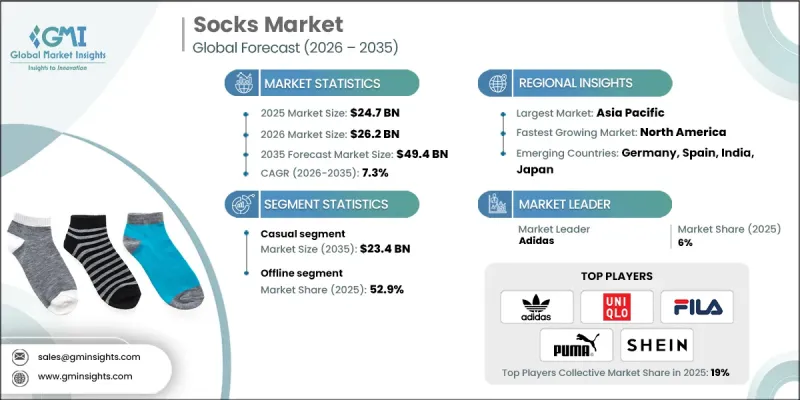
市场成长受消费者优先事项变化的影响,尤其是对永续性和负责任消费的日益重视。消费者越来越倾向于选择环境影响小的产品,这种转变在年轻一代中尤其明显,他们非常注重符合道德规范的采购和生产方式。永续製造技术的进步使品牌能够透过材料创新和高效的生产流程,在提供高品质袜子的同时,最大限度地减少对环境的影响。监管支持和政策主导的永续性目标进一步推动了这项转型,鼓励製造商将产品开发与不断发展的环境标准相衔接。以永续性发展为导向的消费行为,加上技术进步和支援法规,预计将推动全球袜类市场长期稳定成长。同时,生活方式的改变和时尚规范的演变持续影响着消费者的购买模式,增强了不同消费群体对兼具舒适性、功能性和设计多样性的日常穿着产品的需求。
| 市场覆盖范围 | |
|---|---|
| 开始年份 | 2025 |
| 预测年份 | 2026-2035 |
| 起始值 | 247亿美元 |
| 预测金额 | 494亿美元 |
| 复合年增长率 | 7.3% |
预计到2025年,休閒袜市场规模将达到114亿美元,到2035年将达到234亿美元。该细分市场持续保持着强劲的成长势头,主要得益于偏好的改变以及消费者对舒适百搭、适合日常穿着的袜子的需求不断增长。弹性办公和远距办公的日益普及进一步强化了消费者对兼具舒适性和实用性的休閒袜的偏好,使其成为工作、休閒和轻度活动等各种场合的必备单品。
截至2025年,线下通路占了52.9%的市场。实体零售仍然吸引消费者,因为他们可以直接评估产品质量,并受益于商店促销和品牌互动策略,这些策略在促成购买决策方面非常有效。
预计到2025年,美国袜子市占率将达到59%。市场趋势主要受高端和高性能袜子强劲需求以及消费者对功能性和运动型袜子的日益增长的兴趣所驱动。线上购物的持续成长(年增7.8%)也促进了市场扩张和订阅销售模式的普及。
目录
第一章调查方法和范围
第二章执行摘要
第三章业界考察
- 生态系分析
- 供应商情况
- 利润率
- 每个阶段的附加价值
- 影响价值链的因素
- 产业影响因素
- 司机
- 对环保永续袜子的需求日益增长
- 增加医疗保健支出
- 自由裁量权支出正在增加
- 产业潜在风险与挑战
- 消费者偏好和趋势的变化
- 仿冒品品
- 机会
- 永续环保袜的发展
- 扩大智慧袜和功能袜的市场
- 司机
- 成长潜力分析
- 未来市场趋势
- 科技与创新趋势
- 当前技术趋势
- 新兴技术
- 价格趋势
- 依产品类型
- 按地区
- 监管环境
- 标准和合规要求
- 区域法规结构
- 认证标准
- 贸易统计(HS编码-6115.95)
- 主要进口国
- 主要出口国
- 差距分析
- 风险评估与缓解
- 波特五力分析
- PESTEL 分析
- 消费行为分析
- 购买模式
- 偏好分析
- 消费行为的区域差异
- 电子商务如何影响购买决策
第四章 竞争情势
- 介绍
- 公司市占率分析
- 按地区
- 企业矩阵分析
- 主要市场公司的竞争分析
- 竞争定位矩阵
- 重大进展
- 併购
- 伙伴关係与合作
- 新产品发布
- 扩张计划
第五章 依产品类型分類的市场估算与预测,2022-2035年
- 特製袜子
- 运动袜
- 休閒袜
- 正装袜
第六章 按材料分類的市场估算与预测,2022-2035年
- 棉布
- 羊毛
- 聚酯纤维
- 尼龙
- 氨纶
- 丙烯酸纤维
第七章 依长度分類的市场估计与预测,2022-2035年
- 短袜
- 船袜
- 小腿袜
- 隐形袜
第八章 2022-2035年按价格分類的市场估算与预测
- 低价位
- 中号
- 高价位范围
9. 2022-2035年按消费群组分類的市场估计与预测
- 男性
- 女士
- 适合儿童
第十章 按分销管道分類的市场估算与预测,2022-2035年
- 在线的
- 电子商务
- 我们的网站
- 离线
- 超级市场/大卖场
- 专卖店
- 其他(个体店、百货公司等)
第十一章 2022-2035年各地区市场估计与预测
- 北美洲
- 我们
- 加拿大
- 欧洲
- 德国
- 法国
- 英国
- 义大利
- 西班牙
- 亚太地区
- 中国
- 印度
- 日本
- 韩国
- 澳洲
- 拉丁美洲
- 巴西
- 墨西哥
- 阿根廷
- 中东和非洲
- 南非
- 沙乌地阿拉伯
- 阿拉伯聯合大公国
第十二章:公司简介
- Atlantis Corporation
- Bushman USA
- Climate Inc
- DAB Pumps
- Enduramaxx
- Graf Group
- Grundfos
- Heritage Tanks
- JoJo Tanks
- Kingspan Group
- Norwesco
- Snyder Industries
- Stormsaver Ltd
- Watts Water Technologies
- Wisy AG
The Global Socks Market is valued at USD 24.7 billion in 2025 and is estimated to grow at a CAGR of 7.3% to reach USD 49.4 billion by 2035.
Market growth is shaped by changing consumer priorities, particularly the rising emphasis on sustainability and responsible consumption. Buyers are increasingly favoring products manufactured with lower environmental impact, and this shift is especially pronounced among younger demographics who place strong importance on ethical sourcing and production practices. Advances in sustainable manufacturing technologies are enabling brands to deliver high-quality socks while minimizing environmental strain through improved material innovation and more efficient production processes. Regulatory support and policy-driven sustainability goals are further reinforcing this transition, encouraging manufacturers to align product development with evolving environmental standards. As sustainability-focused consumer behavior converges with technological progress and supportive regulations, the global socks market is positioned for steady long-term expansion. In parallel, lifestyle changes and evolving fashion norms continue to influence purchasing patterns, strengthening demand for everyday wear products that combine comfort, functionality, and design versatility across diverse consumer segments.
| Market Scope | |
|---|---|
| Start Year | 2025 |
| Forecast Year | 2026-2035 |
| Start Value | $24.7 Billion |
| Forecast Value | $49.4 Billion |
| CAGR | 7.3% |
The casual socks segment generated USD 11.4 billion in 2025 and is forecast to reach USD 23.4 billion by 2035. This segment remains the primary growth engine of the market due to shifting lifestyle preferences and the rising demand for comfortable, multi-purpose socks suited for daily wear. Increased adoption of flexible and remote working arrangements has further reinforced consumer preference for casual sock options that balance comfort with practicality, making them a staple across work, leisure, and light activity settings.
The offline distribution channels held 52.9% share in 2025. Physical retail continues to attract consumers due to the ability to evaluate product quality directly and benefit from in-store promotions and brand engagement strategies, which remain highly effective in driving purchase decisions.
U.S. Socks Market held 59% share in 2025. Market performance is supported by strong demand for premium and performance-oriented socks, alongside growing interest in functional and athletic designs. Continued growth in online purchasing, which increased by 7.8% year over year, is also contributing to expanded market reach and subscription-based sales models.
Key companies operating in the Global Socks Market include Nike, Adidas, Hanesbrands, Puma, Under Armour, Stance, Bombas, Happy Socks, Smartwool, Jockey International, Fruit of the Loom, Gold Toe Brands, Falke, Burlington Socks, and Sock Dreams. Companies in the socks market are strengthening their market position through product innovation, brand differentiation, and sustainability-driven strategies. Many players are investing in advanced materials and manufacturing processes that improve comfort, durability, and environmental performance. Expanding omnichannel retail strategies allows brands to balance a strong physical retail presence with growing digital sales platforms. Strategic collaborations, targeted marketing campaigns, and lifestyle-focused branding are being used to attract younger consumers and premium buyers. Companies are also broadening product portfolios to address performance, wellness, and everyday wear needs.
Table of Contents
Chapter 1 Methodology & Scope
- 1.1 Market scope and definition
- 1.2 Research design
- 1.2.1 Research approach
- 1.2.2 Data collection methods
- 1.3 Data mining sources
- 1.3.1 Global
- 1.3.2 Regional/Country
- 1.4 Base estimates and calculations
- 1.4.1 Base year calculation
- 1.4.2 Key trends for market estimation
- 1.5 Primary research and validation
- 1.5.1 Primary sources
- 1.6 Forecast model
- 1.7 Research assumptions and limitations
Chapter 2 Executive Summary
- 2.1 Industry 360° synopsis
- 2.2 Key market trends
- 2.2.1 Regional
- 2.2.2 Product Type
- 2.2.3 Material
- 2.2.4 Length
- 2.2.5 Price
- 2.2.6 Consumer Group
- 2.2.7 Distribution Channel
- 2.3 CXO perspectives: Strategic imperatives
- 2.3.1 Key decision points for industry executives
- 2.3.2 Critical success factors for market players
- 2.4 Future outlook and strategic recommendations
Chapter 3 Industry Insights
- 3.1 Industry ecosystem analysis
- 3.1.1 Supplier landscape
- 3.1.2 Profit margin
- 3.1.3 Value addition at each stage
- 3.1.4 Factor affecting the value chain
- 3.2 Industry impact forces
- 3.2.1 Growth drivers
- 3.2.1.1 Rising demand for eco-friendly and sustainable socks
- 3.2.1.2 Growing spending on health
- 3.2.1.3 Rising levels of discretionary spending
- 3.2.2 Industry pitfalls & challenges
- 3.2.2.1 Changing consumer preferences and trends
- 3.2.2.2 Counterfeit and imitation products
- 3.2.3 Opportunities
- 3.2.3.1 Growth in sustainable and eco-friendly socks
- 3.2.3.2 Expansion of smart and functional socks
- 3.2.1 Growth drivers
- 3.3 Growth potential analysis
- 3.4 Future market trends
- 3.5 Technology and innovation landscape
- 3.5.1 Current technological trends
- 3.5.2 Emerging technologies
- 3.6 Price trends
- 3.6.1 By product type
- 3.6.2 By region
- 3.7 Regulatory landscape
- 3.7.1 Standards and compliance requirements
- 3.7.2 Regional regulatory frameworks
- 3.7.3 Certification standards
- 3.8 Trade statistics (HS Code- 6115.95)
- 3.8.1 Major importing countries
- 3.8.2 Major exporting countries
- 3.9 Gap analysis
- 3.10 Risk assessment and mitigation
- 3.11 Porter's analysis
- 3.12 PESTEL analysis
- 3.13 Consumer behaviour analysis
- 3.13.1 Purchasing patterns
- 3.13.2 Preference analysis
- 3.13.3 Regional variations in consumer behaviour
- 3.13.4 Impact of e-commerce on buying decisions
Chapter 4 Competitive Landscape, 2025
- 4.1 Introduction
- 4.2 Company market share analysis
- 4.2.1 By region
- 4.2.1.1 North America
- 4.2.1.2 Europe
- 4.2.1.3 Asia Pacific
- 4.2.1.4 Latin America
- 4.2.1.5 Middle East and Africa
- 4.2.1 By region
- 4.3 Company matrix analysis
- 4.4 Competitive analysis of major market players
- 4.5 Competitive positioning matrix
- 4.6 Key developments
- 4.6.1 Mergers & acquisitions
- 4.6.2 Partnerships & collaborations
- 4.6.3 New product launches
- 4.6.4 Expansion plans
Chapter 5 Market Estimates & Forecast, By Product Type, 2022-2035 (USD Billion) (Million Units)
- 5.1 Key trends
- 5.2 Specialty socks
- 5.3 Sports & athletic socks
- 5.4 Casual socks
- 5.5 Formal socks
Chapter 6 Market Estimates & Forecast, By Material, 2022-2035 (USD Billion) (Million Units)
- 6.1 Key trends
- 6.2 Cotton
- 6.3 Wool
- 6.4 Polyester
- 6.5 Nylon
- 6.6 Spandex
- 6.7 Acrylic
Chapter 7 Market Estimates & Forecast, By Length, 2022-2035 (USD Billion) (Million Units)
- 7.1 Key trends
- 7.2 Ankle socks
- 7.3 Crew socks
- 7.4 Calf socks
- 7.5 No-Show socks
Chapter 8 Market Estimates & Forecast, By Price, 2022-2035 (USD Billion) (Million Units)
- 8.1 Key trends
- 8.2 Low
- 8.3 Medium
- 8.4 High
Chapter 9 Market Estimates & Forecast, By Consumer Group, 2022-2035 (USD Billion) (Million Units)
- 9.1 Key trends
- 9.2 Men
- 9.3 Women
- 9.4 Kids
Chapter 10 Market Estimates & Forecast, By Distribution Channel, 2022-2035 (USD Billion) (Million Units)
- 10.1 Key trends
- 10.2 Online
- 10.2.1 E-Commerce
- 10.2.2 Company website
- 10.3 Offline
- 10.3.1 Supermarkets/Hypermarkets
- 10.3.2 Specialty Stores
- 10.3.3 Others (Individual stores, Departmental stores, etc.)
Chapter 11 Market Estimates & Forecast, By Region, 2022-2035 (USD Billion) (Million Units)
- 11.1 Key trends
- 11.2 North America
- 11.2.1 U.S.
- 11.2.2 Canada
- 11.3 Europe
- 11.3.1 Germany
- 11.3.2 France
- 11.3.3 UK
- 11.3.4 Italy
- 11.3.5 Spain
- 11.4 Asia Pacific
- 11.4.1 China
- 11.4.2 India
- 11.4.3 Japan
- 11.4.4 South Korea
- 11.4.5 Australia
- 11.5 Latin America
- 11.5.1 Brazil
- 11.5.2 Mexico
- 11.5.3 Argentina
- 11.6 MEA
- 11.6.1 South Africa
- 11.6.2 Saudi Arabia
- 11.6.3 UAE
Chapter 12 Company Profiles
- 12.1 Atlantis Corporation
- 12.2 Bushman USA
- 12.3 Climate Inc
- 12.4 DAB Pumps
- 12.5 Enduramaxx
- 12.6 Graf Group
- 12.7 Grundfos
- 12.8 Heritage Tanks
- 12.9 JoJo Tanks
- 12.10 Kingspan Group
- 12.11 Norwesco
- 12.12 Snyder Industries
- 12.13 Stormsaver Ltd
- 12.14 Watts Water Technologies
- 12.15 Wisy AG

 袜类市场:2026-2032年全球市场预测(依产品类型、材料类型、功能、通路和最终用户划分)
 袜子市场分析及预测(至2035年):依类型、产品类型、材料、最终用户、技术、应用、製造流程、功能、安装类型划分袜子市场分析及预测(至2035年):类型、材料类型、应用、最终用户、技术、功能、产品类型及产品介绍足部保湿袜市场分析与预测(至2035年):按类型、产品类型、技术、应用、材料类型、最终用户、功能、部署类型和解决方案划分
 全球保湿袜市场规模、份额、趋势和成长分析报告:2026-2034年
 日本袜类市场规模、份额、趋势和预测:按类型、最终用途和地区划分,2026-2034年
 多趾袜市场 - 全球产业规模、份额、趋势、机会及预测(按产品类型、材料类型、分销管道、地区和竞争格局划分,2021-2031年)袜子市场-全球产业规模、份额、趋势、机会、预测:按类型、类别、销售管道、地区和竞争格局划分,2021-2031年运动袜市场-全球产业规模、份额、趋势、机会、预测:按产品、材料、通路、地区和竞争格局划分,2021-2031年
 运动袜市场机会、成长要素、产业趋势分析及2026年至2035年预测