


 |
市场调查报告书
商品编码
1936563
非酒精智慧饮料机市场机会、成长要素、产业趋势分析及预测(2026-2035年)Non-Alcoholic Smart Beverages Machine Market Opportunity, Growth Drivers, Industry Trend Analysis, and Forecast 2026 - 2035 |
||||||

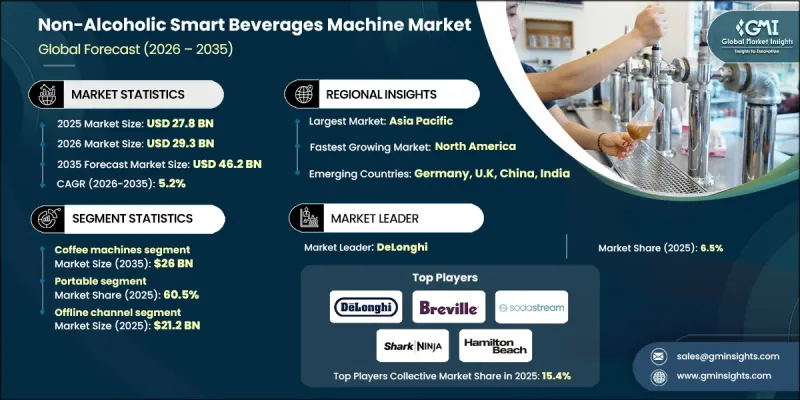
全球非酒精智慧饮料机市场预计到 2025 年将达到 278 亿美元,到 2035 年将达到 462 亿美元,年复合成长率为 5.2%。
消费者对个人化饮品製作和自动化饮品解决方案日益增长的兴趣推动了市场成长。智慧饮品机能够客製化口味、甜度和饮品成分,满足现代消费者对个人化消费体验的需求。日益增强的健康意识也影响消费者的购买行为,促使他们偏好采用天然成分、功能性添加剂和营养强化配方製成的饮品。年轻族群对智慧互联的家用电器表现出浓厚的兴趣,进一步推动了此类产品的普及。然而,製造商面临着许多挑战,例如高昂的开发成本以及将先进硬体与智慧软体平台整合的技术复杂性。开发这些系统需要大量的资金投入、工程技术专长和长期的创新策略。儘管存在这些障碍,智慧家电技术的不断进步以及消费者对便利解决方案日益增长的需求,将继续支撑住宅和商业领域的市场长期扩张。
| 市场覆盖范围 | |
|---|---|
| 开始年份 | 2025 |
| 预测年份 | 2026-2035 |
| 起始金额 | 278亿美元 |
| 预测金额 | 462亿美元 |
| 复合年增长率 | 5.2% |
预计到2025年,咖啡机市场规模将达到153亿美元,到2035年将达到260亿美元。市场成长的驱动力来自全球咖啡需求的不断增长以及人们对製作特产饮料的日益偏好。自动冲泡功能、远端控制和可自订设定等特性提升了用户的使用便利性,从而促进了咖啡机的普及,尤其是在咖啡消费量持续增长的都市区。
到2025年,可携式智慧饮料机市占率预计将达到60.5%。可携式机型的需求主要源自于其易用性、节省空间的设计以及对忙碌生活方式的适应性。都市区生活环境和有限的居住空间进一步推动了对紧凑、易于存放且功能柔软性的设备的需求。
线下分销管道仍将保持最大的市场份额,预计到2025年将创造212亿美元的收入。实体店持续吸引那些希望在购买前亲身了解产品品质、功能和设计的消费者。这种面对面的评估能够增强买家的信心,并且仍然是支撑线下销售表现的关键因素。
预计到2025年,美国非酒精智慧饮料市占率将达到83.5%。高购买力、智慧家电的日益普及以及生活方式的日益自动化,将继续推动市场成长。美国在住宅和商用领域正经历技术的快速普及,巩固了在该地区的主导地位。
目录
第一章调查方法和范围
第二章执行摘要
第三章业界考察
- 生态系分析
- 供应商情况
- 利润率
- 每个阶段的附加价值
- 影响价值链的因素
- 产业影响因素
- 司机
- 智慧技术集成
- 全球家庭和餐厅数量不断增加
- 可支配所得增加与生活水准的改变
- 产业潜在风险与挑战
- 市面上流通的仿冒品
- 替代产品供应充足
- 机会
- 将业务拓展至注重健康的个人化饮品解决方案领域。
- 住宅和商业领域中联网物联网设备的成长
- 司机
- 成长潜力分析
- 未来市场趋势
- 科技与创新趋势
- 当前技术趋势
- 新兴技术
- 价格趋势
- 依产品类型
- 按地区
- 监管环境
- 标准和合规要求
- 区域法规结构
- 认证标准
- 贸易统计
- 主要进口国
- 主要出口国
- 差距分析
- 风险评估与缓解
- 波特五力分析
- PESTEL 分析
- 消费行为分析
- 购买模式
- 偏好分析
- 消费行为的区域差异
- 电子商务对购买决策的影响
第四章 竞争情势
- 介绍
- 公司市占率分析
- 按地区
- 企业矩阵分析
- 主要市场公司的竞争分析
- 竞争定位矩阵
- 重大进展
- 併购
- 伙伴关係与合作
- 新产品发布
- 扩张计划
第五章 依产品类型分類的市场估算与预测,2022-2035年
- 汽水机
- 咖啡机
- 浓缩咖啡机
- 滴滤咖啡机
- 胶囊咖啡机
- 果汁/软性饮料机
- 其他(海水淡化器等)
第六章 依类别分類的市场估计与预测,2022-2035年
- 檯面
- 可携式的
第七章 2022-2035年按价格分類的市场估计与预测
- 低价
- 中价位
- 高价
第八章 依最终用途分類的市场估算与预测,2022-2035年
- 住宅
- 商业
- 饭店
- 餐厅
- 其他的
第九章 按分销管道分類的市场估算与预测,2022-2035年
- 线上管道
- 电子商务
- 公司经营的网站
- 离线频道
- 专卖店
- 大型零售商店
- 其他的
第十章 2022-2035年各地区市场估计与预测
- 北美洲
- 我们
- 加拿大
- 欧洲
- 德国
- 法国
- 英国
- 义大利
- 西班牙
- 亚太地区
- 中国
- 印度
- 日本
- 韩国
- 澳洲
- 拉丁美洲
- 巴西
- 墨西哥
- 阿根廷
- 中东和非洲
- 南非
- 沙乌地阿拉伯
- 阿拉伯聯合大公国
第十一章 公司简介
- Aicook
- Breville
- Cuisinart
- DeLonghi
- Hamilton Beach
- IFB Appliances
- Isoda
- Moccamaster
- Mr. Coffee
- Nebula
- Omega and Cold Press
- SharkNinja
- Smarter
- SodaStream
- Wonderchef
The Global Non-Alcoholic Smart Beverages Machine Market was valued at USD 27.8 billion in 2025 and is estimated to grow at a CAGR of 5.2% to reach USD 46.2 billion by 2035.
Growth is supported by increasing consumer interest in personalized beverage preparation and automated drink solutions. Smart beverage machines allow users to customize flavor profiles, sweetness intensity, and beverage composition, aligning well with modern expectations for tailored consumption experiences. Rising health awareness is also influencing purchasing behavior, with consumers favoring beverages that incorporate natural ingredients, functional additives, and enhanced nutritional profiles. Younger demographics demonstrate a strong interest in connected and technology-enabled appliances, further encouraging their adoption. However, manufacturers face challenges related to high development costs and the technical complexity of integrating advanced hardware with intelligent software platforms. Developing these systems requires significant financial investment, engineering expertise, and long-term innovation strategies. Despite these barriers, ongoing advancements in smart appliance technology and increasing demand for convenience-driven solutions continue to support long-term market expansion across both residential and commercial environments.
| Market Scope | |
|---|---|
| Start Year | 2025 |
| Forecast Year | 2026-2035 |
| Start Value | $27.8 Billion |
| Forecast Value | $46.2 Billion |
| CAGR | 5.2% |
The coffee machines segment generated USD 15.3 billion in 2025 and is expected to reach USD 26 billion by 2035. This segment leads the market due to strong global demand for coffee and growing preference for specialty beverage preparation. Automated brewing, remote operation, and customizable settings enhance user convenience and contribute to widespread adoption, particularly in urban areas where coffee consumption continues to rise.
The portable smart beverage machines segment accounted for 60.5% share in 2025. Demand for portable models is driven by their ease of use, space-saving design, and suitability for fast-paced lifestyles. Urban living conditions and limited household space further support demand for compact and easily stored devices that offer flexibility without compromising functionality.
The offline distribution channel generated USD 21.2 billion in revenue in 2025 and maintained the largest share of the market. Physical retail locations continue to attract consumers who prefer to assess product quality, functionality, and design in person before purchasing. This hands-on evaluation strengthens buyer confidence and remains a key factor supporting offline sales performance.
US Non-Alcoholic Smart Beverages Machine Market accounted for 83.5% share in 2025. Strong purchasing power, widespread adoption of connected home appliances, and increasingly automated lifestyles continue to drive growth. The country benefits from rapid technology adoption across both household and commercial settings, reinforcing its leadership position within the region.
Key companies operating in the Global Non-Alcoholic Smart Beverages Machine Market include Breville, SodaStream, SharkNinja, DeLonghi, Hamilton Beach, Mr. Coffee, Cuisinart, Smarter, Wonderchef, Aicook, IFB Appliances, Nebula, Isoda, Omega, Cold Press, and Moccamaster. Companies in the non-alcoholic smart beverages machine market strengthen their market position by focusing on product innovation, enhanced customization features, and smart connectivity integration. Many manufacturers invest in user-friendly interfaces, mobile app compatibility, and energy-efficient designs to improve consumer appeal. Expanding product portfolios across price points helps brands reach broader customer segments. Strategic partnerships with retail distributors and lifestyle brands support visibility and market penetration. Firms also emphasize design aesthetics and compact form factors to suit urban households.
Table of Contents
Chapter 1 Methodology & Scope
- 1.1 Market scope and definition
- 1.2 Research design
- 1.2.1 Research approach
- 1.2.2 Data collection methods
- 1.3 Data mining sources
- 1.3.1 Global
- 1.3.2 Regional/Country
- 1.4 Base estimates and calculations
- 1.4.1 Base year calculation
- 1.4.2 Key trends for market estimation
- 1.5 Primary research and validation
- 1.5.1 Primary sources
- 1.6 Forecast model
- 1.7 Research assumptions and limitations
Chapter 2 Executive Summary
- 2.1 Industry 3600 synopsis
- 2.2 Key market trends
- 2.2.1 Regional
- 2.2.2 Product Type
- 2.2.3 Category
- 2.2.4 Price
- 2.2.5 End Use
- 2.2.6 Distribution channel
- 2.3 CXO perspectives: Strategic imperatives
- 2.3.1 Key decision points for industry executives
- 2.3.2 Critical success factors for market players
- 2.4 Future outlook and strategic recommendations
Chapter 3 Industry Insights
- 3.1 Industry ecosystem analysis
- 3.1.1 Supplier landscape
- 3.1.2 Profit margin
- 3.1.3 Value addition at each stage
- 3.1.4 Factor affecting the value chain
- 3.2 Industry impact forces
- 3.2.1 Growth drivers
- 3.2.1.1 Smart technology integration
- 3.2.1.2 Growing numbers of household and restaurants across the world
- 3.2.1.3 Growing disposable income and change in the standard of living
- 3.2.2 Industry pitfalls & challenges
- 3.2.2.1 Availability of counterfeit products
- 3.2.2.2 Easy availability of substitute products
- 3.2.3 Opportunities
- 3.2.3.1 Expansion into health-focused, personalized beverage solutions.
- 3.2.3.2 Growth in connected, IoT-enabled machines for residential and commercial segments
- 3.2.1 Growth drivers
- 3.3 Growth potential analysis
- 3.4 Future market trends
- 3.5 Technology and innovation landscape
- 3.5.1 Current technological trends
- 3.5.2 Emerging technologies
- 3.6 Price trends
- 3.6.1 By Product type
- 3.6.2 By Region
- 3.7 Regulatory landscape
- 3.7.1 Standards and compliance requirements
- 3.7.2 Regional regulatory frameworks
- 3.7.3 Certification standards
- 3.8 Trade statistics
- 3.8.1 Major importing countries
- 3.8.2 Major exporting countries
- 3.9 Gap analysis
- 3.10 Risk assessment and mitigation
- 3.11 Porter's analysis
- 3.12 PESTEL analysis
- 3.13 Consumer behaviour analysis
- 3.13.1 Purchasing patterns
- 3.13.2 Preference analysis
- 3.13.3 Regional variations in consumer behaviour
- 3.13.4 Impact of e-commerce on buying decisions
Chapter 4 Competitive Landscape, 2025
- 4.1 Introduction
- 4.2 Company market share analysis
- 4.2.1 By Region
- 4.2.1.1 North America
- 4.2.1.2 Europe
- 4.2.1.3 Asia Pacific
- 4.2.1.4 Latin America
- 4.2.1.5 Middle East and Africa
- 4.2.1 By Region
- 4.3 Company matrix analysis
- 4.4 Competitive analysis of major market players
- 4.5 Competitive positioning matrix
- 4.6 Key developments
- 4.6.1 Mergers & acquisitions
- 4.6.2 Partnerships & collaborations
- 4.6.3 New product launches
- 4.6.4 Expansion plans
Chapter 5 Market Estimates & Forecast, By Product Type, 2022-2035 (USD Billion) (Thousand Units)
- 5.1 Key trends
- 5.2 Soda Machine
- 5.3 Coffee Machine
- 5.3.1 Espresso Machines
- 5.3.2 Drip Coffee Makers
- 5.3.3 Pod Machines
- 5.4 Juice/ Soft Drink Machine
- 5.5 Others (Water Maker Machine, etc.)
Chapter 6 Market Estimates & Forecast, By Category, 2022-2035 (USD Billion) (Thousand Units)
- 6.1 Key trends
- 6.2 Countertop
- 6.3 Portable
Chapter 7 Market Estimates & Forecast, By Price, 2022-2035 (USD Billion) (Thousand Units)
- 7.1 Key trends
- 7.2 Low
- 7.3 Medium
- 7.4 High
Chapter 8 Market Estimates & Forecast, By End Use, 2022-2035 (USD Billion) (Thousand Units)
- 8.1 Key trends
- 8.2 Residential
- 8.3 Commercial
- 8.3.1 Hotels
- 8.3.2 Restaurants
- 8.3.3 Others
Chapter 9 Market Estimates & Forecast, By Distribution Channel, 2022-2035 (USD Billion) (Thousand Units)
- 9.1 Key trends
- 9.2 Online channels
- 9.2.1 Ecommerce
- 9.2.2 Company Owned Website
- 9.3 Offline Channels
- 9.3.1 Specialty Stores
- 9.3.2 Mega Retail stores
- 9.3.3 Others
Chapter 10 Market Estimates & Forecast, By Region, 2022-2035 (USD Billion) (Thousand Units)
- 10.1 Key trends
- 10.2 North America
- 10.2.1 U.S.
- 10.2.2 Canada
- 10.3 Europe
- 10.3.1 Germany
- 10.3.2 France
- 10.3.3 UK
- 10.3.4 Italy
- 10.3.5 Spain
- 10.4 Asia Pacific
- 10.4.1 China
- 10.4.2 India
- 10.4.3 Japan
- 10.4.4 South Korea
- 10.4.5 Australia
- 10.5 Latin America
- 10.5.1 Brazil
- 10.5.2 Mexico
- 10.5.3 Argentina
- 10.6 MEA
- 10.6.1 South Africa
- 10.6.2 Saudi Arabia
- 10.6.3 UAE
Chapter 11 Company Profiles
- 11.1 Aicook
- 11.2 Breville
- 11.3 Cuisinart
- 11.4 DeLonghi
- 11.5 Hamilton Beach
- 11.6 IFB Appliances
- 11.7 Isoda
- 11.8 Moccamaster
- 11.9 Mr. Coffee
- 11.10 Nebula
- 11.11 Omega and Cold Press
- 11.12 SharkNinja
- 11.13 Smarter
- 11.14 SodaStream
- 11.15 Wonderchef


