


 |
市场调查报告书
商品编码
1936566
后扰流板市场机会、成长要素、产业趋势分析及2026年至2035年预测Rear Spoiler Market Opportunity, Growth Drivers, Industry Trend Analysis, and Forecast 2026 - 2035 |
||||||

全球后扰流板市场预计到 2025 年将达到 57 亿美元,到 2035 年将达到 102 亿美元,年复合成长率为 6.1%。
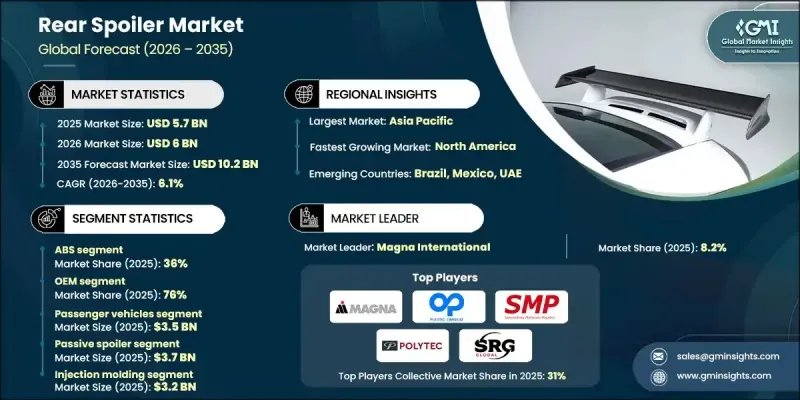
全球汽车产量快速成长、电动和混合动力汽车的日益普及,以及消费者对空气动力学性能、燃油效率和车辆造型的日益偏好,共同推动了这个市场的成长。汽车製造商、整车厂和售后市场供应商正优先采用后扰流板解决方案,以提升车辆的操控性、稳定性和整体性能,同时降低生命週期成本。主动式和被动式扰流板系统、轻质复合材料、精密空气动力学设计和可调式扰流板等技术创新正在改变汽车製造。这些技术能够增强下压力、降低风阻并提高燃油经济性。同时,乘用车、SUV、运动型多用途车和电动车产量的不断增长,也推动了对轻量化、耐用且高性能扰流板的需求。永续材料、基于人工智慧的空气动力学优化、数位监控和预测性维护等新兴趋势,正在进一步塑造这个市场。
| 市场覆盖范围 | |
|---|---|
| 开始年份 | 2025 |
| 预测年份 | 2026-2035 |
| 起始值 | 57亿美元 |
| 预测金额 | 102亿美元 |
| 复合年增长率 | 6.1% |
预计到2025年,ABS材料市占率将达到36%,并在2035年之前以4.6%的复合年增长率成长。由于其轻质、耐用、抗衝击和设计柔软性等优点,ABS仍是乘用车、SUV、商用车和电动车(EV)的首选材料。碳纤维、玻璃纤维和铝等高性能材料因其优异的刚性、强度重量比和美观性,正越来越多地应用于高端汽车和电动车领域。
OEM(整车製造商)细分市场占据76%的市场份额,预计2026年至2035年将以6.2%的复合年增长率成长。 OEM厂商将扰流板直接整合到新车组装流程中,并采用优先考虑轻量化、耐久性和空气动力学优化的系统。他们结合了高强度复合材料、电动车适用解决方案以及主动和被动式设计。与汽车製造商的紧密合作确保了稳定性、安全性、燃油效率和长期性能,使得OEM细分市场在价值和销售方面均位居榜首。
预计到2025年,中国汽车尾翼市场规模将达到4.204亿美元,占全球市场份额的21%。作为全球最大的汽车製造地,中国电动和混合动力汽车产量的激增推动了对先进尾翼解决方案的需求。国内汽车製造商的扩张以及轻量化、精密设计和空气动力学优化尾翼技术的应用,使中国成为该地区的主要收入来源。
目录
第一章调查方法和范围
第二章执行摘要
第三章业界考察
- 生态系分析
- 供应商情况
- 利润率
- 成本结构
- 每个阶段的附加价值
- 影响价值链的因素
- 中断
- 产业影响因素
- 司机
- 全球汽车产量快速成长
- 消费者对空气动力学和造型设计的需求日益增长
- 轻质高强度材料的进步
- 扰流板系统创新
- 产业潜在风险与挑战
- 先进材料和系统的高成本
- 在某些汽车细分市场中应用有限
- 市场机会
- 售后市场和客製化领域的扩张
- 与电动车 (EV) 和智慧汽车平臺集成
- 先进的主动/自我调整扰流板技术
- 整合轻质和永续材料
- 司机
- 成长潜力分析
- 监管环境
- 北美洲
- 联邦机动车辆安全标准(FMVSS)
- 加拿大机动车辆安全标准(CMVSS)
- 欧洲
- 符合德国TUV和BaFin标准
- 法国DGITM指南
- 英国车辆认证机构(VCA)规章
- 义大利运输部
- 亚太地区
- 中国工业和资讯化部(工信部)指南
- 日本国土交通省标准
- 韩国国土交通部(MOLIT)法规
- 印度公路运输和城市发展部 (MoRTH) 和印度标准协会 (BIS) 指南
- 拉丁美洲
- 巴西 DENATRAN 和 ANFAVEA 法规
- 墨西哥SCT和NOM标准
- 中东和非洲
- 阿联酋道路和交通管理局 (RTA) 指南
- 沙乌地阿拉伯运输总局(GAT)规章
- 北美洲
- 波特五力分析
- PESTEL 分析
- 科技与创新趋势
- 当前技术趋势
- 新兴技术
- 价格趋势
- 按地区
- 副产品
- 成本細項分析
- 专利分析
- 永续性和环境方面
- 永续努力
- 减少废弃物策略
- 生产中的能源效率
- 环保倡议
- 碳足迹考量
- 使用案例场景
- 安装和整合成本分析
- 平台和车辆架构相容性
- 客製化和设计差异化的趋势
- 未来设计中断的风险
第四章 竞争情势
- 介绍
- 公司市占率分析
- 北美洲
- 欧洲
- 亚太地区
- 拉丁美洲
- 中东和非洲
- 主要市场公司的竞争分析
- 竞争定位矩阵
- 战略展望矩阵
- 重大进展
- 併购
- 伙伴关係与合作
- 新产品发布
- 企业扩张计画和资金筹措
第五章 按材料分類的市场估算与预测,2022-2035年
- ABS
- 碳纤维
- 玻璃纤维
- 铝
- 其他的
第六章 依车辆类型分類的市场估计与预测,2022-2035年
- 搭乘用车
- 掀背车车
- 轿车
- SUV
- 商用车辆
- 轻型商用车(LCV)
- 中型商用车(MCV)
- 重型商用车(HCV)
第七章 2022-2035年各系统市场估算与预测
- 被动扰流板
- 主动式扰流板
第八章 按技术分類的市场估算与预测,2022-2035年
- 射出成型
- 吹塑成型
- 反应射出成型
9. 2022-2035年按分销管道分類的市场估算与预测
- OEM
- 售后市场
第十章 2022-2035年各地区市场估计与预测
- 北美洲
- 我们
- 加拿大
- 欧洲
- 英国
- 德国
- 法国
- 义大利
- 西班牙
- 比利时
- 荷兰
- 瑞典
- 亚太地区
- 中国
- 印度
- 日本
- 澳洲
- 新加坡
- 韩国
- 越南
- 印尼
- 马来西亚
- 拉丁美洲
- 巴西
- 墨西哥
- 阿根廷
- 中东和非洲
- 阿拉伯聯合大公国
- 南非
- 沙乌地阿拉伯
第十一章 公司简介
- Global Player
- AP Plasman
- Illinois Tool Works(ITW)
- Magna International
- Plastic Omnium
- Polytec
- REHAU Automotive
- Samvardhana Motherson Peguform(SMP Automotive)
- SRG Global
- Stanley Black &Decker
- Wurth
- Regional Player
- AeroPlas Technologies
- Bossard
- Bulten
- CIE Automotive
- KAMAX
- LISI Automotive
- Modulo Automotive
- Nedschroef
- Novares
- Pentair Rear Spoilers
- 新兴企业
- Composite Dynamics
- Ecomotive Spoilers
- EV Aero Solutions
- GreenTech Composites
- Lighter Materials Solutions
The Global Rear Spoiler Market was valued at USD 5.7 billion in 2025 and is estimated to grow at a CAGR of 6.1% to reach USD 10.2 billion by 2035.
The market is propelled by the rapid expansion of global vehicle production, the rising adoption of electric and hybrid vehicles, and increasing consumer preference for enhanced aerodynamics, fuel efficiency, and vehicle styling. Automakers, OEMs, and aftermarket suppliers are prioritizing rear spoiler solutions to improve handling, stability, and overall vehicle performance while reducing lifecycle costs. Technological advancements, including active and passive spoiler systems, lightweight composite materials, precision aerodynamic designs, and adjustable spoilers, are transforming vehicle manufacturing. These innovations enhance downforce, reduce drag, and improve fuel economy. Meanwhile, the growing production of passenger cars, SUVs, sports vehicles, and EVs is driving demand for lightweight, durable, and high-performance spoilers. Emerging trends like sustainable materials, AI-driven aerodynamic optimization, digital monitoring, and predictive maintenance are further shaping the market.
| Market Scope | |
|---|---|
| Start Year | 2025 |
| Forecast Year | 2026-2035 |
| Start Value | $5.7 Billion |
| Forecast Value | $10.2 Billion |
| CAGR | 6.1% |
The ABS material segment held 36% share in 2025 and is projected to grow at a CAGR of 4.6% through 2035. ABS remains a preferred choice for passenger cars, SUVs, commercial vehicles, and EVs due to its lightweight nature, durability, impact resistance, and design flexibility. High-performance materials such as carbon fiber, fiberglass, and aluminum are increasingly used in premium and EV applications, offering superior stiffness, strength-to-weight ratios, and aesthetic appeal.
The OEMs segment held 76% share and is expected to grow at a CAGR of 6.2% from 2026 to 2035. OEMs integrate spoilers directly into new vehicle assembly, prioritize lightweight, durable, and aerodynamically optimized systems, and leverage active and passive designs along with high-strength composites and EV-compatible solutions. Their strong collaborations with vehicle manufacturers ensure stability, safety, fuel efficiency, and long-term performance, making the OEM segment the largest by value and volume.
China Rear Spoiler Market held a 21% share, generating USD 420.4 million in 2025. Its position as the largest automotive manufacturing hub, along with rapid growth in EV and hybrid production, drives demand for advanced spoiler solutions. Domestic OEM expansion and adoption of lightweight, precision-engineered, and aerodynamically optimized spoiler technologies make China the primary revenue contributor in the region.
Key players in the Global Rear Spoiler Market include Magna International, Wurth, Plastic Omnium, SRG Global, AP Plasman, Samvardhana Motherson Peguform (SMP Automotive), REHAU Automotive, Illinois Tool Works (ITW), Polytec, and Stanley Black & Decker. Companies in the rear spoiler market strengthen their position by investing in lightweight and high-performance materials, expanding R&D for active and passive aerodynamic systems, and collaborating closely with OEMs. Strategic partnerships, integration with EV platforms, and adoption of AI-based aerodynamic optimization enhance product offerings. Firms also focus on expanding aftermarket reach, improving precision manufacturing capabilities, and leveraging digital monitoring and predictive maintenance solutions to enhance product value, performance, and customer trust.
Table of Contents
Chapter 1 Methodology & Scope
- 1.1 Market scope and definition
- 1.2 Research design
- 1.2.1 Research approach
- 1.2.2 Data collection methods
- 1.3 Data mining sources
- 1.3.1 Global
- 1.3.2 Regional/Country
- 1.4 Base estimates and calculations
- 1.4.1 Base year calculation
- 1.4.2 Key trends for market estimation
- 1.5 Primary research and validation
- 1.5.1 Primary sources
- 1.6 Forecast
- 1.7 Research assumptions and limitations
Chapter 2 Executive Summary
- 2.1 Industry 360° synopsis, 2022 - 2035
- 2.2 Key market trends
- 2.2.1 Regional
- 2.2.2 Material
- 2.2.3 Vehicle
- 2.2.4 System
- 2.2.5 Technology
- 2.2.6 Distribution Channel
- 2.3 TAM Analysis, 2026-2035
- 2.4 CXO perspectives: Strategic imperatives
- 2.4.1 Executive decision points
- 2.4.2 Critical success factors
- 2.5 Future outlook and strategic recommendations
Chapter 3 Industry Insights
- 3.1 Industry ecosystem analysis
- 3.1.1 Supplier Landscape
- 3.1.2 Profit Margin
- 3.1.3 Cost structure
- 3.1.4 Value addition at each stage
- 3.1.5 Factor affecting the value chain
- 3.1.6 Disruptions
- 3.2 Industry impact forces
- 3.2.1 Growth drivers
- 3.2.1.1 Rapid Expansion of Global Vehicle Production
- 3.2.1.2 Increasing Consumer Demand for Aerodynamics and Styling
- 3.2.1.3 Advancements in Lightweight, High-Strength Materials
- 3.2.1.4 Technological Innovations in Spoiler Systems
- 3.2.2 Industry pitfalls and challenges
- 3.2.2.1 High Cost of Advanced Materials and Systems
- 3.2.2.2 Limited Adoption in Certain Vehicle Segments
- 3.2.3 Market opportunities
- 3.2.3.1 Expansion of Aftermarket and Customization Segments
- 3.2.3.2 Integration with EVs and Smart Vehicle Platforms
- 3.2.3.3 Advanced Active and Adaptive Spoiler Technologies
- 3.2.3.4 Lightweight and Sustainable Material Integration
- 3.2.1 Growth drivers
- 3.3 Growth potential analysis
- 3.4 Regulatory landscape
- 3.4.1 North America
- 3.4.1.1 U.S. Federal Motor Vehicle Safety Standards (FMVSS)
- 3.4.1.2 Canada Motor Vehicle Safety Standards (CMVSS)
- 3.4.2 Europe
- 3.4.2.1 Germany TUV & BaFin Compliance
- 3.4.2.2 France DGITM Guidelines
- 3.4.2.3 UK Vehicle Certification Agency (VCA) Regulations
- 3.4.2.4 Italy Ministry of Infrastructure & Transport
- 3.4.3 Asia Pacific
- 3.4.3.1 China MIIT Guidelines
- 3.4.3.2 Japan MLIT Standards
- 3.4.3.3 South Korea MOLIT Regulations
- 3.4.3.4 India Ministry of MoRTH & BIS Guidelines
- 3.4.4 Latin America
- 3.4.4.1 Brazil DENATRAN & ANFAVEA Regulations
- 3.4.4.2 Mexico SCT & NOM Standards
- 3.4.5 Middle East and Africa
- 3.4.5.1 UAE Roads & Transport Authority (RTA) Guidelines
- 3.4.5.2 Saudi Arabia General Authority for Transport (GAT) Regulations
- 3.4.1 North America
- 3.5 Porter's analysis
- 3.6 PESTEL analysis
- 3.7 Technology and Innovation Landscape
- 3.7.1 Current technological trends
- 3.7.2 Emerging technologies
- 3.8 Price trends
- 3.8.1 By region
- 3.8.2 By product
- 3.9 Cost breakdown analysis
- 3.10 Patent analysis
- 3.11 Sustainability and Environmental Aspects
- 3.11.1 Sustainable practices
- 3.11.2 Waste reduction strategies
- 3.11.3 Energy efficiency in production
- 3.11.4 Eco-friendly initiatives
- 3.11.5 Carbon footprint considerations
- 3.12 Use case scenarios
- 3.13 Installation & Integration Cost Analysis
- 3.14 Platform & Vehicle Architecture Compatibility
- 3.15 Customization & Design Differentiation Trends
- 3.16 Future Design Disruption Risks
Chapter 4 Competitive Landscape, 2025
- 4.1 Introduction
- 4.2 Company market share analysis
- 4.2.1 North America
- 4.2.2 Europe
- 4.2.3 Asia Pacific
- 4.2.4 Latin America
- 4.2.5 Middle East & Africa
- 4.3 Competitive analysis of major market players
- 4.4 Competitive positioning matrix
- 4.5 Strategic outlook matrix
- 4.6 Key developments
- 4.6.1 Mergers & acquisitions
- 4.6.2 Partnerships & collaborations
- 4.6.3 New product launches
- 4.6.4 Expansion plans and funding
Chapter 5 Market Estimates & Forecast, By Material, 2022 - 2035 ($ Bn, Units)
- 5.1 Key trends
- 5.2 ABS
- 5.3 Carbon Fiber
- 5.4 Fiberglass
- 5.5 Aluminum
- 5.6 Others
Chapter 6 Market Estimates & Forecast, By Vehicle, 2022 - 2035 ($ Bn, Units)
- 6.1 Key trends
- 6.2 Passenger vehicles
- 6.2.1 Hatchbacks
- 6.2.2 Sedans
- 6.2.3 SUV
- 6.3 Commercial vehicles
- 6.3.1 Light commercial vehicles (LCV)
- 6.3.2 Medium commercial vehicles (MCV)
- 6.3.3 Heavy commercial vehicles (HCV)
Chapter 7 Market Estimates & Forecast, By System, 2022 - 2035 ($ Bn, Units)
- 7.1 Key trends
- 7.2 Passive Spoiler
- 7.3 Active Spoiler
Chapter 8 Market Estimates & Forecast, By Technology, 2022 - 2035 ($ Bn, Units)
- 8.1 Key trends
- 8.2 Injection Molding
- 8.3 Blow Molding
- 8.4 Reaction Injection Molding
Chapter 9 Market Estimates & Forecast, By Distribution Channel, 2022 - 2035 ($ Bn, Units)
- 9.1 Key trends
- 9.2 OEM
- 9.3 Aftermarket
Chapter 10 Market Estimates & Forecast, By Region, 2022 - 2035 ($ Bn, Units)
- 10.1 Key trends
- 10.2 North America
- 10.2.1 US
- 10.2.2 Canada
- 10.3 Europe
- 10.3.1 UK
- 10.3.2 Germany
- 10.3.3 France
- 10.3.4 Italy
- 10.3.5 Spain
- 10.3.6 Belgium
- 10.3.7 Netherlands
- 10.3.8 Sweden
- 10.4 Asia Pacific
- 10.4.1 China
- 10.4.2 India
- 10.4.3 Japan
- 10.4.4 Australia
- 10.4.5 Singapore
- 10.4.6 South Korea
- 10.4.7 Vietnam
- 10.4.8 Indonesia
- 10.4.9 Malaysia
- 10.5 Latin America
- 10.5.1 Brazil
- 10.5.2 Mexico
- 10.5.3 Argentina
- 10.6 MEA
- 10.6.1 UAE
- 10.6.2 South Africa
- 10.6.3 Saudi Arabia
Chapter 11 Company Profiles
- 11.1 Global Player
- 11.1.1 AP Plasman
- 11.1.2 Illinois Tool Works (ITW)
- 11.1.3 Magna International
- 11.1.4 Plastic Omnium
- 11.1.5 Polytec
- 11.1.6 REHAU Automotive
- 11.1.7 Samvardhana Motherson Peguform (SMP Automotive)
- 11.1.8 SRG Global
- 11.1.9 Stanley Black & Decker
- 11.1.10 Wurth
- 11.2 Regional Player
- 11.2.1 AeroPlas Technologies
- 11.2.2 Bossard
- 11.2.3 Bulten
- 11.2.4 CIE Automotive
- 11.2.5 KAMAX
- 11.2.6 LISI Automotive
- 11.2.7 Modulo Automotive
- 11.2.8 Nedschroef
- 11.2.9 Novares
- 11.2.10 Pentair Rear Spoilers
- 11.3 Emerging Players
- 11.3.1 Composite Dynamics
- 11.3.2 Ecomotive Spoilers
- 11.3.3 EV Aero Solutions
- 11.3.4 GreenTech Composites
- 11.3.5 Lighter Materials Solutions


