


 |
市场调查报告书
商品编码
1936571
花盆及种植者市场机会、成长要素、产业趋势分析及2026年至2035年预测Pots and Planters Market Opportunity, Growth Drivers, Industry Trend Analysis, and Forecast 2026 - 2035 |
||||||

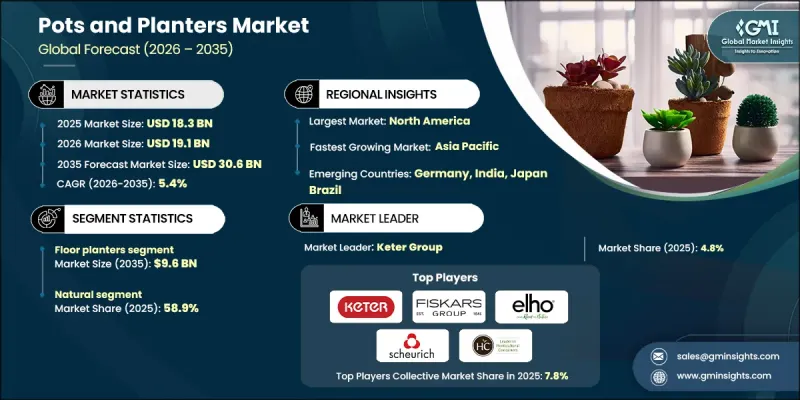
全球花盆和种植箱市场预计到 2025 年将达到 183 亿美元,到 2035 年将达到 306 亿美元,年复合成长率为 5.4%。
城市园艺的兴起、人们对住宅装饰日益增长的兴趣,以及室内园艺在公寓和城市空间的普及,都推动了市场的发展。消费者越来越倾向于选择兼具功能性和美观性的花盆,促使製造商开发适用于室内外环境的设计。环保意识的增强也促进了市场成长,越来越多的消费者青睐由陶土、竹子、再生塑胶和陶瓷等永续材料製成的产品。人们对低维护园艺和永续性的日益关注,以及都市化的加快,都在推动市场扩张的同时,加剧了市场竞争,并为消费者提供了更广泛的选择。为了满足消费者多样化的需求,製造商正透过先进的产品创新来应对,例如推出自动浇水和环保花盆。
| 市场覆盖范围 | |
|---|---|
| 开始年份 | 2025 |
| 预测年份 | 2026-2035 |
| 起始值 | 183亿美元 |
| 预测金额 | 306亿美元 |
| 复合年增长率 | 5.4% |
预计到2025年,落地式花盆市场规模将达62亿美元,2035年将达96亿美元。落地式花盆因其方便实用,能为商业和住宅空间增添绿意而广受欢迎。尺寸、颜色、形状以及金属、塑胶、陶瓷等材质的客製化选择进一步提升了其吸引力,使其能够与各种室内外设计风格完美融合。
预计到2025年,天然材料细分市场将占58.9%的份额。陶土、黏土、陶瓷和木材製成的花盆和种植器皿因其耐用性、美观性和永续性而越来越受到环保意识强的消费者的青睐。製造商正在加强绿色倡议力度,并扩大这些环保产品的生产,以满足不断增长的市场需求。
预计到2025年,美国花盆和种植器皿市场将占据64.3%的市场。推动美国市场成长的主要因素包括住宅景观美化计划的增加、城市园艺趋势的兴起以及消费者对室内植物日益增长的兴趣。政府推广永续和节水型景观设计的措施也促进了市场需求。此外,大型零售连锁店和电商平台的便利销售也为市场扩张做出了贡献,使消费者更容易购买到心仪的产品。
目录
第一章调查方法和范围
第二章执行摘要
第三章业界考察
- 生态系分析
- 供应商情况
- 利润率
- 每个阶段的附加价值
- 影响价值链的因素
- 产业影响因素
- 司机
- 都市化与小规模空间园艺趋势
- 对永续和环保产品的需求日益增长
- DIY园艺和景观美化计划的兴起
- 产业潜在风险与挑战
- 激烈的竞争和对价格的敏感性
- 对季节性需求的依赖
- 机会
- 永续且环保的种植盆和花盆
- 分析智慧自动化供水解决方案的扩展潜力
- 司机
- 未来市场趋势
- 科技与创新趋势
- 当前技术趋势
- 新兴技术
- 价格趋势
- 依产品类型
- 按地区
- 监管环境
- 标准和合规要求
- 区域法规结构
- 认证标准
- 贸易统计(HS编码-6115.95)
- 主要进口国
- 主要出口国
- 差距分析
- 风险评估与缓解
- 波特五力分析
- PESTEL 分析
- 消费行为分析
- 购买模式
- 偏好分析
- 消费行为的区域差异
- 电子商务如何影响购买决策
第四章 竞争情势
- 介绍
- 公司市占率分析
- 按地区
- 企业矩阵分析
- 主要市场公司的竞争分析
- 竞争定位矩阵
- 重大进展
- 併购
- 伙伴关係与合作
- 新产品发布
- 扩张计划
第五章 按类型分類的市场估算与预测,2022-2035年
- 落地式花盆
- 吊挂花盆
- 壁挂式花盆
- 桌面花盆
- 垂直植器
- 其他(自动浇水花盆)
第六章 按材料分類的市场估算与预测,2022-2035年
- 自然的
- 红陶
- 陶瓷製品
- 黏土
- 石材
- 木头
- 具体的
- 合成材料
- 塑胶
- 玻璃纤维
- 其他(回收材料等)
第七章 2022-2035年按价格分類的市场估计与预测
- 低价位
- 中号
- 高价位范围
第八章 按设备类型分類的市场估算与预测,2022-2035年
- 室内空间
- 户外空间
第九章 依类别分類的市场估计与预测,2022-2035年
- 聪明的
- 传统的
第十章 依最终用途分類的市场估计与预测,2022-2035年
- 住宅
- 商业的
- 研究所
- 餐饮(饭店、餐厅、咖啡厅)
- 零售
- 卫生保健
- 对于企业
- 其他(水疗中心、机场和交通枢纽等)
第十一章 按分销管道分類的市场估算与预测,2022-2035年
- 在线的
- 电子商务
- 我们的网站
- 离线
- 超级市场/大卖场
- 专卖店
- 其他(个体店、百货公司等)
第十二章 2022-2035年各地区市场估算与预测
- 北美洲
- 我们
- 加拿大
- 欧洲
- 德国
- 法国
- 英国
- 义大利
- 西班牙
- 亚太地区
- 中国
- 印度
- 日本
- 韩国
- 澳洲
- 拉丁美洲
- 巴西
- 墨西哥
- 阿根廷
- 中东和非洲
- 南非
- 沙乌地阿拉伯
- 阿拉伯聯合大公国
第十三章:公司简介
- Anderson Pots
- Belden Plastics
- Bloem Living
- Crescent Garden
- Deroma
- East Jordan Plastics
- Elho
- Fiskars
- HC公司
- Keter
- Lechuza
- Novelty Manufacturing
- Poppelmann
- Scheurich
- Teraplast
The Global Pots and Planters Market was valued at USD 18.3 billion in 2025 and is estimated to grow at a CAGR of 5.4% to reach USD 30.6 billion by 2035.
The market is benefiting from the growing trend of urban gardening, increased interest in home decoration, and the rising adoption of indoor gardening practices in apartments and urban spaces. Consumers are increasingly seeking both functional and aesthetically appealing planters, which has encouraged manufacturers to innovate with designs that suit indoor and outdoor environments. Eco-conscious choices are also driving growth, as more buyers prefer products made from sustainable materials such as terracotta, bamboo, recycled plastics, and ceramic. The increasing emphasis on low-maintenance gardening and sustainability, along with urbanization, has fueled market expansion while enhancing competition and providing consumers with a wider range of options. Manufacturers are responding with advanced product innovations, including self-watering and eco-friendly planters, to cater to diverse consumer needs.
| Market Scope | |
|---|---|
| Start Year | 2025 |
| Forecast Year | 2026-2035 |
| Start Value | $18.3 Billion |
| Forecast Value | $30.6 Billion |
| CAGR | 5.4% |
The floor planters segment generated USD 6.2 billion in 2025 and is anticipated to reach USD 9.6 billion by 2035. Floor planters are widely adopted for their convenience in adding greenery to both commercial and residential spaces. Customizable options in terms of size, color, shape, and materials such as metal, plastic, and ceramic further boost their appeal, allowing seamless integration into varied interior and exterior designs.
The natural materials segment accounted for 58.9% share in 2025. Pots and planters made from terracotta, clay, ceramic, and wood are increasingly preferred by environmentally conscious consumers, combining durability, aesthetic appeal, and sustainability. Manufacturers are scaling production of these eco-friendly products to meet growing demand while reinforcing their commitment to green initiatives.
U.S. Pots and Planters Market held 64.3% share in 2025. The country's market growth is driven by rising residential landscaping projects, urban gardening trends, and growing consumer interest in indoor plants. Government initiatives promoting sustainable and water-efficient landscaping practices further support demand. The accessibility of products through major retail chains and e-commerce platforms also contributes to market expansion by ensuring easy availability for consumers.
Key players shaping the Global Pots and Planters Market include Anderson Pots, Belden Plastics, Bloem Living, Crescent Garden, Deroma, East Jordan Plastics, Elho, Fiskars, HC Companies, Keter, Lechuza, Novelty Manufacturing, Poppelmann, Scheurich, and Teraplast. Companies in the pots and planters market are adopting multiple strategies to strengthen their presence and capture market share. They focus on developing eco-friendly and sustainable product lines to meet the rising demand for environmentally conscious solutions. Innovation in design, such as self-watering systems and modular planters, enhances product functionality and appeals to urban gardeners. Strategic partnerships and collaborations with retailers and online marketplaces increase product visibility and distribution reach. Brands are also investing in marketing campaigns that emphasize sustainability and lifestyle benefits, strengthening brand loyalty.
Table of Contents
Chapter 1 Methodology & Scope
- 1.1 Market scope and definition
- 1.2 Research design
- 1.2.1 Research approach
- 1.2.2 Data collection methods
- 1.3 Data mining sources
- 1.3.1 Global
- 1.3.2 Regional/Country
- 1.4 Base estimates and calculations
- 1.4.1 Base year calculation
- 1.4.2 Key trends for market estimation
- 1.5 Primary research and validation
- 1.5.1 Primary sources
- 1.6 Forecast model
- 1.7 Research assumptions and limitations
Chapter 2 Executive Summary
- 2.1 Industry 360° synopsis
- 2.2 Key market trends
- 2.2.1 Regional
- 2.2.2 Type
- 2.2.3 Material
- 2.2.4 Price
- 2.2.5 Installation
- 2.2.6 Category
- 2.2.7 End Use
- 2.2.8 Distribution Channel
- 2.3 CXO perspectives: Strategic imperatives
- 2.3.1 Key decision points for industry executives
- 2.3.2 Critical success factors for market players
- 2.4 Future outlook and strategic recommendations
Chapter 3 Industry Insights
- 3.1 Industry ecosystem analysis
- 3.1.1 Supplier landscape
- 3.1.2 Profit margin
- 3.1.3 Value addition at each stage
- 3.1.4 Factor affecting the value chain
- 3.2 Industry impact forces
- 3.2.1 Growth drivers
- 3.2.1.1 Urbanization and small-space gardening trends
- 3.2.1.2 Rising demand for sustainable and eco-friendly products
- 3.2.1.3 Increase in DIY gardening and landscaping projects
- 3.2.2 Industry pitfalls & challenges
- 3.2.2.1 High competition and price sensitivity
- 3.2.2.2 Dependence on seasonal demand
- 3.2.3 Opportunities
- 3.2.3.1 Growth in sustainable and eco-friendly pots and planters
- 3.2.3.2 expansion of smart & self-watering solutions growth potential analysis
- 3.2.1 Growth drivers
- 3.3 Future market trends
- 3.4 Technology and innovation landscape
- 3.4.1 Current technological trends
- 3.4.2 Emerging technologies
- 3.5 Price trends
- 3.5.1 By product type
- 3.5.2 By region
- 3.6 Regulatory landscape
- 3.6.1 Standards and compliance requirements
- 3.6.2 Regional regulatory frameworks
- 3.6.3 Certification standards
- 3.7 Trade statistics (HS Code- 6115.95)
- 3.7.1 Major importing countries
- 3.7.2 Major exporting countries
- 3.8 Gap analysis
- 3.9 Risk assessment and mitigation
- 3.10 Porter's analysis
- 3.11 PESTEL analysis
- 3.12 Consumer behaviour analysis
- 3.12.1 Purchasing patterns
- 3.12.2 Preference analysis
- 3.12.3 Regional variations in consumer behaviour
- 3.12.4 Impact of e-commerce on buying decisions
Chapter 4 Competitive Landscape, 2025
- 4.1 Introduction
- 4.2 Company market share analysis
- 4.2.1 By region
- 4.2.1.1 North America
- 4.2.1.2 Europe
- 4.2.1.3 Asia Pacific
- 4.2.1.4 Latin America
- 4.2.1.5 Middle East and Africa
- 4.2.1 By region
- 4.3 Company matrix analysis
- 4.4 Competitive analysis of major market players
- 4.5 Competitive positioning matrix
- 4.6 Key developments
- 4.6.1 Mergers & acquisitions
- 4.6.2 Partnerships & collaborations
- 4.6.3 New product launches
- 4.6.4 Expansion plans
Chapter 5 Market Estimates & Forecast, By Type, 2022-2035 (USD Billion) (Million Units)
- 5.1 Key trends
- 5.2 Floor planters
- 5.3 Hanging planters
- 5.4 Wall-mounted planters
- 5.5 Tabletop planters
- 5.6 Vertical planters
- 5.7 Others (self-watering planters)
Chapter 6 Market Estimates & Forecast, By Material, 2022-2035 (USD Billion) (Million Units)
- 6.1 Key trends
- 6.2 Natural
- 6.2.1 Terracotta
- 6.2.2 Ceramic
- 6.2.3 Clay
- 6.2.4 Stone
- 6.2.5 Wood
- 6.2.6 Concrete
- 6.3 Synthetic
- 6.3.1 Plastic
- 6.3.2 Fiberglass
- 6.3.3 Others (recycled materials, etc.)
Chapter 7 Market Estimates & Forecast, By Price, 2022-2035 (USD Billion) (Million Units)
- 7.1 Key trends
- 7.2 Low
- 7.3 Medium
- 7.4 High
Chapter 8 Market Estimates & Forecast, By Installation, 2022-2035 (USD Billion) (Million Units)
- 8.1 Key trends
- 8.2 Interior space
- 8.3 Exterior space
Chapter 9 Market Estimates & Forecast, By Category, 2022-2035 (USD Billion) (Million Units)
- 9.1 Key trends
- 9.2 Smart
- 9.3 Conventional
Chapter 10 Market Estimates & Forecast, By End Use, 2022-2035 (USD Billion) (Million Units)
- 10.1 Key trends
- 10.2 Residential
- 10.3 Commercial
- 10.3.1 Institutes
- 10.3.2 HoReCa
- 10.3.3 Retail
- 10.3.4 Healthcare
- 10.3.5 Corporates
- 10.3.6 Others (spa centers, airports and transportation hubs, etc.)
Chapter 11 Market Estimates & Forecast, By Distribution Channel, 2022-2035 (USD Billion) (Million Units)
- 11.1 Key trends
- 11.2 Online
- 11.2.1 E-Commerce
- 11.2.2 Company website
- 11.3 Offline
- 11.3.1 Supermarkets/Hypermarkets
- 11.3.2 Specialty Stores
- 11.3.3 Others (Individual stores, Departmental stores, etc.)
Chapter 12 Market Estimates & Forecast, By Region, 2022-2035 (USD Billion) (Million Units)
- 12.1 Key trends
- 12.2 North America
- 12.2.1 U.S.
- 12.2.2 Canada
- 12.3 Europe
- 12.3.1 Germany
- 12.3.2 France
- 12.3.3 UK
- 12.3.4 Italy
- 12.3.5 Spain
- 12.4 Asia Pacific
- 12.4.1 China
- 12.4.2 India
- 12.4.3 Japan
- 12.4.4 South Korea
- 12.4.5 Australia
- 12.5 Latin America
- 12.5.1 Brazil
- 12.5.2 Mexico
- 12.5.3 Argentina
- 12.6 MEA
- 12.6.1 South Africa
- 12.6.2 Saudi Arabia
- 12.6.3 UAE
Chapter 13 Company Profiles
- 13.1 Anderson Pots
- 13.2 Belden Plastics
- 13.3 Bloem Living
- 13.4 Crescent Garden
- 13.5 Deroma
- 13.6 East Jordan Plastics
- 13.7 Elho
- 13.8 Fiskars
- 13.9 HC Companies
- 13.10 Keter
- 13.11 Lechuza
- 13.12 Novelty Manufacturing
- 13.13 Poppelmann
- 13.14 Scheurich
- 13.15 Teraplast

 花盆与种植箱市场:2026-2032年全球市场预测(依材质、款式、销售管道及应用划分)
 自吸水花盆市场 - 全球产业规模、份额、趋势、机会及预测(按材料类型、销售管道、地区和竞争格局划分,2021-2031年)
 日本花盆市场报告(按类型(塑胶、陶瓷、木质及其他)、应用(商业、住宅及其他)和地区划分,2026-2034年)
 全球花盆和花盆市场
 2025-2029年全球花盆与花槽市场花盆和花槽市场-全球产业规模、份额、趋势、机会和预测,按产品类型、最终用户、配销通路、地区和竞争细分,2020-2030 年
 全球种植园市场 2024-2028