


 |
市场调查报告书
商品编码
1936578
介入性放射学市场机会、成长要素、产业趋势分析及预测(2026年至2035年)Interventional Radiology Market Opportunity, Growth Drivers, Industry Trend Analysis, and Forecast 2026 - 2035 |
||||||

全球介入放射学市场预计到 2025 年将达到 309 亿美元,到 2035 年将达到 515 亿美元,年复合成长率为 5.2%。
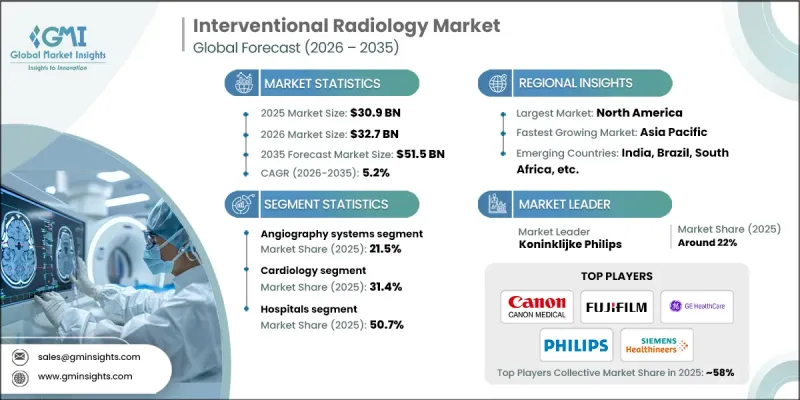
推动市场成长的关键因素包括慢性病发病率上升、人口老化、影像技术的快速发展以及对微创治疗方法日益增长的需求。介入放射学在肿瘤领域的应用、先进的3D和4D成像系统的整合以及影像引导治疗的广泛应用,都在推动对介入放射学解决方案的需求。影像硬体和软体的持续改进催生了新的临床应用,而现代血管造影术系统则提供了更高的空间和时间解析度。此外,融合影像和3D手术蓝图等其他技术能够实现术中精准规划和即时导航,从而提高手术成功率并减少併发症。这些创新,以及携带式影像系统的广泛应用,正在扩大介入放射学在加护病房、急诊和资源匮乏地区的应用范围,进一步推动全球市场成长。
| 市场覆盖范围 | |
|---|---|
| 开始年份 | 2025 |
| 预测年份 | 2026-2035 |
| 起始值 | 309亿美元 |
| 预测金额 | 515亿美元 |
| 复合年增长率 | 5.2% |
预计到2025年,医院将占据50.7%的市场份额,因为医院能够提供支持复杂介入手术所需的基础设施、多学科团队和资金投入。大规模教学医院和运转率高的社区医院进行了大量需要先进影像技术、住院支援和专业知识的高级介入放射学(IR)手术。由于医院能够整合先进技术并在手术过程中提供重症监护支持,因此仍然是复杂介入手术的首选。
预计到2025年,介入放射诊所市场规模将达到78亿美元,其成长主要得益于门诊病人更容易取得影像导引下的微创介入手术。专业的介入放射学诊所拥有更高的病患接诊能力、更专业的知识技能、更先进的影像系统和更有效率的评估流程。这不仅提升了病患的就医便利性,也减轻了医院的负担,使医疗系统能够在确保高品质治疗效果的同时,更有效率地提供医疗服务。
预计到2025年,北美介入放射学市占率将达到36%。该地区的主导地位归功于其先进的医疗基础设施、庞大的手术量、对尖端技术的早期应用、健全的报销机制以及主要医疗设备製造商的集中布局。此外,北美也受惠于高人均医疗支出、公立和私立医疗体系提供的全面保险覆盖,以及在支持创新的同时保障病人安全的成熟法规环境。这些因素共同促成了该地区成为介入放射学解决方案的理想市场。
目录
第一章调查方法和范围
第二章执行摘要
第三章业界考察
- 生态系分析
- 产业影响因素
- 司机
- 全球慢性病盛行率不断上升
- 医学影像技术的进步
- 对微创手术的需求日益增长
- 人口老化趋势日益加剧
- 产业潜在风险与挑战
- 产品相关高成本
- 复杂的法规环境
- 机会
- 利用人工智慧和机器人进行影像引导治疗
- 增加对混合手术室的投资
- 低辐射和无辐射成像技术的发展
- 司机
- 成长潜力分析
- 监管环境
- 北美洲
- 欧洲
- 亚太地区
- 科技与创新趋势
- 当前技术趋势
- 新兴技术
- 价值链分析
- 救赎方案
- 从住院治疗过渡到门诊治疗的趋势
- 定价分析
- 政策环境
- 波特五力分析
- PESTEL 分析
- 差距分析
- 未来市场趋势
第四章 竞争情势
- 介绍
- 企业矩阵分析
- 公司市占率分析
- 世界
- 北美洲
- 欧洲
- 亚太地区
- 主要市场公司的竞争分析
- 竞争定位矩阵
- 重大进展
- 併购
- 伙伴关係与合作
- 新产品发布
- 扩张计划
第五章 2022-2035年按产品分類的市场估算与预测
- 血管造影术系统
- 超音波影像设备
- CT扫描仪
- 磁振造影系统
- 透视
- 切片检查装置
- 其他产品
第六章 按应用领域分類的市场估算与预测,2022-2035年
- 心臟病学
- 肿瘤学
- 妇科
- 产科
- 泌尿系统
- 胃肠病学
- 其他用途
7. 依最终用途分類的市场估计与预测,2022-2035 年
- 医院
- 诊所
- 门诊手术中心
- 其他用途
第八章 2022-2035年各地区市场估算与预测
- 北美洲
- 我们
- 加拿大
- 欧洲
- 德国
- 英国
- 法国
- 西班牙
- 义大利
- 荷兰
- 亚太地区
- 中国
- 日本
- 印度
- 澳洲
- 韩国
- 拉丁美洲
- 巴西
- 墨西哥
- 阿根廷
- 中东和非洲
- 南非
- 沙乌地阿拉伯
- 阿拉伯聯合大公国
第九章:公司简介
- Agfa-Gevaert Group
- Canon Medical Systems
- Carestream Health Inc.
- Cook
- Esaote SPA
- Fujifilm Corporation
- GE Healthcare
- Hologic, Inc.
- Koninklijke Philips
- Mindray
- Olympus Corporation
- Samsung Healthcare
- Shimadzu Corporation
- Siemens Healthineers
- Teleflex
The Global Interventional Radiology Market was valued at USD 30.9 billion in 2025 and is estimated to grow at a CAGR of 5.2% to reach USD 51.5 billion by 2035.
Market expansion is driven by several key factors, including the increasing prevalence of chronic diseases, an aging population, rapid advancements in imaging technologies, and growing demand for minimally invasive procedures. The adoption of interventional radiology in oncology, the integration of advanced 3D and 4D imaging systems, and the rising use of image-guided therapies are fueling the demand for IR solutions. Continuous improvements in imaging hardware and software are unlocking new clinical applications, while modern angiographic systems offer enhanced spatial and temporal resolution. Additional technologies, such as fused imaging and 3D procedural roadmaps, enable precise planning and real-time navigation during procedures, increasing procedural success rates and reducing complications. These innovations, combined with the availability of portable imaging systems, are expanding IR accessibility in intensive care units, emergency departments, and resource-limited settings, further driving the market's growth globally.
| Market Scope | |
|---|---|
| Start Year | 2025 |
| Forecast Year | 2026-2035 |
| Start Value | $30.9 Billion |
| Forecast Value | $51.5 Billion |
| CAGR | 5.2% |
The hospitals segment held a 50.7% share in 2025, as hospitals provide the necessary infrastructure, multidisciplinary teams, and capital investment to support complex interventional procedures. Large academic medical centers and high-volume community hospitals perform many advanced IR procedures, particularly those requiring sophisticated imaging, inpatient support, and specialized expertise. Hospitals remain the preferred choice for complex interventions due to their ability to integrate advanced technologies and provide critical care support during procedures.
The clinics segment was valued at USD 7.8 billion in 2025, contributing to market growth by expanding outpatient access to image-guided, minimally invasive interventions. Specialized IR clinics are improving patient throughput, offering focused expertise, advanced imaging systems, and streamlined evaluation processes. This not only enhances patient convenience but also alleviates hospital burdens, enabling healthcare systems to deliver care more efficiently while maintaining high-quality outcomes.
North America Interventional Radiology Market held 36% share in 2025. The region's leadership stems from advanced healthcare infrastructure, high procedure volumes, early adoption of cutting-edge technologies, robust reimbursement frameworks, and concentration of top medical device manufacturers. North America also benefits from high per-capita healthcare spending, comprehensive insurance coverage through public and private systems, and a mature regulatory environment that supports innovation while ensuring patient safety. These factors make the region a prime market for interventional radiology solutions.
Key players in the Global Interventional Radiology Market include Agfa-Gevaert Group, Canon Medical Systems, Carestream Health Inc., Cook, Esaote SPA, Fujifilm Corporation, GE Healthcare, Hologic, Inc., Koninklijke Philips, Mindray, Olympus Corporation, Samsung Healthcare, Shimadzu Corporation, Siemens Healthineers, and Teleflex. Companies in the interventional radiology market are strengthening their foothold by investing in R&D for advanced imaging technologies, 3D/4D navigation systems, and AI-assisted procedural planning. Strategic partnerships with hospitals, clinics, and health systems enhance market reach and clinical integration. Firms are also expanding service networks and offering training programs to improve adoption and maximize equipment utilization. Focused innovation in portable and minimally invasive systems allows companies to target underserved markets. Additionally, adopting value-based solutions, flexible financing models, and cloud-enabled imaging platforms helps firms improve patient outcomes while reinforcing their competitive positioning in key regions worldwide.
Table of Contents
Chapter 1 Methodology and Scope
- 1.1 Market scope and definition
- 1.2 Research design
- 1.2.1 Research approach
- 1.2.2 Data collection methods
- 1.3 Data mining sources
- 1.3.1 Global
- 1.3.2 Regional/Country
- 1.4 Base estimates and calculations
- 1.4.1 Base year calculation
- 1.4.2 Key trends for market estimation
- 1.5 Primary research and validation
- 1.5.1 Primary sources
- 1.6 Forecast model
- 1.7 Research assumptions and limitations
Chapter 2 Executive Summary
- 2.1 Industry 3600 synopsis
- 2.2 Key market trends
- 2.2.1 Regional trends
- 2.2.2 Product trends
- 2.2.3 Application trends
- 2.2.4 End use trends
- 2.3 CXO perspectives: Strategic imperatives
- 2.3.1 Key decision points for industry executives
- 2.3.2 Critical success factors for market players
- 2.4 Future outlook and strategic recommendations
Chapter 3 Industry Insights
- 3.1 Industry ecosystem analysis
- 3.2 Industry impact forces
- 3.2.1 Growth drivers
- 3.2.1.1 Rising prevalence of chronic disease worldwide
- 3.2.1.2 Technological advancements in medical imaging
- 3.2.1.3 Increasing demand for minimally invasive procedures
- 3.2.1.4 Growing elderly population base
- 3.2.2 Industry pitfalls and challenges
- 3.2.2.1 High cost associated with product
- 3.2.2.2 Complex regulatory scenario
- 3.2.3 Opportunities
- 3.2.3.1 AI- and robotics-enabled image-guided interventions
- 3.2.3.2 Increasing investments in hybrid operating rooms
- 3.2.3.3 Development of low-radiation and radiation-free imaging technologies
- 3.2.1 Growth drivers
- 3.3 Growth potential analysis
- 3.4 Regulatory landscape
- 3.4.1 North America
- 3.4.2 Europe
- 3.4.3 Asia Pacific
- 3.5 Technology and innovation landscape
- 3.5.1 Current technological trends
- 3.5.2 Emerging technologies
- 3.6 Value chain analysis
- 3.7 Reimbursement scenario
- 3.8 In-patient to outpatient shift landscape
- 3.9 Pricing analysis
- 3.10 Policy landscape
- 3.11 Porter's analysis
- 3.12 PESTEL analysis
- 3.13 Gap analysis
- 3.14 Future market trends
Chapter 4 Competitive Landscape, 2025
- 4.1 Introduction
- 4.2 Company matrix analysis
- 4.3 Company market share analysis
- 4.3.1 Global
- 4.3.2 North America
- 4.3.3 Europe
- 4.3.4 Asia Pacific
- 4.4 Competitive analysis of major market players
- 4.5 Competitive positioning matrix
- 4.6 Key developments
- 4.6.1 Mergers & acquisitions
- 4.6.2 Partnerships & collaborations
- 4.6.3 New product launches
- 4.6.4 Expansion plans
Chapter 5 Market Estimates and Forecast, By Product, 2022 - 2035 ($ Mn)
- 5.1 Key trends
- 5.2 Angiography systems
- 5.3 Ultrasound imaging systems
- 5.4 CT scanners
- 5.5 MRI systems
- 5.6 Fluoroscopy systems
- 5.7 Biopsy devices
- 5.8 Other products
Chapter 6 Market Estimates and Forecast, By Application, 2022 - 2035 ($ Mn)
- 6.1 Key trends
- 6.2 Cardiology
- 6.3 Oncology
- 6.4 Gynecology
- 6.5 Obstetrics
- 6.6 Urology
- 6.7 Gastroenterology
- 6.8 Other applications
Chapter 7 Market Estimates and Forecast, By End Use, 2022 - 2035 ($ Mn)
- 7.1 Key trends
- 7.2 Hospitals
- 7.3 Clinics
- 7.4 Ambulatory surgical centers
- 7.5 Other end use
Chapter 8 Market Estimates and Forecast, By Region, 2022 - 2035 ($ Mn)
- 8.1 Key trends
- 8.2 North America
- 8.2.1 U.S.
- 8.2.2 Canada
- 8.3 Europe
- 8.3.1 Germany
- 8.3.2 UK
- 8.3.3 France
- 8.3.4 Spain
- 8.3.5 Italy
- 8.3.6 Netherlands
- 8.4 Asia Pacific
- 8.4.1 China
- 8.4.2 Japan
- 8.4.3 India
- 8.4.4 Australia
- 8.4.5 South Korea
- 8.5 Latin America
- 8.5.1 Brazil
- 8.5.2 Mexico
- 8.5.3 Argentina
- 8.6 MEA
- 8.6.1 South Africa
- 8.6.2 Saudi Arabia
- 8.6.3 UAE
Chapter 9 Company Profiles
- 9.1 Agfa-Gevaert Group
- 9.2 Canon Medical Systems
- 9.3 Carestream Health Inc.
- 9.4 Cook
- 9.5 Esaote SPA
- 9.6 Fujifilm Corporation
- 9.7 GE Healthcare
- 9.8 Hologic, Inc.
- 9.9 Koninklijke Philips
- 9.10 Mindray
- 9.11 Olympus Corporation
- 9.12 Samsung Healthcare
- 9.13 Shimadzu Corporation
- 9.14 Siemens Healthineers
- 9.15 Teleflex


