


 |
市场调查报告书
商品编码
1936600
太阳能板清洁市场机会、成长要素、产业趋势分析及2026年至2035年预测Solar Panel Cleaning Market Opportunity, Growth Drivers, Industry Trend Analysis, and Forecast 2026 - 2035 |
||||||

全球太阳能板清洁市场预计到 2025 年将达到 12.2 亿美元,预计到 2035 年将达到 17.2 亿美元,年复合成长率为 3.5%。
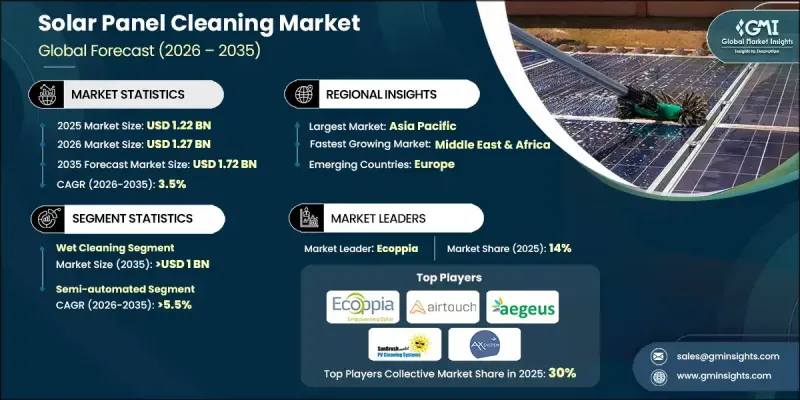
市场成长的驱动力来自于对维持太阳能板最佳性能的需求、清洁技术的进步以及全球大型太阳能发电厂的部署。太阳能板会积聚灰尘、花粉、工业污染物和碎屑,如果不及时清理,会显着降低其效率。清洁解决方案正从人工清洁发展到自主机器人系统、干刷和静电除尘技术。政府支持的研究倡议正在推动防污涂层和机器人清洁技术的创新,在提高效率的同时最大限度地减少对环境的影响。面临水资源短缺的地区,例如中东、北非部分地区、印度和美国西南部,正越来越多地转向无水干式机器人清洁解决方案。永续的清洁方法不仅节约用水,还有助于干旱地区大型太阳能发电厂的运作。占地数百英亩的公用事业规模太阳能发电厂的持续部署,进一步强化了对自动化、高效且环保的清洁解决方案的需求。
| 市场覆盖范围 | |
|---|---|
| 开始年份 | 2025 |
| 预测年份 | 2026-2035 |
| 起始值 | 12.2亿美元 |
| 预测金额 | 17.2亿美元 |
| 复合年增长率 | 3.5% |
预计到2035年,湿式清洗产业规模将达10亿美元。湿式清洗使用水和温和的清洁剂,能够有效去除顽固污垢和其他污染物,例如花粉和工业粉尘。研究表明,在严重污染的条件下,与干式清洗相比,湿式清洗可使面板效率恢復2-5%,这对于维持尖峰时段能源输出至关重要。现代湿式清洗方法越来越多地与自动化系统和智慧水资源管理结合,能够精确施用去离子水,与传统的人工清洗相比,用水量最多可减少90%。这些技术在确保有效维护的同时,也满足了环境永续性和成本效益的目标。
预计到2035年,半自动化太阳能光电发电市场将以5.5%的复合年增长率成长。半自动化系统结合了人工监督和机械工具,为全自动清洁方案提供了高效且经济的替代方案。这些系统,包括电动刷和携带式清洁机,用途广泛,可适应各种面板配置,包括屋顶式、地面式阵列和倾斜式光学模组。半自动化工具兼具高效性和柔软性,能够提供更快、更均匀的清洁效果,使其成为寻求运作可靠性且无需大规模资本投资的中型太阳能电站的理想选择。
预计到2035年,美国太阳能板清洁市场规模将达到1.38亿美元。受大型电站装置量的推动,美国太阳能发电装置容量实现了强劲成长。在降雨量低、多尘的州和地区,污垢造成的效率损失可能超过30%,促使人们对自动化和节水型清洁解决方案的需求日益增长。诸如《通货膨胀控制法案》等政策激励措施鼓励大规模太阳能发电项目的发展和预防性维护计划,间接推动了太阳能板清洁市场的发展。美国市场正优先考虑节水技术、机器人清洁系统和可扩展的维护解决方案,以优化不断增长的太阳能资产的发电效率。
目录
第一章调查方法和范围
第二章执行摘要
第三章业界考察
- 生态系分析
- 原料的供应情况;
- 影响价值链的因素
- 中断
- 监管环境
- 产业影响因素
- 司机
- 产业潜在风险与挑战
- 成长潜力分析
- 波特五力分析
- PESTEL 分析
- 新的机会与趋势
- 投资分析及未来展望
第四章 竞争情势
- 介绍
- 我们按地区分類的市场份额
- 北美洲
- 欧洲
- 亚太地区
- 中东和非洲
- 拉丁美洲
- 策略倡议
- 竞争标竿分析图示
- 战略仪錶板
- 创新与科技趋势
第五章 依技术分類的市场规模及预测(2022-2035年)
- 湿洗
- 半自动
- 自动化
- 水笔
- 其他的
- 干洗
- 静电
- 自动化机器人
- 其他的
第六章 依製程分類的市场规模及预测(2022-2035年)
- 半自动
- 自动化
- 水笔
- 静电
- 自动化机器人
- 其他的
第七章 依营运类型分類的市场规模及预测(2022-2035年)
- 手动的
- 自主
第八章 依应用领域分類的市场规模及预测(2022-2035年)
- 住宅
- 商业的
- 工业和公共产业
第九章 2022-2035年各地区市场规模及预测
- 北美洲
- 我们
- 加拿大
- 墨西哥
- 欧洲
- 英国
- 法国
- 德国
- 义大利
- 俄罗斯
- 西班牙
- 亚太地区
- 中国
- 澳洲
- 印度
- 日本
- 韩国
- 中东和非洲
- 沙乌地阿拉伯
- 阿拉伯聯合大公国
- 土耳其
- 南非
- 埃及
- 拉丁美洲
- 巴西
- 阿根廷
第十章:公司简介
- Aegeus Technologies
- Airtouch Solar
- AX Solar Robot
- Ecoppia
- Greenleap Robotics
- HekaBot
- hyCLEANER GmbH
- IFBOT
- Karcher
- Leopard Dust
- Premier Solar Cleaning, LLC
- Saint Gobain
- Sharp Clean Limited
- Solabot
- SolarCleano
- Sun pure Technology
- SunBrush mobil Gmbh
- Taypro
- Vayu Solar
- Washpanel
The Global Solar Panel Cleaning Market was valued at USD 1.22 billion in 2025 and is estimated to grow at a CAGR of 3.5% to reach USD 1.72 billion by 2035.
Market growth is fueled by the need to maintain optimal solar panel performance, advances in cleaning technologies, and large-scale solar adoption worldwide. Solar panels accumulate dust, pollen, industrial pollutants, and debris, which can significantly reduce efficiency if left unaddressed. Cleaning solutions have evolved from manual washing to autonomous robotic systems, dry-brush methods, and electrostatic dust removal technologies. Government-supported research initiatives promote anti-soiling coatings and robotic cleaning innovations, enhancing efficiency while minimizing environmental impact. Regions facing water scarcity, including the Middle East, parts of North Africa, India, and the southwestern U.S., are increasingly turning to waterless and dry-robotic cleaning solutions. Sustainable cleaning approaches not only conserve water but also support large-scale solar farm operations in arid zones. Rising adoption of utility-scale solar farms, often covering hundreds of acres, further strengthens demand for automated, efficient, and eco-friendly cleaning solutions.
| Market Scope | |
|---|---|
| Start Year | 2025 |
| Forecast Year | 2026-2035 |
| Start Value | $1.22 Billion |
| Forecast Value | $1.72 Billion |
| CAGR | 3.5% |
The wet cleaning segment is forecasted to reach USD 1 billion by 2035. Wet cleaning, using water and mild detergents, effectively removes stubborn debris such as pollen, industrial dust, and other contaminants. Studies indicate that wet cleaning can restore 2-5% more panel efficiency compared to dry methods under heavily soiled conditions, which is critical for maintaining peak energy output. Modern wet cleaning approaches are increasingly integrated with autonomous systems and smart water management, allowing precise application of demineralized water and reducing consumption by up to 90% compared to traditional manual washing. These technologies ensure effective maintenance while aligning with environmental sustainability and cost-efficiency goals.
The semi-automated segment is expected to grow at a CAGR of 5.5% by 2035. Semi-automated systems blend human oversight with mechanized tools, offering an efficient yet cost-effective alternative to fully robotic cleaning solutions. These systems, including motorized brushes and portable cleaning machines, are versatile and adaptable to varied panel layouts such as rooftop installations, ground-mounted arrays, and tilted solar modules. By combining efficiency with flexibility, semi-automated tools deliver faster, more uniform cleaning results, making them ideal for mid-sized solar farms that need operational reliability without large capital investments.
U.S. Solar Panel Cleaning Market is anticipated to reach USD 138 million by 2035. The country experienced robust solar capacity expansion, with utility-scale installations leading the growth. Dust-prone states and regions with low rainfall face efficiency losses exceeding 30% due to soiling, which drives demand for automated and water-efficient cleaning solutions. Incentives from policies such as the Inflation Reduction Act promote large-scale solar development and preventive maintenance programs, indirectly supporting the solar panel cleaning market. The U.S. market emphasizes water-saving technologies, robotic cleaning systems, and scalable maintenance solutions to optimize energy generation from expanding solar assets.
Key players in the Global Solar Panel Cleaning Market include Aegeus Technologies, Airtouch Solar, AX Solar Robot, Ecoppia, Greenleap Robotics, HekaBot, hyCLEANER GmbH, IFBOT, Karcher, Leopard Dust, Premier Solar Cleaning, LLC, Saint Gobain, Sharp Clean Limited, Solabot, SolarCleano, Sun pure Technology, SunBrush mobil GmbH, Taypro, Vayu Solar, and Washpanel. Companies are strengthening their presence by investing in R&D for autonomous robotic cleaners, waterless technologies, and smart sensor integration to optimize cleaning efficiency. Many are expanding service networks for utility-scale solar farms while developing hybrid wet-dry systems for water-sensitive regions. Strategic partnerships with solar developers and EPC contractors enable broader market penetration, while technology licensing agreements accelerate the deployment of innovative cleaning solutions. Additionally, players focus on modular, scalable offerings, enabling mid-sized and large-scale solar projects to adopt sustainable, cost-efficient maintenance systems, solidifying their foothold in a competitive and growing market.
Table of Contents
Chapter 1 Methodology & Scope
- 1.1 Research design
- 1.2 Market estimates & forecast parameters
- 1.3 Forecast calculation
- 1.4 Data sources
- 1.4.1 Primary
- 1.4.2 Secondary
- 1.4.2.1 Paid
- 1.4.2.2 Public
Chapter 2 Executive Summary
- 2.1 Industry synopsis, 2022 - 2035
Chapter 3 Industry Insights
- 3.1 Industry ecosystem analysis
- 3.1.1 Raw material availability landscape
- 3.1.2 Factors affecting the value chain
- 3.1.3 Disruptions
- 3.2 Regulatory landscape
- 3.3 Industry impact forces
- 3.3.1 Growth drivers
- 3.3.2 Industry pitfalls & challenges
- 3.4 Growth potential analysis
- 3.5 Porter's analysis
- 3.5.1 Bargaining power of suppliers
- 3.5.2 Bargaining power of buyers
- 3.5.3 Threat of new entrants
- 3.5.4 Threat of substitutes
- 3.6 PESTEL analysis
- 3.6.1 Political factors
- 3.6.2 Economic factors
- 3.6.3 Social factors
- 3.6.4 Technological factors
- 3.6.5 Legal factors
- 3.6.6 Environmental factors
- 3.7 Emerging opportunities & trends
- 3.8 Investment analysis & future outlook
Chapter 4 Competitive Landscape, 2025
- 4.1 Introduction
- 4.2 Company market share, by region, 2025
- 4.2.1 North America
- 4.2.2 Europe
- 4.2.3 Asia Pacific
- 4.2.4 Middle East & Africa
- 4.2.5 Latin America
- 4.3 Strategic initiatives
- 4.4 Competitive benchmarking depictions
- 4.5 Strategy dashboard
- 4.6 Innovation & technology landscape
Chapter 5 Market Size and Forecast, By Technology, 2022 - 2035 (USD Million)
- 5.1 Key trends
- 5.2 Wet Cleaning
- 5.2.1 Semi-Automated
- 5.2.2 Automated
- 5.2.3 Water Brushes
- 5.2.4 Others
- 5.3 Dry Cleaning
- 5.3.1 Electrostatic
- 5.3.2 Automated Robotic
- 5.3.3 Others
Chapter 6 Market Size and Forecast, By Process, 2022 - 2035 (USD Million)
- 6.1 Key trends
- 6.2 Semi-Automated
- 6.3 Automated
- 6.4 Water Brushes
- 6.5 Electrostatic
- 6.6 Automated Robotic
- 6.7 Others
Chapter 7 Market Size and Forecast, By Mode of Operation, 2022 - 2035 (USD Million)
- 7.1 Key trends
- 7.2 Manual
- 7.3 Autonomous
Chapter 8 Market Size and Forecast, By Application, 2022 - 2035 (USD Million)
- 8.1 Key trends
- 8.2 Residential
- 8.3 Commercial
- 8.4 Industrial & Utility
Chapter 9 Market Size and Forecast, By Region, 2022 - 2035 (USD Million)
- 9.1 Key trends
- 9.2 North America
- 9.2.1 U.S.
- 9.2.2 Canada
- 9.2.3 Mexico
- 9.3 Europe
- 9.3.1 UK
- 9.3.2 France
- 9.3.3 Germany
- 9.3.4 Italy
- 9.3.5 Russia
- 9.3.6 Spain
- 9.4 Asia Pacific
- 9.4.1 China
- 9.4.2 Australia
- 9.4.3 India
- 9.4.4 Japan
- 9.4.5 South Korea
- 9.5 Middle East & Africa
- 9.5.1 Saudi Arabia
- 9.5.2 UAE
- 9.5.3 Turkey
- 9.5.4 South Africa
- 9.5.5 Egypt
- 9.6 Latin America
- 9.6.1 Brazil
- 9.6.2 Argentina
Chapter 10 Company Profiles
- 10.1 Aegeus Technologies
- 10.2 Airtouch Solar
- 10.3 AX Solar Robot
- 10.4 Ecoppia
- 10.5 Greenleap Robotics
- 10.6 HekaBot
- 10.7 hyCLEANER GmbH
- 10.8 IFBOT
- 10.9 Karcher
- 10.10 Leopard Dust
- 10.11 Premier Solar Cleaning, LLC
- 10.12 Saint Gobain
- 10.13 Sharp Clean Limited
- 10.14 Solabot
- 10.15 SolarCleano
- 10.16 Sun pure Technology
- 10.17 SunBrush mobil Gmbh
- 10.18 Taypro
- 10.19 Vayu Solar
- 10.20 Washpanel

 太阳能板清洁系统市场:依自动化程度、清洁方法、电源、最终用户和分销管道划分-2026-2032年全球市场预测
 全球干式自动太阳能板清洗市场规模、份额、趋势和成长分析报告(2026-2034年)智慧太阳能清洁机器人市场按类型、电源、清洁模式、应用、最终用户和分销管道划分-全球预测(2026-2032 年)
 太阳能板清洗市场规模、份额和成长分析(按操作方式、类型、製程、应用和地区划分)—产业预测(2026-2033 年)
 全球太阳能板自动干式清洗市场全球太阳能板自动清洁市场
 太阳能板清洗系统市场 - 成长、未来展望、竞争分析,2025 年至 2033 年
 全球自动太阳能板清洁市场:成长、未来展望与竞争分析(2024-2032 年)
 自动太阳能板清洁市场机会、成长动力、产业趋势分析与预测 2025 - 2034 年
 全球太阳能板清洁市场 2024-2031