


 |
市场调查报告书
商品编码
1936606
有机过氧化物市场机会、成长要素、产业趋势分析及预测(2026年至2035年)Organic Peroxide Market Opportunity, Growth Drivers, Industry Trend Analysis, and Forecast 2026 - 2035 |
||||||

全球有机过氧化物市场预计到 2025 年将达到 23.9 亿美元,到 2035 年将达到 35.9 亿美元,年复合成长率为 4.3%。
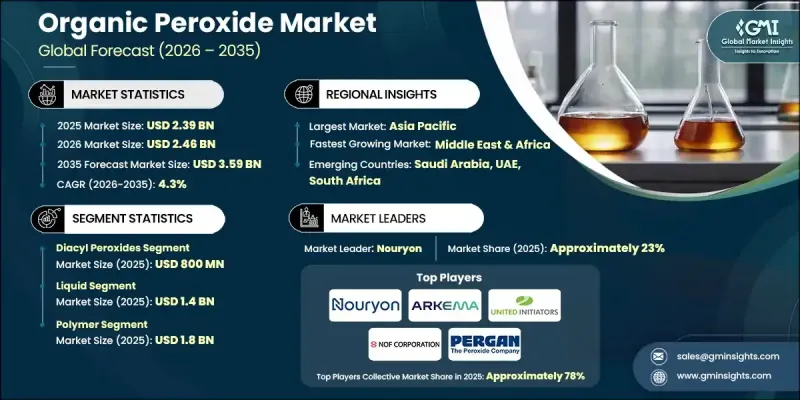
受塑胶和弹性体聚合製程中对有机过氧化物需求不断增长的推动,该行业正经历稳步增长。这些化学物质作为固化剂和催化剂,在聚乙烯、聚丙烯、聚氯乙烯和橡胶的生产中发挥至关重要的作用,而这些产品广泛应用于包装、建筑和消费品行业。聚合物产能的扩张以及高性能复合材料在汽车、航太和可再生能源领域的日益普及,正在推动市场扩张。有机过氧化物对于固化热固性树脂和增强复合材料至关重要,可用于生产轻质、耐用且强度高的零件。电动车、轻量化汽车零件和风力发电应用的发展趋势也显着推动了市场需求。安全操作、定製配方和自动化计量系统的创新也在塑造市场格局,为高价值工业应用创造了机会。
| 市场覆盖范围 | |
|---|---|
| 开始年份 | 2025 |
| 预测年份 | 2026-2035 |
| 起始值 | 23.9亿美元 |
| 预测金额 | 35.9亿美元 |
| 复合年增长率 | 4.3% |
预计到 2025 年,二酰基过氧化物市场规模将达到 8 亿美元,从 2026 年到 2035 年将以 4.4% 的复合年增长率成长。二酰基过氧化物,例如过氧化苯甲酰苯甲酰,广泛用于需要可控引发和可预测反应的製程中,而二烷基过氧化物由于其稳定性和可预测的分解特性,适用于高温操作,从而支持各种过氧化物的持续增长。
预计到2025年,液态有机过氧化物市场规模将达到14亿美元,并在2035年之前以4.4%的复合年增长率持续成长。液态过氧化物在需要精确剂量控制、均匀分散和自动化输送系统的应用中越来越受欢迎。膏状和粉末状过氧化物也用于需要控释和更高安全性的製程中,这反映了聚合物和复合材料製造领域多样化的需求。
2025年,北美有机过氧化物市场规模预计将达6.6亿美元。该地区受益于先进的聚合物生产技术、汽车、建筑和工业市场稳定的需求,以及拥有高安全性和高效率标准的完善化工基础设施。与单纯的销售成长相比,定製配方、更安全的加工技术以及在交联聚合物和热固性复合材料中的应用正日益成为推动市场成长的主要因素。
目录
第一章调查方法
第二章执行摘要
第三章业界考察
- 生态系分析
- 供应商情况
- 利润率
- 每个阶段的附加价值
- 影响价值链的因素
- 中断
- 产业影响因素
- 司机
- 产业潜在风险与挑战
- 市场机会
- 成长潜力分析
- 监管环境
- 北美洲
- 欧洲
- 亚太地区
- 拉丁美洲
- 中东和非洲
- 波特五力分析
- PESTEL 分析
- 价格趋势
- 按地区
- 副产品
- 未来市场趋势
- 科技与创新趋势
- 当前技术趋势
- 新兴技术
- 专利状态
- 贸易统计(註:仅提供主要国家的贸易统计)
- 主要进口国
- 主要出口国
- 永续性和环境方面
- 永续实践
- 减少废弃物策略
- 生产中的能源效率
- 环保倡议
- 碳足迹考量
第四章 竞争情势
- 介绍
- 公司市占率分析
- 按地区
- 北美洲
- 欧洲
- 亚太地区
- 拉丁美洲
- 中东和非洲
- 按地区
- 企业矩阵分析
- 主要市场公司的竞争分析
- 竞争定位矩阵
- 重大进展
- 併购
- 伙伴关係与合作
- 新产品发布
- 业务拓展计划
第五章 按类型分類的市场估算与预测,2022-2035年
- 二酰基过氧化物(例如,过氧化苯甲酰)
- 二烷基过氧化物
- 过氧化物酯
- 氢过氧化物
- 过氧化酮
- 过氧卡特
- 其他(特殊混合)
第六章 按类型分類的市场估算与预测,2022-2035年
- 液体
- 贴上
- 粉末
- 颗粒
第七章 按应用领域分類的市场估算与预测,2022-2035年
- 聚合物
- 聚乙烯
- 聚丙烯
- PVC
- 其他热塑性树脂
- 油漆和黏合剂
- 工业涂料
- 汽车涂料
- 建筑黏合剂
- 密封剂
- 纸张和纺织品
- 漂白
- 纺织加工
- 纸张光泽度提升
- 化妆品
- 护髮产品
- 护肤品
- 口腔护理产品
- 橡皮
- 弹性体的交联
- 硫化工序
- 卫生保健
- 医药中间体
- 医疗设备製造
- 其他的
第八章 2022-2035年各地区市场估算与预测
- 北美洲
- 我们
- 加拿大
- 欧洲
- 德国
- 英国
- 法国
- 义大利
- 西班牙
- 其他欧洲地区
- 亚太地区
- 中国
- 印度
- 日本
- 澳洲
- 韩国
- 亚太其他地区
- 拉丁美洲
- 巴西
- 墨西哥
- 阿根廷
- 其他拉丁美洲地区
- 中东和非洲
- 沙乌地阿拉伯
- 南非
- 阿拉伯聯合大公国
- 其他中东和非洲地区
第九章:公司简介
- Arkema
- United Initiators
- Kawaguchi Chemical Co., Ltd.
- AkzoNobel
- Pergan GmbH
- Nouryon
- NOF Corporation
- BASF
- PeroxyChem
- Solvay
- Evonik Industries
- Mitsubishi Gas Chemical
- DOW
- Huntsman Corporation
The Global Organic Peroxide Market was valued at USD 2.39 billion in 2025 and is estimated to grow at a CAGR of 4.3% to reach USD 3.59 billion by 2035.
The industry is witnessing steady growth driven by rising demand for organic peroxides in polymerization processes for plastics and elastomers. These chemicals are crucial as curing agents and catalysts in the production of polyethylene, polypropylene, PVC, and rubber, which are widely used in packaging, construction, and consumer goods industries. Expanding polymer production capacities and the increasing adoption of high-performance composites in automotive, aerospace, and renewable energy sectors are fueling market expansion. The use of organic peroxides in thermoset resin curing and composite reinforcement is essential for lightweight, durable, and high-strength components. Growing trends in electric vehicles, lightweight automotive parts, and wind energy applications are significantly boosting demand. Innovations in safer handling, tailored formulations, and automated dosing systems are also shaping the market landscape, creating opportunities for high-value industrial applications.
| Market Scope | |
|---|---|
| Start Year | 2025 |
| Forecast Year | 2026-2035 |
| Start Value | $2.39 Billion |
| Forecast Value | $3.59 Billion |
| CAGR | 4.3% |
The diacyl peroxides segment generated USD 800 million in 2025 and is projected to grow at a CAGR of 4.4% from 2026 to 2035. Diacyl peroxides, such as benzoyl peroxide, are widely used in processes requiring controlled initiation and predictable reactions. Meanwhile, dialkyl peroxides are preferred for high-temperature operations due to their stability and predictable decomposition, supporting consistent growth across various peroxide types.
The liquid organic peroxide segment was valued at USD 1.4 billion in 2025 and is anticipated to expand at a CAGR of 4.4% through 2035. Liquid peroxides are increasingly favored in applications that demand precise dosing, uniform dispersion, and automated feeding systems. Paste and powder forms are also utilized in processes requiring controlled release and enhanced safety, reflecting the diverse requirements of polymer and composite manufacturing.
North America Organic Peroxide Market accounted for USD 660 million in 2025. The region benefits from advanced polymer production, steady demand in automotive, construction, and industrial markets, and robust chemical infrastructure with high safety and efficiency standards. Growth is increasingly driven by tailored formulations, safer handling approaches, and applications in cross-linked polymers and thermoset composites rather than purely volume-based expansion.
Key players in the Global Organic Peroxide Market include Nouryon, Arkema, United Initiators, NOF Corporation, Pergan GmbH, and others. Key strategies adopted by companies in the organic peroxide market include investing in research and development to create safer, more efficient, and high-performance peroxide formulations. Firms are focusing on process innovation to enhance automation, improve dosing accuracy, and reduce hazards in handling. Expanding production capacity and establishing regional manufacturing hubs enable companies to cater to rising demand in key markets. Strategic partnerships, collaborations, and supply agreements are being leveraged to strengthen market presence and ensure steady raw material sourcing. Diversification of product portfolios for high-performance polymers, composites, and thermoset applications is also a critical approach. Companies are emphasizing sustainability and regulatory compliance, particularly in reducing environmental impact and aligning with global safety standards, to maintain competitiveness and long-term market leadership.
Table of Contents
Chapter 1 Methodology
- 1.1 Market scope and definition
- 1.2 Research design
- 1.2.1 Research approach
- 1.2.2 Data collection methods
- 1.3 Data mining sources
- 1.3.1 Global
- 1.3.2 Regional/Country
- 1.4 Base estimates and calculations
- 1.4.1 Base year calculation
- 1.4.2 Key trends for market estimation
- 1.5 Primary research and validation
- 1.5.1 Primary sources
- 1.6 Forecast model
- 1.7 Research assumptions and limitations
Chapter 2 Executive Summary
- 2.1 Industry 360° synopsis
- 2.2 Key market trends
- 2.2.1 Regional
- 2.2.2 Type
- 2.2.3 Form
- 2.2.4 Application
- 2.3 TAM Analysis, 2026-2035
- 2.4 CXO perspectives: Strategic imperatives
- 2.4.1 Executive decision points
- 2.4.2 Critical success factors
- 2.5 Future Outlook and Strategic Recommendations
Chapter 3 Industry Insights
- 3.1 Industry ecosystem analysis
- 3.1.1 Supplier Landscape
- 3.1.2 Profit Margin
- 3.1.3 Value addition at each stage
- 3.1.4 Factor affecting the value chain
- 3.1.5 Disruptions
- 3.2 Industry impact forces
- 3.2.1 Growth drivers
- 3.2.2 Industry pitfalls and challenges
- 3.2.3 Market opportunities
- 3.3 Growth potential analysis
- 3.4 Regulatory landscape
- 3.4.1 North America
- 3.4.2 Europe
- 3.4.3 Asia Pacific
- 3.4.4 Latin America
- 3.4.5 Middle East & Africa
- 3.5 Porter's analysis
- 3.6 PESTEL analysis
- 3.7 Price trends
- 3.7.1 By region
- 3.7.2 By product
- 3.8 Future market trends
- 3.9 Technology and Innovation landscape
- 3.9.1 Current technological trends
- 3.9.2 Emerging technologies
- 3.10 Patent Landscape
- 3.11 Trade statistics (Note: the trade statistics will be provided for key countries only)
- 3.11.1 Major importing countries
- 3.11.2 Major exporting countries
- 3.12 Sustainability and Environmental Aspects
- 3.12.1 Sustainable Practices
- 3.12.2 Waste Reduction Strategies
- 3.12.3 Energy Efficiency in Production
- 3.12.4 Eco-friendly Initiatives
- 3.13 Carbon Footprint Considerations
Chapter 4 Competitive Landscape, 2025
- 4.1 Introduction
- 4.2 Company market share analysis
- 4.2.1 By region
- 4.2.1.1 North America
- 4.2.1.2 Europe
- 4.2.1.3 Asia Pacific
- 4.2.1.4 LATAM
- 4.2.1.5 MEA
- 4.2.1 By region
- 4.3 Company matrix analysis
- 4.4 Competitive analysis of major market players
- 4.5 Competitive positioning matrix
- 4.6 Key developments
- 4.6.1 Mergers & acquisitions
- 4.6.2 Partnerships & collaborations
- 4.6.3 New Product Launches
- 4.6.4 Expansion Plans
Chapter 5 Market Estimates and Forecast, By Type, 2022- 2035 (USD Billion, Kilo Tons)
- 5.1 Key trends
- 5.2 Diacyl Peroxides (e.g., benzoyl peroxide)
- 5.3 Dialkyl Peroxides
- 5.4 Peroxyesters
- 5.5 Hydroperoxides
- 5.6 Ketone Peroxides
- 5.7 Peroxyketals
- 5.8 Others (specialty blends)
Chapter 6 Market Estimates and Forecast, By Form, 2022- 2035 (USD Billion, Kilo Tons)
- 6.1 Key trends
- 6.2 Liquid
- 6.3 Paste
- 6.4 Powder
- 6.5 Granules
Chapter 7 Market Estimates and Forecast, By Application, 2022 - 2035 (USD Billion, Kilo Tons)
- 7.1 Key trends
- 7.2 Polymer
- 7.2.1 Polyethylene
- 7.2.2 Polypropylene
- 7.2.3 PVC
- 7.2.4 Other thermoplastics
- 7.3 Coatings & adhesives
- 7.3.1 Industrial coatings
- 7.3.2 Automotive coatings
- 7.3.3 Construction adhesives
- 7.3.4 Sealants
- 7.4 Paper & textiles
- 7.4.1 Bleaching agents
- 7.4.2 Textile finishing
- 7.4.3 Paper brightening
- 7.5 Cosmetics
- 7.5.1 Hair care products
- 7.5.2 Skin care formulations
- 7.5.3 Oral care products
- 7.6 Rubber
- 7.6.1 Crosslinking of elastomers
- 7.6.2 Vulcanization processes
- 7.7 Healthcare
- 7.7.1 Pharmaceutical intermediates
- 7.7.2 Medical device manufacturing
- 7.8 Others
Chapter 8 Market Estimates and Forecast, By Region, 2022 - 2035 (USD Billion, Kilo Tons)
- 8.1 Key trends
- 8.2 North America
- 8.2.1 U.S.
- 8.2.2 Canada
- 8.3 Europe
- 8.3.1 Germany
- 8.3.2 UK
- 8.3.3 France
- 8.3.4 Italy
- 8.3.5 Spain
- 8.3.6 Rest of Europe
- 8.4 Asia Pacific
- 8.4.1 China
- 8.4.2 India
- 8.4.3 Japan
- 8.4.4 Australia
- 8.4.5 South Korea
- 8.4.6 Rest of Asia Pacific
- 8.5 Latin America
- 8.5.1 Brazil
- 8.5.2 Mexico
- 8.5.3 Argentina
- 8.5.4 Rest of Latin America
- 8.6 Middle East & Africa
- 8.6.1 Saudi Arabia
- 8.6.2 South Africa
- 8.6.3 UAE
- 8.6.4 Rest of Middle East & Africa
Chapter 9 Company Profiles
- 9.1 Arkema
- 9.2 United Initiators
- 9.3 Kawaguchi Chemical Co., Ltd.
- 9.4 AkzoNobel
- 9.5 Pergan GmbH
- 9.6 Nouryon
- 9.7 NOF Corporation
- 9.8 BASF
- 9.9 PeroxyChem
- 9.10 Solvay
- 9.11 Evonik Industries
- 9.12 Mitsubishi Gas Chemical
- 9.13 DOW
- 9.14 Huntsman Corporation


