


 |
市场调查报告书
商品编码
1936615
无尘室设备市场机会、成长要素、产业趋势分析及2026年至2035年预测Cleanroom Equipment Market Opportunity, Growth Drivers, Industry Trend Analysis, and Forecast 2026 - 2035 |
||||||

全球无尘室设备市场预计到 2025 年将达到 56 亿美元,到 2035 年将达到 108 亿美元,年复合成长率为 7.5%。
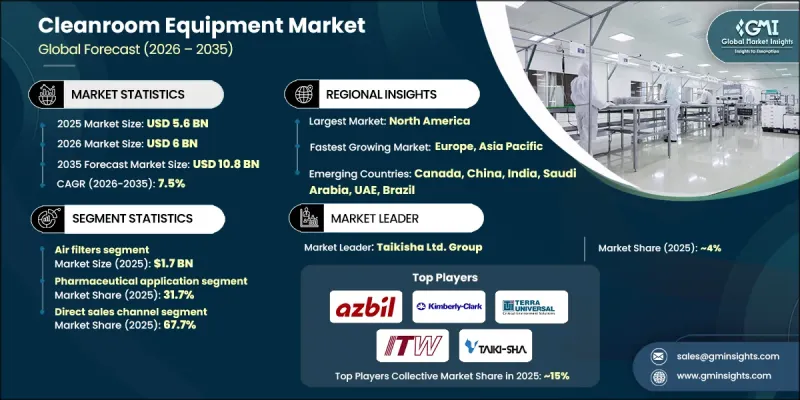
由于全球製药、生物技术和先进治疗方法製造业的扩张,市场正经历快速成长。无菌注射剂、生物製药、疫苗、个人化药物以及细胞和基因疗法的产量增加,显着提升了对受控生产环境的需求。此类生产空间需要配备最先进的空调系统、HEPA 和 ULPA 过滤器、先进的空气调节机以及持续的环境监控。推动成长的另一个关键因素是模组化和灵活洁净室解决方案的日益普及。製造商之所以青睐模组化洁净室,是因为它们安装成本低、部署快捷,并且能够根据不断变化的法规和生产需求扩展生产空间。柔软性快速扩展或重新配置洁净室布局以适应不断增长的产量和法规要求,是其在全球范围内广泛应用的主要驱动力。
| 市场覆盖范围 | |
|---|---|
| 开始年份 | 2025 |
| 预测年份 | 2026-2035 |
| 起始值 | 56亿美元 |
| 预测金额 | 108亿美元 |
| 复合年增长率 | 7.5% |
预计到2025年,空气滤清器市场规模将达到17亿美元,2026年至2035年的复合年增长率将达到7.7%。製药、生物技术、半导体製造和医疗保健行业严格的污染控制法规推动了对高效HEPA和ULPA过滤器的需求。精密电子产品、奈米技术元件和医疗设备的製造业需要超干净的空气环境,这推动了对先进过滤解决方案的需求,无论是新建无尘室还是现有设施的维修,都需要这些解决方案。
截至2025年,直销通路占了67.7%的市场份额,预计到2035年将以7.2%的复合年增长率成长。直销模式使企业能够提供客製化解决方案,例如专用空气处理机组、整合层流系统以及具备即时监控功能的自动化系统。这种模式确保符合GMP、FDA、EMA、ISO和特定产业标准,同时提供来自单一来源的完整文件、验证和资格确认。 OEM製造商透过设计、安装、试运行和全生命週期维护为客户提供支持,最大限度地降低关键无尘室操作中的污染风险和停机时间。
美国洁净室设备市场预计到2025年将达到15亿美元,2026年至2035年的复合年增长率(CAGR)为7.2%。美国强大的製药和生物技术产业,包括生物製药、疫苗、无菌注射和先进治疗方法,正在推动对无尘室设备的稳定需求。对合约研发生产力机构(CDMO)日益增长的依赖,正在加速开发灵活的多产品无尘室设施,进一步促进市场扩张。对先进的暖气、通风和空调(HVAC)、高效能空气微粒过滤器(HEPA/ULPA)、层流空气系统和即时环境监测的投资,是美国市场成长要素。
目录
第一章调查方法和范围
第二章执行摘要
第三章业界考察
- 生态系分析
- 供应商情况
- 利润率
- 每个阶段的附加价值
- 影响价值链的因素
- 产业影响因素
- 司机
- 扩大製药和生物技术製造
- 推出模组化、灵活的无尘室解决方案
- 严格的监管和品质合规要求
- 医疗机构更加重视感染控制
- 产业潜在风险与挑战
- 高资本投资及营运成本
- 能源消耗和永续性
- 司机
- 成长潜力分析
- 未来市场趋势
- 科技与创新趋势
- 当前技术趋势
- 新兴技术
- 价格趋势
- 按地区
- 透过装置
- 监管环境
- 标准和合规要求
- 区域法规结构
- 认证标准
- 贸易统计
- 主要进口国
- 主要出口国
- 波特五力分析
- PESTEL 分析
第四章 竞争情势
- 介绍
- 公司市占率分析
- 按地区
- 北美洲
- 欧洲
- 亚太地区
- 拉丁美洲
- 中东和非洲
- 按地区
- 企业矩阵分析
- 主要市场公司的竞争分析
- 竞争定位矩阵
- 重大进展
- 併购
- 伙伴关係与合作
- 新产品发布
- 扩张计划
第五章 按设备分類的市场估算与预测,2022-2035年
- 空气浴尘室
- 空气过滤器
- 高效能空气过滤器
- ULPA过滤器
- 风机过滤机组
- 吸顶式HEPA过滤器空调机组
- 层流罩
- 水平层流罩
- 垂直层流罩
- 烘干柜
- 不銹钢烘干机柜
- 压克力烘干柜
- 直通
- 化学通风柜
- 洁净室门
- 捲门
- 自动滑动门
- 其他(水槽、檯面、门联锁系统等)
6. 2022-2035年按无尘室类型分類的市场估算与预测
- 传统无尘室
- 模组化洁净室
- 模组化软墙洁净室
- 移动无尘室
- 混合无尘室
7. 2022-2035年按无尘室类型分類的市场估算与预测
- ISO 1至3级
- ISO 4-5级
- ISO 6-7级
- ISO 8-9级
第八章 按应用领域分類的市场估算与预测,2022-2035年
- 製药
- 半导体
- 生物技术
- 医院
- 航太
- 车
- 其他(生命科学、军事设施、研究实验室等)
9. 2022-2035年按分销管道分類的市场估算与预测
- 直销
- 间接销售
第十章 2022-2035年各地区市场估计与预测
- 北美洲
- 我们
- 加拿大
- 欧洲
- 德国
- 英国
- 法国
- 义大利
- 西班牙
- 亚太地区
- 中国
- 印度
- 日本
- 韩国
- 澳洲
- 印尼
- 马来西亚
- 拉丁美洲
- 巴西
- 墨西哥
- 阿根廷
- 中东和非洲
- 沙乌地阿拉伯
- 阿拉伯聯合大公国
- 南非
第十一章 公司简介
- Abtech
- Airomax Airborne LLP
- Alpiq holding AG
- Angstrom Technology
- Ardmac Ltd.
- Azbil Corporation
- Camfil AB Source
- Clean Air Products
- HVAX
- Illinois Tool Works Inc.
- Integrated Cleanroom Technologies Pvt. Ltd.
- Kimberly-Clark Corporation
- Labconco
- M+W Group
- Taikisha Ltd.
- Terra Universal Inc.
The Global Cleanroom Equipment Market was valued at USD 5.6 billion in 2025 and is estimated to grow at a CAGR of 7.5% to reach USD 10.8 billion by 2035.
The market is witnessing rapid growth due to the worldwide expansion of pharmaceutical, biotechnology, and advanced therapy manufacturing. The increasing production of sterile injectables, biologics, vaccines, personalized medicines, and cell and gene therapies has created significant demand for controlled manufacturing environments. These production spaces require state-of-the-art HVAC systems, HEPA and ULPA filtration, advanced air handling units, and continuous environmental monitoring. Another key factor fueling growth is the rising adoption of modular and flexible cleanroom solutions. Manufacturers prefer modular cleanrooms for their lower installation costs, rapid deployment, and ability to scale production spaces according to evolving regulatory or production demands. The flexibility to quickly expand or reconfigure cleanroom layouts to meet increasing output requirements or regulatory compliance is driving strong adoption globally.
| Market Scope | |
|---|---|
| Start Year | 2025 |
| Forecast Year | 2026-2035 |
| Start Value | $5.6 Billion |
| Forecast Value | $10.8 Billion |
| CAGR | 7.5% |
The air filters segment generated USD 1.7 billion in 2025 and is anticipated to grow at a CAGR of 7.7% from 2026 to 2035. Stringent contamination control regulations in pharmaceuticals, biotechnology, semiconductor manufacturing, and healthcare industries are driving demand for high-efficiency HEPA and ULPA filtration. Industries producing sensitive electronics, nanotechnology components, and medical devices require ultra-clean air environments, fueling the need for advanced filtration solutions in both new cleanroom installations and retrofitted facilities.
The direct sales segment held a 67.7% share in 2025 and is expected to grow at a CAGR of 7.2% through 2035. Direct sales allow companies to provide customized solutions such as specialized air handling units, integrated laminar flow systems, and automation with real-time monitoring. This approach ensures compliance with GMP, FDA, EMA, ISO, and industry-specific standards while providing complete documentation, validation, and qualification from a single source. OEMs support customers throughout design, installation, commissioning, and lifecycle maintenance, minimizing contamination risks and downtime in mission-critical cleanroom operations.
U.S. Cleanroom Equipment Market reached USD 1.5 billion in 2025 and is expected to grow at a CAGR of 7.2% from 2026 to 2035. The country's robust pharmaceutical and biotechnology sectors, including biologics, vaccines, sterile injectables, and advanced therapies, drive consistent demand for cleanroom equipment. Increasing reliance on contract development and manufacturing organizations (CDMOs) has accelerated the establishment of multi-product, flexible cleanroom facilities, further supporting market expansion. Investments in advanced HVAC, HEPA/ULPA filtration, laminar airflow systems, and real-time environmental monitoring are key growth drivers in the U.S.
Key players shaping the Global Cleanroom Equipment Market include Abtech, Airomax Airborne LLP, Alpiq Holding AG, Angstrom Technology, Ardmac Ltd., Azbil Corporation, Camfil AB Source, Clean Air Products, HVAX, Illinois Tool Works Inc., Integrated Cleanroom Technologies Pvt. Ltd., Kimberly-Clark Corporation, Labconco, M + W Group, Taikisha Ltd., and Terra Universal Inc. Companies in the cleanroom equipment market strengthen their presence by focusing on product innovation, regulatory compliance, and turnkey solutions. Providers develop modular, scalable, and energy-efficient cleanroom systems to meet evolving industry needs. Strategic collaborations with pharmaceutical, biotech, and semiconductor manufacturers allow co-development of customized solutions. Expanding distribution networks across emerging and established markets improves accessibility, while strong after-sales and maintenance services reinforce customer trust.
Table of Contents
Chapter 1 Methodology & Scope
- 1.1 Market scope and definition
- 1.2 Research design
- 1.2.1 Research approach
- 1.2.2 Data collection methods
- 1.3 Data mining sources
- 1.3.1 Global
- 1.3.2 Regional/Country
- 1.4 Base estimates and calculations
- 1.4.1 Base year calculation
- 1.4.2 Key trends for market estimation
- 1.5 Primary research and validation
- 1.5.1 Primary sources
- 1.6 Forecast model
- 1.7 Research assumptions and limitations
Chapter 2 Executive Summary
- 2.1 Industry 360° synopsis
- 2.2 Key market trends
- 2.2.1 Regional
- 2.2.2 Equipment
- 2.2.3 Type of cleanroom
- 2.2.4 Cleanroom classification
- 2.2.5 Application
- 2.2.6 Distribution channel
- 2.3 CXO perspectives: Strategic imperatives
- 2.3.1 Key decision points for industry executives
- 2.3.2 Critical success factors for market players
- 2.4 Future outlook and strategic recommendations
Chapter 3 Industry Insights
- 3.1 Industry ecosystem analysis
- 3.1.1 Supplier landscape
- 3.1.2 Profit margin
- 3.1.3 Value addition at each stage
- 3.1.4 Factor affecting the value chain
- 3.2 Industry impact forces
- 3.2.1 Growth drivers
- 3.2.1.1 Expanding pharmaceutical & biotechnology manufacturing
- 3.2.1.2 Adoption of modular & flexible cleanroom solutions
- 3.2.1.3 Stringent regulatory & quality compliance requirements
- 3.2.1.4 Increasing focus on infection control in healthcare facilities
- 3.2.2 Industry pitfalls & challenges
- 3.2.2.1 High capital expenditure & operating costs
- 3.2.2.2 Energy consumption & sustainability constraints
- 3.2.1 Growth drivers
- 3.3 Growth potential analysis
- 3.4 Future market trends
- 3.5 Technology and innovation landscape
- 3.5.1 Current technological trends
- 3.5.2 Emerging technologies
- 3.6 Price trends
- 3.6.1 By region
- 3.6.2 By equipment
- 3.7 Regulatory landscape
- 3.7.1 Standards and compliance requirements
- 3.7.2 Regional regulatory frameworks
- 3.7.3 Certification standards
- 3.8 Trade statistics
- 3.8.1 Major importing countries
- 3.8.2 Major exporting countries
- 3.9 Porter's analysis
- 3.10 PESTEL analysis
Chapter 4 Competitive Landscape, 2025
- 4.1 Introduction
- 4.2 Company market share analysis
- 4.2.1 By Region
- 4.2.1.1 North America
- 4.2.1.2 Europe
- 4.2.1.3 Asia Pacific
- 4.2.1.4 Latin America
- 4.2.1.5 Middle East & Africa
- 4.2.1 By Region
- 4.3 Company matrix analysis
- 4.4 Competitive analysis of major market players
- 4.5 Competitive positioning matrix
- 4.6 Key developments
- 4.6.1 Mergers & acquisitions
- 4.6.2 Partnerships & collaborations
- 4.6.3 New product launches
- 4.6.4 Expansion plans
Chapter 5 Market Estimates & Forecast, By Equipment, 2022 - 2035, (USD Billion) (Thousand Units)
- 5.1 Key trends
- 5.2 Air showers
- 5.3 Air filters
- 5.3.1 HEPA filter
- 5.3.2 ULPA filter
- 5.3.3 Fan filter unit
- 5.3.4 Ceiling HEPA filter AC unit
- 5.4 Laminar flow hood
- 5.4.1 Horizontal laminar flow hood
- 5.4.2 Vertical laminar flow hood
- 5.5 Desiccator cabinet
- 5.5.1 Stainless steel desiccator cabinet
- 5.5.2 Acrylic desiccator cabinet
- 5.6 Pass through
- 5.7 Chemical fume hood
- 5.8 Cleanroom doors
- 5.8.1 Roll up doors
- 5.8.2 Automatic sliding doors
- 5.9 Others (sink, bench, door interlock system, etc.)
Chapter 6 Market Estimates & Forecast, By Type of Cleanroom, 2022 - 2035, (USD Billion) (Thousand Units)
- 6.1 Key trends
- 6.2 Traditional cleanroom
- 6.3 Modular cleanroom
- 6.4 Modular softwall cleanrooms
- 6.5 Mobile cleanrooms
- 6.6 Hybrid cleanrooms
Chapter 7 Market Estimates & Forecast, By Cleanroom Classification, 2022 - 2035, (USD Billion) (Thousand Units)
- 7.1 Key trends
- 7.2 ISO Class 1-3
- 7.3 ISO Class 4-5
- 7.4 ISO Class 6-7
- 7.5 ISO Class 8-9
Chapter 8 Market Estimates & Forecast, By Application, 2022 - 2035, (USD Billion) (Thousand Units)
- 8.1 Key trends
- 8.2 Pharmaceutical
- 8.3 Semiconductors
- 8.4 Biotechnology
- 8.5 Hospital
- 8.6 Aerospace
- 8.7 Automotive
- 8.8 Others (Life sciences, Military facilities, Research laboratories, etc.)
Chapter 9 Market Estimates & Forecast, By Distribution Channel, 2022 - 2035, (USD Billion) (Thousand Units)
- 9.1 Key trends
- 9.2 Direct sales
- 9.3 Indirect sales
Chapter 10 Market Estimates & Forecast, By Region, 2022 - 2035, (USD Billion) (Thousand Units)
- 10.1 Key trends
- 10.2 North America
- 10.2.1 U.S.
- 10.2.2 Canada
- 10.3 Europe
- 10.3.1 Germany
- 10.3.2 UK
- 10.3.3 France
- 10.3.4 Italy
- 10.3.5 Spain
- 10.4 Asia Pacific
- 10.4.1 China
- 10.4.2 India
- 10.4.3 Japan
- 10.4.4 South Korea
- 10.4.5 Australia
- 10.4.6 Indonesia
- 10.4.7 Malaysia
- 10.5 Latin America
- 10.5.1 Brazil
- 10.5.2 Mexico
- 10.5.3 Argentina
- 10.6 MEA
- 10.6.1 Saudi Arabia
- 10.6.2 UAE
- 10.6.3 South Africa
Chapter 11 Company Profiles
- 11.1 Abtech
- 11.2 Airomax Airborne LLP
- 11.3 Alpiq holding AG
- 11.4 Angstrom Technology
- 11.5 Ardmac Ltd.
- 11.6 Azbil Corporation
- 11.7 Camfil AB Source
- 11.8 Clean Air Products
- 11.9 HVAX
- 11.10 Illinois Tool Works Inc.
- 11.11 Integrated Cleanroom Technologies Pvt. Ltd.
- 11.12 Kimberly-Clark Corporation
- 11.13 Labconco
- 11.14 M + W Group
- 11.15 Taikisha Ltd.
- 11.16 Terra Universal Inc.

 全球无尘室设备市场规模、份额、趋势和成长分析报告(2026-2034年)
 2026年全球无尘室设备市场报告
 全球无尘室设备市场
 美国商用无尘室设备市场评估:依产品类型、最终用户、地区、机会、预测(2017-2031)