


 |
市场调查报告书
商品编码
1936634
船舶装卸机市场成长机会、成长要素、产业趋势分析及2026年至2035年预测Ship Loader and Unloader Market Opportunity, Growth Drivers, Industry Trend Analysis, and Forecast 2026 - 2035 |
||||||

全球船舶装卸设备市场预计到 2025 年将达到 437 亿美元,到 2035 年将达到 708 亿美元,年复合成长率为 5%。
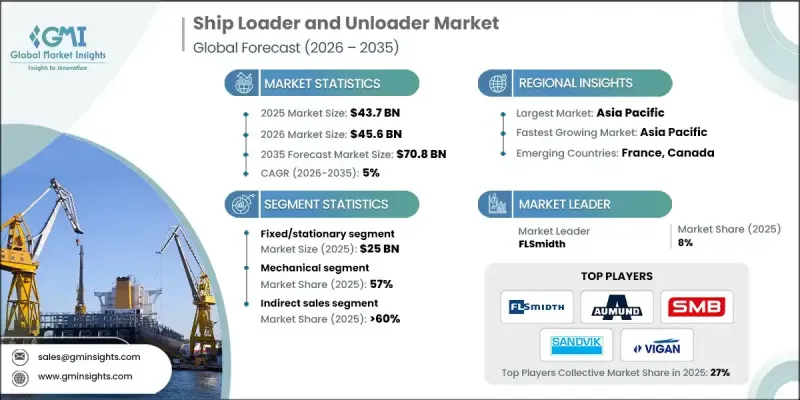
国际贸易的不断扩张,尤其是对煤炭、铁矿石、粮食和化肥等大宗商品需求的日益增长,推动了对高容量装卸解决方案的需求。港口面临着高效处理更大货运量的压力,促使营运商采用自动化和先进的设备。大型船舶的出现以及对快速装卸的更高期望,使得高性能係统成为现代港口运作的必要条件。全球化和新兴市场的崛起进一步凸显了可靠的散装物料输送基础设施的重要性。此外,营运商正在采用物联网感测器、预测性维护演算法和远端监控等数位化和智慧技术,以优化营运效率、减少停机时间、降低成本,同时提高全球港口设施的安全标准和可靠性。
| 市场覆盖范围 | |
|---|---|
| 开始年份 | 2025 |
| 预测年份 | 2026-2035 |
| 起始值 | 437亿美元 |
| 预测金额 | 708亿美元 |
| 复合年增长率 | 5% |
市场正日益采用环保节能的系统。电动和混合动力装卸船机正在研发中,旨在减少碳排放并符合国际环境法规。最新的设备整合了自动化和人工智慧工具,以提高效能并最大限度地减少人工操作,使港口能够在满足不断增长的吞吐量需求的同时,保持永续性。
预计到2025年,固定式装船机市场规模将达250亿美元。大规模港口作业者青睐固定式装船机,因为它们吞吐量高、经久耐用,并且能够处理连续的散装物料流。其坚固的设计确保了长期可靠性和最小的停机时间,儘管初始投资较高,但从整个设备生命週期来看,它们仍然具有成本效益。
预计2025年,机械式物料输送系统将占据57%的市场。机械式系统凭藉其在散装物料处理方面久经考验的可靠性、适应性和成本效益而占据主导地位。这些系统采用输送带、螺旋输送机和斗式提昇机等设备,广泛应用于港口,用于处理煤炭、矿物和谷物。它们能够以极低的能耗处理大批量作业,因此成为大型设施的首选。
预计到2025年,亚太地区船舶装卸设备市场将占据全球40%的市场份额,并在2026年至2035年间以5.3%的复合年增长率成长。中国凭藉其庞大的港口基础设施和国际贸易中的强大地位,引领着该地区的市场发展。快速的工业化进程、庞大的出口量以及对先进货物装卸系统的持续投资,都在推动市场需求。策略性的港口现代化计画和自动化技术的应用进一步巩固了市场地位。此外,监管合规和环境永续性措施也推动了节能抑尘设备的普及应用。
目录
第一章调查方法和范围
第二章执行摘要
第三章业界考察
- 生态系分析
- 供应商情况
- 利润率
- 每个阶段的附加价值
- 影响价值链的因素
- 产业影响因素
- 司机
- 全球贸易及散装物料物料输送不断拓展
- 自动化和技术进步
- 环境法规与永续性目标
- 产业潜在风险与挑战
- 高昂的资本投资和维护成本
- 港口的空间和基础设施限制
- 机会
- 新兴经济体扩张与新港口开发
- 引入绿色节能解决方案
- 司机
- 成长潜力分析
- 未来市场趋势
- 科技与创新趋势
- 当前技术趋势
- 新兴技术
- 价格趋势
- 按地区
- 按作业系统
- 监管环境
- 标准和合规要求
- 区域法规结构
- 认证标准
- 波特五力分析
- PESTEL 分析
第四章 竞争情势
- 介绍
- 公司市占率分析
- 按地区
- 企业矩阵分析
- 主要市场公司的竞争分析
- 竞争定位矩阵
- 重大进展
- 併购
- 伙伴关係与合作
- 新产品发布
- 扩张计划
第五章 依产品类型分類的市场估算与预测,2022-2035年
- 固定/固定类型
- 移动的
第六章 按技术分類的市场估计与预测,2022-2035年
- 自动的
- 机械的
- 气动
第七章 2022-2035年散装市场估算与预测
- 干型
- 液体
第八章 依产能分類的市场估计与预测,2022-2035年
- 5000吨/小时或更少
- 每小时5000吨至10000吨
- 每小时10,000吨至20,000吨
- 超过2万吨/小时
第九章 按应用领域分類的市场估算与预测,2022-2035年
- 矿业
- 港口/航运
- 建造
- 机器
- 其他(发电厂业等)
第十章 按分销管道分類的市场估算与预测,2022-2035年
- 直销
- 间接销售
第十一章 2022-2035年各地区市场估计与预测
- 北美洲
- 我们
- 加拿大
- 欧洲
- 德国
- 英国
- 法国
- 义大利
- 西班牙
- 亚太地区
- 中国
- 日本
- 印度
- 澳洲
- 韩国
- 拉丁美洲
- 巴西
- 墨西哥
- 阿根廷
- 中东和非洲
- 南非
- 沙乌地阿拉伯
- 阿拉伯聯合大公国
第十二章:公司简介
- AMECO
- AUMUND
- BEUMER
- Buhler
- Dana
- EMS-Tech
- FAM Forderanlagen Magdeburg
- FLSmidth
- Liebherr
- NEUERO
- Sandvik
- Shanghai Zhenhua Heavy Industries
- SMB
- TAKRAF
- VIGAN Engineering
The Global Ship Loader and Unloader Market was valued at USD 43.7 billion in 2025 and is estimated to grow at a CAGR of 5% to reach USD 70.8 billion by 2035.
The expansion of international trade, particularly in bulk commodities like coal, iron ore, grains, and fertilizers, is driving demand for high-capacity loading and unloading solutions. Ports are facing increasing pressure to handle larger shipments efficiently, prompting operators to adopt automated and technologically advanced equipment. Larger vessels and faster turnaround expectations have made high-performance systems essential for modern port operations. The rise of globalization and emerging markets further emphasizes the need for reliable bulk material handling infrastructure. Additionally, operators are embracing digital and smart technologies, including IoT-enabled sensors, predictive maintenance algorithms, and remote monitoring, which optimize operational efficiency, reduce downtime, and lower costs while improving safety standards and reliability across port facilities worldwide.
| Market Scope | |
|---|---|
| Start Year | 2025 |
| Forecast Year | 2026-2035 |
| Start Value | $43.7 Billion |
| Forecast Value | $70.8 Billion |
| CAGR | 5% |
The market is witnessing a growing adoption of eco-friendly and energy-efficient systems. Electric and hybrid ship loaders and unloaders are increasingly developed to reduce carbon emissions and comply with international environmental regulations. Modern equipment integrates automation and AI-powered tools to enhance performance and minimize manual intervention, helping ports maintain sustainability while meeting rising throughput demands.
The fixed/stationary segment generated USD 25 billion in 2025. Fixed ship loaders and unloaders are preferred in large-scale port operations due to their high capacity, durability, and ability to handle continuous bulk material flow. Their robust design ensures long-term reliability and minimal downtime, making them cost-efficient over the lifecycle of the equipment despite higher initial investment.
The mechanical segment accounted for 57% share in 2025. Mechanical systems dominate due to their proven dependability, adaptability, and cost-effectiveness in handling bulk materials. Utilizing conveyor belts, screw conveyors, and bucket elevators, these systems are extensively deployed in ports for coal, mineral, and grain handling. Their ability to manage high-volume operations with minimal energy consumption makes them the preferred choice for large facilities.
Asia Pacific Ship Loader and Unloader Market held 40% share in 2025 and is expected to grow at a CAGR of 5.3% from 2026 to 2035. China leads the region due to its vast port infrastructure and strong position in international trade. Rapid industrialization, high export volumes, and continuous investment in advanced cargo handling systems are driving demand. Strategic port modernization initiatives and automation adoption further strengthen the market. Additionally, regulatory compliance and environmental sustainability measures encourage the use of energy-efficient and dust-suppressing equipment.
Major companies operating in the Global Ship Loader and Unloader Market include AMECO, AUMUND, BEUMER, Dana, Buhler, FLSmidth, EMS-Tech, FAM Forderanlagen Magdeburg, Liebherr, NEUERO, Sandvik, Shanghai Zhenhua Heavy Industries, TAKRAF, SMB, and VIGAN Engineering. Companies in the ship loader and unloader market focus on innovation, sustainability, and strategic expansion to reinforce their presence. They invest in R&D to develop high-capacity, automated, and eco-friendly systems that meet global trade demands and regulatory requirements. Collaborations with port operators and technology partners help integrate smart monitoring and predictive maintenance solutions, enhancing operational efficiency. Market players also expand geographically by targeting emerging markets with growing industrial trade and port infrastructure.
Table of Contents
Chapter 1 Methodology and Scope
- 1.1 Market scope and definition
- 1.2 Research design
- 1.2.1 Research approach
- 1.2.2 Data collection methods
- 1.3 Data mining sources
- 1.3.1 Global
- 1.3.2 Regional/Country
- 1.4 Base estimates and calculations
- 1.4.1 Base year calculation
- 1.4.2 Key trends for market estimation
- 1.5 Primary research and validation
- 1.5.1 Primary sources
- 1.6 Forecast model
- 1.7 Research assumptions and limitations
Chapter 2 Executive Summary
- 2.1 Industry 360° synopsis
- 2.2 Key market trends
- 2.2.1 Regional
- 2.2.2 Type
- 2.2.3 Technology
- 2.2.4 Bulk
- 2.2.5 Capacity
- 2.2.6 Application
- 2.2.7 Distribution channel
- 2.3 CXO perspectives: Strategic imperatives
- 2.3.1 Key decision points for industry executives
- 2.3.2 Critical success factors for market players
- 2.4 Future outlook and strategic recommendations
Chapter 3 Industry Insights
- 3.1 Industry ecosystem analysis
- 3.1.1 Supplier landscape
- 3.1.2 Profit margin
- 3.1.3 Value addition at each stage
- 3.1.4 Factor affecting the value chain
- 3.2 Industry impact forces
- 3.2.1 Growth drivers
- 3.2.1.1 Rising global trade and bulk material handling
- 3.2.1.2 Automation and technological advancements
- 3.2.1.3 Environmental regulations and sustainability goals
- 3.2.2 Industry pitfalls & challenges
- 3.2.2.1 High capital investment and maintenance costs
- 3.2.2.2 Space and infrastructure limitations at ports
- 3.2.3 Opportunities
- 3.2.3.1 Expansion of emerging economies and new port developments
- 3.2.3.2 Adoption of eco-friendly and energy-efficient solutions
- 3.2.1 Growth drivers
- 3.3 Growth potential analysis
- 3.4 Future market trends
- 3.5 Technology and innovation landscape
- 3.5.1 Current technological trends
- 3.5.2 Emerging technologies
- 3.6 Price trends
- 3.6.1 By region
- 3.6.2 By operating system
- 3.7 Regulatory landscape
- 3.7.1 Standards and compliance requirements
- 3.7.2 Regional regulatory frameworks
- 3.7.3 Certification standards
- 3.8 Porter's analysis
- 3.9 PESTEL analysis
Chapter 4 Competitive Landscape, 2025
- 4.1 Introduction
- 4.2 Company market share analysis
- 4.2.1 By region
- 4.2.1.1 North America
- 4.2.1.2 Europe
- 4.2.1.3 Asia Pacific
- 4.2.1.4 Latin America
- 4.2.1.5 Middle East and Africa
- 4.2.1 By region
- 4.3 Company matrix analysis
- 4.4 Competitive analysis of major market players
- 4.5 Competitive positioning matrix
- 4.6 Key developments
- 4.6.1 Mergers & acquisitions
- 4.6.2 Partnerships & collaborations
- 4.6.3 New product launches
- 4.6.4 Expansion plans
Chapter 5 Market Estimates and Forecast, By Product Type, 2022 - 2035 (USD Billion) (Thousand Units)
- 5.1 Key trends
- 5.2 Fixed/stationary
- 5.3 Mobile
Chapter 6 Market Estimates and Forecast, By Technology, 2022 - 2035 (USD Billion) (Thousand Units)
- 6.1 Key trends
- 6.2 Automatic
- 6.3 Mechanical
- 6.4 Pneumatic
Chapter 7 Market Estimates and Forecast, By Bulk, 2022 - 2035 (USD Billion) (Thousand Units)
- 7.1 Key trends
- 7.2 Dry
- 7.3 Liquid
Chapter 8 Market Estimates and Forecast, By Capacity, 2022 - 2035 (USD Billion) (Thousand Units)
- 8.1 Key trends
- 8.2 Up to 5000 t/h
- 8.3 5000 t/h to 10,000 t/h
- 8.4 10,000 t/h to 20,000 t/h
- 8.5 Above 20,000 t/h
Chapter 9 Market Estimates and Forecast, By Application, 2022 - 2035 (USD Billion) (Thousand Units)
- 9.1 Key trends
- 9.2 Mining
- 9.3 Ports and Shipping
- 9.4 Construction
- 9.5 Machinery
- 9.6 Others (power plant industry, etc.)
Chapter 10 Market Estimates and Forecast, By Distribution Channel, 2022 - 2035 (USD Billion) (Thousand Units)
- 10.1 Key trends
- 10.2 Direct sales
- 10.3 Indirect sales
Chapter 11 Market Estimates and Forecast, By Region, 2022 - 2035 (USD Billion) (Thousand Units)
- 11.1 Key trends
- 11.2 North America
- 11.2.1 U.S.
- 11.2.2 Canada
- 11.3 Europe
- 11.3.1 Germany
- 11.3.2 UK
- 11.3.3 France
- 11.3.4 Italy
- 11.3.5 Spain
- 11.4 Asia Pacific
- 11.4.1 China
- 11.4.2 Japan
- 11.4.3 India
- 11.4.4 Australia
- 11.4.5 South Korea
- 11.5 Latin America
- 11.5.1 Brazil
- 11.5.2 Mexico
- 11.5.3 Argentina
- 11.6 Middle East and Africa
- 11.6.1 South Africa
- 11.6.2 Saudi Arabia
- 11.6.3 UAE
Chapter 12 Company Profiles
- 12.1 AMECO
- 12.2 AUMUND
- 12.3 BEUMER
- 12.4 Buhler
- 12.5 Dana
- 12.6 EMS-Tech
- 12.7 FAM Forderanlagen Magdeburg
- 12.8 FLSmidth
- 12.9 Liebherr
- 12.10 NEUERO
- 12.11 Sandvik
- 12.12 Shanghai Zhenhua Heavy Industries
- 12.13 SMB
- 12.14 TAKRAF
- 12.15 VIGAN Engineering


