


 |
市场调查报告书
商品编码
1936636
双离合器变速箱市场机会、成长要素、产业趋势分析及预测(2026年至2035年)Dual Clutch Transmission Market Opportunity, Growth Drivers, Industry Trend Analysis, and Forecast 2026 - 2035 |
||||||

全球双离合器变速箱市场预计到 2025 年将达到 249 亿美元,到 2035 年将达到 427 亿美元,年复合成长率为 5.6%。
双离合器变速箱(DCT)是一种先进的变速箱系统,能够提供快速平顺的换檔。它们最初在豪华车和高性能车领域广受欢迎,如今也越来越多地被商用车和部分摩托车所采用。其广泛应用主要源自于对更高燃油效率、更平顺的加速性能和更佳驾驶动态性能的需求。製造商正在将DCT整合到混合动力汽车动力和智慧互联联网汽车平台中,同时增加对轻量化材料和先进控制系统的投入,以优化扭矩控制并降低能量损失。湿式和干式离合器的设计也在不断改进,以提升温度控管、耐久性和成本效益。与车辆诊断系统的软体整合也顺应了自动驾驶和高性能汽车的发展趋势。这些发展使DCT成为现代汽车创新的关键技术,弥合了全球市场在性能、效率和永续性之间的差距。
| 市场覆盖范围 | |
|---|---|
| 开始年份 | 2025 |
| 预测年份 | 2026-2035 |
| 起始值 | 249亿美元 |
| 预测金额 | 427亿美元 |
| 复合年增长率 | 5.6% |
预计到2025年,湿式双离合器变速箱(DCT)市占率将达55%,营收将达140亿美元。湿式双离合器变速箱采用油润滑离合器,因此是高扭力、高性能车辆的首选。这种设计即使在交通拥挤和恶劣条件下,也能提高散热性能、可靠性和行驶性能。
预计到2025年,7速变速箱市占率将达到52.7%,到2035年市场规模将达到223亿美元。这类变速箱兼顾了效率、驾驶性能和可靠性,能够提供平顺的加速和精准的扭力控制。中型轿车、掀背车和紧凑型SUV通常采用7速双离合器变速箱(DCT),这种变速箱在提供最佳性能的同时,避免了8速变速箱的复杂性。
预计到 2035 年,北美双离合器变速箱市场规模将达到 52 亿美元,2026 年至 2035 年的复合年增长率为 5.2%。该地区强大的汽车产业基础、主要汽车製造商的存在以及高性能汽车日益普及,正在推动对双离合器变速箱的需求,尤其是在高端汽车和跑车领域。
目录
第一章调查方法
第二章执行摘要
第三章业界考察
- 生态系分析
- 供应商情况
- 利润率
- 成本结构
- 每个阶段的附加价值
- 影响价值链的因素
- 中断
- 产业影响因素
- 司机
- 全球乘用车产量扩张
- 自动和半自动变速箱越来越受欢迎
- 双离合器变速箱在高檔车和跑车领域拥有强大的市场渗透率。
- 混合动力汽车中双离合器变速箱(DCT)的广泛应用
- 产业潜在风险与挑战
- 电池式电动车(BEV)越来越受欢迎
- 设计与製造的复杂性
- 市场机会
- 双离合器变速箱在混合动力传动系统中的应用日益广泛
- 紧凑型和中型车对双离合器变速箱(DCT)的需求不断增长
- 新兴汽车市场的拓展机会
- OEM合作与策略伙伴关係
- 司机
- 成长潜力分析
- 监管环境
- 北美洲
- 美国国家公路交通安全管理局(NHTSA)
- 美国环保署(EPA)
- 加拿大机动车辆安全标准(运输部)
- 欧洲
- 欧洲标准化委员会(CEN)
- 欧盟车辆类型认证机构
- 欧洲环境署(EEA)
- 亚太地区
- 中国国家标准(GB/国家标准)
- 印度汽车研究协会(ARAI)
- 日本汽车标准国际化中心(JASIC)
- 拉丁美洲
- 南方共同市场汽车法规结构(南方共同市场)
- 巴西国家交通运输局(DENATRAN/Contran)
- 中东和非洲
- 波湾合作理事会(GCC)标准组织(GSO)
- 南非标准局 (SABS)
- 沙乌地阿拉伯标准、计量和品质组织(SASO)
- 北美洲
- 波特五力分析
- PESTEL 分析
- 技术与创新展望
- 当前技术趋势
- 新兴技术
- 价格趋势
- 按地区
- 副产品
- 生产统计
- 生产基地
- 消费基础
- 出口和进口
- 成本細項分析
- 永续性和环境影响
- 环境影响评估
- 社会影响力和社区服务
- 公司管治与企业社会责任
- 永续金融与投资趋势
- DCT架构与设计分析
- 单轴与双轴DCT配置
- 湿式和干式离合器设计的权衡取舍
- 包装限制和车辆整合挑战
- 温度控管和润滑系统设计
- 电气化和电动车普及的影响
- 纯电动车架构对直流变频技术需求的影响
- 混合动力汽车对双离合器变速箱(DCT)系统的持续需求
- 插电式混合动力车与双离合器变速箱融合趋势
- 区域电动车转型对双离合器变速箱(DCT)普及的影响
- 案例研究
- 未来前景与机会
第四章 竞争情势
- 介绍
- 公司市占率分析
- 北美洲
- 欧洲
- 亚太地区
- 拉丁美洲
- 中东和非洲
- 主要市场公司的竞争分析
- 竞争定位矩阵
- 战略展望矩阵
- 重大进展
- 併购
- 伙伴关係与合作
- 新产品发布
- 企业扩张计画和资金筹措
第五章 2022-2035年按产品分類的市场估算与预测
- 湿式双离合器变速箱
- 干式双离合器变速箱
第六章 依传输速度分類的市场估算与预测,2022-2035年
- 6速或更低
- 7速
- 8 个或更多檔位
第七章动力传动系统市场估算与预测,2022-2035年
- 内燃机(ICE)
- 杂交种
- HEV
- PHEV
第八章 按车辆类型分類的市场估算与预测,2022-2035年
- 搭乘用车
- 掀背车
- 轿车
- SUV
- 商用车辆
- 轻型商用车(LCV)
- MCV
- 重型商用车(HCV)
- 跑车
- 摩托车
第九章 依销售管道分類的市场估计与预测,2022-2035年
- OEM
- 售后市场
第十章 2022-2035年各地区市场估计与预测
- 北美洲
- 我们
- 加拿大
- 欧洲
- 德国
- 英国
- 法国
- 义大利
- 西班牙
- 俄罗斯
- 捷克共和国
- 比利时
- 荷兰
- 亚太地区
- 中国
- 印度
- 日本
- 韩国
- 澳洲
- 新加坡
- 马来西亚
- 印尼
- 越南
- 泰国
- 拉丁美洲
- 巴西
- 墨西哥
- 阿根廷
- 哥伦比亚
- 中东和非洲
- 南非
- 沙乌地阿拉伯
- 阿拉伯聯合大公国
第十一章 公司简介
- 世界公司
- ZF Friedrichshafen
- Magna
- Volkswagen
- BorgWarner
- Schaeffler
- Aisin Seiki
- Continental
- Eaton
- Ricardo
- TREMEC
- Stellantis
- General Motors
- Ford Motor
- Honda Motor
- Renault
- Porsche
- 当地公司
- Valeo
- GKN Automotive
- Punch Powertrain
- Hofer Powertrain
- Hyundai
- 新兴企业
- Divgi TorqTransfer Systems
- Guangzhou Jiake Automatic Transmission
- Bosch
- NRB Bearings
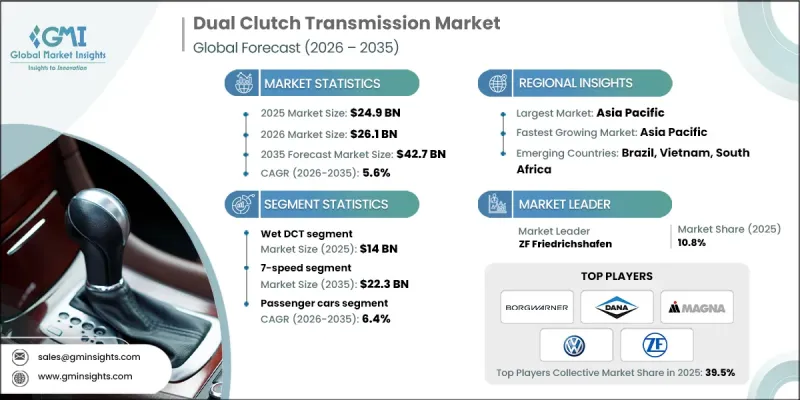
The Global Dual Clutch Transmission Market was valued at USD 24.9 billion in 2025 and is estimated to grow at a CAGR of 5.6% to reach USD 42.7 billion by 2035.
DCTs are advanced transmission systems that offer rapid, seamless gear shifts, initially popularized in premium passenger cars and high-performance vehicles, and gradually expanding into commercial vehicles and select motorcycles. Their growing adoption is driven by the pursuit of better fuel efficiency, smoother acceleration, and improved driving dynamics. Manufacturers are increasingly integrating DCTs with hybrid and connected vehicle platforms, while investing in lightweight materials and advanced control systems to optimize torque handling and reduce energy loss. Wet and dry clutch designs are enhanced for heat management, durability, and cost efficiency, while software integration with vehicle diagnostics supports trends in autonomous and performance-oriented vehicles. These developments position DCTs as a key technology for modern automotive innovation, bridging performance, efficiency, and sustainability demands across global markets.
| Market Scope | |
|---|---|
| Start Year | 2025 |
| Forecast Year | 2026-2035 |
| Start Value | $24.9 Billion |
| Forecast Value | $42.7 Billion |
| CAGR | 5.6% |
The wet DCT segment held 55% share, generating USD 14 billion in 2025. Wet dual clutch transmissions are preferred for high-torque and performance vehicles due to their oil-lubricated clutches, which improve heat dissipation, reliability, and performance under heavy traffic and extreme conditions.
The 7-speed segment accounted for 52.7% in 2025 and is expected to reach USD 22.3 billion by 2035. These transmissions balance efficiency, drivability, and reliability, offering smooth acceleration and precise torque control. Mid-range sedans, hatchbacks, and compact SUVs commonly employ 7-speed DCTs, providing optimal performance without the complexity of 8-speed alternatives.
North America Dual Clutch Transmission Market is projected to reach USD 5.2 billion by 2035, growing at a CAGR of 5.2% from 2026 to 2035. The region's strong automotive base, presence of leading carmakers, and growing adoption of high-performance vehicles drive demand for DCTs, particularly in premium and sports segments.
Key players in the Global Dual Clutch Transmission Market include Magna, ZF Friedrichshafen, BorgWarner, Volkswagen, Aisin, Schaeffler, Great Wall Motors, Dana, TREMEC, and Punch Powertrain. Companies in the Dual Clutch Transmission Market are strengthening their foothold through multiple strategies. They invest heavily in R&D to enhance clutch materials, torque handling, and software integration for hybrid and electric drivetrains. Partnerships with automakers allow tailored solutions for premium, mid-range, and commercial vehicles. Manufacturers are expanding global production facilities to meet rising demand, optimizing supply chains for cost efficiency and faster delivery. Innovation in adaptive and connected transmission systems enhances compatibility with autonomous and smart vehicle platforms. Firms also focus on aftermarket services, retrofitting, and customer support to increase brand loyalty. Strategic collaborations, licensing agreements, and acquisitions help widen geographic reach and consolidate market presence while maintaining competitive advantage.
Table of Contents
Chapter 1 Methodology
- 1.1 Research approach
- 1.2 Quality commitments
- 1.2.1 GMI AI policy & data integrity commitment
- 1.3 Research trail & confidence scoring
- 1.3.1 Research trail components
- 1.3.2 Scoring components
- 1.4 Data collection
- 1.4.1 Partial list of primary sources
- 1.5 Data mining sources
- 1.5.1 Paid sources
- 1.6 Base estimates and calculations
- 1.6.1 Base year calculation
- 1.7 Forecast model
- 1.8 Research transparency addendum
Chapter 2 Executive Summary
- 2.1 Industry 3600 synopsis
- 2.2 Key market trends
- 2.2.1 Regional
- 2.2.2 Product
- 2.2.3 Transmission Speed
- 2.2.4 Powertrain
- 2.2.5 Vehicle
- 2.2.6 Sales Channel
- 2.3 TAM analysis, 2026-2035
- 2.4 CXO perspectives: Strategic imperatives
- 2.4.1 Executive decision points
- 2.4.2 Critical success factors
- 2.5 Future outlook and recommendations
Chapter 3 Industry Insights
- 3.1 Industry ecosystem analysis
- 3.1.1 Supplier landscape
- 3.1.2 Profit margin
- 3.1.3 Cost structure
- 3.1.4 Value addition at each stage
- 3.1.5 Factor affecting the value chain
- 3.1.6 Disruptions
- 3.2 Industry impact forces
- 3.2.1 Growth drivers
- 3.2.1.1 Expansion of the worldwide passenger car production
- 3.2.1.2 Growing adoption of automatic and semi-automatic transmissions
- 3.2.1.3 Strong penetration of DCT in premium and sports cars
- 3.2.1.4 Increasing adoption of DCT in hybrid vehicles
- 3.2.2 Industry pitfalls and challenges
- 3.2.2.1 Rising penetration of battery electric vehicles (BEVs)
- 3.2.2.2 Complexity in design and manufacturing
- 3.2.3 Market opportunities
- 3.2.3.1 Rising adoption of DCT in hybrid powertrains
- 3.2.3.2 Growing demand for DCT in compact and mid-segment vehicles
- 3.2.3.3 Expansion opportunities in emerging automotive markets
- 3.2.3.4 OEM collaborations and strategic partnerships
- 3.2.1 Growth drivers
- 3.3 Growth potential analysis
- 3.4 Regulatory landscape
- 3.4.1 North America
- 3.4.1.1 National Highway Traffic Safety Administration (NHTSA)
- 3.4.1.2 Environmental Protection Agency (EPA)
- 3.4.1.3 Canadian Motor Vehicle Safety Standards (Transport Canada)
- 3.4.2 Europe
- 3.4.2.1 European Committee for Standardization (CEN)
- 3.4.2.2 European Union Vehicle Type Approval Authorities
- 3.4.2.3 European Environment Agency (EEA)
- 3.4.3 Asia Pacific
- 3.4.3.1 China National Standards (GB / Guobiao Standards)
- 3.4.3.2 Automotive Research Association of India (ARAI)
- 3.4.3.3 Japan Automobile Standards Internationalization Center (JASIC)
- 3.4.4 Latin America
- 3.4.4.1 Mercosur Automotive Regulatory Framework (MERCOSUR)
- 3.4.4.2 Brazilian National Traffic Department (DENATRAN / Contran)
- 3.4.5 Middle East & Africa
- 3.4.5.1 Gulf Cooperation Council (GCC) Standards Organization (GSO)
- 3.4.5.2 South African Bureau of Standards (SABS)
- 3.4.5.3 Saudi Standards, Metrology and Quality Organization (SASO)
- 3.4.1 North America
- 3.5 Porter's analysis
- 3.6 PESTEL analysis
- 3.7 Technology and innovation landscape
- 3.7.1 Current technological trends
- 3.7.2 Emerging technologies
- 3.8 Price trends
- 3.8.1 By region
- 3.8.2 By product
- 3.9 Production statistics
- 3.9.1 Production hubs
- 3.9.2 Consumption hubs
- 3.9.3 Export and import
- 3.10 Cost breakdown analysis
- 3.11 Sustainability and environmental impact
- 3.11.1 Environmental impact assessment
- 3.11.2 Social impact & community benefits
- 3.11.3 Governance & corporate responsibility
- 3.11.4 Sustainable finance & investment trends
- 3.12 DCT Architecture and Design Analysis
- 3.12.1 Single-shaft vs. dual-shaft DCT configurations
- 3.12.2 Wet clutch vs. dry clutch design trade-offs
- 3.12.3 Packaging constraints and vehicle integration challenges
- 3.12.4 Thermal management and lubrication system design
- 3.13 Impact of Electrification and EV Adoption
- 3.13.1 BEV architecture impact on DCT demand
- 3.13.2 HEV-driven continuity for DCT systems
- 3.13.3 PHEV-DCT integration dynamics
- 3.13.4 Regional EV transition impact on DCT adoption
- 3.14 Case studies
- 3.15 Future outlook & opportunities
Chapter 4 Competitive Landscape, 2025
- 4.1 Introduction
- 4.2 Company market share analysis
- 4.2.1 North America
- 4.2.2 Europe
- 4.2.3 Asia Pacific
- 4.2.4 LATAM
- 4.2.5 MEA
- 4.3 Competitive analysis of major market players
- 4.4 Competitive positioning matrix
- 4.5 Strategic outlook matrix
- 4.6 Key developments
- 4.6.1 Mergers & acquisitions
- 4.6.2 Partnerships & collaborations
- 4.6.3 New product launches
- 4.6.4 Expansion plans and funding
Chapter 5 Market Estimates & Forecast, By Product, 2022 - 2035 ($Bn, Units)
- 5.1 Key trends
- 5.2 Wet DCT
- 5.3 Dry DCT
Chapter 6 Market Estimates & Forecast, By Transmission Speed, 2022 - 2035 ($Bn, Units)
- 6.1 Key trends
- 6.2 6-Speed & below
- 6.3 7-Speed
- 6.4 8-Speed & above
Chapter 7 Market Estimates & Forecast, By Powertrain, 2022 - 2035 ($Bn, Units)
- 7.1 Key trends
- 7.2 Internal Combustion Engine (ICE)
- 7.3 Hybrid
- 7.3.1 HEV
- 7.3.2 PHEV
Chapter 8 Market Estimates & Forecast, By Vehicle, 2022 - 2035 ($Bn, Units)
- 8.1 Key trends
- 8.2 Passenger Cars
- 8.2.1 Hatchback
- 8.2.2 Sedan
- 8.2.3 SUV
- 8.3 Commercial Vehicle
- 8.3.1 LCV
- 8.3.2 MCV
- 8.3.3 HCV
- 8.4 Sports Cars
- 8.5 Two-wheelers
Chapter 9 Market Estimates & Forecast, By Sales Channel, 2022 - 2035 ($Bn, Units)
- 9.1 Key trends
- 9.2 OEM
- 9.3 Aftermarket
Chapter 10 Market Estimates & Forecast, By Region, 2022 - 2035 ($Bn, Units)
- 10.1 Key trends
- 10.2 North America
- 10.2.1 US
- 10.2.2 Canada
- 10.3 Europe
- 10.3.1 Germany
- 10.3.2 UK
- 10.3.3 France
- 10.3.4 Italy
- 10.3.5 Spain
- 10.3.6 Russia
- 10.3.7 Czech Republic
- 10.3.8 Belgium
- 10.3.9 Netherlands
- 10.4 Asia Pacific
- 10.4.1 China
- 10.4.2 India
- 10.4.3 Japan
- 10.4.4 South Korea
- 10.4.5 Australia
- 10.4.6 Singapore
- 10.4.7 Malaysia
- 10.4.8 Indonesia
- 10.4.9 Vietnam
- 10.4.10 Thailand
- 10.5 Latin America
- 10.5.1 Brazil
- 10.5.2 Mexico
- 10.5.3 Argentina
- 10.5.4 Colombia
- 10.6 MEA
- 10.6.1 South Africa
- 10.6.2 Saudi Arabia
- 10.6.3 UAE
Chapter 11 Company Profiles
- 11.1 Global companies
- 11.1.1 ZF Friedrichshafen
- 11.1.2 Magna
- 11.1.3 Volkswagen
- 11.1.4 BorgWarner
- 11.1.5 Schaeffler
- 11.1.6 Aisin Seiki
- 11.1.7 Continental
- 11.1.8 Eaton
- 11.1.9 Ricardo
- 11.1.10 TREMEC
- 11.1.11 Stellantis
- 11.1.12 General Motors
- 11.1.13 Ford Motor
- 11.1.14 Honda Motor
- 11.1.15 Renault
- 11.1.16 Porsche
- 11.2 Regional companies
- 11.2.1 Valeo
- 11.2.2 GKN Automotive
- 11.2.3 Punch Powertrain
- 11.2.4 Hofer Powertrain
- 11.2.5 Hyundai
- 11.3 Emerging companies
- 11.3.1 Divgi TorqTransfer Systems
- 11.3.2 Guangzhou Jiake Automatic Transmission
- 11.3.3 Bosch
- 11.3.4 NRB Bearings


