


 |
市场调查报告书
商品编码
1936639
炼式输送机市场机会、成长要素、产业趋势分析及预测(2026年至2035年)Chain Conveyors Market Opportunity, Growth Drivers, Industry Trend Analysis, and Forecast 2026 - 2035 |
||||||

预计到 2025 年,全球炼式输送机市场价值将达到 6.165 亿美元,到 2035 年将达到 10.5 亿美元,年复合成长率为 5.6%。
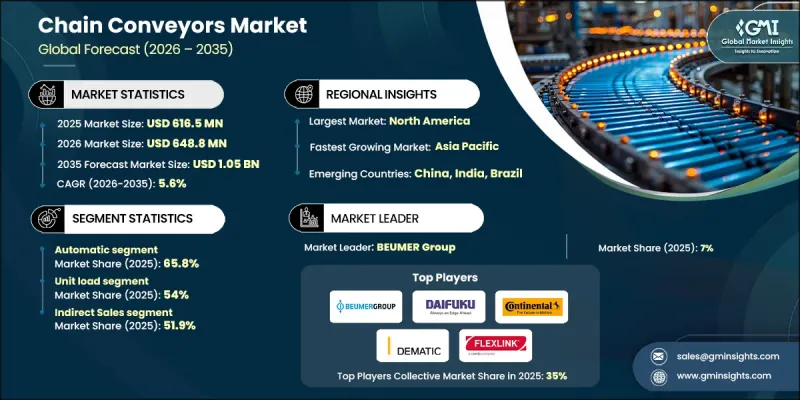
人们对永续供应链营运的日益关注,以及对营运效率的需求,正在推动对先进输送链系统的需求。各行各业的公司都在逐步淘汰传统的人工物料搬运方式,例如堆高机、简易托盘分拣机和重力式系统,这些方式效率低、劳力密集且对环境不可持续。现代炼式输送机越来越多地配备高扭矩、节能型马达、再生煞车系统和智慧物料输送机制,可将电力消耗降低30-39%,并显着减少对环境的影响。这种机械化趋势在食品饮料、汽车和电子商务物流等行业尤其明显,这些行业对高吞吐量、快速交付和稳定的物料流至关重要。主要企业之间的併购也在推动创新和扩张,创造出整合解决方案,进一步提升全球供应链的效率、可靠性和永续性。
| 市场覆盖范围 | |
|---|---|
| 开始年份 | 2025 |
| 预测年份 | 2026-2035 |
| 起始值 | 6.165亿美元 |
| 预测金额 | 10.5亿美元 |
| 复合年增长率 | 5.6% |
到2025年,自动化炼式输送机机市占率将达到65.8%,创造4.055亿美元的收入。自动化炼式系统透过提高安全性、减少物料输送误差来提升生产效率,同时降低对人事费用的依赖。与机器人、感测器和人工智慧的集成,实现了即时监控、预测性维护和自适应控制,从而在高需求环境下优化吞吐量。这一转变反映了「工业4.0」的广泛应用,智慧工厂和全互联仓库优先考虑自动化,以实现卓越营运、节能和缩短週期时间。如今,自动化输送机已被视为现代配销中心、大规模生产工厂和加工厂的关键基础设施,因为在这些场所,物料运输的速度和精确度至关重要。
到2025年,间接销售通路将占据51.9%的市场份额,凸显了市场对经销商、系统整合商和第三方合作伙伴提供专业解决方案的高度依赖。终端用户更倾向于透过这些管道获得本地支援、售后服务和维护合同,这对于最大限度地减少大规模运营中的停机时间至关重要。间接通路还能实现快速的零件更换、客製化解决方案以及针对特定运作环境量身订製的安装服务。随着输送系统技术的日益复杂,第三方整合商在确保无缝实施、系统正确调优和持续技术支援方面发挥关键作用,这使得间接销售成为市场成长的基石。
预计到2025年,美国炼式输送机市占率将达到84.5%,主要得益于仓储自动化、物流优化和电子商务网路扩张的大规模投资。对符合人体工学的操作解决方案和职场安全标准的高需求,正促使企业以自动化炼式输送系统取代人工操作。大型配送中心、履约中心和工业厂房的投资,进一步推动了节能、高容量输送机的应用。此外,企业还利用互联解决方案来改善库存管理、减少营运瓶颈并确保及时完成订单,从而巩固了美国在全球炼式输送机应用领域的领先地位。
目录
第一章调查方法和范围
第二章执行摘要
第三章业界考察
- 生态系分析
- 供应商情况
- 利润率
- 每个阶段的附加价值
- 影响价值链的因素
- 产业影响因素
- 司机
- 电子商务和履约的快速成长
- 工业4.0和智慧製造
- 永续性和能源效率
- 产业潜在风险与挑战
- 初始投资额高,投资回收期长
- 对遗留网站维修的复杂性
- 机会
- 物联网与预测性维护的集成
- 模组化和灵活的输送机设计
- 司机
- 成长潜力分析
- 未来市场趋势
- 科技与创新趋势
- 当前技术趋势
- 新兴技术
- 价格趋势
- 按地区
- 透过操作
- 监管环境
- 标准和合规要求
- 区域法规结构
- 认证标准
- 波特五力分析
- PESTEL 分析
第四章 竞争情势
- 介绍
- 公司市占率分析
- 按地区
- 企业矩阵分析
- 主要市场公司的竞争分析
- 竞争定位矩阵
- 重大进展
- 併购
- 伙伴关係与合作
- 新产品发布
- 扩张计划
5. 2022-2035年按营运方式分類的市场估算与预测
- 手动的
- 自动的
- 半自动
第六章 依负载分類的市场估计与预测,2022-2035年
- 散装货物
- 单元货载
第七章 依安装地点分類的市场估计与预测,2022-2035年
- 地板下植入式
- 落地式
- 吸顶式
8. 2022-2035年按最终用户产业分類的市场估算与预测
- 食品/饮料
- 製药
- 汽车与运输
- 矿业
- 製造业
- 飞机场
- 仓库和物流中心
- 其他(航运、石油和天然气等)
9. 2022-2035年按分销管道分類的市场估算与预测
- 直接地
- 间接
第十章 2022-2035年各地区市场估计与预测
- 北美洲
- 我们
- 加拿大
- 欧洲
- 德国
- 英国
- 法国
- 义大利
- 西班牙
- 亚太地区
- 中国
- 日本
- 印度
- 澳洲
- 韩国
- 拉丁美洲
- 巴西
- 墨西哥
- 阿根廷
- 中东和非洲
- 南非
- 沙乌地阿拉伯
- 阿拉伯聯合大公国
第十一章:公司简介
- BEUMER Group
- Daifuku Co., Ltd.
- Dematic
- Fives
- FlexLink
- Honeywell International Inc
- Hytrol Conveyor Company, Inc.
- Interroll Group
- Kardex
- Regal Rexnord Corporation
- Shuttleworth
- Siemens
- Taikisha Ltd.
- Ultimation Industries, LLC.
- WAMGROUP SpA
The Global Chain Conveyors Market was valued at USD 616.5 million in 2025 and is estimated to grow at a CAGR of 5.6% to reach USD 1.05 billion by 2035.
The rising emphasis on sustainable supply chain operations, coupled with the need for operational efficiency, is fueling demand for advanced conveyor chain systems. Companies across industries are moving away from traditional, manual material handling methods, such as forklifts, basic pallet sorting, and gravity-fed systems, which are less efficient, labor-intensive, and environmentally unsustainable. Modern chain conveyors are increasingly being equipped with high-torque, energy-efficient motors, regenerative braking systems, and smart control mechanisms, capable of reducing power consumption by up to 30-39%, significantly lowering environmental impact. The trend toward mechanization is especially strong in industries such as food & beverage, automotive, and e-commerce logistics, where high throughput, faster delivery, and consistent material flow are critical. Mergers and acquisitions among key players are also driving innovation and expansion, creating integrated solutions that further improve efficiency, reliability, and sustainability of supply chains globally.
| Market Scope | |
|---|---|
| Start Year | 2025 |
| Forecast Year | 2026-2035 |
| Start Value | $616.5 Million |
| Forecast Value | $1.05 Billion |
| CAGR | 5.6% |
In 2025, the automatic chain conveyors segment held 65.8% share, generating USD 405.5 million. Automated chain systems enhance productivity by reducing reliance on manual labor while improving safety and minimizing errors in material handling. Integration with robotics, sensors, and AI enables real-time monitoring, predictive maintenance, and adaptive control, optimizing throughput in high-demand environments. This shift reflects the broader Industry 4.0 adoption, where smart factories and fully connected warehouses prioritize automation to achieve operational excellence, energy savings, and faster cycle times. Automated conveyors are now seen as essential infrastructure in modern distribution centers, high-volume manufacturing plants, and processing facilities that require both speed and precision in material transport.
The indirect sales segment accounted for 51.9% share in 2025, highlighting the reliance on distributors, system integrators, and third-party partners to deliver specialized solutions. End users prefer these channels for localized support, aftermarket services, and maintenance contracts, which are critical for minimizing downtime in high-volume operations. Indirect channels also facilitate rapid part replacements, customized solutions, and installation services tailored to specific operational environments. As conveyor systems become more technologically advanced, third-party integrators play a key role in ensuring seamless deployment, proper system calibration, and ongoing technical assistance, making indirect sales a cornerstone of market growth.
U.S. Chain Conveyors Market held an 84.5% share in 2025, driven by extensive investment in warehouse automation, logistics optimization, and e-commerce network expansion. High demand for ergonomic handling solutions and workplace safety standards encourages companies to replace manual processes with automated chain conveyor systems. Investments in large-scale distribution hubs, fulfillment centers, and industrial plants further support the adoption of energy-efficient and high-capacity conveyors. Additionally, companies are leveraging connected solutions to improve inventory management, reduce operational bottlenecks, and ensure timely order fulfillment, cementing the U.S. as a global leader in chain conveyor deployment.
Key players operating in the Global Chain Conveyors Market include Daifuku Co., Ltd., Siemens, BEUMER Group, Hytrol Conveyor Company, Inc., Interroll Group, Shuttleworth, Honeywell International Inc., FlexLink, Ultimation Industries, LLC., WAMGROUP S.p.A., Kardex, Regal Rexnord Corporation, Taikisha Ltd., Continental AG, and Dematic. Companies in the chain conveyors market are strengthening their position through strategies such as continuous R&D to develop energy-efficient, modular, and high-throughput systems suitable for automated warehouses and production lines. Strategic partnerships with distributors and integrators expand geographic reach while ensuring localized technical support. Firms are investing in AI, IoT, and predictive maintenance technologies to enhance system reliability and reduce operational downtime. Mergers and acquisitions allow them to consolidate expertise, enter new industrial verticals, and offer integrated solutions.
Table of Contents
Chapter 1 Methodology and Scope
- 1.1 Market scope and definition
- 1.2 Research design
- 1.2.1 Research approach
- 1.2.2 Data collection methods
- 1.3 Data mining sources
- 1.3.1 Global
- 1.3.2 Regional/Country
- 1.4 Base estimates and calculations
- 1.4.1 Base year calculation
- 1.4.2 Key trends for market estimation
- 1.5 Primary research and validation
- 1.5.1 Primary sources
- 1.6 Forecast model
- 1.7 Research assumptions and limitations
Chapter 2 Executive Summary
- 2.1 Industry 360° synopsis
- 2.2 Key market trends
- 2.2.1 Regional
- 2.2.2 Operation
- 2.2.3 Load
- 2.2.4 Location
- 2.2.5 End-Use
- 2.2.6 Distribution Channel
- 2.3 CXO perspectives: Strategic imperatives
- 2.3.1 Key decision points for industry executives
- 2.3.2 Critical success factors for market players
- 2.4 Future outlook and strategic recommendations
Chapter 3 Industry Insights
- 3.1 Industry ecosystem analysis
- 3.1.1 Supplier landscape
- 3.1.2 Profit margin
- 3.1.3 Value addition at each stage
- 3.1.4 Factor affecting the value chain
- 3.2 Industry impact forces
- 3.2.1 Growth drivers
- 3.2.1.1 Rapid E-commerce & Fulfillment Growth
- 3.2.1.2 Industry 4.0 & Smart Manufacturing
- 3.2.1.3 Sustainability & Energy Efficiency
- 3.2.2 Industry pitfalls & challenges
- 3.2.2.1 High Initial CAPEX & Long ROI
- 3.2.2.2 Complexity of Retrofitting Legacy Sites
- 3.2.3 Opportunities
- 3.2.3.1 IoT & Predictive Maintenance Integration
- 3.2.3.2 Modular & Flexible Conveyor Design
- 3.2.1 Growth drivers
- 3.3 Growth potential analysis
- 3.4 Future market trends
- 3.5 Technology and innovation landscape
- 3.5.1 Current technological trends
- 3.5.2 Emerging technologies
- 3.6 Price trends
- 3.6.1 By region
- 3.6.2 By Operation
- 3.7 Regulatory landscape
- 3.7.1 Standards and compliance requirements
- 3.7.2 Regional regulatory frameworks
- 3.7.3 Certification standards
- 3.8 Porter's analysis
- 3.9 PESTEL analysis
Chapter 4 Competitive Landscape, 2025
- 4.1 Introduction
- 4.2 Company market share analysis
- 4.2.1 By region
- 4.2.1.1 North America
- 4.2.1.2 Europe
- 4.2.1.3 Asia Pacific
- 4.2.1.4 Latin America
- 4.2.1.5 Middle East and Africa
- 4.2.1 By region
- 4.3 Company matrix analysis
- 4.4 Competitive analysis of major market players
- 4.5 Competitive positioning matrix
- 4.6 Key developments
- 4.6.1 Mergers & acquisitions
- 4.6.2 Partnerships & collaborations
- 4.6.3 New product launches
- 4.6.4 Expansion plans
Chapter 5 Market Estimates and Forecast, By Operation, 2022 - 2035 (USD Million) (Thousand Units)
- 5.1 Key trends
- 5.2 Manual
- 5.3 Automatic
- 5.4 Semi-automatic
Chapter 6 Market Estimates and Forecast, By Load, 2022 - 2035 (USD Million) (Thousand Units)
- 6.1 Key trends
- 6.2 Bulk load
- 6.3 Unit load
Chapter 7 Market Estimates and Forecast, By Location, 2022 - 2035 (USD Million) (Thousand Units)
- 7.1 Key trends
- 7.2 In-floor
- 7.3 On-floor
- 7.4 Overhead
Chapter 8 Market Estimates and Forecast, By End-User Vertical, 2022 - 2035 (USD Million) (Thousand Units)
- 8.1 Key trends
- 8.2 Food & beverages
- 8.3 Pharmaceuticals
- 8.4 Automotive & transport
- 8.5 Mining
- 8.6 Manufacturing
- 8.7 Airport
- 8.8 Warehouses & Logistic Centers
- 8.9 Others (Marine, oil & gas, etc.)
Chapter 9 Market Estimates and Forecast, By Distribution Channel, 2022 - 2035 (USD Million) (Thousand Units)
- 9.1 Key trends
- 9.2 Direct
- 9.3 Indirect
Chapter 10 Market Estimates and Forecast, By Region, 2022 - 2035 (USD Million) (Thousand Units)
- 10.1 Key trends
- 10.2 North America
- 10.2.1 U.S.
- 10.2.2 Canada
- 10.3 Europe
- 10.3.1 Germany
- 10.3.2 UK
- 10.3.3 France
- 10.3.4 Italy
- 10.3.5 Spain
- 10.4 Asia Pacific
- 10.4.1 China
- 10.4.2 Japan
- 10.4.3 India
- 10.4.4 Australia
- 10.4.5 South Korea
- 10.5 Latin America
- 10.5.1 Brazil
- 10.5.2 Mexico
- 10.5.3 Argentina
- 10.6 Middle East and Africa
- 10.6.1 South Africa
- 10.6.2 Saudi Arabia
- 10.6.3 UAE
Chapter 11 Company Profiles
- 11.1 BEUMER Group
- 11.2 Daifuku Co., Ltd.
- 11.3 Dematic
- 11.4 Fives
- 11.5 FlexLink
- 11.6 Honeywell International Inc
- 11.7 Hytrol Conveyor Company, Inc.
- 11.8 Interroll Group
- 11.9 Kardex
- 11.10 Regal Rexnord Corporation
- 11.11 Shuttleworth
- 11.12 Siemens
- 11.13 Taikisha Ltd.
- 11.14 Ultimation Industries, LLC.
- 11.15 WAMGROUP S.p.A.

 输送机自动化系统市场:按类型、运作模式、组件、应用和最终用户产业划分,全球预测,2026-2032年高速输送机市场按类型、自动化程度、运作模式、驱动系统、负载能力和最终用户产业划分,全球预测,2026-2032年
 全球振动给料输送机市场规模、份额、趋势及成长分析报告(2026-2034)全球振动输送机市场规模、份额、趋势和成长分析报告(2026-2034)
 日本工业输送系统市场规模、份额、趋势及预测(按类型、承载能力、运作类型、最终用途产业及地区划分),2026-2034年日本智慧输送系统市场规模、份额、趋势及预测(按组件、产品类型、技术、自动化程度、产业领域及地区划分),2026-2034年
 2026年全球包装输送机市场报告2026年全球输送机系统市场报告斗式提昇机市场 - 2026-2031年预测炼式输送机市场-2026-2031年预测