


 |
市场调查报告书
商品编码
1936644
关节疼痛注射市场:机会、成长要素、产业趋势分析及预测(2026-2035年)Joint Pain Injections Market Opportunity, Growth Drivers, Industry Trend Analysis, and Forecast 2026 - 2035 |
||||||

全球关节疼痛注射市场预计到 2025 年将达到 61 亿美元,到 2035 年将达到 128 亿美元,年复合成长率为 7.8%。
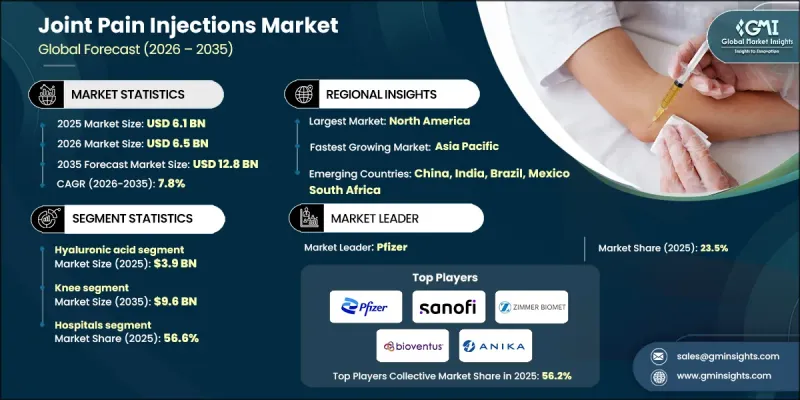
市场成长主要受全球肌肉骨骼疾病负担加重的推动,这些疾病仍然是长期残疾和生活品质下降的主要原因。随着关节相关疾病逐渐限制活动能力和日常功能,对无需手术即可缓解疼痛的治疗方法的需求持续增长。关节疼痛注射是一种微创疗法,旨在减轻发炎、缓解不适并恢復患有退化性疾病和创伤相关疾病患者的关节活动范围。市场正稳步转向先进的再生医学和生物注射解决方案,这些方案专注于组织修復和功能恢復,而非短期症状管理。正面的临床结果和患者活动能力的改善增强了人们对这些治疗方法的信心。随着人口老化,关节炎盛行率不断上升,以及身体活跃人口关节损伤的增加,也推动了市场成长。年轻患者也开始采用注射疗法来维持活动量并延缓手术,将市场拓展到传统老龄化相关族群之外。
| 市场覆盖范围 | |
|---|---|
| 开始年份 | 2025 |
| 预测年份 | 2026-2035 |
| 起始金额 | 61亿美元 |
| 预测金额 | 128亿美元 |
| 复合年增长率 | 7.8% |
2025年,透明质酸市场规模预计将达39亿美元。该市场凭藉其在改善关节润滑、减少摩擦和增强退化性关节疾病患者活动能力方面的显着作用,保持着强劲的市场地位。其良好的安全性、较高的临床接受度和广泛的临床应用,并持续推动透明质酸产品的广泛应用。关节退化性疾病诊断率的不断提高,进一步增强了市场对透明质酸注射疗法的持续需求。
预计到2035年,膝关节疾病市场规模将达96亿美元。这一增长主要受人口老化、生活方式因素和代谢性疾病等因素导致的膝关节退化性疾病发生率上升所驱动。大量的治疗需求和多种注射治疗方案的出现,使膝关节成为治疗频率最高的关节,巩固了其在临床实践和门诊治疗中的主导地位。
预计到2025年,北美关节疼痛注射市场将继续保持其领先区域市场的地位,占据47.1%的市场份额。这一优势得益于大规模的关节疾病患者群体、先进的医疗基础设施以及创新註射疗法的广泛应用。有利的报销制度、高昂的医疗支出、较高的患者意识以及对非手术治疗方法的早期采用,持续推动全部区域的市场成长。主要行业参与者的存在进一步巩固了该地区的主导地位。
目录
第一章调查方法和范围
第二章执行摘要
第三章业界考察
- 生态系分析
- 产业影响因素
- 司机
- 骨关节炎和肌肉骨骼疾病的发生率不断上升
- 微创、非手术治疗方法的普及率不断提高
- 生物医学和再生医学的进展
- 提高医疗意识和改善医疗服务取得途径
- 产业潜在风险与挑战
- 有副作用风险且疗效不一。
- 严格的监管要求
- 市场机会
- 扩大整形外科生物疗法
- 对个人化和联合治疗的需求日益增长
- 司机
- 成长潜力分析
- 监管环境
- 科技趋势
- 当前技术趋势
- 新兴技术
- 救赎方案
- 关节疼痛的流行病学概况
- 管道分析
- 定价分析
- 未来市场趋势
- 波特五力分析
- PESTEL 分析
第四章 竞争情势
- 介绍
- 公司市占率分析
- 世界
- 北美洲
- 欧洲
- 亚太地区
- 企业矩阵分析
- 主要市场公司的竞争分析
- 竞争定位矩阵
- 重大进展
- 併购
- 伙伴关係与合作
- 新产品发布
- 扩张计划
第五章 依注射类型分類的市场估算与预测,2022-2035年
- 玻尿酸注射
- 皮质类固醇注射
- 富血小板血浆注射
- 其他的
第六章 依关节类型分類的市场估计与预测,2022-2035年
- 膝关节
- 肩关节和肘关节
- 踝关节及髋关节
- 其他的
第七章 依最终用途分類的市场估计与预测,2022-2035年
- 医院
- 整形外科和疼痛诊所
- 门诊手术中心
- 其他的
第八章 2022-2035年各地区市场估算与预测
- 北美洲
- 我们
- 加拿大
- 欧洲
- 德国
- 英国
- 法国
- 西班牙
- 义大利
- 荷兰
- 亚太地区
- 中国
- 印度
- 日本
- 澳洲
- 韩国
- 拉丁美洲
- 巴西
- 墨西哥
- 阿根廷
- 中东和非洲
- 南非
- 沙乌地阿拉伯
- 阿拉伯聯合大公国
第九章:公司简介
- Anika Therapeutics
- Arthrex
- Bioventus
- Cipla
- Emcyte Corporation
- Ferring
- Lifecore Biomedical
- OrthogenRx
- Pacira BioSciences(Flexion)
- Pfizer
- Sanofi
- SEIKAGAKU CORPORATION
- Stryker Corporation
- Zimmer Biomet Holdings
The Global Joint Pain Injections Market was valued at USD 6.1 billion in 2025 and is estimated to grow at a CAGR of 7.8% to reach USD 12.8 billion by 2035.
Market growth is supported by the increasing global burden of musculoskeletal disorders, which remain a major cause of long-term disability and reduced quality of life. As joint-related conditions increasingly limit mobility and daily function, demand continues to rise for treatment options that offer pain relief without surgical intervention. Joint pain injections represent minimally invasive therapies designed to reduce inflammation, relieve discomfort, and restore joint movement in patients affected by degenerative and injury-related conditions. The market is steadily shifting toward advanced regenerative and biologic injection solutions that focus on tissue repair and functional recovery rather than short-term symptom control. Positive clinical outcomes and improved patient mobility have strengthened confidence in these therapies. Growth is further supported by rising arthritis prevalence among aging populations and increasing joint injuries among physically active individuals. Younger patients are also adopting injectable treatments to maintain activity levels and postpone surgical procedures, broadening the market beyond traditional age-related use.
| Market Scope | |
|---|---|
| Start Year | 2025 |
| Forecast Year | 2026-2035 |
| Start Value | $6.1 Billion |
| Forecast Value | $12.8 Billion |
| CAGR | 7.8% |
The hyaluronic acid segment reached USD 3.9 billion in 2025. This segment maintains a strong position due to its established role in improving joint lubrication, minimizing friction, and enhancing movement in degenerative joint conditions. Its favorable safety profile, strong clinical acceptance, and broad availability across healthcare settings continue to support widespread adoption. Increasing diagnosis rates of joint degeneration further reinforce the sustained demand for hyaluronic acid-based injection therapies.
The knee segment is projected to reach USD 9.6 billion by 2035. This growth is driven by the rising occurrence of knee joint degeneration associated with aging populations, lifestyle-related factors, and metabolic health conditions. High treatment volumes and the availability of multiple injectable therapy options have positioned the knee as the most frequently treated joint, strengthening its dominance across clinical practices and outpatient care facilities.
North America Joint Pain Injections Market accounted for 47.1% share in 2025, maintaining its position as the leading regional market. This dominance is supported by a large patient base affected by joint disorders, advanced healthcare infrastructure, and widespread use of innovative injection therapies. Favorable reimbursement frameworks, high healthcare spending, strong patient awareness, and early adoption of non-surgical treatment approaches continue to drive market growth across the region. The presence of major industry participants further enhances regional leadership.
Key companies operating in the Joint Pain Injections Market include Zimmer Biomet Holdings, Sanofi, Pfizer, Stryker Corporation, Anika Therapeutics, SEIKAGAKU CORPORATION, Bioventus, Arthrex, OrthogenRx, Lifecore Biomedical, Pacira BioSciences (Flexion), Emcyte Corporation, Cipla, and Ferring. Companies in the joint pain injections market are implementing targeted strategies to strengthen market positioning and sustain growth. Significant investments are being made in research and development to advance biologic and regenerative injection technologies with improved clinical outcomes. Strategic collaborations with healthcare providers and orthopedic specialists are expanding treatment accessibility and clinical adoption. Firms are also focusing on portfolio diversification to address multiple joint types and disease stages. Geographic expansion into emerging markets and strengthening distribution networks remain key priorities.
Table of Contents
Chapter 1 Methodology and Scope
- 1.1 Market scope and definition
- 1.2 Research approach
- 1.3 Quality commitments
- 1.3.1 GMI AI policy and data integrity commitment
- 1.3.1.1 Source consistency protocol
- 1.3.1 GMI AI policy and data integrity commitment
- 1.4 Research trail and confidence scoring
- 1.4.1 Research trail components
- 1.4.2 Scoring components
- 1.5 Data collection
- 1.5.1 Partial list of primary sources
- 1.6 Data mining sources
- 1.6.1 Paid sources
- 1.6.1.1 Sources, by region
- 1.6.1 Paid sources
- 1.7 Base estimates and calculations
- 1.7.1 Revenue share analysis
- 1.7.2 Base year calculation
- 1.8 Forecast model
- 1.9 Research transparency addendum
- 1.9.1 Source attribution framework
- 1.9.2 Quality assurance metrics
- 1.9.3 Our commitment to trust
Chapter 2 Executive Summary
- 2.1 Industry 360° synopsis
- 2.2 Key market trends
- 2.2.1 Regional trends
- 2.2.2 Injection type trends
- 2.2.3 Joint type trends
- 2.2.4 End use trends
- 2.3 CXO perspectives: Strategic imperatives
- 2.3.1 Key decision points for industry executives
- 2.3.2 Critical success factors for market players
- 2.4 Future outlook and strategic recommendations
Chapter 3 Industry Insights
- 3.1 Industry ecosystem analysis
- 3.2 Industry impact forces
- 3.2.1 Growth drivers
- 3.2.1.1 Rising prevalence of osteoarthritis and musculoskeletal disorders
- 3.2.1.2 Growing adoption of minimally invasive and non-surgical therapies
- 3.2.1.3 Advancements in biologic and regenerative therapies
- 3.2.1.4 Rising awareness and healthcare access
- 3.2.2 Industry pitfalls and challenges
- 3.2.2.1 Risk of adverse reactions and variable efficacy
- 3.2.2.2 Stringent regulatory requirements
- 3.2.3 Market opportunities
- 3.2.3.1 Expansion of orthobiologic therapies
- 3.2.3.2 Growing demand for personalized and combination therapies
- 3.2.1 Growth drivers
- 3.3 Growth potential analysis
- 3.4 Regulatory landscape
- 3.4.1 North America
- 3.4.2 Europe
- 3.4.3 Asia Pacific
- 3.4.4 Latin America
- 3.4.5 Middle East and Africa
- 3.5 Technology landscape
- 3.5.1 Current technological trends
- 3.5.2 Emerging technologies
- 3.6 Reimbursement scenario
- 3.7 Joint pain epidemiology scenario
- 3.8 Pipeline analysis
- 3.9 Pricing analysis
- 3.10 Future market trends
- 3.11 Porter's analysis
- 3.12 PESTEL analysis
Chapter 4 Competitive Landscape, 2025
- 4.1 Introduction
- 4.2 Company market share analysis
- 4.2.1 Global
- 4.2.2 North America
- 4.2.3 Europe
- 4.2.4 Asia Pacific
- 4.3 Company matrix analysis
- 4.4 Competitive analysis of major market players
- 4.5 Competitive positioning matrix
- 4.6 Key developments
- 4.6.1 Merger and acquisition
- 4.6.2 Partnership and collaboration
- 4.6.3 New product launches
- 4.6.4 Expansion plans
Chapter 5 Market Estimates and Forecast, By Injection Type, 2022 - 2035 ($ Mn)
- 5.1 Key trends
- 5.2 Hyaluronic acid injections
- 5.3 Corticosteroid injections
- 5.4 Platelet rich plasma injections
- 5.5 Other injection types
Chapter 6 Market Estimates and Forecast, By Joint Type, 2022 - 2035 ($ Mn)
- 6.1 Key trends
- 6.2 Knee
- 6.3 Shoulder and elbow
- 6.4 Ankle and hip
- 6.5 Other joint types
Chapter 7 Market Estimates and Forecast, By End Use, 2022 - 2035 ($ Mn)
- 7.1 Key trends
- 7.2 Hospitals
- 7.3 Orthopedic/pain clinics
- 7.4 Ambulatory surgical centers
- 7.5 Other end users
Chapter 8 Market Estimates and Forecast, By Region, 2022 - 2035 ($ Mn)
- 8.1 Key trends
- 8.2 North America
- 8.2.1 U.S.
- 8.2.2 Canada
- 8.3 Europe
- 8.3.1 Germany
- 8.3.2 UK
- 8.3.3 France
- 8.3.4 Spain
- 8.3.5 Italy
- 8.3.6 Netherlands
- 8.4 Asia Pacific
- 8.4.1 China
- 8.4.2 India
- 8.4.3 Japan
- 8.4.4 Australia
- 8.4.5 South Korea
- 8.5 Latin America
- 8.5.1 Brazil
- 8.5.2 Mexico
- 8.5.3 Argentina
- 8.6 Middle East and Africa
- 8.6.1 South Africa
- 8.6.2 Saudi Arabia
- 8.6.3 UAE
Chapter 9 Company Profiles
- 9.1 Anika Therapeutics
- 9.2 Arthrex
- 9.3 Bioventus
- 9.4 Cipla
- 9.5 Emcyte Corporation
- 9.6 Ferring
- 9.7 Lifecore Biomedical
- 9.8 OrthogenRx
- 9.9 Pacira BioSciences (Flexion)
- 9.10 Pfizer
- 9.11 Sanofi
- 9.12 SEIKAGAKU CORPORATION
- 9.13 Stryker Corporation
- 9.14 Zimmer Biomet Holdings


