


 |
市场调查报告书
商品编码
1936651
牙科护理产品市场机会、成长要素、产业趋势分析及2026年至2035年预测Dental Care Products Market Opportunity, Growth Drivers, Industry Trend Analysis, and Forecast 2026 - 2035 |
||||||

全球牙科护理产品市场预计到 2025 年将达到 608 亿美元,到 2035 年将达到 1,135 亿美元,年复合成长率为 6.8%。
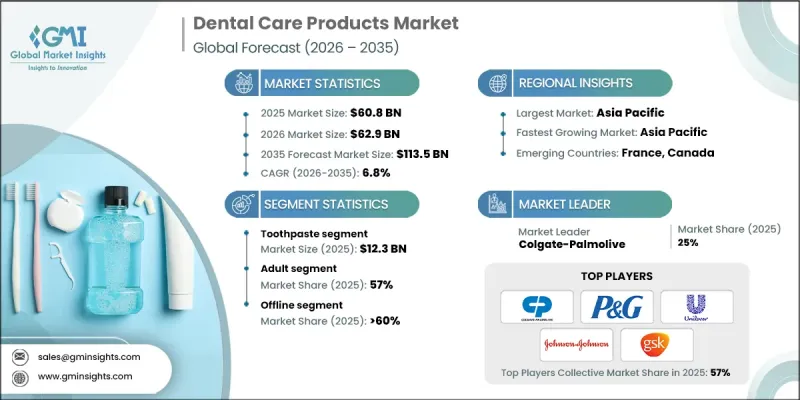
人们越来越意识到口腔卫生与整体健康之间的联繫,这种意识持续影响着各个年龄层的购买行为。消费者如今更加重视预防保健和美观性解决方案,从而推动了对日常基本用品之外的更广泛牙科产品的需求。这种转变在发展中地区尤其显着,这些地区的教育水准、收入成长和资讯取得管道都在快速改善。数位内容和以健康为中心的宣传活动在引导人们养成早期疗育和定期照护的习惯方面发挥着关键作用。产品创新仍然是成长的关键驱动力,製造商致力于提升产品的便利性、性能和永续性。利用科技支援个人化使用和健康监测的口腔清洁用品解决方案进一步提高了消费者的期望,并巩固了零售和专卖通路的长期市场成长。
| 市场覆盖范围 | |
|---|---|
| 开始年份 | 2025 |
| 预测年份 | 2026-2035 |
| 起始值 | 608亿美元 |
| 预测金额 | 1135亿美元 |
| 复合年增长率 | 6.8% |
预计到2025年,牙膏市场收入将达到123亿美元。牙膏在不同地区和年龄层的广泛使用确保了其稳定的需求,而产品多元化则支撑了优质化。针对特定口腔清洁用品需求的配方、强大的品牌知名度和持续的促销活动正在推动市场成长。消费者对成分透明度和替代配方的偏好不断增长,并持续扩大了消费者的兴趣,巩固了牙膏市场的主导地位。
到2025年,成人市场将占据57%的市场。强大的购买力、日益增强的健康意识以及对专业口腔清洁用品解决方案的需求,支撑着该市场的主导地位。饮食习惯和生活方式因素推动了预防保健的需求,而美感偏好促使消费者在高级产品上消费。收入水准的提高和对个人化解决方案的需求预计将继续推动该族群的持续成长。
预计到2025年,亚太地区口腔护理产品市场将占据30%的市场份额,并在2035年之前以8.1%的复合年增长率成长。中国凭藉其庞大的人口规模、收入成长以及人们对个人健康的日益关注,正在推动区域需求的成长。都市生活风格和数位零售的兴起持续促进大众市场和高级产品的渗透,而精准的线上行销则正在提升年轻消费者对品牌的认知。
目录
第一章调查方法和范围
第二章执行摘要
第三章业界考察
- 生态系分析
- 供应商情况
- 利润率
- 每个阶段的附加价值
- 影响价值链的因素
- 产业影响因素
- 司机
- 口腔卫生意识提高
- 技术进步
- 电子商务的扩张
- 产业潜在风险与挑战
- 先进产品高成本
- 监理合规
- 机会
- 对天然和永续产品的需求
- 新兴经济体的扩张
- 司机
- 成长潜力分析
- 未来市场趋势
- 科技与创新趋势
- 当前技术趋势
- 新兴技术
- 价格趋势
- 按地区
- 依产品类型
- 监管环境
- 标准和合规要求
- 区域法规结构
- 认证标准
- 波特五力分析
- PESTEL 分析
第四章 竞争情势
- 介绍
- 公司市占率分析
- 按地区
- 企业矩阵分析
- 主要市场公司的竞争分析
- 竞争定位矩阵
- 重大进展
- 併购
- 伙伴关係与合作
- 新产品发布
- 扩张计划
第五章 依产品类型分類的市场估算与预测,2022-2035年
- 牙膏
- 牙刷
- 牙线
- 漱口水
- 舌苔清洁器
- 美白产品
- 维持器和护齿器
- 牙科套装
- 其他(电动牙刷头等)
第六章 按应用领域分類的市场估算与预测,2022-2035年
- 家庭
- 牙医诊所
- 医院
- 其他(学校、养老院等)
7. 依最终用途分類的市场估计与预测,2022-2035 年
- 成人版
- 儿童
- 对于老年人
第八章 按分销管道分類的市场估算与预测,2022-2035年
- 在线的
- 电子商务
- 公司网站
- 离线
- 药房和药品商店
- 超级市场/大卖场
- 其他(专卖店、便利商店等)
第九章 2022-2035年各地区市场估算与预测
- 北美洲
- 我们
- 加拿大
- 欧洲
- 德国
- 英国
- 法国
- 义大利
- 西班牙
- 亚太地区
- 中国
- 日本
- 印度
- 澳洲
- 韩国
- 拉丁美洲
- 巴西
- 墨西哥
- 阿根廷
- 中东和非洲
- 南非
- 沙乌地阿拉伯
- 阿拉伯聯合大公国
第十章:公司简介
- 3M
- Align Technology
- Church &Dwight
- Colgate-Palmolive
- Danaher
- Dentsply Sirona
- GC Corporation
- GlaxoSmithKline
- Henry Schein
- Ivoclar Vivadent
- Johnson &Johnson
- Kao
- 帕特森公司
- Procter &Gamble
- Straumann Holding
- Sunstar Suisse
- Unilever
The Global Dental Care Products Market was valued at USD 60.8 billion in 2025 and is estimated to grow at a CAGR of 6.8% to reach USD 113.5 billion by 2035.
Rising awareness of oral health and its connection to overall physical wellness continues to influence purchasing behavior across age groups. Consumers now prioritize preventive care and appearance-focused solutions, which supports demand for a broad range of dental products beyond basic daily-use items. This shift is particularly visible in developing regions where education, income growth, and access to information are improving rapidly. Digital content and health-focused outreach initiatives have played a major role in reshaping habits toward early intervention and routine care. Product innovation remains a critical growth driver, with manufacturers focusing on convenience, performance, and sustainability. Technology-enabled oral care solutions that support personalized usage and health monitoring are further elevating consumer expectations and reinforcing long-term market growth across retail and professional channels.
| Market Scope | |
|---|---|
| Start Year | 2025 |
| Forecast Year | 2026-2035 |
| Start Value | $60.8 Billion |
| Forecast Value | $113.5 Billion |
| CAGR | 6.8% |
The toothpaste segment generated USD 12.3 billion in 2025. Its universal use across regions and age groups ensures steady demand, while product variety supports premiumization. Growth is supported by formulations designed to address specific oral care needs, along with strong brand recognition and consistent promotional activity. Shifting preferences toward ingredient transparency and alternative formulations continue to broaden consumer appeal and sustain segment leadership.
The adult segment accounted for 57% share in 2025. Strong purchasing power, higher health awareness, and demand for specialized oral care solutions support segment dominance. Dietary habits and lifestyle factors increase the need for preventive care, while appearance-driven preferences encourage spending on premium products. Rising income levels and interest in tailored solutions ensure ongoing growth within this demographic.
Asia Pacific Dental Care Products Market held 30% share in 2025 and is expected to grow at a CAGR of 8.1% through 2035. China leads regional demand due to population scale, income growth, and increasing focus on personal health. Urban living patterns and digital retail adoption continue to support both mass-market and premium product penetration, while targeted online marketing strengthens brand visibility among younger consumers.
Key companies operating in the Global Dental Care Products Market include Procter & Gamble, Colgate-Palmolive, Unilever, Johnson & Johnson, GlaxoSmithKline, 3M, Danaher, Dentsply Sirona, Align Technology, Straumann Holding, Ivoclar Vivadent, GC Corporation, Church & Dwight, Kao, Henry Schein, Patterson Companies, and Sunstar Suisse. Companies in the dental care products market focus on innovation, portfolio expansion, and brand differentiation to strengthen market positioning. Manufacturers invest in research to develop advanced formulations and technology-driven products that address specific oral health needs. Strategic partnerships with dental professionals and retail channels enhance credibility and distribution reach. Firms also emphasize digital engagement, personalized marketing, and direct-to-consumer platforms to capture evolving buyer preferences. Expanding presence in high-growth regions through localized production and pricing strategies further supports long-term competitiveness and market share growth.
Table of Contents
Chapter 1 Methodology and Scope
- 1.1 Market scope and definition
- 1.2 Research design
- 1.2.1 Research approach
- 1.2.2 Data collection methods
- 1.3 Data mining sources
- 1.3.1 Global
- 1.3.2 Regional/Country
- 1.4 Base estimates and calculations
- 1.4.1 Base year calculation
- 1.4.2 Key trends for market estimation
- 1.5 Primary research and validation
- 1.5.1 Primary sources
- 1.6 Forecast model
- 1.7 Research assumptions and limitations
Chapter 2 Executive Summary
- 2.1 Industry 3600 synopsis
- 2.2 Key market trends
- 2.2.1 Regional
- 2.2.2 Product type
- 2.2.3 Application
- 2.2.4 End use
- 2.2.5 Distribution channel
- 2.3 CXO perspectives: Strategic imperatives
- 2.3.1 Key decision points for industry executives
- 2.3.2 Critical success factors for market players
- 2.4 Future outlook and strategic recommendations
Chapter 3 Industry Insights
- 3.1 Industry ecosystem analysis
- 3.1.1 Supplier landscape
- 3.1.2 Profit margin
- 3.1.3 Value addition at each stage
- 3.1.4 Factor affecting the value chain
- 3.2 Industry impact forces
- 3.2.1 Growth drivers
- 3.2.1.1 Rising awareness of oral hygiene
- 3.2.1.2 Technological advancements
- 3.2.1.3 Expansion of e-commerce
- 3.2.2 Industry pitfalls & challenges
- 3.2.2.1 High cost of advanced products
- 3.2.2.2 Regulatory compliance
- 3.2.3 Opportunities
- 3.2.3.1 Demand for natural & sustainable products
- 3.2.3.2 Expansion in emerging economies
- 3.2.1 Growth drivers
- 3.3 Growth potential analysis
- 3.4 Future market trends
- 3.5 Technology and innovation landscape
- 3.5.1 Current technological trends
- 3.5.2 Emerging technologies
- 3.6 Price trends
- 3.6.1 By region
- 3.6.2 By product type
- 3.7 Regulatory landscape
- 3.7.1 Standards and compliance requirements
- 3.7.2 Regional regulatory frameworks
- 3.7.3 Certification standards
- 3.8 Porter's analysis
- 3.9 PESTEL analysis
Chapter 4 Competitive Landscape, 2025
- 4.1 Introduction
- 4.2 Company market share analysis
- 4.2.1 By region
- 4.2.1.1 North America
- 4.2.1.2 Europe
- 4.2.1.3 Asia Pacific
- 4.2.1.4 Latin America
- 4.2.1.5 Middle East and Africa
- 4.2.1 By region
- 4.3 Company matrix analysis
- 4.4 Competitive analysis of major market players
- 4.5 Competitive positioning matrix
- 4.6 Key developments
- 4.6.1 Mergers & acquisitions
- 4.6.2 Partnerships & collaborations
- 4.6.3 New product launches
- 4.6.4 Expansion plans
Chapter 5 Market Estimates and Forecast, By Product Type, 2022 - 2035 (USD Billion) (Thousand Units)
- 5.1 Key trends
- 5.2 Toothpaste
- 5.3 Toothbrushes
- 5.4 Dental floss
- 5.5 Mouthwash
- 5.6 Tongue scrapers
- 5.7 Whitening products
- 5.8 Retainers and mouthguards
- 5.9 Dental kits
- 5.10 Others (electric toothbrush heads, etc.)
Chapter 6 Market Estimates and Forecast, By Application, 2022 - 2035 (USD Billion) (Thousand Units)
- 6.1 Key trends
- 6.2 Home
- 6.3 Dental clinic
- 6.4 Hospitals
- 6.5 Others (schools, elderly care homes, etc.)
Chapter 7 Market Estimates and Forecast, By End Use, 2022 - 2035 (USD Billion) (Thousand Units)
- 7.1 Key trends
- 7.2 Adult
- 7.3 Children
- 7.4 Geriatric
Chapter 8 Market Estimates and Forecast, By Distribution Channel, 2022 - 2035 (USD Billion) (Thousand Units)
- 8.1 Key trends
- 8.2 Online
- 8.2.1 E-commerce
- 8.2.2 Company websites
- 8.3 Offline
- 8.3.1 Pharmacies/drugstores
- 8.3.2 Supermarkets/hypermarkets
- 8.3.3 Others (specialty stores, convenience stores, etc.)
Chapter 9 Market Estimates and Forecast, By Region, 2022 - 2035 (USD Billion) (Thousand Units)
- 9.1 Key trends
- 9.2 North America
- 9.2.1 U.S.
- 9.2.2 Canada
- 9.3 Europe
- 9.3.1 Germany
- 9.3.2 UK
- 9.3.3 France
- 9.3.4 Italy
- 9.3.5 Spain
- 9.4 Asia Pacific
- 9.4.1 China
- 9.4.2 Japan
- 9.4.3 India
- 9.4.4 Australia
- 9.4.5 South Korea
- 9.5 Latin America
- 9.5.1 Brazil
- 9.5.2 Mexico
- 9.5.3 Argentina
- 9.6 Middle East and Africa
- 9.6.1 South Africa
- 9.6.2 Saudi Arabia
- 9.6.3 UAE
Chapter 10 Company Profiles
- 10.1 3M
- 10.2 Align Technology
- 10.3 Church & Dwight
- 10.4 Colgate-Palmolive
- 10.5 Danaher
- 10.6 Dentsply Sirona
- 10.7 GC Corporation
- 10.8 GlaxoSmithKline
- 10.9 Henry Schein
- 10.10 Ivoclar Vivadent
- 10.11 Johnson & Johnson
- 10.12 Kao
- 10.13 Patterson Companies
- 10.14 Procter & Gamble
- 10.15 Straumann Holding
- 10.16 Sunstar Suisse
- 10.17 Unilever

 牙齿清洁片市场:2026-2032年全球市场预测(按成分、包装、口味、产品类型、分销管道和最终用户划分)
 牙科围裙市场报告:趋势、预测和竞争分析(至2035年)牙间清洁产品市场报告:趋势、预测与竞争分析(至2035年)超音波洁牙系统市场:依产品类型、通路、应用及最终用户划分-2026-2032年全球预测
 2026年全球牙科治疗系统市场报告
 全球奈米牙科市场规模、份额、趋势和成长分析报告(2026-2034年)
 草本口腔护理市场-全球产业规模、份额、趋势、机会及预测(按类型、通路、地区和竞争格局划分,2021-2031年)氟化钙镜片市场按镜片类型、镀膜、外形规格、厚度、应用和最终用户产业划分-2026年至2032年全球预测矫正牙间刷市场按产品类型、刷毛、通路和最终用户划分-2026-2032年全球预测超音波洁牙机市场按技术、类型、价格范围、最终用户、分销管道和应用划分-全球预测,2026-2032年