


 |
市场调查报告书
商品编码
1936659
硬质合金刀具市场机会、成长要素、产业趋势分析及2026年至2035年预测Carbide Tools Market Opportunity, Growth Drivers, Industry Trend Analysis, and Forecast 2026 - 2035 |
||||||

全球硬质合金刀具市场预计到 2025 年将达到 133 亿美元,到 2035 年将达到 198 亿美元,年复合成长率为 4.2%。
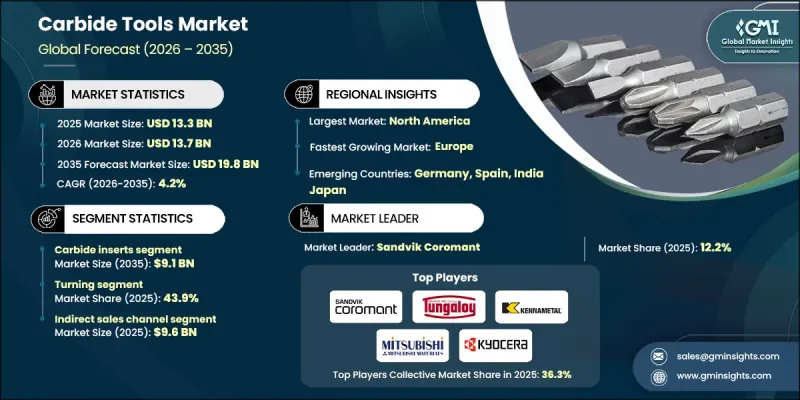
整体市场成长与工业生产中自动化、机器人和数位加工系统的日益普及密切相关。製造商越来越依赖高精度硬质合金刀具,以实现更严格的公差、提高重复性,并在先进的加工环境中实现高速加工。汽车、航太和其他精密加工产业持续优先采用硬质合金刀具,以提高生产效率并维持稳定的品质。表面处理和涂层技术的不断进步提高了刀具的耐用性、耐热性和运作,进一步增强了市场需求。同时,轻质和先进材料的生产扩张推动了对能够满足复杂加工需求的专用刀具解决方案的投资。随着工业设施不断现代化并追求更高的效率,硬质合金刀具仍然是不断发展的製造策略中不可或缺的组成部分。
| 市场覆盖范围 | |
|---|---|
| 开始年份 | 2025 |
| 预测年份 | 2026-2035 |
| 起始值 | 133亿美元 |
| 预测金额 | 198亿美元 |
| 复合年增长率 | 4.2% |
预计到2025年,硬质合金刀片市场规模将达到61亿美元,到2035年将达到91亿美元。硬质合金刀片凭藉其卓越的耐用性、耐磨性和高温性能,占据了最大的市场份额。这些特性使其能够实现更高的切削速度、更精确的尺寸和更长的刀具寿命,因此在对产量和一致性要求极高的生产环境中,刀片成为首选。
到2025年,车削应用领域将占43.9%的市场。由于车削在需要精确材料去除和均匀表面光洁度的行业中得到广泛应用,该领域将继续保持主导地位。车削在製造精度和重复性至关重要的复杂零件中发挥核心作用。旨在提升先进製造能力的扶持政策也促进了车削相关刀具解决方案的需求成长。
预计到2025年,美国硬质合金刀具市占率将达到78.1%。美国拥有完善的製造业基础,汽车、航太和国防等产业对精密加工的高度依赖,支撑了强劲的市场需求。国内对工业生产和基础设施的投资不断增长,并持续刺激金属加工活动,推动了全部区域先进硬质合金刀具的稳步普及。
目录
第一章调查方法和范围
第二章执行摘要
第三章业界考察
- 生态系分析
- 供应商情况
- 利润率
- 每个阶段的附加价值
- 影响价值链的因素
- 产业影响因素
- 司机
- 对精密加工的需求不断成长
- 金属加工和製造业活动的成长
- 工具涂层技术进步
- 产业潜在风险与挑战
- 较高的初始实施和维护成本
- 缺乏对硬质合金刀具维护的认识和专业知识
- 机会
- 与CNC和自动化系统集成
- 新兴市场和电动车生产
- 司机
- 成长潜力分析
- 未来市场趋势
- 科技与创新趋势
- 当前技术趋势
- 新兴技术
- 价格趋势
- 依产品类型
- 按地区
- 监管环境
- 标准和合规要求
- 区域法规结构
- 认证标准
- 贸易统计
- 主要进口国
- 主要出口国
- 差距分析
- 风险评估与缓解
- 波特五力分析
- PESTEL 分析
第四章 竞争情势
- 介绍
- 公司市占率分析
- 按地区
- 企业矩阵分析
- 主要市场公司的竞争分析
- 竞争定位矩阵
- 重大进展
- 併购
- 伙伴关係与合作
- 新产品发布
- 扩张计划
第五章 依产品类型分類的市场估算与预测,2022-2035年
- 硬质合金刀片
- 硬质合金切削刀具
- 硬质合金刀柄
- 硬质合金耐磨件
第六章 依涂料类型分類的市场估算与预测,2022-2035年
- 物理气相沉积(PVD)涂层
- 化学气相沉积(CVD)涂层
- 氮化钛(TiN)涂层
- 未上漆
- 其他(例如钛铝氮化物涂层等)
第七章 按应用领域分類的市场估算与预测,2022-2035年
- 转弯
- 铣削
- 挖掘
- 无聊的
- 切线
- 其他(例如,开槽刀片等)
第八章 依最终用途分類的市场估算与预测,2022-2035年
- 车
- 航太/国防
- 建造
- 机械製造业
- 石油和天然气
- 发电
- 其他(采矿、医疗设备製造等)
9. 2022-2035年按分销管道分類的市场估算与预测
- 直销
- 间接
第十章 2022-2035年各地区市场估计与预测
- 北美洲
- 我们
- 加拿大
- 欧洲
- 德国
- 法国
- 英国
- 义大利
- 西班牙
- 亚太地区
- 中国
- 印度
- 日本
- 韩国
- 澳洲
- 拉丁美洲
- 巴西
- 墨西哥
- 阿根廷
- 中东和非洲
- 南非
- 沙乌地阿拉伯
- 阿拉伯聯合大公国
第十一章 公司简介
- Ceratizit Group
- Guhring KG
- Hitachi Tool Engineering, Ltd.
- Iscar Ltd.
- Kennametal Inc.
- Kyocera Corporation
- Mitsubishi Materials Corporation
- OSG Corporation
- Sandvik Coromant
- Seco Tools
- Sumitomo Electric Industries Ltd.
- Tungaloy Corporation
- YG-1 Co
- Walter AG
- ZCC Cutting Tools
The Global Carbide Tools Market was valued at USD 13.3 billion in 2025 and is estimated to grow at a CAGR of 4.2% to reach USD 19.8 billion by 2035.
Growth across the market is tied to rising adoption of automation, robotics, and digitally controlled machining systems within industrial production. Manufacturers increasingly rely on high-precision carbide tools to meet tighter tolerances, improve repeatability, and support high-speed operations in advanced machining environments. Automotive, aerospace, and other precision-focused industries continue to prioritize carbide tooling to improve productivity while maintaining consistent quality. Ongoing advancements in surface treatment and coating technologies are further strengthening market demand by improving tool durability, heat resistance, and operational lifespan. In parallel, expanding production of lightweight and advanced materials is encouraging greater investment in specialized tooling solutions capable of handling complex machining requirements. As industrial facilities modernize and pursue higher efficiency levels, carbide tools remain essential components within evolving manufacturing strategies.
| Market Scope | |
|---|---|
| Start Year | 2025 |
| Forecast Year | 2026-2035 |
| Start Value | $13.3 Billion |
| Forecast Value | $19.8 Billion |
| CAGR | 4.2% |
The carbide inserts segment generated USD 6.1 billion in 2025 and is projected to reach USD 9.1 billion by 2035. Carbide inserts represent the largest share of the product landscape due to their superior durability, resistance to wear, and ability to perform under high-temperature conditions. These characteristics enable faster machining speeds, improved dimensional accuracy, and longer service life, making inserts a preferred choice for demanding production environments focused on throughput and consistency.
The turning applications segment accounted for 43.9% share in 2025. This segment continues to lead due to widespread use across industries requiring precise material removal and consistent surface finishes. Turning operations play a central role in producing complex components where accuracy and repeatability are critical. Supportive policies aimed at strengthening advanced manufacturing capabilities further contribute to the rising demand for turning-related tooling solutions.
U.S. Carbide Tools Market accounted for 78.1% share in 2025. Strong demand is supported by a well-established manufacturing base across automotive, aerospace, and defense sectors that rely heavily on precision machining. Increased domestic investment in industrial production and infrastructure continues to stimulate metalworking activity, reinforcing steady adoption of advanced carbide tooling across the region.
Key companies operating in the carbide tools market include Sandvik Coromant, Kennametal Inc., Mitsubishi Materials Corporation, Seco Tools, Walter AG, Kyocera Corporation, Iscar Ltd., Sumitomo Electric Industries Ltd., Ceratizit Group, OSG Corporation, Guhring KG, Tungaloy Corporation, Hitachi Tool Engineering, Ltd., YG-1 Co, and ZCC Cutting Tools. Companies in the Global Carbide Tools Market focus on multiple strategies to strengthen market position and sustain competitiveness. Continuous investment in research and development supports innovation in tool geometry, materials engineering, and performance optimization. Many players expand coating and surface treatment capabilities to extend tool life and improve machining efficiency. Strategic partnerships with machine tool manufacturers and industrial customers enable customized solutions and long-term contracts. Geographic expansion through new production facilities and distribution networks improves regional accessibility. Portfolio diversification across application-specific tools allows companies to serve a wider range of industries.
Table of Contents
Chapter 1 Methodology & Scope
- 1.1 Market scope and definition
- 1.2 Research design
- 1.2.1 Research approach
- 1.2.2 Data collection methods
- 1.3 Data mining sources
- 1.3.1 Global
- 1.3.2 Regional/Country
- 1.4 Base estimates and calculations
- 1.4.1 Base year calculation
- 1.4.2 Key trends for market estimation
- 1.5 Primary research and validation
- 1.5.1 Primary sources
- 1.6 Forecast model
- 1.7 Research assumptions and limitations
Chapter 2 Executive Summary
- 2.1 Industry 360° synopsis
- 2.2 Key market trends
- 2.2.1 Regional
- 2.2.2 Product Type
- 2.2.3 Coating Type
- 2.2.4 Application
- 2.2.5 End Use
- 2.2.6 Distribution Channel
- 2.3 CXO perspectives: Strategic imperatives
- 2.3.1 Key decision points for industry executives
- 2.3.2 Critical success factors for market players
- 2.4 Future outlook and strategic recommendations
Chapter 3 Industry Insights
- 3.1 Industry ecosystem analysis
- 3.1.1 Supplier landscape
- 3.1.2 Profit margin
- 3.1.3 Value addition at each stage
- 3.1.4 Factor affecting the value chain
- 3.2 Industry impact forces
- 3.2.1 Growth drivers
- 3.2.1.1 Rising demand for precision machining
- 3.2.1.2 Growth in metalworking and manufacturing activities
- 3.2.1.3 Technological advancements in tool coatings
- 3.2.2 Industry pitfalls & challenges
- 3.2.2.1 High initial installation and maintenance costs
- 3.2.2.2 Limited awareness and expertise in carbide tools maintenance
- 3.2.3 Opportunities
- 3.2.3.1 Integration with CNC and automated systems
- 3.2.3.2 Emerging markets and electric vehicle production
- 3.2.1 Growth drivers
- 3.3 Growth potential analysis
- 3.4 Future market trends
- 3.5 Technology and innovation landscape
- 3.5.1 Current technological trends
- 3.5.2 Emerging technologies
- 3.6 Price trends
- 3.6.1 By product type
- 3.6.2 By region
- 3.7 Regulatory landscape
- 3.7.1 Standards and compliance requirements
- 3.7.2 Regional regulatory frameworks
- 3.7.3 Certification standards
- 3.8 Trade statistics
- 3.8.1 Major importing countries
- 3.8.2 Major exporting countries
- 3.9 Gap analysis
- 3.10 Risk assessment and mitigation
- 3.11 Porter's analysis
- 3.12 PESTEL analysis
Chapter 4 Competitive Landscape, 2025
- 4.1 Introduction
- 4.2 Company market share analysis
- 4.2.1 By region
- 4.2.1.1 North America
- 4.2.1.2 Europe
- 4.2.1.3 Asia Pacific
- 4.2.1.4 Latin America
- 4.2.1.5 Middle East and Africa
- 4.2.1 By region
- 4.3 Company matrix analysis
- 4.4 Competitive analysis of major market players
- 4.5 Competitive positioning matrix
- 4.6 Key developments
- 4.6.1 Mergers & acquisitions
- 4.6.2 Partnerships & collaborations
- 4.6.3 New product launches
- 4.6.4 Expansion plans
Chapter 5 Market Estimates & Forecast, By Product Type, 2022-2035 (USD Billion) (Thousand Units)
- 5.1 Key trends
- 5.2 Carbide Inserts
- 5.3 Carbide Cutting Tools
- 5.4 Carbide Tool Holders
- 5.5 Carbide Wear Parts
Chapter 6 Market Estimates & Forecast, By Coating Type, 2022-2035 (USD Billion) (Thousand Units)
- 6.1 Key trends
- 6.2 PVD (Physical Vapor Deposition) Coated
- 6.3 CVD (Chemical Vapor Deposition) Coated
- 6.4 TiN (Titanium Nitride) Coated
- 6.5 Uncoated
- 6.6 Others (Titanium Aluminum Nitride Coated, etc)
Chapter 7 Market Estimates & Forecast, By Application, 2022-2035 (USD Billion) (Thousand Units)
- 7.1 Key trends
- 7.2 Turning
- 7.3 Milling
- 7.4 Drilling
- 7.5 Boring
- 7.6 Threading
- 7.7 Others (Grooving inserts, etc)
Chapter 8 Market Estimates & Forecast, By End Use, 2022-2035 (USD Billion) (Thousand Units)
- 8.1 Key trends
- 8.2 Automotive
- 8.3 Aerospace & Defense
- 8.4 Construction
- 8.5 Machinery Manufacturing
- 8.6 Oil & Gas
- 8.7 Power Generation
- 8.8 Others (Mining, Medical Equipment Manufacturing, etc.)
Chapter 9 Market Estimates & Forecast, By Distribution Channel, 2022-2035 (USD Billion) (Thousand Units)
- 9.1 Key trends
- 9.2 Direct
- 9.3 Indirect
Chapter 10 Market Estimates & Forecast, By Region, 2022-2035 (USD Billion) (Thousand Units)
- 10.1 Key trends
- 10.2 North America
- 10.2.1 U.S.
- 10.2.2 Canada
- 10.3 Europe
- 10.3.1 Germany
- 10.3.2 France
- 10.3.3 UK
- 10.3.4 Italy
- 10.3.5 Spain
- 10.4 Asia Pacific
- 10.4.1 China
- 10.4.2 India
- 10.4.3 Japan
- 10.4.4 South Korea
- 10.4.5 Australia
- 10.5 Latin America
- 10.5.1 Brazil
- 10.5.2 Mexico
- 10.5.3 Argentina
- 10.6 MEA
- 10.6.1 South Africa
- 10.6.2 Saudi Arabia
- 10.6.3 UAE
Chapter 11 Company Profiles
- 11.1 Ceratizit Group
- 11.2 Guhring KG
- 11.3 Hitachi Tool Engineering, Ltd.
- 11.4 Iscar Ltd.
- 11.5 Kennametal Inc.
- 11.6 Kyocera Corporation
- 11.7 Mitsubishi Materials Corporation
- 11.8 OSG Corporation
- 11.9 Sandvik Coromant
- 11.10 Seco Tools
- 11.11 Sumitomo Electric Industries Ltd.
- 11.12 Tungaloy Corporation
- 11.13 YG-1 Co
- 11.14 Walter AG
- 11.15 ZCC Cutting Tools

 硬质合金切削刀具市场:2026-2032年全球市场预测(依刀具类型、材料类型、製造流程、涂层类型、销售管道及最终用途产业划分)高速钢夹头铰刀市场:依产品类型、涂层类型、机器类型、最终用途产业和应用划分-全球预测,2026-2032年
 2026年全球硬质合金切削刀具市场报告按刀具类型、材质等级、涂层类型、刃数、最终用户和应用分類的整体硬质合金钻削刀具市场—2026-2032年全球预测按刀具类型、材质类型、应用和分销管道分類的整体切削刀具市场 - 全球预测 2026-2032硬质合金铰刀市场按刀具类型、涂层类型、柄部类型、直径范围、终端用户产业、应用和分销管道划分-2026-2032年全球预测
 全球硬质合金刀具市场
 硬质合金刀具市场报告:2031 年趋势、预测与竞争分析
 全球硬质合金刀具市场规模研究与预测(按产品类型、涂层类型、配置、最终用户和区域预测,2025-2035 年)