


 |
市场调查报告书
商品编码
1936669
负压伤口治疗市场机会、成长要素、产业趋势分析及2026年至2035年预测Negative Pressure Wound Therapy Market Opportunity, Growth Drivers, Industry Trend Analysis, and Forecast 2026 - 2035 |
||||||

全球负压伤口治疗 (NPWT) 市场预计到 2025 年将达到 22 亿美元,到 2035 年将达到 38 亿美元,年复合成长率为 5.8%。
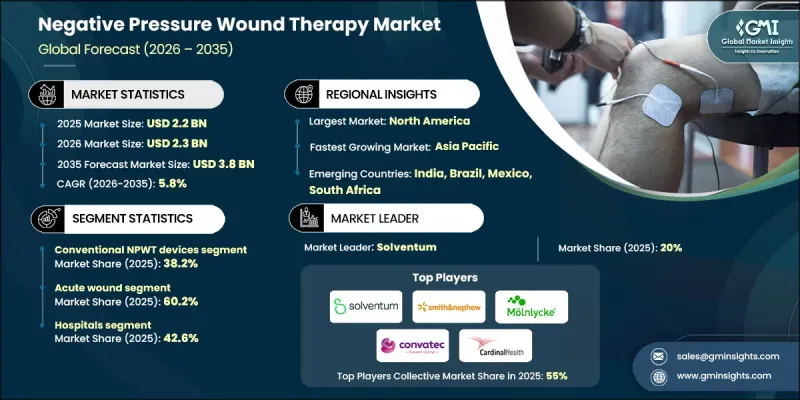
糖尿病盛行率上升、外科手术量增加以及全球急慢性伤口负担加重,推动了负压伤口治疗(NPWT)市场的稳定成长。科技创新重塑了NPWT,现代系统更加紧凑便携,并配备了物联网感测器和即时压力监测等智慧功能,使医护人员能够远端追踪创伤治疗,确保治疗的一致性。一次性装置和自动压力控制等创新技术提高了便利性,降低了感染风险,并有助于居家照护。 NPWT透过连接真空帮浦的封闭式敷料施加可控的减压,仍然是一项重要的创伤护理技术,能够促进伤口癒合,改善组织肉芽组织,并降低急慢性伤口的併发症率。
| 市场覆盖范围 | |
|---|---|
| 开始年份 | 2025 |
| 预测年份 | 2026-2035 |
| 起始值 | 22亿美元 |
| 预测金额 | 38亿美元 |
| 复合年增长率 | 5.8% |
预计到2025年,急性伤口市场规模将达到13亿美元,占市占率的60.2%。手术切口、创伤和烧伤是推动负压伤口治疗(NPWT)应用的主要因素,因为这些伤口需要更快癒合和预防感染。 NPWT装置因其促进组织再生、减轻肿胀和改善患者整体预后(尤其是在复杂手术和急诊手术中)而日益受到青睐,优于传统敷料。
到2025年,医院将占据42.6%的市场份额,成为负压伤口治疗(NPWT)系统的主要终端用户。医院能够维持大量的库存,并在急诊情况下提供及时的护理,这确保了NPWT的持续普及。拥有先进基础设施和高效采购流程的医院为NPWT的推广应用提供了理想的环境,尤其适用于需要即时介入的高风险伤口。携带式、技术赋能係统的集成,使医护人员能够在普通患者照护和重症监护室提供高效的治疗。
美国负压伤口治疗(NPWT)市场预计到2025年将达到7.173亿美元。这一增长主要得益于慢性伤口的高发生率以及美国先进的医疗保健基础设施。遍布全国的医院、诊所和专科治疗中心网络,使得患者能够方便地获得NPWT技术,从而推动了市场成长。
目录
第一章调查方法和范围
第二章执行摘要
第三章业界考察
- 生态系分析
- 产业影响因素
- 司机
- 慢性伤口及急性伤口数量呈上升趋势
- 糖尿病发生率呈上升趋势
- 全球外科手术数量不断增加
- 负压伤口治疗的技术进步
- 产业潜在风险与挑战
- 严格的法规环境
- 替代疗法的可近性
- 市场机会
- 新兴市场的地域扩张
- 司机
- 成长潜力分析
- 监管环境
- 北美洲
- 欧洲
- 亚太地区
- 科技趋势
- 当前技术趋势
- 新兴技术
- 未来市场趋势
- 定价分析
- 波特五力分析
- PESTEL 分析
第四章 竞争情势
- 介绍
- 公司市占率分析
- 企业矩阵分析
- 主要市场公司的竞争分析
- 竞争定位矩阵
- 重大进展
- 併购
- 合作伙伴关係和合资企业
- 新产品发布
- 扩张计划
第五章 2022-2035年按产品分類的市场估算与预测
- 传统负压伤口治疗装置
- 抛弃式负压伤口治疗装置
- NPWT配件和耗材
6. 按伤口类型分類的市场估计和预测,2022-2035 年
- 慢性伤口
- 糖尿病足溃疡
- 压疮
- 静脉性腿部溃疡
- 其他慢性伤口
- 急性伤口
- 外科性创伤
- 创伤性伤口
- 烧伤
7. 依最终用途分類的市场估计与预测,2022-2035 年
- 医院
- 专科诊所
- 居家医疗机构
- 其他最终用户
第八章 2022-2035年各地区市场估算与预测
- 北美洲
- 我们
- 加拿大
- 欧洲
- 德国
- 英国
- 法国
- 义大利
- 西班牙
- 荷兰
- 亚太地区
- 中国
- 印度
- 日本
- 澳洲
- 韩国
- 拉丁美洲
- 巴西
- 墨西哥
- 阿根廷
- 中东和非洲
- 沙乌地阿拉伯
- 南非
- 阿拉伯聯合大公国
第九章:公司简介
- 4L Health &Foryou Medical Electronics
- ATMOS MedizinTechnik
- Cardinal Health
- Carilex Medical
- Convatec
- DeRoyal Industries
- Genadyne Biotechnologies
- Lohmann &Rauscher International
- Medaxis
- Molnlycke
- PAUL HARTMANN
- Smith+Nephew
- Solventum
- Talley Group
- Weigao Group
The Global Negative Pressure Wound Therapy Market was valued at USD 2.2 billion in 2025 and is estimated to grow at a CAGR of 5.8% to reach USD 3.8 billion by 2035.
The market's steady growth is driven by the rising prevalence of diabetes, the increasing number of surgical procedures, and the growing burden of chronic and acute wounds worldwide. Technological advancements have reshaped NPWT, making modern systems more compact, portable, and equipped with smart features such as IoT-enabled sensors and real-time pressure monitoring, allowing clinicians to track wound healing remotely and ensure consistent therapy. Innovations like single-use devices and automated pressure control enhance convenience, reduce infection risks, and support home-based care. NPWT remains a critical wound care technique, using controlled sub-atmospheric pressure through a sealed dressing connected to a vacuum pump to accelerate healing in both acute and chronic wounds, improve tissue granulation, and lower complication rates.
| Market Scope | |
|---|---|
| Start Year | 2025 |
| Forecast Year | 2026-2035 |
| Start Value | $2.2 Billion |
| Forecast Value | $3.8 Billion |
| CAGR | 5.8% |
The acute wound segment accounted for USD 1.3 billion in 2025, representing 60.2% share. Surgical incisions, traumatic injuries, and burns are driving NPWT adoption due to their need for faster healing and infection prevention. NPWT devices are increasingly preferred over traditional dressings because they promote tissue regeneration, reduce swelling, and enhance overall patient outcomes, particularly in complex or emergency surgical cases.
The hospitals segment held 42.6% share in 2025, serving as the primary end users of NPWT systems. Their ability to maintain extensive inventories and deliver timely care in acute situations ensures consistent adoption. Hospitals with advanced infrastructure and streamlined procurement processes provide an ideal setting for NPWT deployment, especially for high-risk wounds where immediate intervention is critical. The integration of portable, technology-enabled systems allows healthcare providers to deliver efficient care in both inpatient and critical care environments.
U.S. Negative Pressure Wound Therapy Market USD 717.3 million in 2025. Growth is driven by the high prevalence of chronic wounds and the country's advanced healthcare infrastructure, supported by a vast network of hospitals, clinics, and specialized care centers that facilitate access to NPWT technologies.
Key players operating in the Global Negative Pressure Wound Therapy Market include 4L Health & Foryou Medical Electronics, ATMOS MedizinTechnik, Cardinal Health, Carilex Medical, Convatec, DeRoyal Industries, Genadyne Biotechnologies, Lohmann & Rauscher International, Medaxis, Molnlycke, PAUL HARTMANN, Smith+Nephew, Solventum, Talley Group, and Weigao Group. Companies in the negative pressure wound therapy market strengthen their foothold by investing in innovative product development, enhancing portability, and integrating smart monitoring features. They focus on expanding home care solutions and single-use devices to meet patient convenience and safety demands. Strategic collaborations with hospitals, clinics, and surgical centers allow co-development of tailored therapies and clinical trials to improve outcomes. Companies also expand geographically, establish robust distribution channels, and offer comprehensive after-sales support, training, and education to clinicians. Marketing campaigns highlighting clinical efficacy, cost-effectiveness, and infection prevention further strengthen brand trust and adoption globally.
Table of Contents
Chapter 1 Methodology and Scope
- 1.1 Market scope and definitions
- 1.2 Research design
- 1.2.1 Research approach
- 1.2.2 Data collection methods
- 1.3 Data mining sources
- 1.3.1 Global
- 1.3.2 Regional/country
- 1.4 Base estimates and calculations
- 1.4.1 Base year calculation
- 1.4.2 Key trends for market estimation
- 1.5 Primary research and validation
- 1.5.1 Primary sources
- 1.6 Forecast model
- 1.7 Research assumptions and limitations
Chapter 2 Executive Summary
- 2.1 Industry 360º synopsis
- 2.2 Key market trends
- 2.2.1 Regional trends
- 2.2.2 Product trends
- 2.2.3 Wound type trends
- 2.2.4 End use trends
- 2.3 CXO perspectives: Strategic imperatives
- 2.3.1 Key decision points for industry executives
- 2.3.2 Critical success factors for market players
- 2.4 Future outlook and strategic recommendations
Chapter 3 Industry Insights
- 3.1 Industry ecosystem analysis
- 3.2 Industry impact forces
- 3.2.1 Growth drivers
- 3.2.1.1 Rising prevalence of chronic and acute wounds
- 3.2.1.2 Increasing prevalence of diabetes
- 3.2.1.3 Increasing number of surgical procedures globally
- 3.2.1.4 Technology advancements in negative pressure wound therapy
- 3.2.2 Industry pitfalls and challenges
- 3.2.2.1 Stringent regulatory scenario
- 3.2.2.2 Availability of alternative therapies
- 3.2.3 Market opportunities
- 3.2.3.1 Regional expansion in emerging markets
- 3.2.1 Growth drivers
- 3.3 Growth potential analysis
- 3.4 Regulatory landscape
- 3.4.1 North America
- 3.4.2 Europe
- 3.4.3 Asia Pacific
- 3.5 Technology landscape
- 3.5.1 Current technological trends
- 3.5.2 Emerging technologies
- 3.6 Future market trends
- 3.7 Pricing analysis
- 3.8 Porter's analysis
- 3.9 PESTEL analysis
Chapter 4 Competitive Landscape, 2025
- 4.1 Introduction
- 4.2 Company market share analysis
- 4.3 Company matrix analysis
- 4.4 Competitive analysis of major market players
- 4.5 Competitive positioning matrix
- 4.6 Key development
- 4.6.1 Mergers and acquisitions
- 4.6.2 Partnerships and collaborations
- 4.6.3 New product launches
- 4.6.4 Expansion plans
Chapter 5 Market Estimates and Forecast, By Product, 2022 - 2035 ($ Mn)
- 5.1 Key trends
- 5.2 Conventional NPWT devices
- 5.3 Single use NPWT devices
- 5.4 NPWT accessories and consumables
Chapter 6 Market Estimates and Forecast, By Wound Type, 2022 - 2035 ($ Mn)
- 6.1 Key trends
- 6.2 Chronic wound
- 6.2.1 Diabetic foot ulcers
- 6.2.2 Pressure ulcers
- 6.2.3 Venous leg ulcers
- 6.2.4 Other chronic wounds
- 6.3 Acute wound
- 6.3.1 Surgical wounds
- 6.3.2 Traumatic wounds
- 6.3.3 Burns
Chapter 7 Market Estimates and Forecast, By End Use, 2022 - 2035 ($ Mn)
- 7.1 Key trends
- 7.2 Hospitals
- 7.3 Specialty clinics
- 7.4 Home care settings
- 7.5 Other end users
Chapter 8 Market Estimates and Forecast, By Region, 2022 - 2035 ($ Mn)
- 8.1 Key trends
- 8.2 North America
- 8.2.1 U.S.
- 8.2.2 Canada
- 8.3 Europe
- 8.3.1 Germany
- 8.3.2 UK
- 8.3.3 France
- 8.3.4 Italy
- 8.3.5 Spain
- 8.3.6 Netherlands
- 8.4 Asia Pacific
- 8.4.1 China
- 8.4.2 India
- 8.4.3 Japan
- 8.4.4 Australia
- 8.4.5 South Korea
- 8.5 Latin America
- 8.5.1 Brazil
- 8.5.2 Mexico
- 8.5.3 Argentina
- 8.6 Middle East and Africa
- 8.6.1 Saudi Arabia
- 8.6.2 South Africa
- 8.6.3 UAE
Chapter 9 Company Profiles
- 9.1 4L Health & Foryou Medical Electronics
- 9.2 ATMOS MedizinTechnik
- 9.3 Cardinal Health
- 9.4 Carilex Medical
- 9.5 Convatec
- 9.6 DeRoyal Industries
- 9.7 Genadyne Biotechnologies
- 9.8 Lohmann & Rauscher International
- 9.9 Medaxis
- 9.10 Molnlycke
- 9.11 PAUL HARTMANN
- 9.12 Smith+Nephew
- 9.13 Solventum
- 9.14 Talley Group
- 9.15 Weigao Group

 一次性伤口护理设备市场:按应用、最终用途、技术、伤口类型、产品类型、国家和地区划分-全球产业分析、市场规模、市场份额及2025年至2032年预测
 负压伤口治疗敷料市场规模、份额和成长分析:按产品类型、材质类型、应用、最终用户和地区划分 - 2026-2033 年行业预测
 2026年全球真空治疗设备市场报告
 负压伤口治疗法(NPWT)设备:全球市场
 负压伤口治疗法市场报告:按设备、组件、伤口类型、适应症、最终用户和地区划分,2026-2034 年
 抛弃式局部负压伤口治疗法设备市场规模、份额和趋势分析报告:按类型、伤口类型、最终用途、地区和细分市场预测(2026-2033 年)
 电刺激设备市场-全球产业规模、份额、趋势、机会及预测(按产品、适应症、最终用户、地区和竞争格局划分,2021-2031年)负压伤口治疗法(NPWT)市场规模、份额和趋势分析报告:按产品、伤口类型、最终用途、地区和细分市场预测,2026-2033年
 负压排水海绵市场:依产品类型、技术、应用、最终用户和分销管道划分-2026-2032年全球预测
 负压伤口治疗市场规模、份额和成长分析(按产品类型、伤口类型、最终用户、分销管道、应用和地区划分)—2026-2033年产业预测