


 |
市场调查报告书
商品编码
1936675
復健设备市场机会、成长要素、产业趋势分析及2026年至2035年预测Rehabilitation Equipment Market Opportunity, Growth Drivers, Industry Trend Analysis, and Forecast 2026 - 2035 |
||||||

全球康復设备市场预计到 2025 年将达到 230 亿美元,到 2035 年将达到 472 亿美元,年复合成长率为 7.5%。
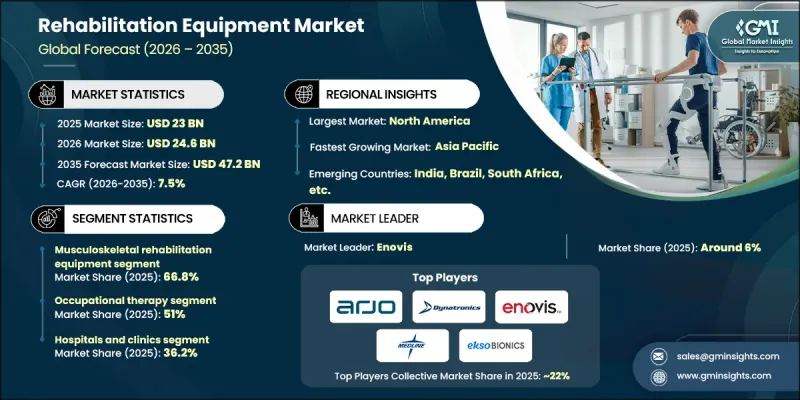
市场成长的驱动因素包括:身体残疾人数的增加、復健治疗覆盖范围的扩大、技术的快速创新、人口老化以及慢性疾病负担的加重。全球范围内需要长期行动辅助和物理復健解决方案的患者群体不断扩大,并持续刺激对復健设备的需求。随着功能障碍在人群中日益普遍,对辅助肌肉恢復、疼痛管理和独立行动的工具的需求也不断增长。此外,人们对早期復健介入和结构化復健计画重要性的认识不断提高,也推动了市场的发展。同时,创伤相关疾病发生率的上升也促使人们对持续復健支持的需求增加,从而在医疗机构中持续推高了对先进復健产品的需求。復健产业正经历重大变革时期,先进技术的融合提高了治疗的精准性、适应性和可及性。数位化系统的应用正在推动个人化护理的普及,并扩大了中心和门诊復健服务的覆盖范围。
| 市场覆盖范围 | |
|---|---|
| 开始年份 | 2025 |
| 预测年份 | 2026-2035 |
| 起始值 | 230亿美元 |
| 预测金额 | 472亿美元 |
| 复合年增长率 | 7.5% |
预计到2025年,肌肉骨骼復健设备市占率将达到66.8%。该领域的成长主要得益于对行动不便和术后復健解决方案日益增长的需求。行动障碍发生率的上升持续推动着用于恢復身体机能、增强肌肉力量以及辅助医疗干预后復健的专用设备的使用。
预计到2025年,职业治疗领域将占据51%的市场份额,这反映了其在恢復功能独立性方面发挥的核心作用。职能治疗中使用的设备有助于恢復日常生活活动能力,并帮助患者适应功能障碍。由于功能恢復仍然是医疗保健领域的关键挑战,因此对客製化復健解决方案日益增长的需求正在推动该领域的成长。
预计到2025年,北美復健设备市占率将达到36.8%。完善的医疗基础设施、早期復健实践的日益普及以及对先进治疗方案的强劲需求正在推动市场扩张。持续的技术进步也促进了復健设备在院内和门诊环境中的广泛应用。
目录
第一章调查方法和范围
第二章执行摘要
第三章业界考察
- 生态系分析
- 产业影响因素
- 司机
- 肌肉骨骼疾病呈上升趋势
- 技术进步
- 人口老化和慢性病盛行率上升
- 对復健治疗的需求不断增长
- 产业潜在风险与挑战
- 復健治疗高成本
- 缺乏对復健服务的认识与获取途径
- 机会
- 机器人辅助復健设备的快速发展
- 透过穿戴式感测器整合实现个人化復健跟踪
- 司机
- 成长潜力分析
- 监管环境
- 北美洲
- 欧洲
- 亚太地区
- LAMEA
- 科技与创新趋势
- 当前技术趋势
- 新兴技术
- 价值链分析
- 救赎方案
- 投资趋势和资金筹措环境
- 对消费行为的洞察
- 政策环境
- 波特五力分析
- PESTEL 分析
- 差距分析
- 未来市场趋势
第四章 竞争情势
- 介绍
- 企业矩阵分析
- 公司市占率分析
- 世界
- 北美洲
- 欧洲
- 亚太地区
- LAMEA
- 主要市场公司的竞争分析
- 竞争定位矩阵
- 重大进展
- 併购
- 伙伴关係与合作
- 新产品发布
- 扩张计划
第五章 2022-2035年按产品分類的市场估算与预测
- 肌肉骨骼復健设备
- 雷射疗法
- 超音波
- 电疗
- 其他肌肉骨骼装置
- 神经復健设备
- 神经机器人学
- 上肢矫正器具
- 下肢矫正器具
- 前臂矫正器具(手部)
- 健走训练器
- 外骨骼
- 非侵入性刺激器
- 穿戴式装置
- 脑机介面
- 神经復健评估设备
- 面向大众的神经復健设备
- 神经机器人学
- 心肺復健设备
- 椭圆机
- 平衡球
- 固定自行车
- 跑步机
- 划船机
- 心率监测器
- 血压监测仪
- 其他心肺装置
第六章 按应用领域分類的市场估算与预测,2022-2035年
- 职业疗法
- 物理治疗
- 其他用途
7. 依最终用途分類的市场估计与预测,2022-2035 年
- 医院和诊所
- 復健中心
- 居家医疗环境
- 物理治疗中心
第八章 2022-2035年各地区市场估算与预测
- 北美洲
- 我们
- 加拿大
- 欧洲
- 德国
- 英国
- 法国
- 西班牙
- 义大利
- 亚太地区
- 中国
- 日本
- 印度
- 澳洲
- 韩国
- 拉丁美洲
- 巴西
- 墨西哥
- 阿根廷
- 中东和非洲
- 南非
- 沙乌地阿拉伯
- 阿拉伯聯合大公国
第九章:公司简介
- Arjo
- Bioness
- BioXtreme
- BTL
- Caremax Rehabilitation Equipment
- Dynatronics
- Enovis
- Ekso Bionics
- Medline
- MicroPort
- OMRON Healthcare
- ReWalk Robotics
- Richmar
- STORZ MEDICAL
- Tyromotion
- Zimmer MedizinSysteme
The Global Rehabilitation Equipment Market was valued at USD 23 billion in 2025 and is estimated to grow at a CAGR of 7.5% to reach USD 47.2 billion by 2035.
Market growth is driven by the rising prevalence of physical impairments, increasing utilization of rehabilitation therapies, rapid technological innovation, and the expanding aging population, alongside a growing burden of chronic conditions. A substantial global patient base requiring long-term mobility support and physical recovery solutions continues to stimulate demand for rehabilitation equipment. As functional limitations become more common across populations, the need for tools that support strength restoration, pain management, and independent mobility continues to rise. The market also benefits from increasing awareness of early rehabilitation interventions and the importance of structured recovery programs. In parallel, a higher incidence of injury-related conditions has intensified the need for continuous rehabilitation support, creating sustained demand for advanced rehabilitation products across healthcare settings. The rehabilitation industry is undergoing a significant transformation fueled by the integration of advanced technologies that enhance therapy accuracy, adaptability, and accessibility. The adoption of digitally enabled systems has improved treatment personalization and expanded access to rehabilitation services across institutional and outpatient environments.
| Market Scope | |
|---|---|
| Start Year | 2025 |
| Forecast Year | 2026-2035 |
| Start Value | $23 Billion |
| Forecast Value | $47.2 Billion |
| CAGR | 7.5% |
The musculoskeletal rehabilitation equipment segment accounted for 66.8% share in 2025. Segment growth is supported by increasing demand for recovery solutions addressing movement limitations and post-treatment rehabilitation needs. Rising occurrences of mobility-related conditions continue to drive utilization of specialized equipment designed to restore physical function, improve strength, and support recovery processes following medical interventions.
The occupational therapy segment held a 51% share in 2025, reflecting its central role in restoring functional independence. Equipment used in occupational therapy supports individuals in regaining daily activity capabilities and adapting to functional limitations. Growing demand for customized rehabilitation solutions continues to strengthen this segment as functional recovery remains a key healthcare priority.
North America Rehabilitation Equipment Market accounted for 36.8% share in 2025. Market expansion is supported by a well-established healthcare infrastructure, increasing adoption of early rehabilitation practices, and strong demand for advanced therapeutic solutions. Continuous technological progress supports broader deployment across both hospital-based and outpatient care settings.
Key companies operating in the Global Rehabilitation Equipment Market include Medline, Arjo, Zimmer MedizinSysteme, Enovis, OMRON Healthcare, Ekso Bionics, ReWalk Robotics, Dynatronics, STORZ MEDICAL, BTL, Tyromotion, Bioness, Richmar, BioXtreme, Caremax Rehabilitation Equipment, and MicroPort. These companies maintain competitive positions through diversified product portfolios and global distribution capabilities. To strengthen their foothold, rehabilitation equipment manufacturers prioritize continuous product innovation and integration of advanced technologies that enhance therapy outcomes and usability. Companies invest heavily in research and development to improve device efficiency, adaptability, and patient engagement. Strategic partnerships with healthcare providers and rehabilitation centers help expand clinical adoption and long-term demand. Geographic expansion into emerging healthcare markets supports revenue diversification, while training programs and clinician education initiatives drive product utilization.
Table of Contents
Chapter 1 Methodology and Scope
- 1.1 Market scope and definition
- 1.2 Research design
- 1.2.1 Research approach
- 1.2.2 Data collection methods
- 1.3 Data mining sources
- 1.3.1 Global
- 1.3.2 Regional/Country
- 1.4 Base estimates and calculations
- 1.4.1 Base year calculation
- 1.4.2 Key trends for market estimation
- 1.5 Primary research and validation
- 1.5.1 Primary sources
- 1.6 Forecast model
- 1.7 Research assumptions and limitations
Chapter 2 Executive Summary
- 2.1 Industry 3600 synopsis
- 2.2 Key market trends
- 2.2.1 Regional trends
- 2.2.2 Product trends
- 2.2.3 Application trends
- 2.2.4 End use trends
- 2.3 CXO perspectives: Strategic imperatives
- 2.3.1 Key decision points for industry executives
- 2.3.2 Critical success factors for market players
- 2.4 Future outlook and strategic recommendations
Chapter 3 Industry Insights
- 3.1 Industry ecosystem analysis
- 3.2 Industry impact forces
- 3.2.1 Growth drivers
- 3.2.1.1 Growing incidences of musculoskeletal disorders
- 3.2.1.2 Technological advancements
- 3.2.1.3 Increasing geriatric population along with rising prevalence of chronic diseases
- 3.2.1.4 Rising demand for rehabilitation therapies
- 3.2.2 Industry pitfalls and challenges
- 3.2.2.1 High cost of rehab therapies
- 3.2.2.2 Lack of awareness and access to rehabilitation services
- 3.2.3 Opportunities
- 3.2.3.1 Rapid expansion of robotic-assisted rehabilitation devices
- 3.2.3.2 Integration of wearable sensors for personalized rehab tracking
- 3.2.1 Growth drivers
- 3.3 Growth potential analysis
- 3.4 Regulatory landscape
- 3.4.1 North America
- 3.4.2 Europe
- 3.4.3 Asia Pacific
- 3.4.4 LAMEA
- 3.5 Technology and innovation landscape
- 3.5.1 Current technological trends
- 3.5.2 Emerging technologies
- 3.6 Value chain analysis
- 3.7 Reimbursement scenario
- 3.8 Investment trends and funding landscape
- 3.9 Consumer behavioral insights
- 3.10 Policy landscape
- 3.11 Porter's analysis
- 3.12 PESTEL analysis
- 3.13 Gap analysis
- 3.14 Future market trends
Chapter 4 Competitive Landscape, 2025
- 4.1 Introduction
- 4.2 Company matrix analysis
- 4.3 Company market share analysis
- 4.3.1 Global
- 4.3.2 North America
- 4.3.3 Europe
- 4.3.4 Asia Pacific
- 4.3.5 LAMEA
- 4.4 Competitive analysis of major market players
- 4.5 Competitive positioning matrix
- 4.6 Key developments
- 4.6.1 Mergers & acquisitions
- 4.6.2 Partnerships & collaborations
- 4.6.3 New product launches
- 4.6.4 Expansion plans
Chapter 5 Market Estimates and Forecast, By Product, 2022 - 2035 ($ Mn)
- 5.1 Key trends
- 5.2 Musculoskeletal rehabilitation equipment
- 5.2.1 Laser therapy
- 5.2.2 Ultrasound
- 5.2.3 Electrotherapy
- 5.2.4 Other musculoskeletal equipment
- 5.3 Neurological rehabilitation equipment
- 5.3.1 Neurorobotic devices
- 5.3.1.1 Upper limb devices
- 5.3.1.2 Lower limb devices
- 5.3.1.3 Lower arm devices (Hands)
- 5.3.1.4 Gait training devices
- 5.3.1.5 Exoskeleton devices
- 5.3.2 Non-invasive stimulators
- 5.3.3 Wearable devices
- 5.3.4 Brain computer interface
- 5.3.5 Neuro-rehabilitation assessment equipment
- 5.3.6 Consumer neuro-rehabilitation equipment
- 5.3.1 Neurorobotic devices
- 5.4 Cardiopulmonary rehabilitation equipment
- 5.4.1 Elliptical trainer
- 5.4.2 Stabilization ball
- 5.4.3 Stationary bicycle
- 5.4.4 Treadmill
- 5.4.5 Rower
- 5.4.6 Heart rate monitor
- 5.4.7 Blood pressure monitor
- 5.4.8 Other cardiopulmonary equipment
Chapter 6 Market Estimates and Forecast, By Application, 2022 - 2035 ($ Mn)
- 6.1 Key trends
- 6.2 Occupational therapy
- 6.3 Physiotherapy
- 6.4 Other applications
Chapter 7 Market Estimates and Forecast, By End Use, 2022 - 2035 ($ Mn)
- 7.1 Key trends
- 7.2 Hospitals and clinics
- 7.3 Rehabilitation centers
- 7.4 Homecare settings
- 7.5 Physiotherapy centers
Chapter 8 Market Estimates and Forecast, By Region, 2022 - 2035 ($ Mn)
- 8.1 Key trends
- 8.2 North America
- 8.2.1 U.S.
- 8.2.2 Canada
- 8.3 Europe
- 8.3.1 Germany
- 8.3.2 UK
- 8.3.3 France
- 8.3.4 Spain
- 8.3.5 Italy
- 8.4 Asia Pacific
- 8.4.1 China
- 8.4.2 Japan
- 8.4.3 India
- 8.4.4 Australia
- 8.4.5 South Korea
- 8.5 Latin America
- 8.5.1 Brazil
- 8.5.2 Mexico
- 8.5.3 Argentina
- 8.6 MEA
- 8.6.1 South Africa
- 8.6.2 Saudi Arabia
- 8.6.3 UAE
Chapter 9 Company Profiles
- 9.1 Arjo
- 9.2 Bioness
- 9.3 BioXtreme
- 9.4 BTL
- 9.5 Caremax Rehabilitation Equipment
- 9.6 Dynatronics
- 9.7 Enovis
- 9.8 Ekso Bionics
- 9.9 Medline
- 9.10 MicroPort
- 9.11 OMRON Healthcare
- 9.12 ReWalk Robotics
- 9.13 Richmar
- 9.14 STORZ MEDICAL
- 9.15 Tyromotion
- 9.16 Zimmer MedizinSysteme

 復健诊断设备市场按产品类型、应用和最终用户划分,全球预测(2026-2032)
 2026年全球復健设备市场报告
 復健设备市场-全球产业规模、份额、趋势、机会及预测(依产品类型、行动辅助设备、运动设备、应用、最终用户、地区及竞争格局划分),2021-2031年復健和护理设备市场按产品类型、行动性别、应用、最终用户和分销管道划分 - 全球预测(2026-2032 年)
 日本復健设备市场报告(按产品类型、应用、最终用途和地区划分,2026-2034年)
 流域维修设备市场规模、份额及成长分析(依设备类型、应用领域、终端用户产业、动力来源、设备尺寸及地区划分)-2026-2033年产业预测
 復健设备市场规模、份额和成长分析(按类型、应用、最终用途和地区划分)-2026-2033年产业预测復健设备市场按产品类型、操作方式、材料、年龄层、最终用户和分销管道划分-全球预测,2025-2032年
 2025-2029年全球復健设备市场2025 年至 2033 年復健设备市场报告(按产品类型、应用、最终用途和地区)