


 |
市场调查报告书
商品编码
1959282
汽车eSIM管理市场机会、成长要素、产业趋势分析及预测(2026-2035年)Automotive eSIM Management Market Opportunity, Growth Drivers, Industry Trend Analysis, and Forecast 2026 - 2035 |
||||||

2025 年全球汽车 eSIM 管理市场价值为 13 亿美元,预计到 2035 年将达到 54 亿美元,复合年增长率为 15.9%。
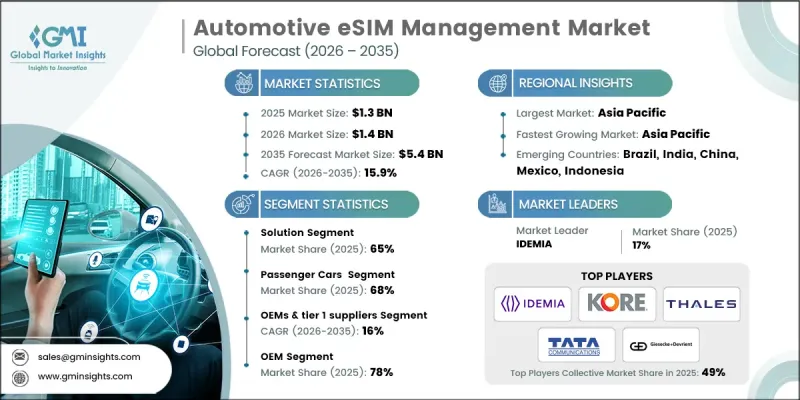
市场扩张的驱动力在于车辆对安全、远端系统管理的蜂窝网路连线日益增长的需求。与传统的可拆卸SIM卡不同,eSIM整合于车载资讯服务控制单元中,无需物理干预即可更新、启动和切换行动网路设定檔。车载eSIM管理平台正成为现代车辆互联的必备工具,为原始设备製造商 (OEM)、车队运营商和出行服务供应商提供车载资讯服务、空中下载 (OTA) 更新、资讯娱乐、紧急通讯和车联网 (V2X) 服务。高级驾驶辅助系统 (ADAS) 和自动驾驶技术的快速发展进一步推动了市场需求,不间断的高频宽蜂窝网路连接对于即时感测器数据、基于云端的决策和高清地图更新至关重要。监管要求、消费者对无缝车载连接的日益增长的期望以及汽车生态系统的数位转型是推动市场成长的关键因素。中国、日本和韩国的汽车频宽庞大,加上 5G 网路的扩展和智慧运输计画的推进,亚太地区正在崛起成为规模最大、成长最快的区域市场。
| 市场范围 | |
|---|---|
| 开始年份 | 2025 |
| 预测年份 | 2026-2035 |
| 起始金额 | 13亿美元 |
| 预测金额 | 54亿美元 |
| 复合年增长率 | 15.9% |
预计到2025年,解决方案市占率将达到65%,并在2035年之前以16.6%的复合年增长率成长。此细分市场包括eSIM管理软体平台、安全硬体组件和整合配置系统。解决方案的高普及率主要源自于部署企业级eSIM管理平台的高昂成本(全球OEM授权费在500万美元至1,500万美元之间)。这些平台提供订阅管理、远端SIM配置伺服器、设定檔生成以及与汽车后端系统的中间件整合。由于开发后的毛利率高达75%至85%,解决方案供应商享有强劲的获利能力,能够产生持续的收入并推动平台不断改进。
预计到2025年,乘用车市占率将达到68%,并在2035年之前维持16.2%的复合年增长率。乘用车在销售方面占据市场主导地位,并且正在率先采用各种互联功能,包括安全系统、资讯娱乐系统、远端车辆服务以及新兴的自动驾驶功能。尤其值得一提的是,消费者对车载智慧型手机般体验的期望正在推动eSIM的普及,尤其是在高阶豪华车领域。此外,乘用车安全法规的日益严格,例如强制性紧急呼叫系统,也促使市场对可靠的互联解决方案提出了更高的要求。
中国汽车eSIM管理市场预计到2025年将达到1.831亿美元,并在2035年之前以16.2%的复合年增长率成长。中国市场的成长主要得益于联网汽车的日益普及、政府主导的智慧型运输系统(ITS)推广、5G网路的扩展以及消费者对数位化汽车服务日益增长的需求。中国汽车年产量超过2,700万辆,在本土技术供应商和电动车(EV)创新者的支持下,eSIM互联服务正在中国市场快速整合。
目录
第一章:调查方法
第二章执行摘要
第三章业界考察
- 生态系分析
- 供应商情况
- 利润率分析
- 成本结构
- 每个阶段增加的价值
- 影响价值链的因素
- 中断
- 影响产业的因素
- 促进因素
- 联网汽车和自动驾驶汽车的普及速度正在迅速加快。
- 5G网路基础设施的扩展
- 关于车辆互联(eCall、C-V2X)的监管要求
- OEM厂商对远端订阅管理的需求
- 全球车队营运成本优化
- 增强型车辆网路安全要求
- 产业潜在风险与挑战
- 传统车队管理的复杂性
- 前期实施成本高
- 目前网路安全漏洞和威胁状况
- 全球法规结构不一致
- 市场机会
- 扩大电动车(EV)的互联互通
- 车队远端资讯处理的数位化
- V2X通讯生态系的发展
- 售后连接解决方案的成长
- 拓展新兴市场(印度、东南亚)
- 促进因素
- 成长潜力分析
- 监理情势
- 北美洲
- 美国:联邦车辆安全法规、排放气体法规、售后服务法规
- 加拿大:经认证的维护和电动车服务提供系统
- 欧洲
- 德国:欧盟车辆安全法规与国家服务标准
- 英国:关于脱欧后服务合规性和联网汽车的指导意见
- 法国:国家车辆检验与电动车维修政策
- 义大利:智慧交通系统试点计画和智慧服务法规
- 亚太地区
- 中国:工信部车辆服务要求和标准
- 印度:新兴汽车服务和互联互通的监管
- 日本:智慧交通系统互联互通与认证服务政策
- 澳洲:技术中立的智慧交通系统政策
- 拉丁美洲
- 墨西哥:NOM车辆安全标准
- 阿根廷:国家交通法 24.449
- 中东和非洲
- 南非:《道路交通法》(1996 年)
- 沙乌地阿拉伯:交通运输法律与2030愿景交通运输倡议
- 北美洲
- 波特的分析
- PESTEL 分析
- 技术与创新展望
- 当前技术趋势
- 远端SIM卡配置(RSP)技术
- SM-DP+架构的演变
- SM-SR 安全增强
- 新兴技术
- 零接触配置(ZTP)创新
- 工厂内设定檔配置 (IFPP) 的兴起
- 多模连接解决方案
- 当前技术趋势
- 专利分析
- 价格分析
- 定价模式(按设备收费、订阅、混合模式)
- 区域价格差异
- 价格趋势分析
- 成本结构细分
- 使用案例和成功案例
- 永续性和环境方面
- 永续倡议
- 减少废弃物策略
- 生产中的能源效率
- 具有环保意识的倡议
- 碳足迹考量
- 安全和隐私框架
- 资料加密通讯协定
- 安全的OTA更新与远端配置
- 遵守全球隐私法规
- 网路威胁缓解策略
- 服务和支援基础设施
- 经认证的 eSIM 和联网汽车支援服务中心系统
- 工程师培训和认证项目
- 远端诊断和预测性维护支持
- 客户支援和故障排除框架
- OEM一级供应商采用蓝图
第四章 竞争情势
- 介绍
- 企业市占率分析
- 北美洲
- 欧洲
- 亚太地区
- 拉丁美洲
- 中东和非洲
- 主要市场公司的竞争分析
- 竞争定位矩阵
- 战略展望矩阵
- 主要进展
- 併购
- 伙伴关係与合作
- 新产品发布
- 业务拓展计划及资金筹措
第五章 市场估算与预测:依产品类型划分,2022-2035年
- 解决方案
- 连结管理平台(CMP)
- 订阅管理员资料准备
- 订阅管理器安全路由 (SM-SR)
- 整合RSP平台
- 安全性和认证解决方案
- 其他的
- 服务
- 託管服务
- 专业服务
第六章 市场估价与预测:依车辆类型划分,2022-2035年
- 搭乘用车
- 掀背车车
- SUV
- 轿车
- 商用车辆
- 轻型商用车(LCV)
- 中型商用车(MCV)
- 重型商用车(HCV)
第七章 市场估计与预测:以连结方式划分,2022-2035年
- 4G/LTE eSIM
- 5G eSIM
- NB-IoT/LTE-M eSIM
- 混合型(4G + 5G)eSIM
第八章 市场估计与预测:依驱动因素划分,2022-2035年
- 电池式电动车(BEV)
- 插电式混合动力车(PHEV)
- 混合动力电动车(HEV)
- 内燃机车
第九章 市场估价与预测:依销售管道划分,2022-2035年
- OEM集成
- 售后市场
第十章 市场估价与预测:依最终用途划分,2022-2035年
- OEM製造商和一级供应商
- 车队营运商
- 售后服务服务供应商
第十一章 市场估价与预测:按地区划分,2022-2035年
- 北美洲
- 我们
- 加拿大
- 欧洲
- 德国
- 英国
- 法国
- 义大利
- 西班牙
- 俄罗斯
- 荷兰
- 瑞典
- 丹麦
- 波兰
- 亚太地区
- 中国
- 印度
- 日本
- 澳洲
- 韩国
- 新加坡
- 泰国
- 印尼
- 越南
- 拉丁美洲
- 巴西
- 墨西哥
- 阿根廷
- 哥伦比亚
- 中东和非洲
- 南非
- 沙乌地阿拉伯
- 阿拉伯聯合大公国
- 以色列
第十二章:公司简介
- 世界玩家
- Aeris Communications
- AT&T
- Deutsche Telekom
- Giesecke+Devrient(G+D)
- IDEMIA
- Kigen(Arm Company)
- KORE Wireless
- Tata Communications
- Thales
- Verizon Communications
- 本地球员
- Eseye
- Infineon Technologies
- NTT DOCOMO
- NXP Semiconductors
- Pelion
- Qualcomm Technologies
- Soracom
- STMicroelectronics
- Telefonica
- Trasna Solutions
- 新兴企业和技术支援公司
- 1Global
- Onomondo
- Singapore Telecommunications(Singtel)
- Valid
- Wireless Logic
The Global Automotive eSIM Management Market was valued at USD 1.3 billion in 2025 and is estimated to grow at a CAGR of 15.9% to reach USD 5.4 billion by 2035.
The market expansion is fueled by the increasing demand for secure, remotely managed cellular connectivity in vehicles. Unlike traditional removable SIM cards, eSIMs are embedded within telematics control units, allowing mobile network profiles to be updated, activated, or switched without physical intervention. Automotive eSIM management platforms have become essential for modern vehicle connectivity, supporting telematics, over-the-air updates, infotainment, emergency communications, and vehicle-to-everything (V2X) services for OEMs, fleet operators, and mobility service providers. The rapid growth of advanced driver assistance systems (ADAS) and autonomous driving technologies further drives demand, as uninterrupted high-bandwidth cellular connectivity is required for real-time sensor data, cloud-based decision-making, and HD map updates. Regulatory mandates, increasing consumer expectations for seamless in-car connectivity, and the digital transformation of the automotive ecosystem are key forces shaping market growth. Asia Pacific emerges as the largest and fastest-growing regional market due to high vehicle production in China, Japan, and South Korea, alongside expanding 5G networks and smart mobility initiatives.
| Market Scope | |
|---|---|
| Start Year | 2025 |
| Forecast Year | 2026-2035 |
| Start Value | $1.3 Billion |
| Forecast Value | $5.4 Billion |
| CAGR | 15.9% |
The solution segment held a 65% share in 2025 and is expected to grow at a CAGR of 16.6% through 2035. This segment includes eSIM management software platforms, secure hardware elements, and integrated provisioning systems. Solution adoption is high due to the significant costs associated with deploying enterprise-grade eSIM management platforms, with licensing fees for global OEMs ranging from USD 5 million to USD 15 million. These platforms provide subscription management, remote SIM provisioning servers, profile generation, and middleware integration with automotive backend systems. With gross margins of 75-85% post-development, solution providers benefit from strong vendor economics, driving recurring revenue and incentivizing ongoing platform enhancements.
The passenger car segment accounted for 68% share in 2025 and is expected to maintain a 16.2% CAGR through 2035. Passenger vehicles dominate the market in terms of unit volume and early adoption of connectivity features, including safety systems, infotainment, remote vehicle services, and emerging autonomous capabilities. Consumer expectations for smartphone-like experiences in cars, particularly in premium and luxury segments, are driving eSIM adoption. Stricter safety regulations in passenger vehicles, including emergency call mandates, also reinforce the need for reliable connectivity solutions.
China Automotive eSIM Management Market reached USD 183.1 million in 2025 and is projected to grow at a CAGR of 16.2% through 2035. The market growth in China is driven by widespread connected vehicle adoption, government-backed intelligent transportation initiatives, 5G network expansion, and rising consumer demand for digital vehicle services. With over 27 million vehicles produced annually, China's automotive market is rapidly integrating eSIM-enabled connected services, supported by domestic technology providers and electric vehicle innovators.
Key players operating in the Global Automotive eSIM Management Market include Aeris Communications, AT&T, Deutsche Telekom, Giesecke+Devrient (G+D), IDEMIA, Kigen (Arm Company), KORE Wireless, Tata Communications, Thales, and Verizon Communications. Companies in the Automotive eSIM Management Market are strengthening their presence by investing in comprehensive eSIM platforms that support remote provisioning, network switching, and lifecycle management across global OEMs. Strategic partnerships with vehicle manufacturers, telecom operators, and cloud providers enable seamless integration of connectivity services and ensure compliance with regional regulations. Vendors are expanding their service portfolios to include subscription management, middleware integration, and analytics for connected services. Investments in R&D focus on improving scalability, security, and interoperability of eSIM platforms, while regional expansions target high-growth markets in Asia Pacific and Europe.
Table of Contents
Chapter 1 Methodology
- 1.1 Research approach
- 1.2 Quality commitments
- 1.3 Research trail and confidence scoring
- 1.3.1 Research trail components
- 1.3.2 Scoring components
- 1.4 Data collection
- 1.4.1 Partial list of primary sources
- 1.5 Data mining sources
- 1.5.1 Paid sources
- 1.6 Best estimates and calculations
- 1.6.1 Base year calculation for any one approach
- 1.7 Forecast model
- 1.8 Research transparency addendum
Chapter 2 Executive Summary
- 2.1 Industry 360° synopsis, 2022 - 2035
- 2.2 Key market trends
- 2.2.1 Regional
- 2.2.2 Offering
- 2.2.3 Vehicle
- 2.2.4 Connectivity
- 2.2.5 Propulsion
- 2.2.6 Sales Channel
- 2.2.7 End Use
- 2.3 TAM Analysis, 2026-2035
- 2.4 CXO perspectives: Strategic imperatives
Chapter 3 Industry Insights
- 3.1 Industry ecosystem analysis
- 3.1.1 Supplier landscape
- 3.1.2 Profit margin analysis
- 3.1.3 Cost structure
- 3.1.4 Value addition at each stage
- 3.1.5 Factor affecting the value chain
- 3.1.6 Disruptions
- 3.2 Industry impact forces
- 3.2.1 Growth drivers
- 3.2.1.1 Surge in connected & autonomous vehicle deployments
- 3.2.1.2 5G network infrastructure expansion
- 3.2.1.3 Regulatory mandates for vehicle connectivity (eCall, C-V2X)
- 3.2.1.4 OEM demand for remote subscription management
- 3.2.1.5 Cost optimization in global fleet operations
- 3.2.1.6 Enhanced vehicle cybersecurity requirements
- 3.2.2 Industry pitfalls and challenges
- 3.2.2.1 Legacy fleet management complexity
- 3.2.2.2 High initial implementation costs
- 3.2.2.3 Cybersecurity vulnerabilities & threat landscape
- 3.2.2.4 Inconsistent global regulatory frameworks
- 3.2.3 Market opportunities
- 3.2.3.1 Electric vehicle (EV) connectivity expansion
- 3.2.3.2 Fleet telematics digitalization
- 3.2.3.3 V2X communication ecosystem development
- 3.2.3.4 Aftermarket connectivity solutions growth
- 3.2.3.5 Emerging markets penetration (India, Southeast Asia)
- 3.2.1 Growth drivers
- 3.3 Growth potential analysis
- 3.4 Regulatory landscape
- 3.4.1 North America
- 3.4.1.1 US- Federal vehicle safety, emissions, and post-repair service regulations
- 3.4.1.2 Canada - Certified maintenance and EV servicing framework
- 3.4.2 Europe
- 3.4.2.1 Germany- EU vehicle safety regulations & national service standards
- 3.4.2.2 UK- Post-Brexit service compliance & connected vehicle guidance
- 3.4.2.3 France- National vehicle inspection & EV servicing policy
- 3.4.2.4 Italy- ITS pilots & smart-service regulations
- 3.4.3 Asia Pacific
- 3.4.3.1 China- MIIT vehicle servicing mandates & standards
- 3.4.3.2 India- Emerging automotive service & connectivity regulations
- 3.4.3.3 Japan- ITS connect & certified service policies
- 3.4.3.4 Australia- Technology neutral ITS policies
- 3.4.4 LATAM
- 3.4.4.1 Mexico- NOM vehicle safety standards
- 3.4.4.2 Argentina- National traffic law 24.449
- 3.4.5 MEA
- 3.4.5.1 South Africa- National road traffic act (1996)
- 3.4.5.2 Saudi Arabia- Traffic law & vision 2030 transport initiatives
- 3.4.1 North America
- 3.5 Porter’s analysis
- 3.6 PESTEL analysis
- 3.7 Technology and innovation landscape
- 3.7.1 Current technological trends
- 3.7.1.1 Remote SIM provisioning (RSP) technology
- 3.7.1.2 SM-DP+ architecture advancements
- 3.7.1.3 SM-SR security enhancements
- 3.7.2 Emerging technologies
- 3.7.2.1 Zero-touch provisioning (ZTP) innovations
- 3.7.2.2 In-factory profile provisioning (IFPP) emergence
- 3.7.2.3 Multi-mode connectivity solutions
- 3.7.1 Current technological trends
- 3.8 Patent analysis
- 3.9 Pricing analysis
- 3.9.1 Pricing models (per-device, subscription, hybrid)
- 3.9.2 Regional price variations
- 3.9.3 Price trend analysis
- 3.9.4 Cost structure breakdown
- 3.10 Use cases & success stories
- 3.11 Sustainability and environmental aspects
- 3.11.1 Sustainable practices
- 3.11.2 Waste reduction strategies
- 3.11.3 Energy efficiency in production
- 3.11.4 Eco-friendly Initiatives
- 3.11.5 Carbon footprint considerations
- 3.12 Security & privacy framework
- 3.12.1 Data encryption protocols
- 3.12.2 Secure OTA updates & remote provisioning
- 3.12.3 Compliance with global privacy regulations
- 3.12.4 Cyber threat mitigation strategies
- 3.13 Service & support infrastructure
- 3.13.1 Authorized service center readiness for eSIM and connected vehicles
- 3.13.2 Technician training & certification programs
- 3.13.3 Remote diagnostics & predictive maintenance support
- 3.13.4 Customer support & troubleshooting frameworks
- 3.14 OEM & Tier-1 Adoption Roadmap
Chapter 4 Competitive Landscape, 2025
- 4.1 Introduction
- 4.2 Company market share analysis
- 4.2.1 North America
- 4.2.2 Europe
- 4.2.3 Asia Pacific
- 4.2.4 LATAM
- 4.2.5 MEA
- 4.3 Competitive analysis of major market players
- 4.4 Competitive positioning matrix
- 4.5 Strategic outlook matrix
- 4.6 Key developments
- 4.6.1 Mergers & acquisitions
- 4.6.2 Partnerships & collaborations
- 4.6.3 New product launches
- 4.6.4 Expansion plans and funding
Chapter 5 Market Estimates & Forecast, By Offering, 2022 - 2035 ($Bn)
- 5.1 Key trends
- 5.2 Solution
- 5.2.1 Connectivity management platforms (CMP)
- 5.2.2 Subscription manager data preparation
- 5.2.3 Subscription manager secure routing (SM-SR)
- 5.2.4 Integrated RSP platforms
- 5.2.5 Security & authentication solutions
- 5.2.6 Others
- 5.3 Services
- 5.3.1 Managed services
- 5.3.2 Professional services
Chapter 6 Market Estimates & Forecast, By Vehicle, 2022 - 2035 ($Bn)
- 6.1 Key trends
- 6.2 Passenger cars
- 6.2.1 Hatchbacks
- 6.2.2 SUV
- 6.2.3 Sedan
- 6.3 Commercial vehicles
- 6.3.1 Light commercial vehicles (LCVs)
- 6.3.2 Medium commercial vehicles (MCVs)
- 6.3.3 Heavy commercial vehicles (HCVs)
Chapter 7 Market Estimates & Forecast, By Connectivity, 2022 - 2035 ($Bn)
- 7.1 Key trends
- 7.2 4G/LTE eSIM
- 7.3 5G eSIM
- 7.4 NB-IoT / LTE-M eSIM
- 7.5 Hybrid (4G + 5G) eSIM
Chapter 8 Market Estimates & Forecast, By Propulsion, 2022 - 2035 ($Bn)
- 8.1 Key trends
- 8.2 Battery electric vehicles (BEV)
- 8.3 Plug-in hybrid electric vehicles (PHEV)
- 8.4 Hybrid electric vehicles (HEV)
- 8.5 Internal combustion engine (ICE) vehicles
Chapter 9 Market Estimates & Forecast, By Sales Channel, 2022 - 2035 ($Bn)
- 9.1 Key trends
- 9.2 OEM embedded
- 9.3 Aftermarket
Chapter 10 Market Estimates & Forecast, By End Use, 2022 - 2035 ($Bn)
- 10.1 Key trends
- 10.2 OEMs & tier 1 suppliers
- 10.3 Fleet operators
- 10.4 Aftermarket service providers
Chapter 11 Market Estimates & Forecast, By Region, 2022 - 2035 ($Bn)
- 11.1 Key trends
- 11.2 North America
- 11.2.1 US
- 11.2.2 Canada
- 11.3 Europe
- 11.3.1 Germany
- 11.3.2 UK
- 11.3.3 France
- 11.3.4 Italy
- 11.3.5 Spain
- 11.3.6 Russia
- 11.3.7 Netherlands
- 11.3.8 Sweden
- 11.3.9 Denmark
- 11.3.10 Poland
- 11.4 Asia Pacific
- 11.4.1 China
- 11.4.2 India
- 11.4.3 Japan
- 11.4.4 Australia
- 11.4.5 South Korea
- 11.4.6 Singapore
- 11.4.7 Thailand
- 11.4.8 Indonesia
- 11.4.9 Vietnam
- 11.5 Latin America
- 11.5.1 Brazil
- 11.5.2 Mexico
- 11.5.3 Argentina
- 11.5.4 Colombia
- 11.6 MEA
- 11.6.1 South Africa
- 11.6.2 Saudi Arabia
- 11.6.3 UAE
- 11.6.4 Israel
Chapter 12 Company Profiles
- 12.1 Global Players
- 12.1.1 Aeris Communications
- 12.1.2 AT&T
- 12.1.3 Deutsche Telekom
- 12.1.4 Giesecke+Devrient (G+D)
- 12.1.5 IDEMIA
- 12.1.6 Kigen (Arm Company)
- 12.1.7 KORE Wireless
- 12.1.8 Tata Communications
- 12.1.9 Thales
- 12.1.10 Verizon Communications
- 12.2 Regional Players
- 12.2.1 Eseye
- 12.2.2 Infineon Technologies
- 12.2.3 NTT DOCOMO
- 12.2.4 NXP Semiconductors
- 12.2.5 Pelion
- 12.2.6 Qualcomm Technologies
- 12.2.7 Soracom
- 12.2.8 STMicroelectronics
- 12.2.9 Telefonica
- 12.2.10 Trasna Solutions
- 12.3 Emerging Players & Technology Enablers
- 12.3.1 1Global
- 12.3.2 Onomondo
- 12.3.3 Singapore Telecommunications (Singtel)
- 12.3.4 Valid
- 12.3.5 Wireless Logic

 停车位侦测系统市场按技术类型、组件、最终用户和部署模式划分,全球预测(2026-2032年)
 卫星互联汽车:全球趋势与预测(2024-2034)
 日本联网汽车市场规模、份额、趋势和预测:按技术、应用、连网性别、车辆类型和地区划分,2026-2034年智慧驾驶网关控制器市场按连接类型、技术、驾驶自动化等级、车辆类型、感测器介面、分销管道和应用划分,全球预测,2026-2032年
 先进车辆远端资讯处理市场预测至2032年:按组件、连接方式、车辆类型、应用、最终用户和地区分類的全球分析全球OTA车辆升级平台市场预测(至2032年),按升级类型、车辆类型、动力类型、应用、最终用户和地区划分日本联网汽车市场报告:按技术、连网解决方案、服务、终端市场和地区划分(2026-2034年)
 联网汽车市场规模、份额和成长分析(按技术类型、应用、互联性别、车辆互联性别、车辆类型、终端市场和地区划分)-2026-2033年产业预测联网汽车市场预测至2032年:按连接类型、网路和V2X、动力系统、车辆类型、应用、终端市场和地区分類的全球分析
 车载资讯娱乐、导航和车载资讯服务市场规模、占有率、成长及全球产业分析:按类型、应用和地区划分的洞察与预测(2024-2032 年)