


 |
市场调查报告书
商品编码
1959291
按需付费订阅市场机会、成长要素、产业趋势分析及预测(2026-2035 年)Performance-on-Demand Subscription Market Opportunity, Growth Drivers, Industry Trend Analysis, and Forecast 2026 - 2035 |
||||||

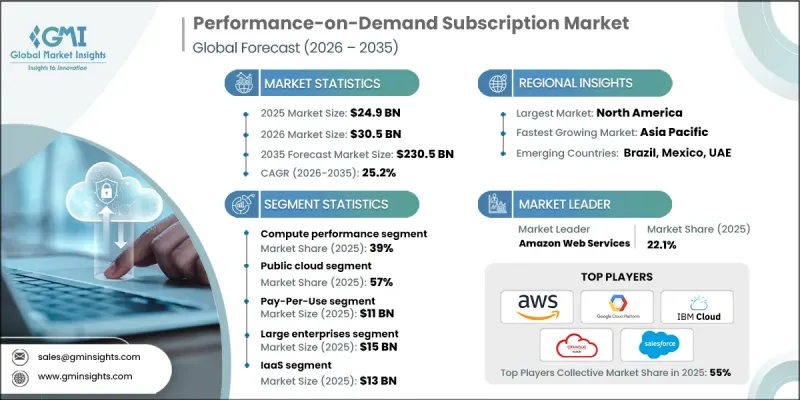
2025 年全球按需付费订阅市场价值为 249 亿美元,预计到 2035 年将达到 2,305 亿美元,年复合成长率为 25.2%。
市场成长的驱动力来自云端原生架构的加速转型、企业对计量型IT模式日益增长的偏好,以及在维持成本控制的同时即时优化效能的迫切需求。各行各业的组织都面临越来越大的压力,需要提高营运柔软性、控制基础设施支出、增强应用程式回应能力,并遵守不断发展的安全和监管标准。因此,将资源利用率与实际工作负载需求挂钩的基于效能的订阅框架正变得越来越普遍。企业正在从固定容量的基础设施转向可扩展的、基于使用量的环境,以支援动态配置和可衡量的效能结果。这种转变在混合云和多重云端环境中尤其显着,因为企业需要持续了解运算、储存、网路和应用程式的效率。因此,随着全球数位转型力度的加大,随选性能订阅市场预计将显着成长。
| 市场范围 | |
|---|---|
| 开始年份 | 2025 |
| 预测年份 | 2026-2035 |
| 起始金额 | 249亿美元 |
| 预测金额 | 2305亿美元 |
| 复合年增长率 | 25.2% |
快速的技术进步正在重塑按需效能订阅的格局。人工智慧 (AI) 和机器学习的进步实现了预测性资源分配、自动化工作负载平衡和即时基础设施分析。现代可观测性工具和编配平台提高了分散式 IT 系统的可见性,而边缘到云端的连接则改善了响应速度和营运弹性。无伺服器运算框架和模组化订阅模式透过无需大量资本支出即可实现资源即时扩展,进一步变革了传统的基础设施策略。行业相关人员越来越关注可互通的、以云端为中心的订阅生态系统,并希望对绩效指标和支出模式进行精细控制。这些发展正在重新定义企业 IT 策略,为全球企业、中小企业和专业工业环境带来更敏捷、高效和数据驱动的基础设施管理。
预计到2025年,计算性能细分市场将占据39%的市场份额,并在2026年至2035年间以25.3%的复合年增长率成长。该细分市场之所以能保持主导地位,是因为运算资源是云端、混合云和多重云端环境中数位工作负载的基础。企业依靠可扩展的运算服务来管理不断变化的处理需求、支援进阶分析并保持应用程式的回应速度。动态分配虚拟化和容器化资源的能力,透过确保业务连续性并最大限度地减少延迟和资源利用不足,进一步巩固了该细分市场的主导地位。
预计到2025年,公共云端市场占有率将达到57%,并在2035年之前以25.7%的复合年增长率成长。对于地理位置分散的企业而言,公共云端平台凭藉其可扩展性、维运柔软性和成本优化优势,仍是首选的部署模式。企业青睐公共云端环境,因为它能够集中进行效能监控、智慧工作负载最佳化、提供预测分析功能并存取远端系统。公有云能够即时扩展运算、储存、网路和应用服务,同时与现有IT系统保持无缝集成,这持续推动其广泛应用和市场领先地位。
预计2025年,美国按需付费效能订阅市场规模将达到约80亿美元,市占率高达83%。成熟的云端基础设施、先进的数位生态系统以及人工智慧驱动的效能管理解决方案的快速整合是推动这一成长的主要因素。高速连接框架的早期应用,例如支援预测性工作负载分析、自动化资源配置以及高效安全的IT运维,也促进了该地区的成长。企业对技术的广泛应用以及对云端创新持续投入,进一步巩固了北美在按需付费性能订阅市场的领先地位。
目录
第一章:调查方法和范围
第二章执行摘要
第三章业界考察
- 生态系分析
- 供应商情况
- 利润率
- 成本结构
- 每个阶段增加的价值
- 影响价值链的因素
- 中断
- 影响产业的因素
- 促进因素
- 云端和混合IT环境的广泛应用
- 对IT支出成本优化和透明度的需求日益增长
- 数据密集型和人工智慧驱动型工作负载的扩展
- 自动化和可观测性技术的进步
- 产业潜在风险与挑战
- 与成本可预测性相关的挑战
- 安全、合规和供应商锁定风险
- 市场机会
- 人工智慧驱动的效能优化平台的应用日益广泛
- 拓展新兴市场与中小企业领域
- 从边缘到云端的集成
- 行业特定定制
- 促进因素
- 成长潜力分析
- 监理情势
- 北美洲
- 美国:国家公路交通安全管理局 (NHTSA) 和联邦通讯委员会 (FCC) 指南
- 加拿大:加拿大和加拿大创新、科学与经济发展部 (ISED) 指南
- 欧洲
- 德国:联邦交通和数位基础设施部
- 法国:生态转型部
- 英国:运输部
- 义大利:基础设施和运输部
- 亚太地区
- 中国:工业和资讯化部
- 日本国土交通省
- 韩国国土交通部
- 印度:公路运输与公路部
- 拉丁美洲
- 巴西:国家交通运输署
- 墨西哥:通讯与运输部部 (SCT)
- 中东和非洲
- 阿拉伯联合大公国:工业与先进技术部
- 沙乌地阿拉伯:沙乌地阿拉伯标准、计量和品质研究院
- 北美洲
- 波特的分析
- PESTEL 分析
- 科技与创新趋势
- 当前技术趋势
- 新兴技术
- 价格趋势
- 按地区
- 副产品
- 成本細項分析
- 专利分析
- 永续性和环境方面
- 永续实践
- 减少废弃物策略
- 生产中的能源效率
- 具有环保意识的倡议
- 碳足迹考量
- 使用案例场景
第四章 竞争情势
- 介绍
- 企业市占率分析
- 北美洲
- 欧洲
- 亚太地区
- 拉丁美洲
- 中东和非洲
- 主要市场公司的竞争分析
- 竞争定位矩阵
- 战略展望矩阵
- 主要进展
- 併购
- 伙伴关係与合作
- 新产品发布
- 业务拓展计划及资金筹措
第五章 市场估计与预测:依服务业划分,2022-2035年
- 运算效能
- 储存吞吐量
- 网路效能
- 资料库/分析效能
- 安全性能服务
第六章 市场估价与预测:依订阅模式划分,2022-2035年
- 付费使用制
- 按层级分類的绩效
- 动态缩放
- 油电混合套件
第七章 市场估算与预测:依部署类型划分,2022-2035年
- 公共云端
- 私有云端
- 混合云端
第八章 市场估算与预测:依云端服务模式划分,2022-2035年
- IaaS
- PaaS
- SaaS
- FaaS
第九章 市场估计与预测:依公司规模划分,2022-2035年
- 大公司
- 小型企业
第十章 市场估计与预测:依产业划分,2022-2035年
- BFSI
- 卫生保健
- 零售与电子商务
- 沟通
- IT和软体服务
- 其他的
第十一章 市场估价与预测:按地区划分,2022-2035年
- 北美洲
- 我们
- 加拿大
- 欧洲
- 英国
- 德国
- 法国
- 义大利
- 西班牙
- 比利时
- 荷兰
- 瑞典
- 亚太地区
- 中国
- 印度
- 日本
- 澳洲
- 新加坡
- 韩国
- 越南
- 印尼
- 拉丁美洲
- 巴西
- 墨西哥
- 阿根廷
- 中东和非洲
- 阿拉伯聯合大公国
- 南非
- 沙乌地阿拉伯
第十二章:公司简介
- Global Player
- Alibaba Cloud
- Amazon Web Services(AWS)
- Dassault Systemes
- Google Cloud Platform(GCP)
- IBM Cloud
- Microsoft Azure
- Oracle Cloud
- PTC
- Salesforce
- Siemens
- Regional Player
- ANSYS
- Baidu Cloud
- EZ Crusher
- Hexagon
- Huawei Cloud
- Keestrack
- NEC
- OverBuilt
- SAP
- Tata Consultancy Services
- 新玩家
- CloudSigma
- Cohesity
- DigitalOcean
- Nutanix
- OutSystems
The Global Performance-on-Demand Subscription Market was valued at USD 24.9 billion in 2025 and is estimated to grow at a CAGR of 25.2% to reach USD 230.5 billion by 2035.
Market growth is fueled by the accelerating shift toward cloud-native architectures, the growing preference among enterprises for consumption-based IT models, and the increasing need to optimize performance in real-time while maintaining cost discipline. Organizations across industries are under mounting pressure to enhance operational flexibility, control infrastructure spending, improve application responsiveness, and comply with evolving security and regulatory standards. As a result, performance-based subscription frameworks that align resource utilization with actual workload demand are gaining widespread traction. Enterprises are moving away from fixed-capacity infrastructure toward scalable, usage-driven environments that support dynamic provisioning and measurable performance outcomes. This transition is particularly strong in hybrid and multi-cloud ecosystems, where businesses require continuous visibility into compute, storage, networking, and application efficiency. The performance-on-demand subscription market is therefore positioned for substantial expansion as digital transformation initiatives intensify globally.
| Market Scope | |
|---|---|
| Start Year | 2025 |
| Forecast Year | 2026-2035 |
| Start Value | $24.9 Billion |
| Forecast Value | $230.5 Billion |
| CAGR | 25.2% |
Rapid technological innovation is reshaping the performance-on-demand subscription landscape. Advancements in artificial intelligence and machine learning are enabling predictive resource allocation, automated workload balancing, and real-time infrastructure analytics. Modern observability tools and orchestration platforms are enhancing visibility across distributed IT systems, while edge-to-cloud connectivity is improving response times and operational resilience. Serverless computing frameworks and modular subscription models are further transforming traditional infrastructure strategies by allowing organizations to scale resources instantly without heavy capital expenditure. Industry participants are increasingly focused on interoperable, cloud-centric subscription ecosystems that provide granular control over performance metrics and spending patterns. These developments are redefining enterprise IT strategies by enabling more agile, efficient, and data-driven infrastructure management across global enterprises, SMEs, and specialized industry environments.
The compute performance segment accounted for 39% share in 2025 and is anticipated to grow at a CAGR of 25.3% from 2026 to 2035. This segment maintains a leading position because compute resources form the backbone of digital workloads across cloud, hybrid, and multi-cloud environments. Organizations rely on scalable compute services to manage fluctuating processing requirements, support advanced analytics, and maintain consistent application responsiveness. The ability to dynamically allocate virtualized and containerized resources ensures operational continuity while minimizing latency and resource underutilization, reinforcing the segment's dominance.
The public cloud segment held 57% share in 2025 and is forecast to grow at a CAGR of 25.7% through 2035. Public cloud platforms remain the preferred deployment model due to their scalability, operational flexibility, and cost optimization advantages across geographically distributed enterprises. Businesses favor public cloud environments for centralized performance monitoring, intelligent workload optimization, predictive analytics capabilities, and remote system accessibility. The capacity to scale compute, storage, networking, and application services in real time while integrating seamlessly with existing IT systems continues to drive widespread adoption and market leadership.
United States Performance-on-Demand Subscription Market accounted for 83% share, generating nearly USD 8 billion in 2025, owing to its mature cloud infrastructure, advanced digital ecosystem, and rapid integration of AI-powered performance management solutions. The region benefits from early deployment of predictive workload analytics, automated resource provisioning, and high-speed connectivity frameworks that support efficient and secure IT operations. Strong enterprise technology adoption and continuous investment in cloud innovation further solidify North America's dominant position within the performance-on-demand subscription market.
Major companies operating in the Global Performance-on-Demand Subscription Market include Amazon Web Services (AWS), Microsoft Azure, Google Cloud Platform (GCP), IBM Cloud, Oracle Cloud, Alibaba Cloud, Salesforce, Siemens, Dassault Systemes, and PTC. Companies in the Performance-on-Demand Subscription Market are strengthening their competitive advantage through continuous platform innovation, AI-driven automation, and ecosystem expansion strategies. Providers are investing heavily in advanced analytics, intelligent workload orchestration, and predictive performance modeling to enhance service differentiation. Strategic partnerships and multi-cloud integrations enable broader market reach and seamless interoperability across enterprise environments. Many vendors are adopting flexible pricing models aligned with usage metrics to attract cost-conscious organizations. In addition, companies emphasize cybersecurity enhancements, compliance certifications, and edge integration capabilities to address complex regulatory and operational demands.
Table of Contents
Chapter 1 Methodology & Scope
- 1.1 Market scope and definition
- 1.2 Research design
- 1.2.1 Research approach
- 1.2.2 Data collection methods
- 1.3 Data mining sources
- 1.3.1 Global
- 1.3.2 Regional/Country
- 1.4 Base estimates and calculations
- 1.4.1 Base year calculation
- 1.4.2 Key trends for market estimation
- 1.5 Primary research and validation
- 1.5.1 Primary sources
- 1.6 Forecast
- 1.7 Research assumptions and limitations
Chapter 2 Executive Summary
- 2.1 Industry 360° synopsis, 2022 - 2035
- 2.2 Key market trends
- 2.2.1 Regional
- 2.2.2 Services
- 2.2.3 Subscription Model
- 2.2.4 Deployment Mode
- 2.2.5 Cloud Service Model
- 2.2.6 Organization Size
- 2.2.7 Vertical
- 2.3 TAM Analysis, 2026-2035
- 2.4 CXO perspectives: Strategic imperatives
- 2.4.1 Executive decision points
- 2.4.2 Critical success factors
- 2.5 Future outlook and strategic recommendations
Chapter 3 Industry Insights
- 3.1 Industry ecosystem analysis
- 3.1.1 Supplier Landscape
- 3.1.2 Profit Margin
- 3.1.3 Cost structure
- 3.1.4 Value addition at each stage
- 3.1.5 Factor affecting the value chain
- 3.1.6 Disruptions
- 3.2 Industry impact forces
- 3.2.1 Growth drivers
- 3.2.1.1 Rising Adoption of Cloud & Hybrid IT Environments
- 3.2.1.2 Growing Need for Cost Optimization & IT Spend Transparency
- 3.2.1.3 Expansion of Data-Intensive & AI-Driven Workloads
- 3.2.1.4 Advancements in Automation & Observability Technologies
- 3.2.2 Industry pitfalls and challenges
- 3.2.2.1 Cost Predictability Challenges
- 3.2.2.2 Security, Compliance & Vendor Lock-In Risks
- 3.2.3 Market opportunities
- 3.2.3.1 Growing Adoption of AI-Driven Performance Optimization Platforms
- 3.2.3.2 Expansion in Emerging Markets & SME Segment
- 3.2.3.3 Edge-to-Cloud Integration
- 3.2.3.4 Industry-Specific Customization
- 3.2.1 Growth drivers
- 3.3 Growth potential analysis
- 3.4 Regulatory landscape
- 3.4.1 North America
- 3.4.1.1 U.S.: NHTSA & FCC Guidelines
- 3.4.1.2 Canada: Canada & ISED Guidelines
- 3.4.2 Europe
- 3.4.2.1 Germany: Federal Ministry of Transport & Digital Infrastructure
- 3.4.2.2 France: Ministry for the Ecological Transition
- 3.4.2.3 UK: Department for Transport
- 3.4.2.4 Italy: Ministry of Infrastructure & Transport
- 3.4.3 Asia Pacific
- 3.4.3.1 China: Ministry of Industry and Information Technology
- 3.4.3.2 Japan: Ministry of Land, Infrastructure, Transport and Tourism
- 3.4.3.3 South Korea: Ministry of Land, Infrastructure and Transport
- 3.4.3.4 India: Ministry of Road Transport & Highways
- 3.4.4 Latin America
- 3.4.4.1 Brazil: National Transport Agency
- 3.4.4.2 Mexico: Secretariat of Communications and Transportation (SCT)
- 3.4.5 Middle East and Africa
- 3.4.5.1 UAE: Ministry of Industry and Advanced Technology
- 3.4.5.2 Saudi Arabia: Saudi Standards, Metrology and Quality Organization
- 3.4.1 North America
- 3.5 Porter’s analysis
- 3.6 PESTEL analysis
- 3.7 Technology and Innovation Landscape
- 3.7.1 Current technological trends
- 3.7.2 Emerging technologies
- 3.8 Price trends
- 3.8.1 By region
- 3.8.2 By product
- 3.9 Cost breakdown analysis
- 3.10 Patent analysis
- 3.11 Sustainability and Environmental Aspects
- 3.11.1 Sustainable practices
- 3.11.2 Waste reduction strategies
- 3.11.3 Energy efficiency in production
- 3.11.4 Eco-friendly initiatives
- 3.11.5 Carbon footprint considerations
- 3.12 Use case scenarios
Chapter 4 Competitive Landscape, 2025
- 4.1 Introduction
- 4.2 Company market share analysis
- 4.2.1 North America
- 4.2.2 Europe
- 4.2.3 Asia Pacific
- 4.2.4 Latin America
- 4.2.5 Middle East & Africa
- 4.3 Competitive analysis of major market players
- 4.4 Competitive positioning matrix
- 4.5 Strategic outlook matrix
- 4.6 Key developments
- 4.6.1 Mergers & acquisitions
- 4.6.2 Partnerships & collaborations
- 4.6.3 New product launches
- 4.6.4 Expansion plans and funding
Chapter 5 Market Estimates & Forecast, By Service, 2022 - 2035 ($ Bn)
- 5.1 Key trends
- 5.2 Compute Performance
- 5.3 Storage & Throughput
- 5.4 Network Performance
- 5.5 Database/Analytics Performance
- 5.6 Security Performance Services
Chapter 6 Market Estimates & Forecast, By Subscription Model, 2022 - 2035 ($ Bn)
- 6.1 Key trends
- 6.2 Pay-Per-Use
- 6.3 Tiered Performance
- 6.4 Dynamic Scaling
- 6.5 Hybrid Packages
Chapter 7 Market Estimates & Forecast, By Deployment Mode, 2022 - 2035 ($ Bn)
- 7.1 Key trends
- 7.2 Public Cloud
- 7.3 Private Cloud
- 7.4 Hybrid Cloud
Chapter 8 Market Estimates & Forecast, By Cloud Service Model, 2022 - 2035 ($ Bn)
- 8.1 Key trends
- 8.2 IaaS
- 8.3 PaaS
- 8.4 SaaS
- 8.5 FaaS
Chapter 9 Market Estimates & Forecast, By Organization Size, 2022 - 2035 ($ Bn)
- 9.1 Key trends
- 9.2 Large Enterprises
- 9.3 SMEs
Chapter 10 Market Estimates & Forecast, By Vertical, 2022 - 2035 ($ Bn)
- 10.1 Key trends
- 10.2 BFSI
- 10.3 Healthcare
- 10.4 Retail & E-commerce
- 10.5 Telecom
- 10.6 IT & Software Services
- 10.7 Others
Chapter 11 Market Estimates & Forecast, By Region, 2022 - 2035 ($ Bn)
- 11.1 Key trends
- 11.2 North America
- 11.2.1 US
- 11.2.2 Canada
- 11.3 Europe
- 11.3.1 UK
- 11.3.2 Germany
- 11.3.3 France
- 11.3.4 Italy
- 11.3.5 Spain
- 11.3.6 Belgium
- 11.3.7 Netherlands
- 11.3.8 Sweden
- 11.4 Asia Pacific
- 11.4.1 China
- 11.4.2 India
- 11.4.3 Japan
- 11.4.4 Australia
- 11.4.5 Singapore
- 11.4.6 South Korea
- 11.4.7 Vietnam
- 11.4.8 Indonesia
- 11.5 Latin America
- 11.5.1 Brazil
- 11.5.2 Mexico
- 11.5.3 Argentina
- 11.6 MEA
- 11.6.1 UAE
- 11.6.2 South Africa
- 11.6.3 Saudi Arabia
Chapter 12 Company Profiles
- 12.1 Global Player
- 12.1.1 Alibaba Cloud
- 12.1.2 Amazon Web Services (AWS)
- 12.1.3 Dassault Systemes
- 12.1.4 Google Cloud Platform (GCP)
- 12.1.5 IBM Cloud
- 12.1.6 Microsoft Azure
- 12.1.7 Oracle Cloud
- 12.1.8 PTC
- 12.1.9 Salesforce
- 12.1.10 Siemens
- 12.2 Regional Player
- 12.2.1 ANSYS
- 12.2.2 Baidu Cloud
- 12.2.3 EZ Crusher
- 12.2.4 Hexagon
- 12.2.5 Huawei Cloud
- 12.2.6 Keestrack
- 12.2.7 NEC
- 12.2.8 OverBuilt
- 12.2.9 SAP
- 12.2.10 Tata Consultancy Services
- 12.3 Emerging Players
- 12.3.1 CloudSigma
- 12.3.2 Cohesity
- 12.3.3 DigitalOcean
- 12.3.4 Nutanix
- 12.3.5 OutSystems

 2026-2030年全球订阅服务市场
 付费电视市场分析及预测(至2035年):按类型、产品类型、服务、技术、组件、应用、设备、部署类型、最终用户和解决方案划分订阅服务市场分析及预测(至2035年):按类型、产品类型、服务、技术、组件、应用、部署类型、最终用户、解决方案和交付类型划分
 付费电视市场-全球产业规模、份额、趋势、机会、预测:按类型、应用、地区和竞争格局划分,2021-2031年
 全球电视分发模式市场:市场规模、占有率、成长率、产业分析、依类型、应用和地区划分的分析以及未来预测(2026-2034)
 2026-2030年全球付费电视市场
 影片编辑与剪辑软体市场:按部署模式、平台、定价模式、最终用户和应用程式划分,全球预测,2026-2032年
 付费电视市场规模、份额和成长分析(按类型、技术类型、应用和地区划分)-2026-2033年产业预测付费电视服务市场按服务类型、订阅等级、设备类型、视讯品质和最终用户划分-2025-2032 年全球预测
 2025 年至 2033 年付费电视市场规模、份额、趋势及预测(按类型、技术类型、应用和地区)