


 |
市场调查报告书
商品编码
1959297
废气后后处理系统市场:机会、成长要素、产业趋势分析及2026年至2035年预测Exhaust Aftertreatments System Market Opportunity, Growth Drivers, Industry Trend Analysis, and Forecast 2026 - 2035 |
||||||

2025 年全球废气后处理系统市场价值为 266 亿美元,预计到 2035 年将达到 586 亿美元,年复合成长率为 8.3%。
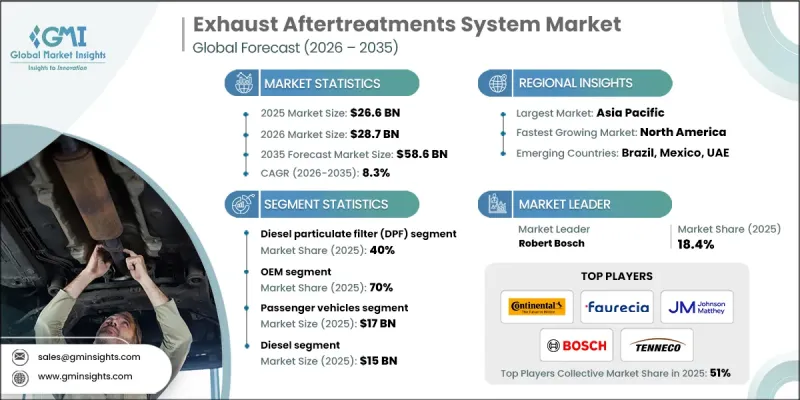
主要汽车市场日益严格的排放气体法规、全球汽车产量不断增长以及人们对减少氮氧化物、颗粒物、一氧化碳和未燃烧碳氢化合物等有害排放物的日益关注,共同推动了废气后处理技术的发展。汽车製造商和车队营运商面临持续的压力,需要在满足实际驾驶条件下的监管目标的同时,提供更清洁、更有效率的车辆。这加速了先进废气后处理解决方案在乘用车和商用车领域的应用。製造商越来越重视系统的耐久性、燃油效率和排放气体性能的最佳化。催化剂成分、系统整合、基于感测器的控制和数位诊断技术的持续创新也在推动市场发展,重新定义了排放的监控和管理方式。这些进步提高了系统效率,加快了合规速度,并增强了长期性能,进一步提升了废气后处理技术在不断发展的全球汽车产业生态系统中的重要性。
| 市场范围 | |
|---|---|
| 开始年份 | 2025 |
| 预测年份 | 2026-2035 |
| 起始值 | 266亿美元 |
| 预测金额 | 586亿美元 |
| 复合年增长率 | 8.3% |
随着製造商寻求能够适应各种引擎平台和运作条件的解决方案,对先进废气后处理系统的需求持续成长。柴油颗粒过滤器、选择性催化还原系统、柴油氧化催化剂、汽油颗粒过滤器和三元触媒转换器等技术正日益被应用于整合排放气体控制架构中。商用车柴油动力系统的日益普及以及乘用车缸内喷油引擎的广泛应用,进一步推动了高性能后处理系统的发展。催化剂效率、模组化系统设计、即时排放气体检测和车载诊断系统的不断进步,在提高系统可靠性和合规性的同时,也降低了全生命週期成本。
预计到2025年,柴油颗粒过滤器(DPF)市占率将达到40%,并在2026年至2035年间以8.1%的复合年增长率成长。该细分市场之所以保持其重要性,是因为其能够有效捕捉柴油引擎排放的细悬浮微粒,使其成为多种车型排放法规合规的核心要求。其卓越的性能和法规要求持续推动製造商和供应商的强劲需求。
预计到2025年,OEM(整车製造商)市占率将达到70%,并在2035年之前维持8.6%的复合年增长率。 OEM的领先地位得益于在车辆生产阶段整合废气后处理系统,从而确保了优化的标定、系统的耐久性和稳定的排放气体性能。 OEM安装的系统是先进排放气体解决方案的首选供应途径,可提供卓越的品管、与引擎管理系统的无缝相容性以及长期的法规遵循保证。
预计2025年,中国废气后处理系统市场规模将达42亿美元,市占率高达41%。这一市场领先地位主要得益于大规模的汽车生产、先进排放气体控制技术的快速普及以及汽车製造商、零件供应商和催化剂开发商之间的紧密合作。政府的支持、高产能和完善的供应链也持续推动国内现代化后处理系统的应用。
目录
第一章:调查方法和范围
第二章执行摘要
第三章业界考察
- 生态系分析
- 供应商情况
- 利润率
- 成本结构
- 每个阶段增加的价值
- 影响价值链的因素
- 中断
- 影响产业的因素
- 促进因素
- 严格的全球排放法规
- 商用车产量增加
- 缸内喷油(GDI)引擎应用范围扩大
- 后处理技术的进步
- 产业潜在风险与挑战
- 高成本的系统和材料价格波动
- 电池式电动车(BEV)的广泛普及
- 市场机会
- 即将推出的欧盟7排放标准与超低氮氧化物排放法规
- 扩展售后市场和改装解决方案
- 催化剂和感测器的技术创新
- 产业伙伴关係与OEM合作
- 促进因素
- 成长潜力分析
- 监理情势
- 北美洲
- 美国:EPA、CARB、NHTSA排放标准
- 加拿大:运输部,CMVSS 305
- 欧洲
- 德国:BMDV,欧6/7法规
- 法国:运输部,6/7欧元
- 英国:运输部,Euro 6/7
- 义大利:基础设施和运输部将遵守排放法规
- 亚太地区
- 中国:工业与资讯化部(工信部),中国6/7标准
- 日本:国土交通省,JIS排放法规
- 韩国:国土交通部,韩国环境标准
- 印度:公路运输部部,BS6标准
- 拉丁美洲
- 巴西:DENATRAN、CONAMA 标准
- 墨西哥:交通运输运输部将规范天然排放
- 中东和非洲
- 阿联酋:RTA、ESMA排放法规
- 沙乌地阿拉伯:运输部製定SASO排放标准
- 北美洲
- 波特的分析
- PESTEL 分析
- 科技与创新趋势
- 当前技术趋势
- 新兴技术
- 价格趋势
- 按地区
- 副产品
- 成本細項分析
- 专利分析
- 永续性和环境方面
- 永续倡议
- 减少废弃物策略
- 生产中的能源效率
- 具有环保意识的倡议
- 碳足迹考量
- 使用案例场景
第四章 竞争情势
- 介绍
- 企业市占率分析
- 北美洲
- 欧洲
- 亚太地区
- 拉丁美洲
- 中东和非洲
- 主要市场公司的竞争分析
- 竞争定位矩阵
- 战略展望矩阵
- 主要进展
- 併购
- 伙伴关係与合作
- 新产品发布
- 业务拓展计划及资金筹措
第五章 市场估计与预测:依组件划分,2022-2035年
- 柴油颗粒过滤器(DPF)
- 选择性催化还原(SCR)
- 柴油氧化催化剂(DOC)
- 三元催化剂(TWC)
- 废气再循环(EGR)
第六章 市场估价与预测:依车辆类型划分,2022-2035年
- 搭乘用车
- 掀背车车
- 轿车
- SUV
- 商用车辆
- 轻型商用车(LCV)
- 中型商用车(MCV)
- 重型商用车(HCV)
第七章 市场估计与预测:依技术划分,2022-2035年
- 传统的
- 加热类型
- 声学
- 配备抬头显示器(HUD)
第八章 市场估算与预测:依燃料类型划分,2022-2035年
- 柴油引擎
- 汽油
- 替代燃料
第九章 市场估价与预测:依销售管道划分,2022-2035年
- OEM
- 售后市场
第十章 市场估价与预测:依地区划分,2022-2035年
- 北美洲
- 我们
- 加拿大
- 欧洲
- 英国
- 德国
- 法国
- 义大利
- 西班牙
- 比利时
- 荷兰
- 瑞典
- 亚太地区
- 中国
- 印度
- 日本
- 澳洲
- 新加坡
- 韩国
- 越南
- 印尼
- 拉丁美洲
- 巴西
- 墨西哥
- 阿根廷
- 中东和非洲
- 阿拉伯聯合大公国
- 南非
- 沙乌地阿拉伯
第十一章:公司简介
- Global Player
- BorgWarner
- Continental AG
- Cummins
- Eberspacher Group
- Faurecia SE
- HJS Emission Technology GmbH
- Johnson Matthey
- MANN+HUMMEL GmbH
- Robert Bosch GmbH
- Tenneco
- Regional Player
- Akebono Brake Industry
- Calsonic Kansei
- Denso Corporation
- Dongfeng Motor Component
- Johnson Controls
- Mahle GmbH
- NGK Insulators
- Tofas Engine Systems
- Umicore
- Valeo
- 新兴企业
- Anhui Ankai Automotive Components
- Clean Emission Technologies
- EcoMotors
- GreenTech Catalysts
- ZF Aftermarket Solutions
The Global Exhaust Aftertreatment System Market was valued at USD 26.6 billion in 2025 and is estimated to grow at a CAGR of 8.3% to reach USD 58.6 billion by 2035.
Growth is driven by tightening emission requirements across major automotive regions, increasing global vehicle production, and a growing focus on minimizing harmful exhaust emissions, including nitrogen oxides, particulate matter, carbon monoxide, and unburned hydrocarbons. Automakers and fleet operators are under continuous pressure to deliver cleaner and more efficient vehicles while meeting compliance targets under real-world operating conditions. This has accelerated the integration of advanced exhaust aftertreatment solutions across both passenger and commercial vehicle segments. Manufacturers are increasingly prioritizing system durability, fuel efficiency improvement, and emission performance optimization. The market is also benefiting from ongoing innovation in catalyst formulations, system integration, sensor-based control, and digital diagnostics, which are redefining how exhaust emissions are monitored and managed. These developments are enabling higher system efficiency, faster regulatory compliance, and improved long-term performance, reinforcing the importance of exhaust aftertreatment technologies within the evolving global automotive ecosystem.
| Market Scope | |
|---|---|
| Start Year | 2025 |
| Forecast Year | 2026-2035 |
| Start Value | $26.6 Billion |
| Forecast Value | $58.6 Billion |
| CAGR | 8.3% |
Demand for advanced exhaust aftertreatment systems continues to rise as manufacturers seek solutions capable of addressing diverse engine platforms and operating conditions. Technologies such as diesel particulate filters, selective catalytic reduction systems, diesel oxidation catalysts, gasoline particulate filters, and three-way catalysts are increasingly deployed as part of integrated emission control architectures. The growing use of diesel powertrains in commercial vehicles and gasoline direct injection engines in passenger cars is further supporting the adoption of high-performance aftertreatment systems. Continuous advancements in catalyst efficiency, modular system design, real-time emission sensing, and onboard diagnostics are enhancing system reliability and compliance while reducing lifecycle costs.
The diesel particulate filter segment held a 40% share in 2025 and is expected to grow at a CAGR of 8.1% between 2026 and 2035. This segment remains critical due to its effectiveness in capturing fine particulate emissions from diesel engines, making it a core requirement for emission compliance across multiple vehicle categories. Its proven performance and regulatory necessity continue to drive strong demand among manufacturers and suppliers.
The original equipment manufacturers segment accounted for 70% share in 2025 and is projected to grow at a CAGR of 8.6% through 2035. OEM dominance is supported by the integration of aftertreatment systems during vehicle production, ensuring optimized calibration, system durability, and consistent emission performance. OEM-installed systems offer better quality control, seamless compatibility with engine management systems, and long-term compliance assurance, making this channel the preferred route for advanced emission solutions.
China Exhaust Aftertreatment System Market held a 41% share in 2025 and reached USD 4.2 billion. Market leadership is supported by large-scale vehicle manufacturing, rapid adoption of advanced emission control technologies, and strong collaboration between automakers, component suppliers, and catalyst developers. Government support, high production volumes, and established supply chains continue to accelerate the deployment of modern aftertreatment systems across the country.
Key companies operating in the Global Exhaust Aftertreatment System Market include Robert Bosch, BorgWarner, Tenneco, Johnson Matthey, Continental, Cummins, Faurecia, Eberspacher, MANN+HUMMEL, and HJS Emission Technology. Companies in the exhaust aftertreatment system market are strengthening their market position through continuous investment in technology innovation and system integration. Manufacturers are focusing on developing compact, lightweight, and modular solutions that improve efficiency while reducing overall system costs. Strategic collaborations with automakers help align product development with evolving engine platforms and emission targets. Firms are also expanding global manufacturing footprints to improve supply reliability and reduce lead times. Enhanced digital monitoring, diagnostics, and sensor integration are being used to improve system performance and compliance over vehicle lifecycles. In addition, companies emphasize research into advanced catalyst materials and durability improvements to meet long-term regulatory and customer requirements, reinforcing competitiveness in a highly regulated market environment.
Table of Contents
Chapter 1 Methodology & Scope
- 1.1 Market scope and definition
- 1.2 Research design
- 1.2.1 Research approach
- 1.2.2 Data collection methods
- 1.3 Data mining sources
- 1.3.1 Global
- 1.3.2 Regional/Country
- 1.4 Base estimates and calculations
- 1.4.1 Base year calculation
- 1.4.2 Key trends for market estimation
- 1.5 Primary research and validation
- 1.5.1 Primary sources
- 1.6 Forecast
- 1.7 Research assumptions and limitations
Chapter 2 Executive Summary
- 2.1 Industry 360° synopsis, 2022 - 2035
- 2.2 Key market trends
- 2.2.1 Regional
- 2.2.2 Component
- 2.2.3 Vehicle
- 2.2.4 Fuel type
- 2.2.5 Sales Channel
- 2.3 TAM Analysis, 2026-2035
- 2.4 CXO perspectives: Strategic imperatives
- 2.4.1 Executive decision points
- 2.4.2 Critical success factors
- 2.5 Future outlook and strategic recommendations
Chapter 3 Industry Insights
- 3.1 Industry ecosystem analysis
- 3.1.1 Supplier Landscape
- 3.1.2 Profit Margin
- 3.1.3 Cost structure
- 3.1.4 Value addition at each stage
- 3.1.5 Factor affecting the value chain
- 3.1.6 Disruptions
- 3.2 Industry impact forces
- 3.2.1 Growth drivers
- 3.2.1.1 Stringent Global Emission Regulations
- 3.2.1.2 Rising Production of Commercial Vehicles
- 3.2.1.3 Increasing Adoption of Gasoline Direct Injection (GDI) Engines
- 3.2.1.4 Advancements in Aftertreatment Technologies
- 3.2.2 Industry pitfalls and challenges
- 3.2.2.1 High System Cost and Material Price Volatility
- 3.2.2.2 Growing Penetration of Battery Electric Vehicles (BEVs)
- 3.2.3 Market opportunities
- 3.2.3.1 Upcoming Euro 7 and Ultra-Low NOx Regulations
- 3.2.3.2 Expansion of Aftermarket and Retrofit Solutions
- 3.2.3.3 Technological Innovation in Catalysts and Sensors
- 3.2.3.4 Industrial Partnerships and OEM Collaborations
- 3.2.1 Growth drivers
- 3.3 Growth potential analysis
- 3.4 Regulatory landscape
- 3.4.1 North America
- 3.4.1.1 U.S.: EPA, CARB, NHTSA Emission Standards
- 3.4.1.2 Canada: Transport Canada, CMVSS 305
- 3.4.2 Europe
- 3.4.2.1 Germany: BMDV, Euro 6/7 Regulations
- 3.4.2.2 France: Ministry of Transport, Euro 6/7
- 3.4.2.3 UK: Department for Transport, Euro 6/7
- 3.4.2.4 Italy: Ministry of Infrastructure & Transport, Emission Compliance
- 3.4.3 Asia Pacific
- 3.4.3.1 China: MIIT, China 6/7 Standards
- 3.4.3.2 Japan: MLIT, JIS Emission Regulations
- 3.4.3.3 South Korea: MOLIT, KS Emission Standards
- 3.4.3.4 India: MoRTH, BS6 Norms
- 3.4.4 Latin America
- 3.4.4.1 Brazil: DENATRAN, CONAMA Standards
- 3.4.4.2 Mexico: Ministry of Communications & Transport, NOM Emission Regulations
- 3.4.5 Middle East and Africa
- 3.4.5.1 UAE: RTA, ESMA Emission Regulations
- 3.4.5.2 Saudi Arabia: Ministry of Transport, SASO Emission Standards
- 3.4.1 North America
- 3.5 Porter’s analysis
- 3.6 PESTEL analysis
- 3.7 Technology and Innovation Landscape
- 3.7.1 Current technological trends
- 3.7.2 Emerging technologies
- 3.8 Price trends
- 3.8.1 By region
- 3.8.2 By product
- 3.9 Cost breakdown analysis
- 3.10 Patent analysis
- 3.11 Sustainability and Environmental Aspects
- 3.11.1 Sustainable practices
- 3.11.2 Waste reduction strategies
- 3.11.3 Energy efficiency in production
- 3.11.4 Eco-friendly initiatives
- 3.11.5 Carbon footprint considerations
- 3.12 Use case scenarios
Chapter 4 Competitive Landscape, 2025
- 4.1 Introduction
- 4.2 Company market share analysis
- 4.2.1 North America
- 4.2.2 Europe
- 4.2.3 Asia Pacific
- 4.2.4 Latin America
- 4.2.5 Middle East & Africa
- 4.3 Competitive analysis of major market players
- 4.4 Competitive positioning matrix
- 4.5 Strategic outlook matrix
- 4.6 Key developments
- 4.6.1 Mergers & acquisitions
- 4.6.2 Partnerships & collaborations
- 4.6.3 New product launches
- 4.6.4 Expansion plans and funding
Chapter 5 Market Estimates & Forecast, By Component, 2022 - 2035 ($ Bn)
- 5.1 Key trends
- 5.2 Diesel Particulate Filter (DPF)
- 5.3 Selective Catalytic Reduction (SCR)
- 5.4 Diesel Oxidation Catalyst (DOC)
- 5.5 Three-Way Catalyst (TWC)
- 5.6 Exhaust Gas Recirculation (EGR)
Chapter 6 Market Estimates & Forecast, By Vehicle, 2022 - 2035 ($ Bn)
- 6.1 Key trends
- 6.2 Passenger vehicles
- 6.2.1 Hatchbacks
- 6.2.2 Sedans
- 6.2.3 SUV
- 6.3 Commercial vehicles
- 6.3.1 Light commercial vehicles (LCV)
- 6.3.2 Medium commercial vehicles (MCV)
- 6.3.3 Heavy commercial vehicles (HCV)
Chapter 7 Market Estimates & Forecast, By Technology, 2022 - 2035 ($ Bn)
- 7.1 Key trends
- 7.2 Conventional
- 7.3 Heated
- 7.4 Acoustic
- 7.5 Heads-Up Display (HUD) Enabled
Chapter 8 Market Estimates & Forecast, By Fuel Type, 2022 - 2035 ($ Bn)
- 8.1 Key trends
- 8.2 Diesel
- 8.3 Gasoline
- 8.4 Alternative Fuels
Chapter 9 Market Estimates & Forecast, By Sales Channel, 2022 - 2035 ($ Bn)
- 9.1 Key trends
- 9.2 OEM
- 9.3 Aftermarket
Chapter 10 Market Estimates & Forecast, By Region, 2022 - 2035 ($ Bn)
- 10.1 Key trends
- 10.2 North America
- 10.2.1 US
- 10.2.2 Canada
- 10.3 Europe
- 10.3.1 UK
- 10.3.2 Germany
- 10.3.3 France
- 10.3.4 Italy
- 10.3.5 Spain
- 10.3.6 Belgium
- 10.3.7 Netherlands
- 10.3.8 Sweden
- 10.4 Asia Pacific
- 10.4.1 China
- 10.4.2 India
- 10.4.3 Japan
- 10.4.4 Australia
- 10.4.5 Singapore
- 10.4.6 South Korea
- 10.4.7 Vietnam
- 10.4.8 Indonesia
- 10.5 Latin America
- 10.5.1 Brazil
- 10.5.2 Mexico
- 10.5.3 Argentina
- 10.6 MEA
- 10.6.1 UAE
- 10.6.2 South Africa
- 10.6.3 Saudi Arabia
Chapter 11 Company Profiles
- 11.1 Global Player
- 11.1.1 BorgWarner
- 11.1.2 Continental AG
- 11.1.3 Cummins
- 11.1.4 Eberspacher Group
- 11.1.5 Faurecia SE
- 11.1.6 HJS Emission Technology GmbH
- 11.1.7 Johnson Matthey
- 11.1.8 MANN+HUMMEL GmbH
- 11.1.9 Robert Bosch GmbH
- 11.1.10 Tenneco
- 11.2 Regional Player
- 11.2.1 Akebono Brake Industry
- 11.2.2 Calsonic Kansei
- 11.2.3 Denso Corporation
- 11.2.4 Dongfeng Motor Component
- 11.2.5 Johnson Controls
- 11.2.6 Mahle GmbH
- 11.2.7 NGK Insulators
- 11.2.8 Tofas Engine Systems
- 11.2.9 Umicore
- 11.2.10 Valeo
- 11.3 Emerging Players
- 11.3.1 Anhui Ankai Automotive Components
- 11.3.2 Clean Emission Technologies
- 11.3.3 EcoMotors
- 11.3.4 GreenTech Catalysts
- 11.3.5 ZF Aftermarket Solutions

 汽车排放气体分析仪市场:依分析仪类型、排放气体类型、技术、最终用户和通路划分-2026-2032年全球市场预测汽车排放气体控制系统市场:按设备类型、车辆类型、燃料类型、最终用户和应用划分-2026-2032年全球市场预测柴油车废气后后处理系统市场:按组件、后处理技术、车辆类型、销售管道和应用划分-2026-2032年全球市场预测汽车排放气体感知器市场:依技术、车辆类型、燃料类型、应用和终端市场划分-2026-2032年全球市场预测
 汽车蒸发排放控制系统市场规模、份额、成长分析(依燃料类型、零件类型、车辆类型、销售管道和地区划分)-2026-2033年产业预测
 汽车后处理市场 - 全球产业规模、份额、趋势、机会及预测(按车辆类型、燃料类型、销售管道、地区和竞争格局划分,2021-2031年)汽车蒸发排放控制系统市场 - 全球产业规模、份额、趋势、机会及预测(按车辆类型、零件、销售管道、地区和竞争格局划分,2021-2031年)挥发性有机化合物排放检测服务市场(按服务类型、检测方法、样品类型、产业部门、部署类型和最终用途划分)-全球预测,2026-2032年排放检测市场按产品类型、污染物、服务、最终用户和部署方式划分-全球预测,2026-2032年柴油引擎废气颗粒物过滤器市场(按乘用车、技术、材料、再生类型、涂层、最终用途、过滤器类型、销售管道和应用划分),全球预测,2026-2032年