


 |
市场调查报告书
商品编码
1959298
细菌纤维素市场机会、成长要素、产业趋势分析及纺织品及生物医学应用预测(2026-2035年)Bacterial Cellulose in Textiles and Biomedical Market Opportunity, Growth Drivers, Industry Trend Analysis, and Forecast 2026 - 2035 |
||||||

2025 年全球纺织和生物医学领域的细菌纤维素市场价值为 1,040 万美元,预计到 2035 年将达到 3,090 万美元,年复合成长率为 11%。
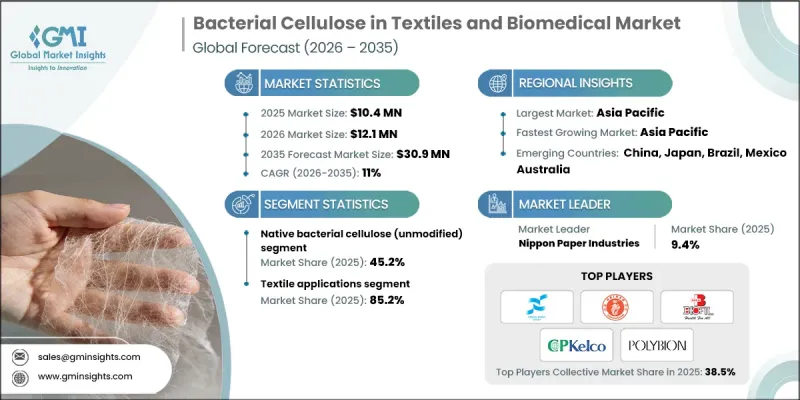
该行业涵盖多种细菌纤维素形式,包括未改性材料、奈米纤维素变体、复合材料和功能化形式,以及专为医疗传输应用而设计的水凝胶系统。据称,其生产依赖多种製造方法,包括间歇式、机械增强型、连续式和生物优化製程。公共部门的各项措施推动了市场趋势,这些措施旨在促进生物基材料和循环经济的采用,强调永续性与先进医疗需求之间的紧密联繫。亚太地区凭藉着强大的基础设施投资和有利的法规环境,成为该市场的主要区域贡献者。另一方面,北美市场则因其不断变化的消费者偏好以及对永续和无需测试材料的创新需求而快速发展。总体而言,该市场被定位为环保纤维与下一代生物医学解决方案的融合点。
| 市场范围 | |
|---|---|
| 开始年份 | 2025 |
| 预测期 | 2026-2035 |
| 起始金额 | 1040万美元 |
| 预测金额 | 3090万美元 |
| 复合年增长率 | 11% |
预计到2025年,天然细菌纤维素市场份额将达到45.2%,并在2035年之前以10.8%的复合年增长率增长。与传统纤维素原料相比,天然细菌纤维素具有更高的纯度、更完整的结构和奈米级纤维排列,因此在许多工业和医疗应用领域备受关注。该材料因其耐用性、透气性和生物相容性等优点,成为需要此类应用的理想选择,其商业性应用也不断扩大。
预计到2025年,纺织品应用领域将占据85.2%的市场份额,并在2035年之前以10.9%的复合年增长率成长。细菌纤维素在纺织相关产品中的应用正在时尚、室内设计和交通出行等领域不断扩展。与传统的纺织品和皮革替代品相比,这些材料因其柔软性、优质的表面外观和更低的环境影响而备受认可。
预计2026年至2035年,北美纺织品和生物医学应用领域的细菌纤维素市场将以11%的复合年增长率成长。该地区受益于生物製造技术的进步和对永续材料开发投资的增加。市场前景凸显了消费者日益增强的环保意识和材料安全意识,促使製造商和设计师将细菌纤维素应用于医疗级产品和生活用品中。
目录
第一章:调查方法和范围
第二章执行摘要
第三章业界考察
- 生态系分析
- 供应商情况
- 利润率
- 每个阶段增加的价值
- 影响价值链的因素
- 中断
- 影响产业的因素
- 促进因素
- 产业潜在风险与挑战
- 市场机会
- 成长潜力分析
- 监理情势
- 波特五力分析
- PESTEL 分析
- 价格趋势
- 按地区
- 依产品类型
- 未来市场趋势
- 科技与创新趋势
- 当前技术趋势
- 新兴技术
- 专利状态
- 贸易统计(HS编码)
- 主要进口国
- 主要出口国
- 永续性和环境方面
- 永续倡议
- 减少废弃物策略
- 生产中的能源效率
- 具有环保意识的倡议
- 考虑碳足迹
第四章 竞争情势
- 介绍
- 企业市占率分析
- 按地区
- 北美洲
- 欧洲
- 亚太地区
- 拉丁美洲
- 中东和非洲
- 按地区
- 公司矩阵分析
- 主要市场公司的竞争分析
- 竞争定位矩阵
- 主要进展
- 併购
- 伙伴关係与合作
- 新产品发布
- 业务拓展计划
第五章 市场估算与预测:依产品类型划分,2022-2035年
- 天然细菌纤维素(未改质)
- 细菌奈米纤维素(BNC)
- 细菌纤维素复合材料/功能化细菌纤维素
- 抗菌BC
- 聚合物-BC复合材料
- 奈米颗粒增强型细菌纤维素
- 导电BC(智慧纺织品)
- 基于细菌纤维素的水凝胶和药物传递系统
- 缓释系统
- 经皮给药系统
- 刺激响应型水凝胶
第六章 市场估计与预测:依技术类型划分,2022-2035年
- 纺织应用
- 时尚界的纯素皮革
- 医疗保健用途
- 为了保护/功能
- 用于化妆品和个人护理
- 生物医学应用
- 创伤护理
- 组织工程与再生医学
- 药物传输及经皮吸收系统
- 植入式医疗设备和医用黏合剂
第七章 市场估计与预测:依地区划分,2022-2035年
- 北美洲
- 我们
- 加拿大
- 欧洲
- 德国
- 英国
- 法国
- 西班牙
- 义大利
- 其他欧洲地区
- 亚太地区
- 中国
- 印度
- 日本
- 澳洲
- 韩国
- 亚太其他地区
- 拉丁美洲
- 巴西
- 墨西哥
- 阿根廷
- 其他拉丁美洲地区
- 中东和非洲
- 沙乌地阿拉伯
- 南非
- 阿拉伯聯合大公国
- 其他中东和非洲地区
第八章:公司简介
- CPKelco
- Hainan Yeguo Foods
- Nippon Paper Industries
- Polybion
- Biofill
- Nanollose
- Axcelon Biopolymers
- BOWIL Biotech
- fzmb GmbH
- San-Ei Gen FFI
- Kusano Sakko
- S2Medical
- Modern Synthesis
- ScobyTec
- Cellugy
The Global Bacterial Cellulose in Textiles and Biomedical Market was valued at USD 10.4 million in 2025 and is estimated to grow at a CAGR of 11% to reach USD 30.9 million by 2035.
The industry is portrayed as covering a wide range of bacterial cellulose forms, including unmodified materials, nanocellulose variants, composite and functionalized formats, and hydrogel-based systems designed for medical delivery applications. Production is stated to rely on multiple manufacturing approaches, including batch-based, mechanically enhanced, continuous, and biologically optimized processes. The market narrative highlights its strong alignment with sustainability and advanced healthcare needs, supported by public sector initiatives promoting bio-based materials and circular economy adoption. Asia Pacific is identified as the leading regional contributor due to strong infrastructure investment and favorable regulatory environments, while North America is characterized as a rapidly advancing market driven by innovation and changing consumer preferences toward sustainable and cruelty-free materials. Overall, the market is positioned as a convergence point between eco-conscious textiles and next-generation biomedical solutions.
| Market Scope | |
|---|---|
| Start Year | 2025 |
| Forecast Year | 2026-2035 |
| Start Value | $10.4 Million |
| Forecast Value | $30.9 Million |
| CAGR | 11% |
The native bacterial cellulose segment held 45.2% share in 2025 and is projected to grow at a CAGR of 10.8% through 2035. This segment is described as gaining traction across multiple industrial and medical uses due to its purity, structural integrity, and nanoscale fiber arrangement when compared with conventional cellulose sources. The material is positioned as a preferred option for applications requiring durability, breathability, and biocompatibility, supporting its continued commercial adoption.
The textiles segment held 85.2% share in 2025 and is forecast to grow at a CAGR of 10.9% through 2035. The use of bacterial cellulose in textile-related products is described as expanding across fashion, interior design, and mobility-related sectors. These materials are recognized for offering flexibility, premium surface appearance, and reduced environmental impact compared with traditional textile and leather alternatives.
North America Bacterial Cellulose in Textiles and Biomedical Market is estimated to grow at a CAGR of 11% between 2026 and 2035. The region is characterized as benefiting from advancements in biomanufacturing technologies and rising investment in sustainable material development. The market outlook emphasizes increasing consumer awareness regarding environmental responsibility and material safety, which is encouraging manufacturers and designers to incorporate bacterial cellulose into both medical-grade and lifestyle-focused products.
Key companies active in the Global Bacterial Cellulose in Textiles and Biomedical Market are described as including Polybion, Nippon Paper Industries, Nanollose, CPKelco, Modern Synthesis, Cellugy, San-Ei Gen F.F.I., Axcelon Biopolymers, Biofill, ScobyTec, Hainan Yeguo Foods, fzmb GmbH, BOWIL Biotech, Kusano Sakko, and S2Medical. Companies operating in the Bacterial Cellulose in Textiles and Biomedical Market are stated to be strengthening their positions through a combination of capacity expansion, process optimization, and strategic collaborations. Many players are focusing on improving fermentation efficiency and material consistency to support scalable production. Investments in research and development are described as targeting enhanced performance characteristics and broader application suitability. Firms are also reported to be forming partnerships with fashion brands, healthcare providers, and research institutions to accelerate commercialization.
Table of Contents
Chapter 1 Methodology & Scope
- 1.1 Market scope and definition
- 1.2 Research design
- 1.2.1 Research approach
- 1.2.2 Data collection methods
- 1.3 Data mining sources
- 1.3.1 Global
- 1.3.2 Regional/Country
- 1.4 Base estimates and calculations
- 1.4.1 Base year calculation
- 1.4.2 Key trends for market estimation
- 1.5 Primary research and validation
- 1.5.1 Primary sources
- 1.6 Forecast model
- 1.7 Research assumptions and limitations
Chapter 2 Executive Summary
- 2.1 Industry 360° synopsis
- 2.2 Key market trends
- 2.2.1 Product type
- 2.2.2 Application
- 2.2.3 Regional
- 2.3 TAM Analysis, 2026-2035
- 2.4 CXO perspectives: Strategic imperatives
- 2.4.1 Executive decision points
- 2.4.2 Critical success factors
- 2.5 Future Outlook and Strategic Recommendations
Chapter 3 Industry Insights
- 3.1 Industry ecosystem analysis
- 3.1.1 Supplier landscape
- 3.1.2 Profit margin
- 3.1.3 Value addition at each stage
- 3.1.4 Factor affecting the value chain
- 3.1.5 Disruptions
- 3.2 Industry impact forces
- 3.2.1 Growth drivers
- 3.2.2 Industry pitfalls and challenges
- 3.2.3 Market opportunities
- 3.3 Growth potential analysis
- 3.4 Regulatory landscape
- 3.4.1 North America
- 3.4.2 Europe
- 3.4.3 Asia Pacific
- 3.4.4 Latin America
- 3.4.5 Middle East & Africa
- 3.5 Porter's analysis
- 3.6 PESTEL analysis
- 3.7 Price trends
- 3.7.1 By region
- 3.7.2 By product type
- 3.8 Future market trends
- 3.9 Technology and innovation landscape
- 3.9.1 Current technological trends
- 3.9.2 Emerging technologies
- 3.10 Patent Landscape
- 3.11 Trade statistics (HS code)
- 3.11.1 Major importing countries
- 3.11.2 Major exporting countries
- 3.12 Sustainability and environmental aspects
- 3.12.1 Sustainable practices
- 3.12.2 Waste reduction strategies
- 3.12.3 Energy efficiency in production
- 3.12.4 Eco-friendly initiatives
- 3.13 Carbon footprint consideration
Chapter 4 Competitive Landscape, 2025
- 4.1 Introduction
- 4.2 Company market share analysis
- 4.2.1 By region
- 4.2.1.1 North America
- 4.2.1.2 Europe
- 4.2.1.3 Asia Pacific
- 4.2.1.4 LATAM
- 4.2.1.5 MEA
- 4.2.1 By region
- 4.3 Company matrix analysis
- 4.4 Competitive analysis of major market players
- 4.5 Competitive positioning matrix
- 4.6 Key developments
- 4.6.1 Mergers & acquisitions
- 4.6.2 Partnerships & collaborations
- 4.6.3 New Product Launches
- 4.6.4 Expansion Plans
Chapter 5 Market Estimates and Forecast, By Product Type, 2022-2035 (USD Million) (Kilo Tons)
- 5.1 Key trends
- 5.2 Native bacterial cellulose (unmodified)
- 5.3 Bacterial nanocellulose (BNC)
- 5.4 BC composites and functionalized BC
- 5.4.1 Antimicrobial BC
- 5.4.2 Polymer-BC composites
- 5.4.3 Nanoparticle-enhanced BC
- 5.4.4 Conductive BC (smart textiles)
- 5.5 BC-based hydrogels and drug delivery systems
- 5.5.1 Controlled-release systems
- 5.5.2 Transdermal delivery systems
- 5.5.3 Stimuli-responsive hydrogels
Chapter 6 Market Estimates and Forecast, By Technology Type, 2022-2035 (USD Million) (Kilo Tons)
- 6.1 Key trends
- 6.2 Textile applications
- 6.2.1 Vegan leather and fashion materials
- 6.2.2 Medical and healthcare textiles
- 6.2.3 Protective and performance textiles
- 6.2.4 Cosmetic and personal care textiles
- 6.3 Biomedical applications
- 6.3.1 Wound care
- 6.3.2 Tissue engineering and regenerative medicine
- 6.3.3 Drug delivery and transdermal systems
- 6.3.4 Implantable devices and medical adhesives
Chapter 7 Market Estimates and Forecast, By Region, 2022-2035 (USD Million) (Kilo Tons)
- 7.1 Key trends
- 7.2 North America
- 7.2.1 U.S.
- 7.2.2 Canada
- 7.3 Europe
- 7.3.1 Germany
- 7.3.2 UK
- 7.3.3 France
- 7.3.4 Spain
- 7.3.5 Italy
- 7.3.6 Rest of Europe
- 7.4 Asia Pacific
- 7.4.1 China
- 7.4.2 India
- 7.4.3 Japan
- 7.4.4 Australia
- 7.4.5 South Korea
- 7.4.6 Rest of Asia Pacific
- 7.5 Latin America
- 7.5.1 Brazil
- 7.5.2 Mexico
- 7.5.3 Argentina
- 7.5.4 Rest of Latin America
- 7.6 Middle East and Africa
- 7.6.1 Saudi Arabia
- 7.6.2 South Africa
- 7.6.3 UAE
- 7.6.4 Rest of Middle East and Africa
Chapter 8 Company Profiles
- 8.1 CPKelco
- 8.2 Hainan Yeguo Foods
- 8.3 Nippon Paper Industries
- 8.4 Polybion
- 8.5 Biofill
- 8.6 Nanollose
- 8.7 Axcelon Biopolymers
- 8.8 BOWIL Biotech
- 8.9 fzmb GmbH
- 8.10 San-Ei Gen F.F.I.
- 8.11 Kusano Sakko
- 8.12 S2Medical
- 8.13 Modern Synthesis
- 8.14 ScobyTec
- 8.15 Cellugy

 2026年全球进阶创伤护理市场报告
 非处方高阶创伤护理市场分析及预测至2035年:依类型、产品、技术、应用、材料类型、最终用户、剂型、设备、製程及部署方式划分
 全球高阶创伤护理市场规模、份额、趋势和成长分析报告(2026-2034年)
 日本先进创伤护理市场报告:按产品、应用、最终用户和地区划分(2026-2034年)
 rh-EGF外用溶液市场:依剂型、应用、最终用户和通路划分-2026-2032年全球预测先进创伤护理市场-2026-2031年预测
 进阶创伤护理市场规模、份额和趋势分析报告:按产品、应用、最终用途、地区和细分市场预测(2026-2033 年)非处方高阶创伤护理市场规模、份额和趋势分析报告:按产品、应用、分销管道、地区和细分市场预测(2026-2033 年)
 用于伤口癒合的蛋白质水解物市场机会、成长驱动因素、产业趋势分析及预测(2025-2034年)高阶伤口护理市场机会、成长驱动因素、产业趋势分析及预测(2025-2034年)