


 |
市场调查报告书
商品编码
1959311
汽车电子导电塑胶市场:市场机会、成长要素、产业趋势分析及2026-2035年预测Conductive Plastics for Automotive Electronics Market Opportunity, Growth Drivers, Industry Trend Analysis, and Forecast 2026 - 2035 |
||||||

2025 年全球汽车电子导电塑胶市场价值为 6.7 亿美元,预计到 2035 年将达到 20 亿美元,年复合成长率为 11.5%。
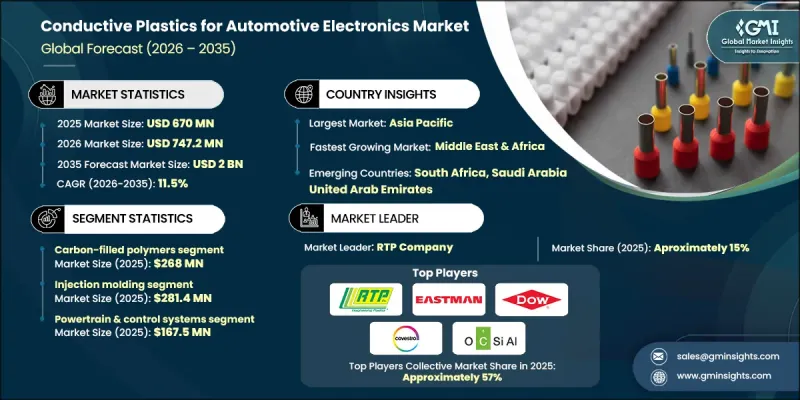
这一成长源于汽车产业对轻量化、高性能材料的日益依赖,以提高能源效率、减轻车身重量并增强设计柔软性。导电塑胶正越来越多地取代传统金属,应用于电子机壳、连接器和结构件中,在显着降低成本的同时,还能提供与之相当的性能。这种转变符合原始设备製造商 (OEM) 的优先事项,例如热效率、紧凑封装以及复杂电子架构的无缝整合。随着汽车平臺变得更加模组化和电气化,对兼具导电性、耐久性和可製造性的多功能材料的需求持续成长。汽车电子产品(包括高级驾驶辅助系统 (ADAS)、连网解决方案、资讯娱乐系统和电力电子产品)的普及,也增加了对有效电磁和高频干扰屏蔽的需求。导电塑胶在保护敏感元件和实现紧凑系统设计方面发挥着至关重要的作用,使其成为现代汽车电子产品开发不可或缺的材料。
| 市场范围 | |
|---|---|
| 开始年份 | 2025 |
| 预测年份 | 2026-2035 |
| 起始值 | 6.7亿美元 |
| 预测金额 | 20亿美元 |
| 复合年增长率 | 11.5% |
预计到2025年,碳填充聚合物市场规模将达到2.68亿美元。这类材料因其兼具导电性、成本效益和低密度等优点而被广泛应用,尤其适用于电磁干扰(EMI)和静电放电(ESD)屏蔽。其他类型的导电塑胶则满足不同的性能需求;高导电性材料能够承受严苛的电气和热学条件,而柔性导电聚合物在需要耐腐蚀性和可调性的特殊应用中也日益受到重视。
预计到2025年,动力传动系统和控制系统市场规模将达到1.675亿美元,并在2026年至2035年间以12.1%的复合年增长率成长。在这些系统中,在热应力和机械应力下保持稳定的电气性能至关重要,这促使导电塑胶在感测器、控制单元和电子模组中的应用日益广泛。此外,导电塑胶在安全相关电子设备和驾驶辅助系统中的应用也在不断扩展,因为这些系统需要稳定的讯号传输和有效的屏蔽才能确保可靠运作。
预计到2025年,北美汽车电子导电塑胶市场规模将达到1.209亿美元,并有望在预测期内持续成长。该地区受益于先进汽车电子产品的普及、成熟的製造基础设施以及对电动车生产的大力投资。美国凭藉其完善的供应链以及对轻质高性能材料的专注,占据了该地区最大的需求份额,这些材料能够提升电气安全性和屏蔽性能。
目录
第一章:调查方法和范围
第二章执行摘要
第三章业界考察
- 生态系分析
- 供应商情况
- 利润率
- 每个阶段增加的价值
- 影响价值链的因素
- 中断
- 影响产业的因素
- 促进因素
- 汽车电子领域轻量化材料的应用日益广泛
- 电磁干扰/射频干扰屏蔽元件的需求增加
- 导电添加剂的技术进步
- 产业潜在风险与挑战
- 有限的热导率
- 复杂且高成本的製作流程
- 市场机会
- 电动车和智慧电子设备的应用范围不断扩大
- 高性能导电填料的进展
- 促进因素
- 成长潜力分析
- 监理情势
- 北美洲
- 欧洲
- 亚太地区
- 拉丁美洲
- 中东和非洲
- 波特的分析
- PESTEL 分析
- 价格趋势
- 按地区
- 产品类型
- 未来市场趋势
- 科技与创新趋势
- 当前技术趋势
- 新兴技术
- 专利状态
- 贸易统计资料(HS编码)(註:贸易统计仅提供主要国家的资料)
- 主要进口国
- 主要出口国
- 永续性和环境方面
- 永续倡议
- 减少废弃物策略
- 生产中的能源效率
- 具有环保意识的倡议
- 碳足迹考量
第四章 竞争情势
- 介绍
- 企业市占率分析
- 按地区
- 北美洲
- 欧洲
- 亚太地区
- 拉丁美洲
- 中东和非洲
- 按地区
- 公司矩阵分析
- 主要市场公司的竞争分析
- 竞争定位矩阵
- 主要进展
- 併购
- 伙伴关係与合作
- 新产品发布
- 扩张计划
第五章 市场估算与预测:导电塑胶依类型划分,2022-2035年
- 碳填充聚合物
- 炭黑
- 奈米碳管(CNTs)
- 石墨烯/石墨
- 金属填充聚合物
- 镀银
- 镍填充
- 铜填充物
- 混合金属填料
- 本征导电聚合物
- 聚苯胺(PANI)
- 聚吡咯(PPy)
- 聚(3,4-硫酚)(PEDOT)
- 导电聚合物复合材料
- 热塑性复合材料
- 热固性复合材料
第六章 依製造流程分類的市场估算与预测,2022-2035年
- 射出成型
- 挤出成型(型材、薄膜、片材、电缆)
- 涂层和表面处理
- 积层製造(3D列印)
- 混炼和母粒生产
第七章 市场估算与预测:最终用途分类,2022-2035年
- 动力传动系统与控制系统
- 引擎控制模组(ECM)
- 电动车电池管理系统(BMS)
- 安全/ADAS
- 安全气囊感知器
- 光达/雷达外壳
- 相机支架和护罩
- 资讯娱乐与车载资讯系统
- 触控显示器和边框
- 天线罩
- 电磁干扰/射频干扰屏蔽
- 人体电子系统
- 智慧钥匙收纳
- 感测器外壳(接近感测器、雨量感测器、光照感测器)
- 连接模组
- 充电/电源分配
- 电动车充电组件
- 配电单元
- 连接器外壳
第八章 市场估计与预测:依地区划分,2022-2035年
- 北美洲
- 我们
- 加拿大
- 欧洲
- 德国
- 英国
- 法国
- 西班牙
- 义大利
- 其他欧洲地区
- 亚太地区
- 中国
- 印度
- 日本
- 澳洲
- 韩国
- 亚太其他地区
- 拉丁美洲
- 巴西
- 墨西哥
- 其他拉丁美洲地区
- 中东和非洲
- 沙乌地阿拉伯
- 南非
- 阿拉伯聯合大公国
- 其他中东和非洲地区
第九章:公司简介
- RTP Company
- Eastman Chemical Company
- SIMONA AG
- Nanocyl SA
- OCSiAl
- DOW
- Covestro AG
- Heraeus Materials Technology
- Agfa-Gevaert NV
The Global Conductive Plastics for Automotive Electronics Market was valued at USD 670 million in 2025 and is estimated to grow at a CAGR of 11.5% to reach USD 2 billion by 2035.
Growth is driven by the automotive industry's increasing reliance on lightweight, high-performance materials to improve energy efficiency, reduce vehicle mass, and enable greater design flexibility. Conductive plastics are increasingly replacing conventional metals in electronic housings, connectors, and structural components, offering comparable performance with significantly lower weight. This transition aligns with OEM priorities around thermal efficiency, compact packaging, and seamless integration of complex electronic architectures. As vehicle platforms become more modular and electrified, demand for multifunctional materials that combine conductivity, durability, and manufacturability continues to rise. The rapid increase in onboard electronics, including advanced driver assistance, connectivity solutions, infotainment systems, and power electronics, has heightened the need for effective electromagnetic and radio-frequency interference shielding. Conductive plastics play a critical role in protecting sensitive components while enabling compact system designs, making them essential to modern automotive electronics development.
| Market Scope | |
|---|---|
| Start Year | 2025 |
| Forecast Year | 2026-2035 |
| Start Value | $670 Million |
| Forecast Value | $2 Billion |
| CAGR | 11.5% |
The carbon-filled polymers segment reached USD 268 million in 2025. These materials are widely adopted due to their balanced electrical conductivity, cost efficiency, and low density, making them suitable for EMI and ESD shielding applications. Other conductive plastic types address different performance requirements, with higher conductivity materials supporting demanding electrical and thermal conditions, while flexible conductive polymers are gaining relevance in specialized applications that require corrosion resistance and tunable performance characteristics.
The powertrain and control systems segment accounted for USD 167.5 million in 2025 and is expected to grow at a CAGR of 12.1% during 2026-2035. Conductive plastics are increasingly used in sensors, control units, and electronic modules within these systems, where consistent electrical performance under thermal and mechanical stress is essential. Their adoption is also expanding across safety-related electronics and driver assistance systems, where stable signal transmission and effective shielding are critical for reliable operation.
North America Conductive Plastics for Automotive Electronics Market generated USD 120.9 million in 2025 and is expected to experience sustained growth over the forecast period. The region benefits from advanced automotive electronics adoption, mature manufacturing infrastructure, and strong investment in electric vehicle production. The United States represents the largest share of regional demand due to its well-established supply chain and focus on lightweight, high-performance materials that enhance electrical safety and shielding performance.
Key companies active in the Global Conductive Plastics for Automotive Electronics Market include Covestro AG, RTP Company, DOW, Eastman Chemical Company, Nanocyl SA, OCSiAl, Heraeus Materials Technology, SIMONA AG, and Agfa Gevaert NV. Companies in the conductive plastics for automotive electronics market are strengthening their market position through continuous material innovation and close collaboration with automotive OEMs. Manufacturers are investing in advanced polymer formulations that deliver improved conductivity, thermal stability, and weight reduction. Strategic partnerships with electronics and vehicle platform developers help align materials with next-generation design requirements. Firms are also expanding production capabilities and regional footprints to support growing EV and electronics demand. Emphasis on scalable manufacturing, cost optimization, and compliance with automotive standards enables wider adoption.
Table of Contents
Chapter 1 Methodology & Scope
- 1.1 Market scope and definition
- 1.2 Research design
- 1.2.1 Research approach
- 1.2.2 Data collection methods
- 1.3 Data mining sources
- 1.3.1 Global
- 1.3.2 Regional/Country
- 1.4 Base estimates and calculations
- 1.4.1 Base year calculation
- 1.4.2 Key trends for market estimation
- 1.5 Primary research and validation
- 1.5.1 Primary sources
- 1.6 Forecast model
- 1.7 Research assumptions and limitations
Chapter 2 Executive Summary
- 2.1 Industry 360° synopsis
- 2.2 Key market trends
- 2.2.1 Regional
- 2.2.2 Conductive Plastic Type
- 2.2.3 Manufacturing Process
- 2.2.4 End Use Application
- 2.3 TAM Analysis, 2026-2035
- 2.4 CXO perspectives: Strategic imperatives
- 2.4.1 Executive decision points
- 2.4.2 Critical success factors
- 2.5 Future Outlook and Strategic Recommendations
Chapter 3 Industry Insights
- 3.1 Industry ecosystem analysis
- 3.1.1 Supplier Landscape
- 3.1.2 Profit Margin
- 3.1.3 Value addition at each stage
- 3.1.4 Factor affecting the value chain
- 3.1.5 Disruptions
- 3.2 Industry impact forces
- 3.2.1 Growth drivers
- 3.2.1.1 Rising adoption of lightweight materials in automotive electronics
- 3.2.1.2 Increasing demand for EMI/RFI shielding components
- 3.2.1.3 Technological advancements in conductive additives
- 3.2.2 Industry pitfalls and challenges
- 3.2.2.1 Limited thermal conductivity
- 3.2.2.2 Complex and costly processing
- 3.2.3 Market opportunities
- 3.2.3.1 Expansion of EV & smart electronics applications
- 3.2.3.2 Advancements in high-performance conductive fillers
- 3.2.1 Growth drivers
- 3.3 Growth potential analysis
- 3.4 Regulatory landscape
- 3.4.1 North America
- 3.4.2 Europe
- 3.4.3 Asia Pacific
- 3.4.4 Latin America
- 3.4.5 Middle East & Africa
- 3.5 Porter's analysis
- 3.6 PESTEL analysis
- 3.7 Price trends
- 3.7.1 By region
- 3.7.2 Product type
- 3.8 Future market trends
- 3.9 Technology and Innovation Landscape
- 3.9.1 Current technological trends
- 3.9.2 Emerging technologies
- 3.10 Patent Landscape
- 3.11 Trade statistics (HS code) (Note: the trade statistics will be provided for key countries only)
- 3.11.1 Major importing countries
- 3.11.2 Major exporting countries
- 3.12 Sustainability and environmental aspects
- 3.12.1 Sustainable practices
- 3.12.2 Waste reduction strategies
- 3.12.3 Energy efficiency in production
- 3.12.4 Eco-friendly initiatives
- 3.13 Carbon footprint considerations
Chapter 4 Competitive Landscape, 2024
- 4.1 Introduction
- 4.2 Company market share analysis
- 4.2.1 By region
- 4.2.1.1 North America
- 4.2.1.2 Europe
- 4.2.1.3 Asia Pacific
- 4.2.1.4 LATAM
- 4.2.1.5 MEA
- 4.2.1 By region
- 4.3 Company matrix analysis
- 4.4 Competitive analysis of major market players
- 4.5 Competitive positioning matrix
- 4.6 Key developments
- 4.6.1 Mergers & acquisitions
- 4.6.2 Partnerships & collaborations
- 4.6.3 New product launches
- 4.6.4 Expansion plans
Chapter 5 Market Estimates and Forecast, By Conductive Plastic Type, 2022 - 2035 (USD million) (Kilo Tons)
- 5.1 Key trends
- 5.2 Carbon-filled polymers
- 5.2.1 Carbon black
- 5.2.2 Carbon nanotubes (CNT)
- 5.2.3 Graphene/graphite
- 5.3 Metal-filled polymers
- 5.3.1 Silver-filled
- 5.3.2 Nickel-filled
- 5.3.3 Copper-filled
- 5.3.4 Hybrid metal fillers
- 5.4 Intrinsic conductive polymers
- 5.4.1 Polyaniline (PANI)
- 5.4.2 Polypyrrole (PPy)
- 5.4.3 Poly(3,4-ethylenedioxythiophene) (PEDOT)
- 5.5 Conductive polymer composites
- 5.5.1 Thermoplastic composites
- 5.5.2 Thermoset composites
Chapter 6 Market Estimates and Forecast, By Manufacturing Process, 2022 - 2035 (USD million) (Kilo Tons)
- 6.1 Key trends
- 6.2 Injection molding
- 6.3 Extrusion (Profile, Film, Sheet, Cable)
- 6.4 Coating & surface treatment
- 6.5 Additive manufacturing (3D Printing)
- 6.6 Compounding & masterbatch production
Chapter 7 Market Estimates and Forecast, By End Use Application, 2022 - 2035 (USD million) (Kilo Tons)
- 7.1 Key trends
- 7.2 Powertrain & control systems
- 7.2.1 Engine control modules (ECM)
- 7.2.2 Battery management systems (BMS) for EVs
- 7.3 Safety & ADAS
- 7.3.1 Airbag sensors
- 7.3.2 Lidar/radar housings
- 7.3.3 Camera mounts & shielding
- 7.4 Infotainment & telematics
- 7.4.1 Touch displays & bezels
- 7.4.2 Antenna covers
- 7.4.3 EMI/RFI Shields
- 7.5 Body electronics
- 7.5.1 Smart key housings
- 7.5.2 Sensor housings (Proximity, Rain, Light)
- 7.5.3 Connectivity modules
- 7.6 Charging & power distribution
- 7.6.1 Ev charging components
- 7.6.2 Power distribution units
- 7.6.3 Connector housings
Chapter 8 Market Estimates and Forecast, By Region, 2022 - 2035 (USD million) (Kilo Tons)
- 8.1 Key trends
- 8.2 North America
- 8.2.1 U.S.
- 8.2.2 Canada
- 8.3 Europe
- 8.3.1 Germany
- 8.3.2 UK
- 8.3.3 France
- 8.3.4 Spain
- 8.3.5 Italy
- 8.3.6 Rest of Europe
- 8.4 Asia Pacific
- 8.4.1 China
- 8.4.2 India
- 8.4.3 Japan
- 8.4.4 Australia
- 8.4.5 South Korea
- 8.4.6 Rest of Asia Pacific
- 8.5 Latin America
- 8.5.1 Brazil
- 8.5.2 Mexico
- 8.5.3 Rest of Latin America
- 8.6 Middle East and Africa
- 8.6.1 Saudi Arabia
- 8.6.2 South Africa
- 8.6.3 UAE
- 8.6.4 Rest of Middle East and Africa
Chapter 9 Company Profiles
- 9.1 RTP Company
- 9.2 Eastman Chemical Company
- 9.3 SIMONA AG
- 9.4 Nanocyl SA
- 9.5 OCSiAl
- 9.6 DOW
- 9.7 Covestro AG
- 9.8 Heraeus Materials Technology
- 9.9 Agfa-Gevaert NV

 汽车电子製造服务市场:按服务类型、车辆类型、技术和应用划分-2026-2032年全球市场预测汽车电子编程系统市场:按车辆类型、技术、工具类型、最终用途、部署模式和应用划分,全球预测,2026-2032年
 全球汽车电子元件市场:按应用、销售管道、动力方式、车辆类型、类型、国家和地区划分-产业分析、市场规模、份额及2025年至2032年未来预测
 2026-2034年全球汽车内装环境照明系统市场规模、份额、趋势及成长分析报告汽车偏光滤镜市场:按材料、偏光滤镜类型、车辆类型、应用和销售管道,全球预测,2026-2032年汽车级胎压监测晶片市场:按应用、类型、车辆类型和技术分類的全球预测(2026-2032年)车用级蓝牙晶片市场:按应用、晶片类型、整合类型、车辆类型、分销管道和范围划分 - 全球预测,2026-2032年全球汽车电子市场规模、份额、趋势和成长分析报告(2026-2034)
 日本汽车电子市场规模、份额、趋势和预测:按零件、车辆类型、分销管道、应用和地区划分,2026-2034年汽车电子市场规模、份额、趋势及预测(按组件、车辆类型、通路、应用和地区划分),2026-2034年