


 |
市场调查报告书
商品编码
1959548
晶体振盪器市场机会、成长要素、产业趋势分析及2026年至2035年预测Crystal Oscillator Market Opportunity, Growth Drivers, Industry Trend Analysis, and Forecast 2026 - 2035 |
||||||

2025年全球晶体振盪器市值为32亿美元,预计2035年将达45亿美元,年复合成长率为3.5%。
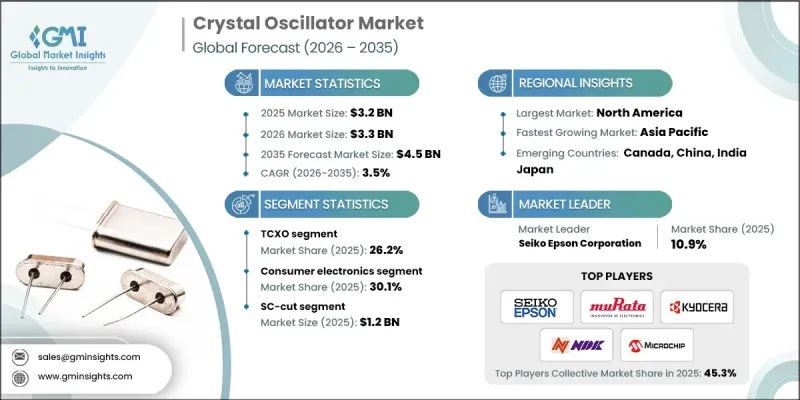
市场扩张的主要驱动力是高频电路对高频稳定性的需求不断增长,以及通讯设备中温度补偿晶体振盪器 (TCXO) 和恆温晶体振盪器 (OCXO) 的广泛应用。汽车产业也是重要的推动因素,温度稳定振盪器越来越多地整合到电控系统(ECU) 中,以支援高级驾驶辅助系统 (ADAS)、资讯娱乐系统和动力传动系统管理。此外,基地台对精确时脉同步的需求以及网路设备对低相位杂讯振盪器的需求也在推动市场成长。超小型晶体封装技术的进步使得开发更薄更轻的电子设备成为可能。同时,从分离式晶体振盪器到整合振盪器模组的趋势正在提高定时精度和设计效率。这一转变始于 2019 年左右,预计将持续到 2028 年,因为市场对缩短产品上市时间的需求不断增长。这将有利于能够提供低抖动、工厂校准解决方案的供应商。
| 市场范围 | |
|---|---|
| 开始年份 | 2025 |
| 预测年份 | 2026-2035 |
| 起始值 | 32亿美元 |
| 预测金额 | 45亿美元 |
| 复合年增长率 | 3.5% |
由于TCXO能够在温度波动下保持稳定的频率,预计到2025年,其市占率将达到26.2%。这些振盪器在通讯、射频模组、工业自动化和汽车电子等领域至关重要,因为这些领域对高精度和长期可靠性要求极高。 TCXO在4G/5G网路和联网汽车应用中也发挥关键作用,因为这些应用对频率精度和运行稳定性要求极高。
预计2026年至2035年,汽车产业将以4.1%的复合年增长率成长。晶体振盪器正日益整合到先进的ECU、ADAS模组和资讯娱乐系统中,提供稳定可靠的时序,这对汽车安全、互联和自动驾驶功能至关重要。电动车和联网汽车的日益普及,以及日益严格的汽车安全法规,正在加速推动该行业对温度稳定型振盪器的需求。
预计到2025年,北美晶体振盪器市占率将达到35.2%。该地区的成长主要得益于通讯、工业自动化和汽车电子领域对精确定时的需求。 TCXO、VCXO和OCXO技术的快速普及推动了5G、物联网和联网汽车技术的应用,这些技术需要稳定的频率、低相位杂讯和同步运作。政府对通讯基础设施、智慧电网和汽车电子领域的持续投资也进一步促进了市场扩张。
目录
第一章:调查方法和范围
第二章执行摘要
第三章业界考察
- 生态系分析
- 供应商情况
- 利润率
- 成本结构
- 每个阶段增加的价值
- 影响价值链的因素
- 中断
- 影响产业的因素
- 促进因素
- 高频电路对高频稳定性的需求
- TCXO和OCXO在通讯设备的应用现状
- 需要温度稳定振盪器的汽车ECU
- 网路设备对低相位杂讯振盪器的需求
- 基地台台时钟同步的必要性
- 产业潜在风险与挑战
- 小型化对频率稳定度的影响
- 基于MEMS的定时解决方案的竞争格局
- 市场机会
- 物联网对低功耗振盪器的需求不断成长
- 用于航太航太导航系统的高可靠性振盪器
- 促进因素
- 成长潜力分析
- 监理情势
- 北美洲
- 欧洲
- 亚太地区
- 拉丁美洲
- 中东和非洲
- 波特的分析
- PESTEL 分析
- 科技与创新趋势
- 当前技术趋势
- 新兴技术
- 价格趋势
- 按地区
- 副产品
- 定价策略
- 新兴经营模式
- 合规要求
- 专利和智慧财产权分析
- 地缘政治和贸易趋势
第四章 竞争情势
- 介绍
- 企业市占率分析
- 按地区
- 北美洲
- 欧洲
- 亚太地区
- 拉丁美洲
- 中东和非洲
- 市场集中度分析
- 按地区
- 主要企业的竞争标竿分析
- 财务绩效比较
- 收入
- 利润率
- 研究与开发
- 产品系列比较
- 产品线的广度
- 科技
- 创新
- 地理位置比较
- 全球扩张分析
- 服务网路覆盖
- 按地区分類的市场渗透率
- 竞争定位矩阵
- 领导企业
- 受让人
- 追踪者
- 小众玩家
- 战略展望矩阵
- 财务绩效比较
- 主要进展
- 併购
- 伙伴关係与合作
- 技术进步
- 扩张和投资策略
- 数位转型计划
- 新兴/Start-Ups竞争对手的发展趋势
第五章 市场估计与预测:依类型划分,2022-2035年
- 时钟振盪器(XO)
- 电压调节器晶体振盪器(VCXO)
- 温度补偿晶体振盪器(TCXO)
- 电压调节器温度补偿晶体振盪器(VCTCXO)
- 恆温晶体振盪器(OCXO)
- 其他的
第六章 市场估算与预测:以切割方式划分,2022-2035年
- AT
- BT
- SC
- CT
- 其他(IT、GT、XY)
第七章 市场估计与预测:依频率划分,2022-2035年
- 低的
- 缓和
- 高的
第八章 市场估算与预测:依最终用途产业划分,2022-2035年
- 家用电子电器
- 电讯
- 车
- 工业的
- 航太/国防
- 其他的
第九章 市场估计与预测:依地区划分,2022-2035年
- 北美洲
- 我们
- 加拿大
- 欧洲
- 德国
- 英国
- 法国
- 俄罗斯
- 义大利
- 亚太地区
- 中国
- 印度
- 日本
- 澳洲
- 拉丁美洲
- 巴西
- 墨西哥
- 阿根廷
- 中东和非洲
- 南非
- 沙乌地阿拉伯
- 阿拉伯聯合大公国
第十章:公司简介
- 主要企业
- CTS Corporation
- Seiko Epson Corporation
- Murata Manufacturing Co. Ltd
- Kyocera Corporation
- Nihon Dempa Kogyo(NDK)Co. Ltd
- TXC Corporation
- 按地区分類的主要企业
- 北美洲
- Abracon LLC
- Bliley Technologies, Inc.
- NEL Frequency Controls Inc.
- Microchip Technology Inc.
- SiTime Corporation
- Mercury Inc.
- 亚太地区
- Daishinku Corp.
- Hosonic Electronic Co. Ltd
- RIVER ELETEC CORPORATION
- Siward Crystal Technology Co. Ltd
- Rakon Ltd
- 欧洲
- Greenray Industries Inc.
- IQD Frequency Products
- 北美洲
The Global Crystal Oscillator Market was valued at USD 3.2 billion in 2025 and is estimated to grow at a CAGR of 3.5% to reach USD 4.5 billion in 2035.
Market expansion is driven by the growing demand for high-frequency stability in RF circuits and the increasing deployment of temperature-compensated (TCXO) and oven-controlled crystal oscillators (OCXO) in telecommunications equipment. The automotive sector is also a significant contributor, as temperature-stable oscillators are increasingly integrated into electronic control units (ECUs) to support advanced driver-assistance systems (ADAS), infotainment, and powertrain management. The need for precise clock synchronization in base stations and low phase-noise oscillators in networking equipment is further propelling market growth. Advancements in ultra-miniaturized crystal packaging enable the development of thinner, lighter electronic devices, while the trend of replacing discrete crystals with integrated oscillator modules improves timing accuracy and design efficiency. This shift, initiated around 2019, is expected to continue through 2028 due to the growing demand for rapid time-to-market, favoring suppliers offering low-jitter, factory-calibrated solutions.
| Market Scope | |
|---|---|
| Start Year | 2025 |
| Forecast Year | 2026-2035 |
| Start Value | $3.2 Billion |
| Forecast Value | $4.5 Billion |
| CAGR | 3.5% |
The TCXO segment accounted for 26.2% share in 2025, owing to its ability to maintain consistent frequency despite temperature fluctuations. These oscillators are critical for telecom communication, RF modules, industrial automation, and automotive electronics requiring high accuracy and long-term reliability. TCXOs play a pivotal role in 4G/5G networks and connected vehicle applications, where frequency precision and operational stability are essential.
The automotive sector is projected to grow at a CAGR of 4.1% through 2026-2035. Crystal oscillators are increasingly integrated into advanced ECUs, ADAS modules, and infotainment systems, providing stable and reliable timing critical for automotive safety, connectivity, and autonomous functions. The rising adoption of electric and connected vehicles, alongside stringent automotive safety regulations, is accelerating demand for temperature-stable oscillators in this segment.
North America Crystal Oscillator Market held a 35.2% share in 2025. The region's growth is driven by demand for precise timing in telecommunications, industrial automation, and automotive electronics. North America is witnessing the rapid adoption of TCXO, VCXO, and OCXO technologies for 5G, IoT, and connected vehicle applications due to requirements for stable frequencies, low phase noise, and synchronized operations. Government investments in telecommunication infrastructure, smart grids, and automotive electronics continue to fuel market expansion.
Key players operating in the Global Crystal Oscillator Market include IQD Frequency Products, Kyocera Corporation, Abracon LLC, Mercury Inc., Daishinku Corp., Rakon Ltd, CTS Corporation, Seiko Epson Corporation, Microchip Technology Inc., TXC Corporation, Bliley Technologies, Inc., Murata Manufacturing Co. Ltd, SiTime Corporation, River Eletec Corporation, NEL Frequency Controls Inc., Nihon Dempa Kogyo (NDK) Co. Ltd, Greenray Industries Inc., Hosonic Electronic Co. Ltd, and Siward Crystal Technology Co. Ltd. Companies in the crystal oscillator market are strengthening their foothold through multiple strategies. They are heavily investing in R&D to develop ultra-miniaturized, low-jitter, and temperature-stable oscillator solutions. Expanding global manufacturing capabilities and diversifying production locations reduces costs and improves supply chain resilience. Firms are forming strategic partnerships with telecom providers, automotive OEMs, and industrial equipment manufacturers to secure long-term contracts. Companies are also focusing on product differentiation by offering integrated, factory-calibrated solutions that simplify design and accelerate time-to-market.
Table of Contents
Chapter 1 Methodology and Scope
- 1.1 Market scope and definition
- 1.2 Research design
- 1.2.1 Research approach
- 1.2.2 Data collection methods
- 1.3 Data mining sources
- 1.3.1 Global
- 1.3.2 Regional/Country
- 1.4 Base estimates and calculations
- 1.4.1 Base year calculation
- 1.4.2 Key trends for market estimation
- 1.5 Primary research and validation
- 1.5.1 Primary sources
- 1.6 Forecast model
- 1.7 Research assumptions and limitations
Chapter 2 Executive Summary
- 2.1 Industry 360° synopsis, 2022 - 2035
- 2.2 Key market trends
- 2.2.1 Type trends
- 2.2.2 Cut trends
- 2.2.3 Frequency trends
- 2.2.4 End-use industry trends
- 2.2.5 Regional trends
- 2.3 TAM Analysis, 2026-2035
- 2.4 CXO perspectives: Strategic imperatives
- 2.4.1 Executive decision points
- 2.4.2 critical success factors
- 2.5 Future outlook and strategic recommendations
Chapter 3 Industry Insights
- 3.1 Industry ecosystem analysis
- 3.1.1 Supplier Landscape
- 3.1.2 Profit Margin
- 3.1.3 Cost structure
- 3.1.4 Value addition at each stage
- 3.1.5 Factor affecting the value chain
- 3.1.6 Disruptions
- 3.2 Industry impact forces
- 3.2.1 Growth drivers
- 3.2.1.1 Demand for high-frequency stability in RF circuits
- 3.2.1.2 TCXO and OCXO adoption in telecom equipment
- 3.2.1.3 Automotive ECUs requiring temperature-stable oscillators
- 3.2.1.4 Network equipment demand for low phase-noise oscillators
- 3.2.1.5 Clock synchronization needs in base stations
- 3.2.2 Industry pitfalls and challenges
- 3.2.2.1 Miniaturization impacting frequency stability performance
- 3.2.2.2 Competition from MEMS-based timing solutions
- 3.2.3 Market opportunities
- 3.2.3.1 Growing low-power oscillator demand in IoT
- 3.2.3.2 High-reliability oscillators for aerospace navigation systems
- 3.2.1 Growth drivers
- 3.3 Growth potential analysis
- 3.4 Regulatory landscape
- 3.4.1 North America
- 3.4.2 Europe
- 3.4.3 Asia Pacific
- 3.4.4 Latin America
- 3.4.5 Middle East & Africa
- 3.5 Porter’s analysis
- 3.6 PESTEL analysis
- 3.7 Technology and Innovation landscape
- 3.7.1 Current technological trends
- 3.7.2 Emerging technologies
- 3.8 Price trends
- 3.8.1 By region
- 3.8.2 By product
- 3.9 Pricing Strategies
- 3.10 Emerging Business Models
- 3.11 Compliance Requirements
- 3.12 Patent and IP analysis
- 3.13 Geopolitical and trade dynamics
Chapter 4 Competitive Landscape, 2025
- 4.1 Introduction
- 4.2 Company market share analysis
- 4.2.1 By region
- 4.2.1.1 North America
- 4.2.1.2 Europe
- 4.2.1.3 Asia Pacific
- 4.2.1.4 Latin America
- 4.2.1.5 Middle East & Africa
- 4.2.2 Market concentration analysis
- 4.2.1 By region
- 4.3 Competitive benchmarking of key players
- 4.3.1 Financial performance comparison
- 4.3.1.1 Revenue
- 4.3.1.2 Profit margin
- 4.3.1.3 R&D
- 4.3.2 Product portfolio comparison
- 4.3.2.1 Product range breadth
- 4.3.2.2 Technology
- 4.3.2.3 Innovation
- 4.3.3 Geographic presence comparison
- 4.3.3.1 Global footprint analysis
- 4.3.3.2 Service network coverage
- 4.3.3.3 Market penetration by region
- 4.3.4 Competitive positioning matrix
- 4.3.4.1 Leaders
- 4.3.4.2 Challengers
- 4.3.4.3 Followers
- 4.3.4.4 Niche players
- 4.3.5 Strategic outlook matrix
- 4.3.1 Financial performance comparison
- 4.4 Key developments
- 4.4.1 Mergers and acquisitions
- 4.4.2 Partnerships and collaborations
- 4.4.3 Technological advancements
- 4.4.4 Expansion and investment strategies
- 4.4.5 Digital transformation initiatives
- 4.5 Emerging/ startup competitors landscape
Chapter 5 Market Estimates and Forecast, By Type, 2022 - 2035 (USD Million)
- 5.1 Key trends
- 5.2 Clock oscillators (XO)
- 5.3 Voltage controlled crystal oscillator (VCXO)
- 5.4 Temperature compensated crystal oscillator (TCXO)
- 5.5 Voltage controlled temperature compensated crystal oscillator (VCTCXO)
- 5.6 Oven controlled crystal oscillator (OCXO)
- 5.7 Others
Chapter 6 Market Estimates and Forecast, By Cut, 2022 - 2035 (USD Million)
- 6.1 Key trends
- 6.2 AT
- 6.3 BT
- 6.4 SC
- 6.5 CT
- 6.6 Others (IT, GT, XY)
Chapter 7 Market Estimates and Forecast, By Frequency, 2022 - 2035 (USD Million)
- 7.1 Key trends
- 7.2 Low
- 7.3 Medium
- 7.4 High
Chapter 8 Market Estimates and Forecast, By End-use Industry, 2022 - 2035 (USD Million)
- 8.1 Key trends
- 8.2 Consumer Electronics
- 8.3 Telecommunications
- 8.4 Automotive
- 8.5 Industrial
- 8.6 Aerospace and Defense
- 8.7 Others
Chapter 9 Market Estimates and Forecast, By Region, 2022 - 2035 (USD Million)
- 9.1 Key trends
- 9.2 North America
- 9.2.1 U.S.
- 9.2.2 Canada
- 9.3 Europe
- 9.3.1 Germany
- 9.3.2 UK
- 9.3.3 France
- 9.3.4 Russia
- 9.3.5 Italy
- 9.4 Asia Pacific
- 9.4.1 China
- 9.4.2 India
- 9.4.3 Japan
- 9.4.4 Australia
- 9.5 Latin America
- 9.5.1 Brazil
- 9.5.2 Mexico
- 9.5.3 Argentina
- 9.6 Middle East and Africa
- 9.6.1 South Africa
- 9.6.2 Saudi Arabia
- 9.6.3 UAE
Chapter 10 Company Profiles
- 10.1 Global Key Players
- 10.1.1 CTS Corporation
- 10.1.2 Seiko Epson Corporation
- 10.1.3 Murata Manufacturing Co. Ltd
- 10.1.4 Kyocera Corporation
- 10.1.5 Nihon Dempa Kogyo (NDK) Co. Ltd
- 10.1.6 TXC Corporation
- 10.2 Regional key players
- 10.2.1 North America
- 10.2.1.1 Abracon LLC
- 10.2.1.2 Bliley Technologies, Inc.
- 10.2.1.3 NEL Frequency Controls Inc.
- 10.2.1.4 Microchip Technology Inc.
- 10.2.1.5 SiTime Corporation
- 10.2.1.6 Mercury Inc.
- 10.2.2 Asia Pacific
- 10.2.2.1 Daishinku Corp.
- 10.2.2.2 Hosonic Electronic Co. Ltd
- 10.2.2.3 RIVER ELETEC CORPORATION
- 10.2.2.4 Siward Crystal Technology Co. Ltd
- 10.2.2.5 Rakon Ltd
- 10.2.3 Europe
- 10.2.3.1 Greenray Industries Inc.
- 10.2.3.2 IQD Frequency Products
- 10.2.1 North America

 晶体振盪器市场:2026年至2032年全球市场按封装、产品类型、应用和频段分類的预测晶体振盪器市场:2026-2032年全球市场预测(依封装类型、频率、技术、应用及通路划分)
 晶体振盪器市场:按类型、安装方式、终端用户产业和地区划分
 恆温晶体振盪器 (OCXO) 市场分析及至 2035 年预测:类型、产品、技术、组件、应用、最终用户、功能、安装配置、设备振动工具市场:按电源、应用、分销管道和最终用户划分,全球预测,2026-2032年晶体振盪器市场分析及预测(至2035年):依类型、产品类型、技术、应用、材质、最终用户、功能及安装类型划分
 全球锁相晶体振盪器(PLXO)市场规模、份额、趋势和成长分析报告(2026-2034)
 2026年晶体振盪器市场报告:全球收入、市场占有率及主要企业排名晶体振盪器市场规模、占有率、成长及全球产业分析:依类型、应用和地区划分的洞察与预测(2026-2034)
 2026年全球晶体振盪器市场报告