


 |
市场调查报告书
商品编码
1959569
2026 年至 2035 年语言翻译设备的市场机会、成长要素、产业趋势分析与预测。Language Translation Device Market Opportunity, Growth Drivers, Industry Trend Analysis, and Forecast 2026 - 2035 |
||||||

2025 年全球语言翻译设备市场价值 19 亿美元,预计到 2035 年将达到 65 亿美元,年复合成长率为 13.5%。
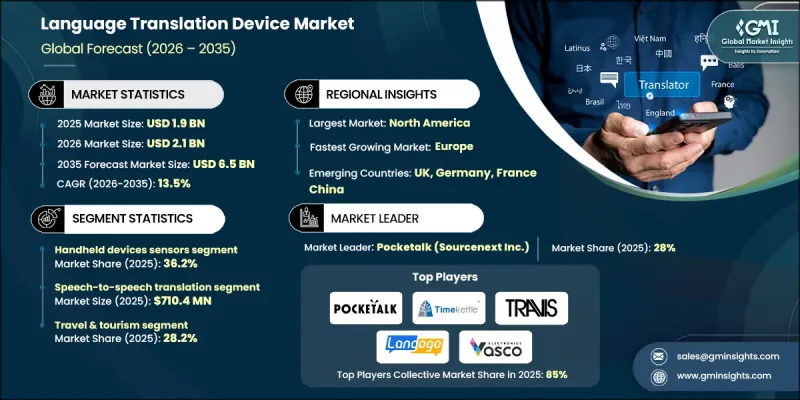
这一成长的驱动力来自不断扩大的国际旅行、日益频繁的跨境商务活动,以及职场和麵向客户的行业对无缝多语言沟通日益增长的需求。全球电子商务和多语言客户支援业务的扩张进一步提升了对专用即时翻译硬体的需求。在医疗保健和紧急应变领域,准确的沟通对于安全性、服务品质和合规性至关重要,因此即时翻译硬体也得到了广泛应用。使用者对设备内建和离线翻译功能的日益青睐,提高了在不可靠通讯环境下的可靠性、资料安全性和效能。人工智慧硬体的进步加速了这一转变,实现了无需依赖云端即可进行高速处理和高精度翻译。翻译设备正逐渐从消费级配件转变为专业工具,免持和穿戴式装置在工作环境中持续沟通方面也越来越受欢迎。
| 市场范围 | |
|---|---|
| 开始年份 | 2025 |
| 预测年份 | 2026-2035 |
| 起始值 | 19亿美元 |
| 预测金额 | 65亿美元 |
| 复合年增长率 | 13.5% |
预计2026年至2035年间,穿戴式翻译设备市场将以15.3%的复合年增长率成长。企业、医疗保健和专业领域应用对不间断、免持通讯的需求日益增长,是推动市场成长的主要因素。穿戴式装置支援自然流畅的对话,提高多语言环境下的工作效率,并有助于满足无障碍存取要求。
预计到2035年,医疗保健和医疗通讯应用领域将以15%的复合年增长率成长。医疗服务提供者越来越依赖翻译设备来提高病人参与、降低沟通风险并满足语言服务标准。穿戴式解决方案能够帮助医护人员与英语能力有限的患者进行快速且准确的沟通,从而改善临床疗效。
预计到2025年,北美语言翻译设备市占率将达到37.5%。主要驱动因素包括人工智慧语言工具的高普及率、多元化的多语言人口以及旅游、医疗保健、教育和企业等行业的强劲需求。翻译设备正日益融入各行各业,以提升服务品质和内部沟通效率。
目录
第一章:调查方法和范围
第二章执行摘要
第三章业界考察
- 生态系分析
- 供应商情况
- 利润率
- 成本结构
- 每个阶段增加的价值
- 影响价值链的因素
- 中断
- 影响产业的因素
- 促进因素
- 国际观光和跨境旅游的成长
- 多语言职场沟通的需求日益增长。
- 全球电子商务和客户支援服务的扩展
- 在医疗和紧急应变环境中的应用日益增多
- 提高神经语音辨识引擎的准确率
- 产业潜在风险与挑战
- 低资源和区域语言的准确性局限性
- 与免费智慧型手机翻译应用程式的竞争
- 市场机会
- 携带式和可穿戴感测设备的扩展
- 用于商用应用的免持可穿戴翻译器
- 促进因素
- 成长潜力分析
- 监理情势
- 波特五力分析
- PESTEL 分析
- 科技与创新趋势
- 当前技术趋势
- 新兴技术
- 价格趋势
- 按地区
- 副产品
- 定价策略
- 新兴经营模式
- 合规要求
- 专利和智慧财产权分析
- 地缘政治和贸易趋势
第四章 竞争情势
- 介绍
- 企业市占率分析
- 按地区
- 市场集中度分析
- 主要企业的竞争标竿分析
- 财务绩效比较
- 收入
- 利润率
- 研究与开发
- 产品系列比较
- 产品线的广度
- 科技
- 创新
- 地理位置比较
- 全球扩张分析
- 服务网路覆盖
- 按地区分類的市场渗透率
- 竞争定位矩阵
- 领导企业
- 受让人
- 追踪者
- 小众玩家
- 战略展望矩阵
- 财务绩效比较
- 主要进展
- 併购
- 伙伴关係与合作
- 技术进步
- 扩张和投资策略
- 数位转型计划
- 新兴/Start-Ups竞争对手的发展趋势
第五章 市场估算与预测:依产品类型划分,2022-2035年
- 手持式翻译设备
- 袖珍翻译器
- 穿戴式翻译设备
- 特殊形状
第六章 市场估计与预测:依翻译功能划分,2022-2035年
- 语音转语音翻译
- 语音转文本
- 文本到文本的翻译
- 图像转文字翻译(OCR 和相机)
第七章 市场估计与预测:依连结类型划分,2022-2035年
- 线上(基于云端的)翻译设备
- 离线翻译设备
- 混合型(线上+离线)设备
第八章 市场估计与预测:依技术划分,2022-2035年
- 人工智慧和神经机器翻译(NMT)设备
- 基于规则的翻译装置
- 混合翻译系统
第九章 市场估计与预测:依应用领域划分,2022-2035年
- 观光观光
- 商业与企业传播
- 医疗保健和医疗沟通
- 教育和培训
- 政府和公共服务
- 饭店和客户服务
- 移民和边境管制
- 其他的
第十章 市场估价与预测:依地区划分,2022-2035年
- 北美洲
- 我们
- 加拿大
- 欧洲
- 德国
- 英国
- 法国
- 西班牙
- 义大利
- 俄罗斯
- 亚太地区
- 中国
- 印度
- 日本
- 澳洲
- 韩国
- 拉丁美洲
- 巴西
- 墨西哥
- 阿根廷
- 中东和非洲
- 南非
- 沙乌地阿拉伯
- 阿拉伯聯合大公国
第十一章:公司简介
- 主要企业
- Pocketalk(Sourcenext Inc.)
- Jarvisen(iFLYTEK)
- Langogo Technology Co., Ltd.
- Timekettle Technologies
- Vasco Electronics LLC
- Waverly Labs Inc.
- 按地区分類的主要企业
- 北美洲
- ECTACO Inc.
- Cheetah Mobile Inc.
- Travis GT BV
- 亚太地区
- Lingmo International Ltd.
- Xiaomi Corporation
- Anfier Technology Co. Ltd.
- 欧洲
- Mymanu(CEH Tech Ltd)
- Birgus(Shenzhen Birgus International)
- 北美洲
- 特殊玩家/干扰者
- Poliglu Translator
The Global Language Translation Device Market was valued at USD 1.9 billion in 2025 and is estimated to grow at a CAGR of 13.5% to reach USD 6.5 billion by 2035.
Growth is supported by expanding international travel, rising cross-border business activity, and the growing need for seamless multilingual communication across workplaces and customer-facing industries. The expansion of global e-commerce and multilingual customer support operations is further increasing demand for dedicated real-time translation hardware. Adoption is also rising in healthcare and emergency response environments where accurate communication is critical for safety, service quality, and regulatory compliance. Increasing preference for on-device and offline translation capabilities is improving reliability, data security, and performance in low-connectivity settings. Advances in artificial intelligence hardware are accelerating this shift by enabling faster processing and higher accuracy without cloud dependence. Translation devices are increasingly positioned as professional-grade tools rather than consumer accessories, with hands-free and wearable formats gaining popularity for continuous interaction in operational settings.
| Market Scope | |
|---|---|
| Start Year | 2025 |
| Forecast Year | 2026-2035 |
| Start Value | $1.9 Billion |
| Forecast Value | $6.5 Billion |
| CAGR | 13.5% |
The wearable translation devices segment will grow at a CAGR of 15.3% during 2026-2035. Demand is driven by the need for uninterrupted, hands-free communication in enterprise, healthcare, and field-based professional use. Wearable formats support natural conversation flow and improve efficiency in multilingual environments while supporting compliance with accessibility requirements.
The healthcare and medical communication applications segment is expected to grow at a CAGR of 15% through 2035. Healthcare providers increasingly rely on translation devices to improve patient engagement, reduce communication-related risks, and meet language access standards. Wearable solutions enable fast, accurate interaction with patients who have limited English proficiency, supporting better clinical outcomes.
North America Language Translation Device Market accounted for 37.5% share in 2025. Market leadership is driven by high adoption of AI-powered language tools, diverse multilingual populations, and strong demand from travel, healthcare, education, and enterprise sectors. Translation devices are increasingly integrated across industries to improve service delivery and internal communication.
Key companies operating in the Global Language Translation Device Market include Pocketalk (Sourcenext Inc.), Timekettle Technologies, Vasco Electronics LLC, Waverly Labs Inc., Travis GT B.V., Anfier Technology Co. Ltd., ECTACO Inc., Xiaomi Corporation, Langogo Technology Co., Ltd., Jarvisen (iFLYTEK), Mymanu (CEH Tech Ltd), Lingmo International Ltd., Poliglu Translator, Cheetah Mobile Inc., and Birgus (Shenzhen Birgus International). Companies in the language translation device market apply focused strategies to strengthen market position and long-term growth. Continuous investment in artificial intelligence improves translation accuracy, speed, and contextual understanding. Many players prioritize offline and on-device processing to enhance security and reliability. Product diversification across wearable and handheld formats expands addressable use cases. Strategic partnerships with enterprises and service providers support large-scale adoption. Localization of language databases increases relevance across regions. Competitive pricing models and subscription-based software updates improve customer retention.
Table of Contents
Chapter 1 Methodology and Scope
- 1.1 Market scope and definition
- 1.2 Research design
- 1.2.1 Research approach
- 1.2.2 Data collection methods
- 1.3 Data mining sources
- 1.3.1 Global
- 1.3.2 Regional/Country
- 1.4 Base estimates and calculations
- 1.4.1 Base year calculation
- 1.4.2 Key trends for market estimation
- 1.5 Primary research and validation
- 1.5.1 Primary sources
- 1.6 Forecast model
- 1.7 Research assumptions and limitations
Chapter 2 Executive Summary
- 2.1 Industry 360° synopsis, 2022 - 2035
- 2.2 Key market trends
- 2.2.1 Sensor type trends
- 2.2.2 Product type trends
- 2.2.3 Translation capability trends
- 2.2.4 Connectivity type trends
- 2.2.5 Technology trends
- 2.2.6 Application trends
- 2.2.7 Regional trends
- 2.3 TAM Analysis, 2026-2035
- 2.4 CXO perspectives: Strategic imperatives
- 2.4.1 Executive decision points
- 2.4.2 critical success factors
- 2.5 Future outlook and strategic recommendations
Chapter 3 Industry Insights
- 3.1 Industry ecosystem analysis
- 3.1.1 Supplier Landscape
- 3.1.2 Profit Margin
- 3.1.3 Cost structure
- 3.1.4 Value addition at each stage
- 3.1.5 Factor affecting the value chain
- 3.1.6 Disruptions
- 3.2 Industry impact forces
- 3.2.1 Growth drivers
- 3.2.1.1 Growth in international tourism and cross-border travel
- 3.2.1.2 Rising multilingual workplace communication requirements
- 3.2.1.3 Expansion of global e-commerce and customer support services
- 3.2.1.4 Increased adoption in healthcare and emergency response settings
- 3.2.1.5 Accuracy improvements in neural speech-to-speech engines
- 3.2.2 Industry pitfalls and challenges
- 3.2.2.1 Accuracy limitations in low-resource and regional languages
- 3.2.2.2 Competition from free smartphone translation applications
- 3.2.3 Market opportunities
- 3.2.3.1 Expansion of portable and wearable sensing devices
- 3.2.3.2 Wearable translators for hands-free professional applications
- 3.2.1 Growth drivers
- 3.3 Growth potential analysis
- 3.4 Regulatory landscape
- 3.4.1 North America
- 3.4.2 Europe
- 3.4.3 Asia Pacific
- 3.4.4 Latin America
- 3.4.5 Middle East & Africa
- 3.5 Porter's analysis
- 3.6 PESTEL analysis
- 3.7 Technology and Innovation landscape
- 3.7.1 Current technological trends
- 3.7.2 Emerging technologies
- 3.8 Price trends
- 3.8.1 By region
- 3.8.2 By product
- 3.9 Pricing Strategies
- 3.10 Emerging Business Models
- 3.11 Compliance Requirements
- 3.12 Patent and IP analysis
- 3.13 Geopolitical and trade dynamics
Chapter 4 Competitive Landscape, 2025
- 4.1 Introduction
- 4.2 Company market share analysis
- 4.2.1 By region
- 4.2.1.1 North America
- 4.2.1.2 Europe
- 4.2.1.3 Asia Pacific
- 4.2.1.4 Latin America
- 4.2.1.5 Middle East & Africa
- 4.2.2 Market concentration analysis
- 4.2.1 By region
- 4.3 Competitive benchmarking of key players
- 4.3.1 Financial performance comparison
- 4.3.1.1 Revenue
- 4.3.1.2 Profit margin
- 4.3.1.3 R&D
- 4.3.2 Product portfolio comparison
- 4.3.2.1 Product range breadth
- 4.3.2.2 Technology
- 4.3.2.3 Innovation
- 4.3.3 Geographic presence comparison
- 4.3.3.1 Global footprint analysis
- 4.3.3.2 Service network coverage
- 4.3.3.3 Market penetration by region
- 4.3.4 Competitive positioning matrix
- 4.3.4.1 Leaders
- 4.3.4.2 Challengers
- 4.3.4.3 Followers
- 4.3.4.4 Niche players
- 4.3.5 Strategic outlook matrix
- 4.3.1 Financial performance comparison
- 4.4 Key developments
- 4.4.1 Mergers and acquisitions
- 4.4.2 Partnerships and collaborations
- 4.4.3 Technological advancements
- 4.4.4 Expansion and investment strategies
- 4.4.5 Digital transformation initiatives
- 4.5 Emerging/ startup competitors landscape
Chapter 5 Market Estimates and Forecast, By Product Type, 2022 - 2035 (USD Million)
- 5.1 Key trends
- 5.2 Handheld translation devices
- 5.3 Pocket translators
- 5.4 Wearable translation devices
- 5.5 Specialized form factors
Chapter 6 Market Estimates and Forecast, By Translation Capability, 2022 - 2035 (USD Million)
- 6.1 Key trends
- 6.2 Speech-to-speech translation
- 6.3 Speech-to-text translation
- 6.4 Text-to-text translation
- 6.5 Image-to-text translation (OCR & camera)
Chapter 7 Market Estimates and Forecast, By Connectivity Type, 2022 - 2035 (USD Million)
- 7.1 Key trends
- 7.2 Online (cloud-based) translation devices
- 7.3 Offline translation devices
- 7.4 Hybrid (online + offline) devices
Chapter 8 Market Estimates and Forecast, By Technology, 2022 - 2035 (USD Million)
- 8.1 Key trends
- 8.2 AI & neural machine translation (NMT) devices
- 8.3 Rule-based translation devices
- 8.4 Hybrid translation systems
Chapter 9 Market Estimates and Forecast, By Application, 2022 - 2035 (USD Million)
- 9.1 Key trends
- 9.2 Travel & tourism
- 9.3 Business & corporate communication
- 9.4 Healthcare & medical communication
- 9.5 Education & training
- 9.6 Government & public services
- 9.7 Hospitality & customer service
- 9.8 Immigration & border control
- 9.9 Others
Chapter 10 Market Estimates and Forecast, By Region, 2022 - 2035 (USD Million)
- 10.1 Key trends
- 10.2 North America
- 10.2.1 U.S.
- 10.2.2 Canada
- 10.3 Europe
- 10.3.1 Germany
- 10.3.2 UK
- 10.3.3 France
- 10.3.4 Spain
- 10.3.5 Italy
- 10.3.6 Russia
- 10.4 Asia Pacific
- 10.4.1 China
- 10.4.2 India
- 10.4.3 Japan
- 10.4.4 Australia
- 10.4.5 South Korea
- 10.5 Latin America
- 10.5.1 Brazil
- 10.5.2 Mexico
- 10.5.3 Argentina
- 10.6 Middle East and Africa
- 10.6.1 South Africa
- 10.6.2 Saudi Arabia
- 10.6.3 UAE
Chapter 11 Company Profiles
- 11.1 Global Key Players
- 11.1.1 Pocketalk (Sourcenext Inc.)
- 11.1.2 Jarvisen (iFLYTEK)
- 11.1.3 Langogo Technology Co., Ltd.
- 11.1.4 Timekettle Technologies
- 11.1.5 Vasco Electronics LLC
- 11.1.6 Waverly Labs Inc.
- 11.2 Regional key players
- 11.2.1 North America
- 11.2.1.1 ECTACO Inc.
- 11.2.1.2 Cheetah Mobile Inc.
- 11.2.1.3 Travis GT B.V.
- 11.2.2 Asia Pacific
- 11.2.2.1 Lingmo International Ltd.
- 11.2.2.2 Xiaomi Corporation
- 11.2.2.3 Anfier Technology Co. Ltd.
- 11.2.3 Europe
- 11.2.3.1 Mymanu (CEH Tech Ltd)
- 11.2.3.2 Birgus (Shenzhen Birgus International)
- 11.2.1 North America
- 11.3 Niche Players/Disruptors
- 11.3.1 Poliglu Translator


