


 |
市场调查报告书
商品编码
1959577
红外线LED市场机会、成长要素、产业趋势分析及2026年至2035年预测Infrared (IR) LED Market Opportunity, Growth Drivers, Industry Trend Analysis, and Forecast 2026 - 2035 |
||||||

2025 年全球红外线 (IR) LED 市场价值为 13 亿美元,预计到 2035 年将达到 32 亿美元,年复合成长率为 9.7%。
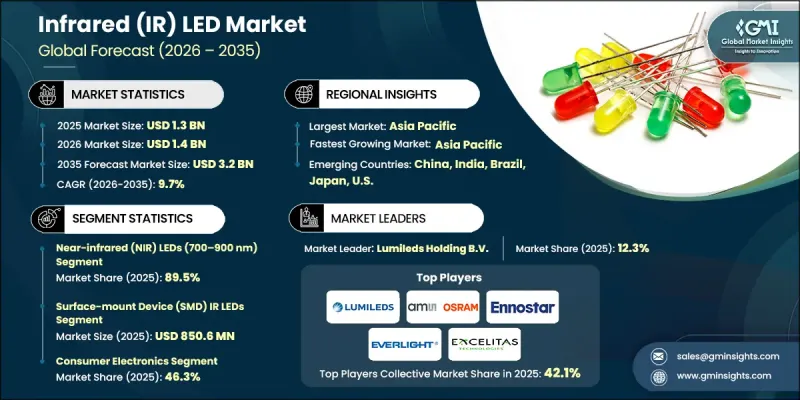
市场扩张的驱动力来自消费科技领域的日益融合、汽车感测和安全平台的广泛应用、工厂自动化和视觉系统的加速普及、生物识别和医疗解决方案的日益广泛应用,以及安防监控基础设施的持续需求。红外线LED设计的进步着重于系统级效率的提升,而非单一组件性能的增强,从而在降低热应力的同时实现更高的辐射输出。这些性能的提升简化了封装要求,延长了使用寿命,并实现了更紧凑的外形规格。短期内,效率的逐步提升将持续累积;而中期来看,发展趋势表明,原始设备製造商(OEM)正朝着直接调整其产品架构以适应这些改进的红外线性能特性的方向发展。
| 市场范围 | |
|---|---|
| 开始年份 | 2025 |
| 预测年份 | 2026-2035 |
| 起始值 | 13亿美元 |
| 预测金额 | 32亿美元 |
| 复合年增长率 | 9.7% |
消费性电子产品仍是整体需求的最大贡献者,这主要得益于感测精度、能源效率和小型化技术的不断提升。製造商正从传统的材料结构转向更先进的异质结构设计,以抑制高电流下的效率下降并提高光提取效率。这种转变使得晶粒尺寸更小、亮度更高,从而支援更薄的模组和更佳的散热控制。对系统级效能的日益重视,使整合商能够实现更长的运作週期和更大的设计柔软性。
预计2026年至2035年间,短波红外线LED市场将以11.8%的复合年增长率成长。对短波红外线(SWIR)技术的需求主要来自于需要更长波长性能的应用,这些应用能够提供更强的渗透性、更高的探测精度和更可靠的成像效果。儘管该细分市场目前在总出货量中所占比例较小,但由于其在高价值环境中的应用,其收入增长仍然强劲,在这些环境中,性能比成本更为重要。技术的不断进步以及在专业工业、医疗和国防相关系统中的日益普及,支撑了SWIR产品的高价位结构和持续的研发投入。
预计2026年至2035年间,汽车和交通运输业将以13.5%的复合年增长率成长,成为成长最快的终端用户产业之一。这一增长与高级驾驶辅助系统(ADAS)架构、车载监控平台以及半自动驾驶和自动驾驶系统的日益普及密切相关。电动车产量的成长和全球安全标准的日益严格正在加速红外线LED在乘员检测、车载感知和弱光辅助功能方面的应用。这些应用对产品的可靠性和使用寿命提出了更高的要求,从而为高利润产品创造了机会,并促进了汽车供应链中供应商之间深厚合作关係的建立。
预计到2025年,北美红外线(IR)LED市场占有率将达到20.7%。该地区作为主要需求中心的地位依然稳固,这得益于汽车製造、工业自动化和国防相关项目的强劲需求。智慧感测技术的快速普及,以及成熟的製造业基础,正在推动全部区域的持续成长。美国和加拿大仍然是先进感测器整合、微机电系统(MEMS)和高性能光电元件投资的重点,所有这些都为红外线LED的稳定长期需求做出了贡献。
目录
第一章:调查方法和范围
第二章执行摘要
第三章业界考察
- 生态系分析
- 供应商情况
- 利润率
- 成本结构
- 每个阶段增加的价值
- 影响价值链的因素
- 中断
- 影响产业的因素
- 促进因素
- 家用电子电器的普及率不断提高
- 在汽车感测和安全系统中得到更广泛的应用
- 工业自动化和机器视觉的扩展
- 对生物识别和医疗保健应用的需求日益增长
- 安全和监控系统的发展
- 产业潜在风险与挑战
- 高功率长波长红外线LED的技术局限性
- 对零件供应链的依赖和半导体短缺
- 市场机会
- 穿戴式和携带式医疗设备的成长
- 智慧家庭和物联网设备的应用日益普及
- 促进因素
- 成长潜力分析
- 监理情势
- 北美洲
- 欧洲
- 亚太地区
- 拉丁美洲
- 中东和非洲
- 波特的分析
- PESTEL 分析
- 科技与创新趋势
- 当前技术趋势
- 新兴技术
- 价格趋势
- 按地区
- 副产品
- 定价策略
- 新兴经营模式
- 合规要求
- 专利和智慧财产权分析
- 地缘政治和贸易趋势
第四章 竞争情势
- 介绍
- 企业市占率分析
- 按地区
- 北美洲
- 欧洲
- 亚太地区
- 拉丁美洲
- 中东和非洲
- 市场集中度分析
- 按地区
- 主要企业的竞争标竿分析
- 财务绩效比较
- 收入
- 利润率
- 研究与开发
- 产品系列比较
- 产品线的广度
- 科技
- 创新
- 地理位置比较
- 全球扩张分析
- 服务网路覆盖
- 按地区分類的市场渗透率
- 竞争定位矩阵
- 领导企业
- 受让人
- 追踪者
- 小众玩家
- 战略展望矩阵
- 财务绩效比较
- 主要进展
- 併购
- 伙伴关係与合作
- 技术进步
- 扩张和投资策略
- 数位转型计划
- 新兴/Start-Ups竞争对手的发展趋势
第五章 市场估计与预测:依波长范围划分,2022-2035年
- 近红外线(NIR)LED(700-900奈米)
- 短波长红外线(SWIR)LED(900-1000+nm)
第六章 市场估计与预测:依产量划分,2022-2035年
- 低功率红外线LED(≤100毫瓦)
- 中功率红外线LED(100毫瓦至1瓦)
- 高功率红外线LED(超过1瓦)
第七章 市场估价与预测:依包装类型划分,2022-2035年
- 通孔红外线发光二极体
- 表面黏着技术(SMD)红外线LED
- 其他的
第八章 市场估计与预测:依应用领域划分,2022-2035年
- 感测和接近检测
- 生物识别
- 用于成像和夜视的红外线照明
- 远端控制和人机介面(HMI)
- 光纤通讯和数据传输
- 其他的
第九章 市场估计与预测:依最终用途产业划分,2022-2035年
- 家用电子电器
- 医疗及医疗设备
- 汽车/运输设备
- 安全、国防和执法机关
- 工业製造
- 其他的
第十章 市场估价与预测:依地区划分,2022-2035年
- 北美洲
- 我们
- 加拿大
- 欧洲
- 德国
- 英国
- 法国
- 西班牙
- 义大利
- 荷兰
- 亚太地区
- 中国
- 印度
- 日本
- 澳洲
- 韩国
- 拉丁美洲
- 巴西
- 墨西哥
- 阿根廷
- 中东和非洲
- 南非
- 沙乌地阿拉伯
- 阿拉伯聯合大公国
第十一章:公司简介
- 主要企业
- Lumileds Holding BV
- ams-OSRAM AG
- Ennostar Inc.
- Everlight Electronics Co., Ltd.
- Excelitas Technologies Corp.
- 按地区分類的主要企业
- 北美洲
- Broadcom
- Luminus, Inc.
- Vishay Intertechnology, Inc.
- 亚太地区
- Kingbright
- DOWA Electronics Materials Co., Ltd.
- Stanley Electric Co., Ltd.
- Hamamatsu Photonics KK
- 欧洲
- Wurth Elektronik eiSos GmbH &Co. KG
- Dialight
- 北美洲
- 特殊玩家/干扰者
- Boston Electronics
- Marktech Optoelectronics Inc.
The Global Infrared (IR) LED Market was valued at USD 1.3 billion in 2025 and is estimated to grow at a CAGR of 9.7% to reach USD 3.2 billion by 2035.
Market expansion is fueled by rising integration across consumer-focused technologies, stronger deployment within automotive sensing and safety platforms, accelerating adoption in factory automation and vision-based systems, increasing utilization in biometric identification and healthcare solutions, and sustained demand from security and monitoring infrastructures. Advancements in infrared LED design are focused on improving system-level efficiency rather than isolated component gains, allowing higher radiant output with reduced thermal stress. These performance improvements simplify packaging requirements, extend operational lifecycles, and enable more compact form factors. In the near term, gradual efficiency enhancements continue to accumulate, while mid-term development trends show original equipment manufacturers aligning product architectures directly with these improved infrared performance characteristics.
| Market Scope | |
|---|---|
| Start Year | 2025 |
| Forecast Year | 2026-2035 |
| Start Value | $1.3 Billion |
| Forecast Value | $3.2 Billion |
| CAGR | 9.7% |
Consumer-oriented electronics remain the largest contributor to overall demand, driven by continuous upgrades in sensing accuracy, power efficiency, and miniaturization. Manufacturers are transitioning away from traditional material structures toward more advanced heterostructure designs that limit efficiency degradation at elevated current levels and improve light extraction. This shift enables smaller die sizes with higher brightness output, supporting thinner modules and improved thermal control. The emphasis is increasingly placed on achieving higher performance at the system level, which allows longer operating cycles and greater design flexibility for integrators.
The short-wave infrared LED segment is forecast to register a CAGR of 11.8% during 2026-2035. Demand for SWIR technology is being driven by applications that require longer wavelength performance to achieve enhanced penetration, higher detection accuracy, and improved imaging reliability. Although this segment currently accounts for a smaller share of total shipments, revenue growth remains strong due to its use in high-value environments where performance outweighs cost sensitivity. Ongoing technical refinement and expanding acceptance across specialized industrial, medical, and defense-related systems are supporting premium pricing structures and sustained investment in SWIR development.
The automotive and transportation segment is expected to grow at a CAGR of 13.5% during 2026-2035, making it one of the fastest-growing end-use segments. Growth is linked to the rising deployment of advanced driver-assistance architectures, in-cabin monitoring platforms, and semi-autonomous and autonomous mobility systems. Increased production of electric vehicles and stricter global safety mandates are accelerating the integration of infrared LEDs for occupant detection, interior sensing, and low-light assistance functions. These applications demand high reliability and long operational life, creating opportunities for higher-margin products and deeper supplier relationships within the automotive supply chain.
North America Infrared (IR) LED Market accounted for 20.7% share in 2025. The region continues to serve as a key demand center, supported by strong activity across automotive manufacturing, industrial automation, and defense-related programs. Rapid adoption of smart sensing technologies, combined with a well-established manufacturing base, underpins consistent regional growth. The United States and Canada remain focal points for investment in advanced sensor integration, microelectromechanical systems, and performance-driven optoelectronic components, all of which contribute to stable long-term demand for infrared LEDs.
Key participants operating in the Global Infrared (IR) LED Market include ams-OSRAM AG, Vishay Intertechnology, Inc., Everlight Electronics Co., Ltd., Stanley Electric Co., Ltd., Broadcom, Lumileds Holding B.V., Wurth Elektronik eiSos GmbH & Co. KG, Hamamatsu Photonics K.K., Ennostar Inc., Luminus, Inc., Marktech Optoelectronics Inc., Dialight, Excelitas Technologies Corp., Kingbright, DOWA Electronics Materials Co., Ltd., and Boston Electronics. Companies operating in the Global Infrared (IR) LED Market are actively strengthening their market position through a combination of technology innovation, portfolio diversification, and strategic partnerships. A strong focus is placed on developing higher-efficiency emitters with improved thermal performance and longer operating lifespans to meet evolving system-level requirements. Many players are investing in advanced packaging techniques and wafer-level optimization to reduce form factors while enhancing output consistency. Expansion into high-growth application segments such as automotive sensing, industrial automation, and medical diagnostics is another key strategy, often supported by long-term supply agreements.
Table of Contents
Chapter 1 Methodology and Scope
- 1.1 Market scope and definition
- 1.2 Research design
- 1.2.1 Research approach
- 1.2.2 Data collection methods
- 1.3 Data mining sources
- 1.3.1 Global
- 1.3.2 Regional/Country
- 1.4 Base estimates and calculations
- 1.4.1 Base year calculation
- 1.4.2 Key trends for market estimation
- 1.5 Primary research and validation
- 1.5.1 Primary sources
- 1.6 Forecast model
- 1.7 Research assumptions and limitations
Chapter 2 Executive Summary
- 2.1 Industry 360° synopsis, 2022 - 2035
- 2.2 Key market trends
- 2.2.1 Wavelength range trends
- 2.2.2 Power output trends
- 2.2.3 Packaging type trends
- 2.2.4 Application trends
- 2.2.5 End-use industry trends
- 2.2.6 Regional trends
- 2.3 TAM Analysis, 2026-2035
- 2.4 CXO perspectives: Strategic imperatives
- 2.4.1 Executive decision points
- 2.4.2 Critical success factors
- 2.5 Future outlook and strategic recommendations
Chapter 3 Industry Insights
- 3.1 Industry ecosystem analysis
- 3.1.1 Supplier Landscape
- 3.1.2 Profit Margin
- 3.1.3 Cost structure
- 3.1.4 Value addition at each stage
- 3.1.5 Factor affecting the value chain
- 3.1.6 Disruptions
- 3.2 Industry impact forces
- 3.2.1 Growth drivers
- 3.2.1.1 Rising adoption in consumer electronics
- 3.2.1.2 Increasing use in automotive sensing & safety systems
- 3.2.1.3 Expansion of industrial automation & machine vision
- 3.2.1.4 Growing demand for biometric and healthcare applications
- 3.2.1.5 Growth in security & surveillance systems
- 3.2.2 Industry pitfalls and challenges
- 3.2.2.1 Technical limitations in high-power and long-wavelength IR LEDs
- 3.2.2.2 Dependence on component supply chain and semiconductor shortages
- 3.2.3 Market opportunities
- 3.2.3.1 Growth in wearable and portable healthcare devices
- 3.2.3.2 Increasing adoption in smart homes and IoT devices
- 3.2.1 Growth drivers
- 3.3 Growth potential analysis
- 3.4 Regulatory landscape
- 3.4.1 North America
- 3.4.2 Europe
- 3.4.3 Asia Pacific
- 3.4.4 Latin America
- 3.4.5 Middle East & Africa
- 3.5 Porter’s analysis
- 3.6 PESTEL analysis
- 3.7 Technology and Innovation landscape
- 3.7.1 Current technological trends
- 3.7.2 Emerging technologies
- 3.8 Price trends
- 3.8.1 By region
- 3.8.2 By product
- 3.9 Pricing Strategies
- 3.10 Emerging Business Models
- 3.11 Compliance Requirements
- 3.12 Patent and IP analysis
- 3.13 Geopolitical and trade dynamics
Chapter 4 Competitive Landscape, 2025
- 4.1 Introduction
- 4.2 Company market share analysis
- 4.2.1 By region
- 4.2.1.1 North America
- 4.2.1.2 Europe
- 4.2.1.3 Asia Pacific
- 4.2.1.4 Latin America
- 4.2.1.5 Middle East & Africa
- 4.2.2 Market concentration analysis
- 4.2.1 By region
- 4.3 Competitive benchmarking of key players
- 4.3.1 Financial performance comparison
- 4.3.1.1 Revenue
- 4.3.1.2 Profit margin
- 4.3.1.3 R&D
- 4.3.2 Product portfolio comparison
- 4.3.2.1 Product range breadth
- 4.3.2.2 Technology
- 4.3.2.3 Innovation
- 4.3.3 Geographic presence comparison
- 4.3.3.1 Global footprint analysis
- 4.3.3.2 Service network coverage
- 4.3.3.3 Market penetration by region
- 4.3.4 Competitive positioning matrix
- 4.3.4.1 Leaders
- 4.3.4.2 Challengers
- 4.3.4.3 Followers
- 4.3.4.4 Niche players
- 4.3.5 Strategic outlook matrix
- 4.3.1 Financial performance comparison
- 4.4 Key developments
- 4.4.1 Mergers and acquisitions
- 4.4.2 Partnerships and collaborations
- 4.4.3 Technological advancements
- 4.4.4 Expansion and investment strategies
- 4.4.5 Digital transformation initiatives
- 4.5 Emerging/ startup competitors landscape
Chapter 5 Market Estimates and Forecast, By Wavelength Range, 2022 - 2035 (USD Million & Units)
- 5.1 Key trends
- 5.2 Near-infrared (NIR) LEDs (700-900 nm)
- 5.3 Short-wave infrared (SWIR) LEDs (900-1,000+ nm)
Chapter 6 Market Estimates and Forecast, By Power Output, 2022 - 2035 (USD Million & Units)
- 6.1 Key trends
- 6.2 Low-power IR LEDs (≤100 mW)
- 6.3 Medium-power IR LEDs (100 mW-1 W)
- 6.4 High-power IR LEDs (>1 W)
Chapter 7 Market Estimates and Forecast, By Packaging Type, 2022 - 2035 (USD Million & Units)
- 7.1 Key trends
- 7.2 Through-hole IR LEDs
- 7.3 Surface-mount device (SMD) IR LEDs
- 7.4 Others
Chapter 8 Market Estimates and Forecast, By Application, 2022 - 2035 (USD Million & Units)
- 8.1 Key trends
- 8.2 Sensing & proximity detection
- 8.3 Biometric identification
- 8.4 IR illumination for imaging & night vision
- 8.5 Remote control & human-machine interface (HMI)
- 8.6 Optical communication & data transmission
- 8.7 Others
Chapter 9 Market Estimates and Forecast, By End-use Industry, 2022 - 2035 (USD Million & Units)
- 9.1 Key trends
- 9.2 Consumer electronics
- 9.3 Healthcare & medical devices
- 9.4 Automotive & transportation
- 9.5 Security, defense & law enforcement
- 9.6 Industrial manufacturing
- 9.7 Others
Chapter 10 Market Estimates and Forecast, By Region, 2022 - 2035 (USD Million & Units)
- 10.1 Key trends
- 10.2 North America
- 10.2.1 U.S.
- 10.2.2 Canada
- 10.3 Europe
- 10.3.1 Germany
- 10.3.2 UK
- 10.3.3 France
- 10.3.4 Spain
- 10.3.5 Italy
- 10.3.6 Netherlands
- 10.4 Asia Pacific
- 10.4.1 China
- 10.4.2 India
- 10.4.3 Japan
- 10.4.4 Australia
- 10.4.5 South Korea
- 10.5 Latin America
- 10.5.1 Brazil
- 10.5.2 Mexico
- 10.5.3 Argentina
- 10.6 Middle East and Africa
- 10.6.1 South Africa
- 10.6.2 Saudi Arabia
- 10.6.3 UAE
Chapter 11 Company Profiles
- 11.1 Global Key Players
- 11.1.1 Lumileds Holding B.V.
- 11.1.2 ams-OSRAM AG
- 11.1.3 Ennostar Inc.
- 11.1.4 Everlight Electronics Co., Ltd.
- 11.1.5 Excelitas Technologies Corp.
- 11.2 Regional key players
- 11.2.1 North America
- 11.2.1.1 Broadcom
- 11.2.1.2 Luminus, Inc.
- 11.2.1.3 Vishay Intertechnology, Inc.
- 11.2.2 Asia Pacific
- 11.2.2.1 Kingbright
- 11.2.2.2 DOWA Electronics Materials Co., Ltd.
- 11.2.2.3 Stanley Electric Co., Ltd.
- 11.2.2.4 Hamamatsu Photonics K.K.
- 11.2.3 Europe
- 11.2.3.1 Wurth Elektronik eiSos GmbH & Co. KG
- 11.2.3.2 Dialight
- 11.2.1 North America
- 11.3 Niche Players/Disruptors
- 11.3.1 Boston Electronics
- 11.3.2 Marktech Optoelectronics Inc.


